Sauter au contenu principal
actuellecd
  • This website is also available in English.

Blogue

4946 résultats
  • 159
  • 160
  • 161
  • 162
  • 163
  • 164
  • 165
  • 166
  • 167
  • The Muted Note dans Musicworks

    «Review», Stuart Broomer, Musicworks, no 118, 1 mars 2014
    samedi 1 mars 2014 Presse

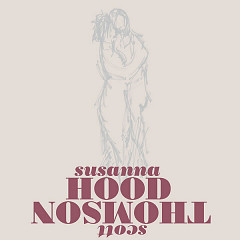
    The songs on The Muted Note are an outgrowth of work made by trombonist Scott Thomson and singer-dancer Susanna Hood as part of The Rent, a Toronto quintet that was initially dedicated to performing the music of the late saxophonist and composer Steve Lacy — including his extensive setting of texts ranging from Lao Tzu to Gregory Corso. That experience led Thomson to compose this suite of song settings of poems by P. K. Page, a project that started in 2010, following Page’s death at age ninety-three. The suite was written in Montreal under the supervision of Jean Derome, with whom Thomson was studying at the time. Thomson has arranged the suite in quintet form for The Rent and in this intimate duet form for voice and trombone heard on The Muted Note. A version with choreography by Hood will debut in Toronto in September 2014.

    The title of the suite comes from The Understatement, the penultimate poem in Page’s Cosmologies:

    I speak not in hyperbole,
    I speak in true words muted to their undertone,
    choosing a pebble where you would choose a stone,
    projecting pebbles to immensity.

    For where love is no word can be compounded
    extravagant enough to frame the kiss
    and so I use the under-emphasis,
    the muted note, the less than purely rounded.

    Thomson’s work follows from Page’s sense of the undertone. What emerges is a kind of dance between voice and trombone, between word and sound — a subtle counterpoint between conjoined melodies and ideas of voice, always in close connection to the gestural power of Page’s phrases. If there is a tone of reserve, a kind of deliberate precision in the setting of Page’s phrases, it may exist to establish a kind of reverence for the poems, a desire to present as well as represent. But as the suite evolves, the music and words sail further, both together and apart. This Heavy Craft extends to a stirring Hood improvisation with multiphonic throat singing, a vocal technique that’s reflected later in Thomson’s sustained multiphonics on The Mole. Blue takes the title literally, exploring the range of jazz vocalizing from liberated exuberance to clearly ironic cliché.

    The Muted Note is a striking accomplishment — an almost naked work, in which unaccompanied trombone and voice are frequent (it ends, for example, with a recapitulation of the opening As Ten, As Twenty, now for voice alone). One does not hear these episodes as the work of individuals but as part of a complex ensemble of poet, composer, and interpreters. The Muted Note ultimately resonates like Page’s galvanized language itself.

    The Muted Note is a striking accomplishment

    Combines dans Musicworks

    «Recordings», Stuart Broomer, Musicworks, no 118, 1 mars 2014
    samedi 1 mars 2014 Presse

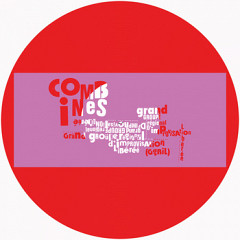
    The Grand groupe régional d’improvisation libérée (GGRIL) is one of Canada’s few large improvising ensembles, a feat made more improbable by their location in relatively isolated Rimouski. From a population of 46,000, bassist Éric Normand has managed to assemble a group of up to fourteen people that has begun to cultivate its own identity, evidently using chance strategies and gaming procedures as well as free improvisation. The version of the Grand groupe heard here has ten members, with instrumentation emphasizing strings (including electric and acoustic basses, electric guitars, violin and cello) and percussion, complemented by the distinctive, often melodic input of accordionist Robin Servant and trumpeter Alexandre Robichaud.

    The group’s music is as distinctive as the format of this release, a startling red vinyl LP in a clear vinyl sleeve. The use of chance methods creates unpredictable textures that continually surprise, including the mysteriously isolated, abstracted passages that arise in Normand’s two-part Jeu de cartes, and the moody depths that characterize Oui, cela pourrait commencer ainsi…, a piece literally titled with a description of its spatial evolution. The sudden overlaps and spiky intrusions of Situation à deux chefs are an inevitable outcome of its method. Dedicated to Butch Morris, the founder of conduction, who died in January 2013, the piece takes conducted improvisation one step further with both Normand and guitarist Robert Bastien acting as conductors.

    Éric Normand has managed to assemble a group of up to fourteen people that has begun to cultivate its own identity, evidently using chance strategies and gaming procedures as well as free improvisation.

    Eviyan Live dans Point of Departure

    «Moment’s Notice», Bill Shoemaker, Point of Departure, no 46, 1 mars 2014
    samedi 1 mars 2014 Presse

    Folk music is the well, pure and simple. Why musicians are drawn to a particular well can be complex; but, almost always, folk music represents the most essential means for personal statements, a starting point that grounds and gives context, regardless of how far afield a musician roams from the conventions of a given folk music tradition. In recent decades, folk music has been a beacon especially for Europeans, partially in response to American hegemony, shifting national borders, and the lingering legacy of genocide, ethnic cleansing, and political and cultural repression. Bottom line: Whatever good there may be in a particular people — and the recent passing of Pete Seeger is emblematic of this — it can be traced from their folk music. And, perhaps ironically, folk music is one of the better means of waking one from the nightmare that is history, if only because folk music has the aura of prehistory.

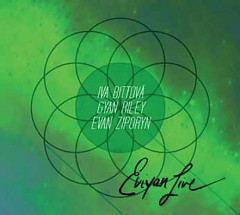
    That aura shines, albeit refracted by well-developed post-modern sensibilities, on both on Eviyan Live, which documents the 2013 Victoriaville festival performance by the trio of Czech singer/violinist Iva Bittová, guitarist Gyan Riley and clarinetist Evan Ziporyn […] Both albums have ample charm, primarily located in the voices — Bittová’s has an incomparable gliding lightness in its upper register, and smokier tones in her lowest notes, while Torto’s leavens its operatic capacity with sensuous, occasionally sultry color.

    Still, both albums are collective efforts […] Ziporyn’s fluid work frequently dovetails Bittová’s vocalese with supple ease, while providing contrast to her often scampering violin in terms of timbre and, when he switches to bass clarinet, pitch. Playing an acoustic guitar, Riley reveals a familiarity with flamenco, gypsy and other European guitar traditions, as well as the boldness to interject an incisive run or strummed flurry reminiscent of Ralph Towner’s startling early work. […]

    The main difference between the two albums is one of tone, traceable in part to regional differences […] There’s a peasant whirl to stretches of Eviyan Live […]. Despite their differences, Eviyan Live and Heureux comme avec une femme finely complement each other, as they tap if not the same well, then the same aquifer.

    Despite their differences, Eviyan Live and Heureux comme avec une femme finely complement each other, as they tap if not the same well, then the same aquifer.

    Transition de phase, Combines, Vivaces, Beau comme un aéroport dans Skug

    «Kritik», Curt Cuisine, Skug, 10 février 2014
    lundi 10 février 2014 Presse

    Tour de Bras nennt sich ein kanadisches Label, das sich komplett der improvisierten Musik verschrieben hat, und das darüber hinaus Konzertreihen, Workshops und ein zweijährlich stattfindendes Festival veranstaltet. Gefördert werden soll damit die Impro-Musik in der Region, wobei mit Region hier die Provinz Quebéc gemeint ist, mit 8 Millionen Einwohnern der besiedlungsdichteste Fleck in Kanada. Nicht unbedingt, was wir unter einer»Provinz«verstehen.

    Eines der Lieblingsprojekte des Labels ist Le GGRIL (steht für Grand groupe régional d’improvisation libérée), ein Live-Impro Ensemble aus einer Kleinstadt im Osten von Quebéc, das auf eine mittlerweile sechsjährigen Spielpraxis in eher schriller Zusammensetzung (etwa zwei Akkordeons, ein elektrischer und ein Kontrabass, Tuba und Fagott, sowie Violinen, Percussions und diverse Bläser) zurückblicken kann. Eine sehr feine Demonstration dieser Konstellation bietet die CD»Vivaces«von 2012, realisiert in 13-köpfiger Besetzung und offensichtlich doch nicht komplett free umgesetzt. Laut Labeleigendefinition handelt es sich aber ohnehin um»musique neuve et d’occasion«, was eigentlich einen sehr schönen Begriff in die Improvisationsmusik einführt, eben den der Okkasion. Bei uns leider viel zu einschlägig als günstige Gelegenheit oder gutes Geschäft besetzt, doch im Französischen ist die»occasion«viel näher am Begriff des Ereignishaften. Musik als Ereignis, für die Ort und Umstände und natürlich auch der Zeitpunkt des Entstehens essentiell sind. Zu diesen Umständen gehört auf»Vivaces«ein strukturiertes Miteinander einzelner Ensembleteile, was zusätzlich für eine angenehme Abwechslung gegenüber der sonst viel zu häufigen Monotonie im Improgenre sorgt. Auch der regionale Einschlag, der vor allem durch die beiden Akkordeons ins Spiel kommt und immer wieder Assoziationen zu einem außer Rand und Band geratenen Chanson-Abend unter Avantgardisten weckt, machen»Vivaces«zu einer charmanten Angelegenheit.

    Phasen und Flughäfen

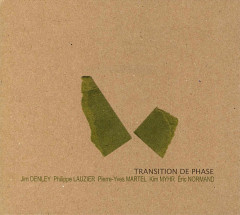
    Zwei Jahre zuvor zeigte ein Teil des Le GGRIL-Ensembles, dass man auch ganz klassisch im Sinne der Improvisationsmusik kann. Auf»Transition de Phase«geben sich die zwei Saxophonisten Jim Denley und Philippe Lauzier gemeinsam mit Pierre-Yves Martel (Violakorpus und Elektronik), Kim Myhr (Akustikgitarre) und Éric Normand (Bass) die Ehre. Die fünf Herren gehen es weitaus introspektiver an und betreiben zugleich das Spiel gegen den instrumentalen Strich, also Überblasen, Schnattern, Kratzen, Bürsten usw. — eben alles was man tun kann, um seinem Instrument unerwartete Noises zu entlocken. Auch diese Übung ist prächtig gelungen, wenn auch nicht ganz so klangfarbenprächtig wie im großen Ensemble.

    Auf»Beau comme un aéroport«treffen wir die Herren Philippe Lauzier und Pierre-Yves Martel wieder. Gemeinsam mit fünf weiteren Herren haben sie offenbar beschlossen, unter dem halbwegs bescheuerten Gruppennamen Mecha fixes clock eine fast schon traumwandlerisch sichere Gratwanderung zwischen Impro und Jazz einzuspielen. Hier stimmt fast alles, hier liebt man fast alles, egal aus welchem Lager man kommt. Natürlich schlägt das Pendel in die eine oder andere Richtung aus, mal spielen Saxophon und Trompete herrlich trockene Phrasen, während die Kompagnons fröhlich dagegen bürsten, dann wieder knackst und noiselt es, bis das Piano unverfroren ein süßlich-minimalistisches Thema einstreut, das aber dann ebenso fröhlich wieder zerhäckselt wird. Und mitunter kommt sogar noch ein Beat dazu und man vertschüsst sich zeitweilig ins Sphärische. Sehr fein ist diese CD geworden, ein Leckerbissen für Quereinsteiger ebenso wie Genrefans. Auch toll: die außerordentlich hübsch gestaltete CD-Hülle.

    Vinylporno

    A propos besonders hübsch. Wir kehren zurück zum aktuellen Release von»Tour de Bras«, der unter dem Titel»Combines!«wieder das komplette Ensemble von Le GGRIL vereint. Nur dieses Mal auf Platte — und zwar auf knallrotem Vinyl, das in einer durchsichtigen Hülle, die natürlich mehr zeigt als versteckt. Ein Vinylporno, wenn man so will — und entsprechend geil anzusehen.»Combines!«wirkt streckenweise wie die Quintessenz aller bisher besprochenen CDs. Das strukturierte Ensemblespiel ist wieder da (ein Stück funktioniert als Improvisationsspiel, ein anderes ist für zwei Dirigenten ausgelegt), die disziplinierte Zurückhaltung, die in fast jazzige Reminiszenz gleitet (irgendwo zwischen spätem Gil Evans und frühem Cecil Taylor, aber wie gesagt nur fast), und natürlich das franko-kanadische Lokalkolorit. Alles zusammen ergibt eine hübsch spannungsgeladene, immer wieder fordernde, aber auch belohnende Ensembleimprovisation, die wirklich wärmstens empfohlen werden kann.

    Ach ja,»Tour des Bras«heißt übersetzt»Armumfang«, kann aber auch»Was das Zeug hält«heißen, je nach dem. Wer danach googelt, findet jedenfalls vor allem tätowierte Oberarme von einschlägigen Muskelpaketen.

    Transparence dans The WholeNote

    «Something In The Air: Outstanding Solo Sets», Ken Waxman, The WholeNote, no 19:5, 6 février 2014
    jeudi 6 février 2014 Presse

    As the strictures of advanced contemporary music continue to loosen, more improvisers are taking advantage of the freedom to experiment. A parallel outgrowth is the number of players of almost any instrument willing to nakedly expose their skills in all solo sessions. Commonplace doesn’t mean accomplished however. Still the best dates, as the CDs cited here, offer original perspectives on the sounds of an individual instrument.

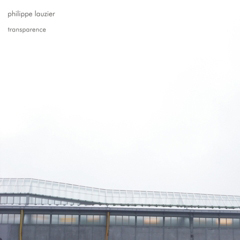
    Montreal’s Philippe Lauzier used three studios to record the 12 tracks which make up Transparence as well as coming up with different strategies for different instruments. Heard on bass and half-bass (sic) clarinet, alto and soprano saxophones plus motorized bells, he uses amplification, feedback and multi-tracking to express his unique ideas. Geyser for instance re-imagines the bass clarinet as hollow tube and percussion, swallowing and expelling pure air as he depresses the keys. Au-dessus on the other hand magnifies the soprano saxophone’s usually ethereal qualities into overlapping vibrations, with the next commencing before the previous one has died away. In contrast, alto saxophone feedback on L’object trouvé literally does as defined, managing to direct the echoes back into the horn’s body tube while making each finger motion and breath transparent. The audacity of Lauzier’s skill is most clearly delineated on En-dessous. Here the multi-tracking of four bass clarinets creates more variety among the timbres he exhales, but the intertwined and affiliated trills produced relate without question to the multiphonics he invented for a single horn. […]

    … more improvisers are taking advantage of the freedom to experiment.
  • 159
  • 160
  • 161
  • 162
  • 163
  • 164
  • 165
  • 166
  • 167