Sauter au contenu principal
actuellecd

Blogue

109 résultats
  • 1
  • 2
  • 3
  • 4
  • 5
  • 6
  • 7
  • 8
  • 9
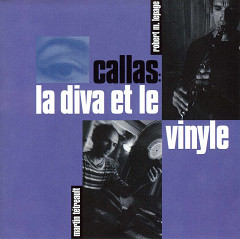
  • Callas: La diva et le vinyle dans Avant

    «Review», Richard Cochrane, Avant, no 10, 1 décembre 1999
    mercredi 1 décembre 1999 Presse

    Here’s the deal: take a world-famous opera diva. Give her recordings to an iconoclastic turntable artiste. Introduce him to a brown-toned clarinettist and leave the two alone together for a while. The result? An unexpectedly lyrical, flowing album of improvisations packed with melodic invention, and nary a camp postmodernist joke to be found. It most assuredly is a funny old world. There are one or two gags, of course — there could hardly not have been. The first thing you hear is Callas warming up. Shortly afterwards, Tétreault puts on a teach-yourself-ltalian disk full of opera house cliches and leaves Lepage to play an uncharacteristically lumpy solo over the top. Nothing lasts for very long (shortest track: 28 seconds), and Tétreault shows perecious little respect for the compositions which Callas was originally performing. At one point, he even mimics the soprano perfoming a descending scale by slowing the turntable down with his finger. It all sounds like a recipe for knockabout cultural reference humour but, astonishingly. such impulses seem merely to be registered in order to keep them in check. Instead, Tétreault and Lepage seem intent on making a record of beautiful music. Of course. Callas’ voice is a fantastic sound-source, and rendered atonal, quavering and unpredictable as it is here it becomes a musical instrument up to the task of interacting with Lepage. The latter plays with a scrupulously clean classical tone throughout, enunciating his ostinati and curlicues of scales with careful precision. At this disk’s finest moments, Lepage seems to curl his clarinet around Callas’ voice, the two locked in an impossible, or at least implausible, counterpoint. This also brings Tétreaults acheivement to the fore. He seems to have given over considerable time to the preparation of this disk — perhaps he did not but if not then his work here is all the more remarkable. What he manages to do is to take apart Callas’ voice, to use the different elements of it in different pieces, yet to do so without it becoming a gimmick. Most of the pieces here have real musical interest not just novelty value. Part of the credit for that goes to Lepage because without an attentive and sensitive duo panner this would have been unlistenable. Part, however, must go to Tétreault for having the imagination and musicality to carry it off. Or then again, perhaps this conventional musicality is all part of another kind of joke, a sort of meta-joke about making a record of opera diva cutups with a straight face. This is a genuine ambiguity for a lot of this disk, the confusion between irony and sincerity, and that too is something of a strength in comparison with all those earnestly wry referential works which tend to dissolve into kitsch.

    An unexpectedly lyrical, flowing album of improvisations packed with melodic invention…

    Chants cachés dans Rubberneck

    «Review», Rubberneck, 1 décembre 1999
    mercredi 1 décembre 1999 Presse

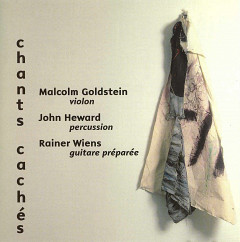
    Chants cachés by contrast is a plugged-in affair, decidedly electroacoustic. The organic/laminal approach to improvisation of AMM is ever present, though with wider external references. Every so often shards of delta blues, jazz, gamelan, and African music emerge. Each musician knows the other’s parameters and a high degree of empathy is evident. John Heward uses a predominantly metallic percussion set-up, very different from his free jazz burnouts with the late Glenn Spearman, and Rainer Wiens’ prepared guitar produces a panoply of beguiling effects. By virtue of the relative pitches of the instruments, Goldstein unintentionally emerges as the lead voice on these very different and satisfying discs.

    Compil zouave dans Revue & Corrigée

    «Critique», Pierre Durr, Revue & Corrigée, no 42, 1 décembre 1999
    mercredi 1 décembre 1999 Presse

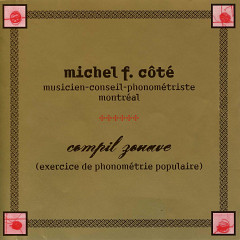
    Cet exercice de phonométrie populaire, tel que l’auteur définit ce recueil, très british d’approche — on pense entre autres aux altérations beresfordiennes — dégage un fort parfum de nonchalance. L’apport de la trompette de Pierre Bastien, présent sur quelques titres, des rythmes placides de ses mécaniums, n’est pas étranger à ce caractère. Mais il n’y a certes pas que cela. Il y a ces manipulations diverses, pour lesquelles Côté est réduit à créer des néologismes succulents pour les évoquer, faute de mieux: batteries cabochonnes. japonaiseries et bridages, manustuprations génétiques, qui constituent autant d’invitations à mettre son nez — et la main de sa sœur! — dans cette compil zouave à laquelle participent, outre le sus-nommé Pierre Bastien, la famille du magnétisme ambiant (Derome, Falaise, Hétu, Labrosse, Tétreault. Fradette…) et quelques autres, qui au koto, qui au feeling canin ou au crooning approximatif, multipliant les approches et les rythmes (même reggae).

    Upbeat dans Tone Clusters

    «Review», Ken Egbert, Tone Clusters, no 74, 1 décembre 1999
    mercredi 1 décembre 1999 Presse

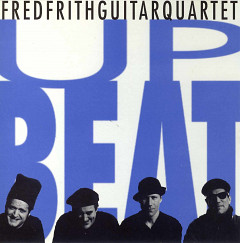
    Our excitable Executive Editor, or our executive Excitable Editor, Chuck Burns, views this foursome with a suspicious eye: “When they play live,” he says, with his teeth in his mouth and his bare face hanging out (please, you’re frightening our dear readers — Ed. ), >do they overdub the bass and drums after everybody leaves?“ Hmmm, one of those questions that will probably never be answered in our lifetimes. Just as well. Still and all, this mostly live recording (from 1997 gigs in Europe) proves that letting four melodic instruments hang in the air with no root functions can provide for scandalous fun, to say nothing of the fact that Chuck talks too loud. But don’t expect 75 minutes of ants-scrabbling-on-a-lap-guitar noise either; note the easy-rollin’ Red Rag, a Fred Frith composition with delightfully bluesy chording and odd petit mal seizures from René Lussier (to say nothing of Mark Stewart or Nick Didkovsky doubling on kazoo MIDI), or Mark Stewart’s Speedy Feety, which interpolates Commander Cody’s 1974 rockabilly hit, Hot Rod Lincoln. If you’d rather hear Fred and company tear the strings off their guitars and chew on them purposefully, they do that too, say, on Say Slinky. There Nick does his Hendrix-bottom-out slow-motion chainsaw bit (If you remember Jimi’s low Mars Delta guitar growls during the Big Finish of Purple Haze at the Monterey Pop Festival in ’67, you’ll know what I mean. Now that’s a historical command of the instrument) while René keeps blowing the stop-work whistle. To all their credit, no one pays attention. Other evidence of a highly-developed collective sense of humor can be found mid-way through Antaeus, where at one point we seem to have René and Mark imitating dueling grandfather clocks. A completely unrecognizable Out to Bomb Fresh Kings is also good clean fun (except for the central riff which in this version has all its paint blasted off). René’s Tout de suite is a bravura slice of everything the Quartet does well: transistorized flip-flop riffs, everybody else playing 1-2-3 Red Light while Fred chops onions, moments of quiet introspection before the tsunami next door comes calling and bows in the roof. I do wish Stewart had written more for this CD, but Frith is not hard pressed to come up with such gems as No Bones, a loose-limbed country swing (think Bob Wills and the Texas Playboys) deeply buried inside a Shanghai noodle factory (Traffic reference not intended). Most of the heavy equipment is malfunctioning and tossing cogs in all directions. And for those of you who always wondered where Nick D. gets his composition names from, I suspect it’s all those AM cartoons on the WB network: To Laugh Uncleanly at the Nurse (with its garlands of cheery semitonal nonsense and compositional dead ends) is what the Animaniacs do every chance they get on their TV show of the same name. “HEL000000, NURSE!!!“ Ha ha, and you thought he got them from Paul Eluard or Tristan Tzara. Guess it’s proof that watching cartoons does not rot your mind (Don’t your kids read this mag? — Ed. ). Not a chance, Chief. And for more proof that the Quartet all together is no dip at improvising; note Stinky Eye, with its Oriental veneer and decided debt to late period Moby Grape (“Chinese Song,” from their 1975 recording, 20 Granite Creek, on Warner Brothers. Now out of print, may the Warners’ names be blotted out). No, if you were expecting covers of middle-period Anthony Braxton or four stiff guys in stiff tuxedos, get ye hence to Lincoln Center; there may yet be tickets remaining to Wynton Marsalis’ AII Rise. This is improvisational. This is music of the moment, and essential for modern guitar fans. And no, nobody plays bass.

    21 situations dans Rubberneck

    «Review», Jim Barker, Rubberneck, no 30, 1 décembre 1999
    mercredi 1 décembre 1999 Presse

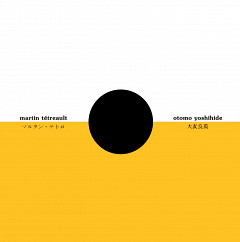
    21 situations finds Yoshihide on more familiar territory, alongside French-Canadian turntable abuser Tétreault, banging out 21 short, radiofriendly slabs of surface noise, technical detritus and musical dementia. All tracks are under four minutes, and the approach is as varied as the subject matter (e. g. cartoon, machine, tension, science fiction). And it’s not just scratching; those drum sounds you hear from time to time are not samples but the players drumming on the turntables. Familiarity with technology has bred contempt, which has in turn bred imaginahon and adventure. This is gamelan for the 21st Century A fine example of revolutionary improv.

    A fine example of revolutionary improv.

    Compil zouave dans Le Soleil

    «Critique», Pierre-Paul Noreau, Le Soleil, 12 novembre 1999
    vendredi 12 novembre 1999 Presse

    Vous vous auto-flattez le rebondi d’avoir l’esprit aussi ouvert! Vous ne dédaignez pas non plus une petite épate à susciter de sincères: “Jamais entendu ça C’est bon c’técoeurant” Et vous avez le cœur résolument festif. Voici l’incontournable de votre prochaine soirée “Moi-même and friends”. Promesse de souverain pontife, la compil zouave va tous les laisser gaga et bouche la bée. Personne n’aura jamais rien entendu de pareil. Et pour tout dire, moi non plus! Le percussionniste Michel F Côté qui a l’insigne honneur d’avoir signé avec Bernard Falaise l’incroyable Encore un peu de saké?, japonaiserie extraite de la bande sonore du film (Robert Lepage), s’est offert le plus insolite bric-à-brac de musiques éthyliques, question de trouver un prétexte pour s’amuser avec une vingtaine de musiciens parmi les plus actifs de la scène zouaviste québécoise! Du boulot de pros qui percute tout azimut, passant du cosmic-jazz, au lo-fly, au néo-reggae et autres indescriptibles modes d’expression dont le point commun d’ancrage est le bonheur de sa rythmique et le plaisir épidermique suscité!

    Personne n’aura jamais rien entendu de pareil. Et pour tout dire, moi non plus!
  • 1
  • 2
  • 3
  • 4
  • 5
  • 6
  • 7
  • 8
  • 9