Sauter au contenu principal
actuellecd
  • This website is also available in English.

Blogue

49 résultats
  • 1
  • 2
  • 3
  • 4
  • 5
  • 6
  • 7
  • 8
  • 9
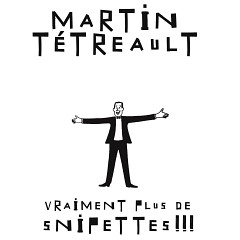
  • Vraiment plus de Snipettes!!! dans PAN M 360

    «Critique», Réjean Beaucage, PAN M 360, 1 décembre 2024
    mardi 17 décembre 2024 Presse

    Étrangement, c’est en anglais que l’on utilise «snipette», alors que le terme français est «snippet»… Il s’agit selon Wikipédia d’une «petite portion réutilisable de code source ou de texte, (…) à incorporer dans des modules plus larges».

    Le tout premier opus du joueur de tourne-disques Martin Tétreault, Des pas et des mois (1991), était dans le même esprit, qui ne craint vraiment pas d’avoir recours à l’humour, que ce que l’on trouve sur les collections de «snippettes» dont ce volume est le troisième. Après ses premières expériences, alors qu’il utilisait beaucoup la «citation», c’est-à-dire des extraits de disques dont on peut encore reconnaître le contenu, instruments, bruits divers ou bribes de monologues absurdes, Tétreault a exploré toutes les manières de jouer du tourne-disques sans disque, comme d’autres font du «no input», ou avec des «disques préparés», tel un John Cage du phonographe.

    À travers ses nombreuses collaborations, ici et ailleurs, avec René Lussier, Michel F Côté, Diane Labrosse, Otomo Yoshihide et bien d’autres, incluant son propre quatuor de tourne-disques, Tétreault est devenu un maître dans l’art de faire chanter (si j’ose dire) les platines sur tous les tons. Mais on ne se lasse pas du Tétreault première manière, qui glisse une imprécation lancée par un hypnotiseur amateur entre un tango déjanté et un «trois dans un» épileptique (le «trois dans un» étant fait à partir de trois disques qui sont découpés en tiers, l’artiste prenant ensuite un tiers de chacun pour reconstituer un disque entier — ça swingue sur un moyen temps). On était donc heureux quand Ambiances Magnétiques a publié sur CD en 2007 le premier volume Snipettes! (et Morceaux choisis), paru sur cassette à tirage limité en 1992. Puis, en 2018, surprises! Plus de Snipettes!! était lancé, toujours chez Ambiances Magnétiques.

    Le troisième volume, Vraiment plus de snipettes!!!, a ceci de particulier qu’après une floppée de snipettes, il nous donne l’occasion d’entendre Tétreault live, dans un concert enregistré en 1994. On y découvre aussi la «Méthode Zappa», où la batterie de Sandy Nelson accompagne la guitare de Tony Romandini dans ce qui évoque la xénochronie du compositeur américain (notons que des informations sur les disques utilisés, tous plus obscurs les uns que les autres, sont incluses). Dans l’ensemble, ça part dans tous les sens et ça peut écorcher quelques neurones au passage, alors on ne recommande pas l’écoute des trois volumes en une seule séance, à moins d’avoir des prédispositions, mais en petites doses ça fait du bien par où ça passe.

    On y découvre aussi la «Méthode Zappa», où la batterie de Sandy Nelson accompagne la guitare de Tony Romandini dans ce qui évoque la xénochronie du compositeur américain… Dans l’ensemble, ça part dans tous les sens et ça peut écorcher quelques neurones au passage…

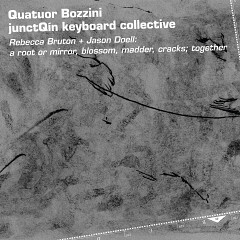
    Rebecca Bruton + Jason Doell: a root or mirror, blossom, madder, cracks; together dans The Intelligencer

    «Review», David Reed, The Intelligencer, 10 décembre 2024
    mardi 10 décembre 2024 Presse

    Quartuor Bozzini is a respected string quartet, known for their love of contemporary music. The junctQín keyboard collective is a trio of pianists working for six-hand piano (meaning all three pianists are playing the same piano together).

    The two entities have merged for this latest release, celebrating and interpreting the music of Rebecca Bruton and Jason Doell.

    Bruton’s The Faerie Ribbon is a four-part suite. Part One is a percolating tapestry at the beginning, dissolving into moments of stark minimalism, and gradually rebuilding.

    Humming and whistling augment the gentler second part and the third part features only piano with extended silences. Part Four is a dense closing movement.

    Doell’s to carry dust & breaks through the body is a curious twenty-minute journey that finds the strings gradually detuning by a semitone over the course of the work, while the piano stays in tune. The resulting dissonance is uncomfortable (which is the point).

    Those who are unfamiliar with modern classical music may find this record challenging, but I would encourage the effort to try something new. A wise friend once said “we need to be comfortable with being uncomfortable.”

    … percolating tapestry at the beginning, dissolving into moments of stark minimalism, and gradually rebuilding.

    Vraiment plus de Snipettes!!! dans Percorsi Musicali

    «Review», Eyal Hareuveni, Percorsi Musicali, 8 décembre 2024
    dimanche 8 décembre 2024 Presse

    Canadian, Québec-based Martin Tétreault is a sound artist, turntablist, DJ and improviser who came to music from the visual arts milieu. His work shifted from highly imaginative puzzles of musical citations to exploration of the intrinsic qualities of the turntable, its motor sound, its interferences, needles, or prepared surfaces, with preparations and analog glitches He has collaborated with local improvisers like René Lussier, Jean Derome and Michel F Côté and others from the international, free-improvisation scene like Otomo Yoshihide, Ikue Mori and Xavier Charles.

    Vraiment plus de Snipettes!!! (Really more Snipettes!!!) is Tétreault’s third installment in a series that he began in 1992 with a limited edition of 250 cassettes of Snipettes! (remastered to an album by Ambiances Magnétiques, 2007), and continued with Plus De Snipettes!! (More Snippets!!, Ambiances Magnétiques, 2018). Now, at 65 and without the enthusiasm of a 25-year-old, Tétreaul promises this is the final installment.

    These installations are made of raw chunks of material excavated from Tétreault’s early archives — magnetic tapes and audio cassettes that were transferred to the computer and then being destroyed. In some cases, the original recordings were made without a mixing console, directly onto a reel-to-reel tape recorder. “I wanted to preserve as much as possible the original qualities of these materials and their supports”, Tétreault explains. “This involves the good moves and the mistakes conducive to learning and the naivety of time. The disc brings together gone gestures, analog tools and magnetic sounds. Most of the tools used for these recordings have disappeared from my entourage. As for music, it fixes in time plays and explorations that are elsewhere… ” The sound materials for Vraiment plus de Snipettes!!! were collected between 1984 and 2023.

    Vraiment plus de Snipettes!!! demonstrates the brilliant, thought-provoking work of Tétreault as a sound artist and turntablist who finds delight in abrupt and brief, subversive juxtapositions between concentrated, obscure fragments of sound, that, surprisingly, gain enigmatic clarity and momentum as the album progresses. Obviously, all these sonic collisions. highlight Tétreault’s wily sense of humor. The last, 25th piece, the 27-minute From Raymond a Micheline begins after three minutes of silence and documents a virtuosic, cathartic live recording from 1994, showing Tétreault juggling with conventional DJ techniques alongside his wildly imaginative story-telling gift and personal abstraction tactics. It ends with the analog scratches of vinyl. Vraiment plus de Snipettes!!! is a reflective but bumpy rollercoaster journey to an innocent musical universe but also a remarkable, experimental sound art with a punkish, even John Cage-like sense of discovery.

    The album comes with Tétreault’s text — thoughts about the irreverent nature of his art and each piece and its original materials. “Improvisation means work, pain, occasionally prolonged spells away from home, sacrifices, and God knows if we improvise”, he wonders in Improviser. “Listen carefully, because it will sound to you crazy. And, if it does not sound to you crazy, that is a sure sign that you have not started to understand what we are talking about. That not to understand is something like not to understand music. And you’ll begin to understand when you begin to find out that you can love music. That you can begin to get really interested in ideas, in puzzles, in surprises. And then you’ll realize that science is much more interesting than music”, he quotes a lecture by Hungarian-American theoretical physicist Edward Teller, “the father of hydrogen bomb”, in Bongos en furie (Furious Bongos). Tétreault immediately matches this statement with Conscience/Awareness, and his own thoughts about Teller’s statement: “Now, here are some other exercises that will help you become aware. Correction, correction, I repeat, correction. Okay, that makes you happy. Take a moment to think about your answer, to develop it mentally. Hmmm… Are you thinking? Let’s start: one, two, four, three, five. Phew!”. Tétreault concludes this text with an optimistic promise: “If you listen to this record, you will always feel ready to face the next day”. You are guaranteed to feel better after taking this wild ride with Tétreault.

    … brilliant, thought-provoking work of Tétreault as a sound artist and turntablist who finds delight in abrupt and brief, subversive juxtapositions between concentrated, obscure fragments of sound, that, surprisingly, gain enigmatic clarity and momentum as the album progresses.

    Vraiment plus de Snipettes!!! dans Monolith Cocktail

    «Review», Dominic Valvona, Monolith Cocktail, 3 décembre 2024
    mardi 3 décembre 2024 Presse

    As the exclamation marks denote this is the third such volume of retrieved archival experiments produced via an apparatus of record player, cassettes, radio and various surface sounds from the free improvisation Québec innovator Martin Tétreault. With over sixty releases under his belt there’s a lot of material floating about: a lot of it previously unused.

    Although there’s been considerable gaps in this series, which initially began back in 1992 with the limited cassette collection Snipettes!, followed by a “reprise” in 2007 after that inaugural instalment was re-released on CD, the latest volume continues to draw upon the idiosyncratic turntablist’s more “irreverent” sonic, dialogue, concrete and musical collages. For there is levity, a sense of fun, playfulness, wit in the way each avant-garde etude, passage or improvised performance is spliced (more in the sense of how it sounds than actual methodology) and put together.

    At the centre of it all, or most of this play, is the turntable, which often sounds as if it is being impeded or led astray through pitch and speed manipulation and covered or wrapped by hidden materials. Less Qbert or DJ Shadow and more Basquiat or Nam June Paik qualifying for an avant-garde version of the DMC World Championships, captured extracts of serious theory, science, philosophy, lectures, the state of consciousness are morphed, twisted or shunted by a lifetime of accumulated snippets from TV, radio, cartoons, theatre, the opera, the rock concert and the art world. High meets low art, popular soundtracks meet the Afro-Cuban, and retro futuristic predictions of computer power, of domed utopias and the like come up against the mooning, the loony and ridiculous.

    At times it plays out like Fluxus skits, and at others, finds a new rhythm and groove bordering on Afro-jazz or no wave or even funk from the transformed source material. A bastardised jazz-prog-noodling Zappa can suddenly also evoke Django Reinhardt fronting The Fugs; an informative French speaker is taken over by staccato nylon-strung Caribbean music and an off-kilter transformation of the Tango; Michèle Bokanowski “cirque’ comes to town under a bendy hallucination of shooting effects and Library music zaps; an echo of Jef Gilson is lost in the background cacophony of classical theatre; articulated ideas on science and reality sit next to feminine coquettish French annunciation and the scraping, rubbing and distorted abrasion of paper; and retro computerised calculus and sci-fi is paired with the spooky gothic theatrics of Edgar Allen Poe. These are just some of the happy accidents or intended results (in my mind) of these often humorous and amusing snippets. The uninspiring concrete mundanity of loading the tape recorder and other mechanised clicks, the dialling of an old telephone, stretch the imagination, whilst also stretching the listener’s patience in what can only be described as another of these Tétreault teases or in-jokes.

    Originally these recordings would have been directly recorded on to a reel-to-reel, bypassing any mixing console. And so all the “quirks” the surface noises, the fizzes, crispy crinkles and muffles are kept as part of the makeup, the character; as Tétreault puts it, in keeping with preserving as much of the original recordings as possible.

    Reanimating and morphing a diverse range of collected fragments from lessons in hypnotising to Marx Brothers like nights at the opera, and from echoes of the Art Ensemble of Chicago to recontextualised lofty addresses and sketches, Vraiment plus de Snipettes!!! is in many ways an antidote to the seriousness and earnestness of this art form.

    Facilitated by the Canadian Ambiances Magnétiques — just one of the many labels that gathers under the Distribution Ambiances Magnetiques (or DAME as it is known) platform umbrella — this third collection of fragments, variations further cements Tétreault’s playful and experimental legacy, whilst also introducing a new generation to his pioneering work in the field of turntable-led, but also radio and cassette tape, exploration and transference. I’d recommend to anyone interested in Philip Jeck, Christian Marcley, People Like Us and Milan Knizak.

    … this third collection of fragments, variations further cements Tétreault’s playful and experimental legacy, whilst also introducing a new generation to his pioneering work in the field of turntable-led, but also radio and cassette tape, exploration and transference. I’d recommend to anyone interested in Philip Jeck, Christian Marcley, People Like Us and Milan Knizak.
  • 1
  • 2
  • 3
  • 4
  • 5
  • 6
  • 7
  • 8
  • 9