Sauter au contenu principal
actuellecd
  • This website is also available in English.

Blogue

4946 résultats
  • 177
  • 178
  • 179
  • 180
  • 181
  • 182
  • 183
  • 184
  • 185
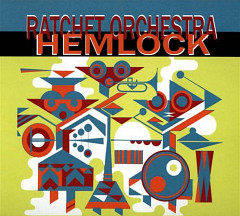
  • Hemlock dans Vital

    «Review», Dolf Mulder, Vital, no 864, 7 janvier 2013
    lundi 7 janvier 2013 Presse

    I thought I knew most improvisers and composers that are around in Montréal, because of the numerous CDs by Ambiances Magnétiques that slipped through my hands over the years. However the name Nicolas Caloia is new to me. He works as a performer, composer and organizer in this city. The Ratchet Orchestra is one of his projects and also his best known one, since he started it around 1990. It is a big orchestra of 30 musicians: Jean Derome (bass flute, piccolo, flute), Craig Dionne (flute), Lori Freedman (clarinet), Gordon Krieger (bass clarinet), Christopher Cauley (soprano sax), Louisa Sage (alto sax), Damián Nisenson (tenor sax), Jason Sharp (bass sax), Ellwood Epps (trumpet), Philippe Battikha (trumpet), Tom Walsh (trombone), Scott Thomson (trombone), Jacques Gravel (trombone), Thea Pratt (E flat horn), Eric Lewis (huphonium), Noah Countability (sousaphone), Gabriel Rivest (tuba), Joshua Zubot (violin), Guido Del Fabbro (violin), Brigitte Dajczer (violin), Jean René (viola), Gen Heistek (viola), Norsola Johnson (cello), Nicolas Caloia (bass), Chris Burns (guitar), Sam Shalabi (guitar), Guillaume Dostaler (piano), Ken Doolittle (percussion), Michel Bonneau (conga), Isaiah Ceccarelli (drums), John Heward (drums). Yes, one needs to be a hell of an organizer to bring together so many musicians! With this orchestra Caloia experiments with improvised chamber music and jazz. Hemlock is the third release of this project that started as a quintet. Recorded in three days in May, 2011. For the Sun Ra tribute in 2007 Live at the Sala Rossa Caloia expanded the line up to what it is now. The compositions by Caloia are well-constructed and move within known territories. Some parts are very open for improvisation, others not. Some compositions — Winnow and Yield — are not very surprising, others however are very appealing like Dusty and the title track. The recording and mixing is ok. One hear and enjoy all participants, all sounds and colors coming from their instruments. Although this music is consumed best in a live performance. Caloia uses a wide spectrum of sounds by continuously making different combinations of instruments and arrangements. The full span of possibilities that are contained in this big band of reputed players come into being.

    The full span of possibilities that are contained in this big band of reputed players come into being.

    S’enfouir, Ailleurs dans Bad Alchemy

    «Kritik», Rigobert Dittmann, Bad Alchemy, no 76, 1 janvier 2013
    mardi 1 janvier 2013 Presse

    Ich muss die Buchstaben erst etwas zurecht schütteln, um bestätigt zu finden, was anfangs einigermaßen rätselhaft klingt. Ja, Alexandre St-Onge spielt auf Ailleurs (EZ 18) basse électrique assistee par ordinateur, also E-Bass & Computer. Er schrappelt die Saiten, und der Rechner generiert saußende und sirrende Wooshes, Triller, klirrende, zischende und jaulende Sounds. Als wäre man in ein Meeting von R2D2s geraten, bei dem es heiß her geht, eine Klimakonferenz viel- leicht, was weiß ich. Diese effektvolle Sonic Fiction führt jedenfalls anderswohin, weg von üblichen Bassfunktionen, hinein in ein elektro- nisches Abenteuer. Mit sprudelnden und zirpenden Klängen, tröpfeln- den und klingelnden Lauten, zu denen sich beim besten Willen kein irdisches Ambiente mehr assoziieren lässt. Nicht hier, nicht da, son- dern fern, abgeschieden und fremd. Größer als die Nullen und Einsen leuchtet da ein X, das für xeno steht. Gefragt sind Xenolinguisten, denn St-Onge seltsame Lautwelt hat etwas Sprechendes, eine Art Sprac- hrhythmus, rhetorische Akzente auf der Basslinie und um die Basslinie herum. Bei À L’écart und Pas là gibt es zwar auch die Anmutung ir- discher Melodievorstellungen, aber wie zerlegt von einem Überset- zungsprogramm, das mühsam hinter dem sinnvollen Tempo her hinkt. Komisch ist dennoch, das da etwas Elegisches, eine gewisse Tristesse als Stimmung durchaus sich vermittelt. Ein universaler ET-ismus, die von Hier wollen fort, die von Dort wollen heim.

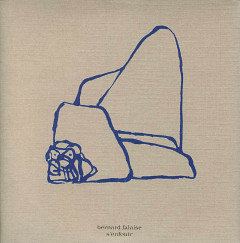
    A suite of five pieces repeated four times. At each repetition, I scratched, twisted, dislocated, polluted, deboned, objected. A record about exhaustion, saturation and sinking. So beschreibt Bernard Falaise selbst das, was er da als S’enfouir (ET 19) konstruiert hat. Bass, Keyboards, Gitarre, Klavier, Flöten, eine Sprechstimme oder was auch immer, womöglich auch nur Samples davon, dekonstruiert, kannibalisiert, verdreht, geloopt, anagramma- tisch permutiert, umgestellt, zerrüttet, verstümmelt, abgestumpft, zer- mulmt. Aus ‘ruine’ wird ‘nuire’, ‘urne’’, ‘ri’ und ‘zuletzt ‘nu’, ich nenne das keine Karriere. Aber durchaus eine Philosophie, ein Sicheingraben in die Variabilität des Ruins, ein Sichvertiefen in Variationen des Schei- terns und des Schwunds. Jedoch den Kreislauf ebenso bejahend wie die Transformation — beides als nackte Wahrheiten, die man letztlich nur mit einem Lachen quittieren kann. Die Musik selbst ist nicht unbe- dingt lustig, aber konsequent.

    S’enfouir, Ailleurs dans Blow Up

    «Altrisuoni», Stefano Isidoro Bianchi, Blow Up, no 176, 1 janvier 2013
    mardi 1 janvier 2013 Presse

    Klaxon Gueule in libera uscita; e libera da chiunque, visto che sia l’uno che l’altro fanno tutto da soli. St-Onge, il bassista, suona il suo strumento “assistito dal computer” (il basso elettrico, non St-Onge) e lo ripropone in vesti non abituali: contraffatto, misterioso, mutevole. Una bella prova di maestria ma anche quel buon tot di gratuità che contribuisce a lasciarci indifferenti; non mi pare che ci siano altre linee maestre che un certo alt-sfoggio. St-Onge da solista non è mai stato troppo convincente (anzi) e in Ailleurs ce ne dà conferma.

    Invece Falaise, il chitarrista, stavolta suona anche il piano e duetta con se stesso nella migliore delle maniere. Li mixa, smista e depista, li fa collidere e combaciare, usa la fantasia per farli camminare insieme, sbilenchi entrambi e d’improvviso all’unisono. Per dire insomma di un disco che ha gran bella creatività e null’altro da sfoggiare oltre le (numerose) idee messe in campo: pezzi brevi per lo più come frammenti conchiusi, tutti motivati da curiosità e spinta verso l’ignoto, beati nella loro fragilità, densi di mille spunti che vanno dal jazz alla contemporanea, da rimasugli RIO a musiche da film (direi soprattutto queste). Nessuna rivoluzione, e forse anche in questo caso non molto più che una prova di maestria: ma che differenza!

    Avant ailleurs dans Vital

    «Review», Frans de Waard, Vital, no 863, 1 janvier 2013
    mardi 1 janvier 2013 Presse

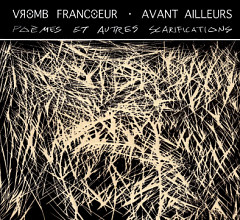
    […] Along similar lines — electronic music and texts read in the French language is to be found on the release by Vromb and Lucien Francoeur. Vromb we obviously know from his various releases on Ant-Zen, but also from Hushush from his home town Montréal. He has quite a following I am told. Lucien Francoeur is a writer from Montréal, who has been active since the mid 60s. In his performances of the past he worked with musicians from the world of improvisation and as such has released a couple of LPs. Here we have twelve pieces, and unlike the release by Bruyas/Julliard, it’s not easy to escape from it; one can not play this a nice backdrop. The voice of Francoeur is more demanding in it that it is more present, and perhaps also because he skips occasionally back and forth between French and English, so you pick up sometimes something. The electronic music by Vromb is also more present and up front. Not in a disturbing way loud or anything, but more piercing at times and also more demanding. He has sustaining, insect like sounds, pulsating beats of a minimal nature, and throughout the music is spooky and mysterious. Certainly indeed one that requires full attention but if you fail to speak the language, like I do, it’s also a bit more complicated to grasp. We may return to what I said about the CD by Petit/Robinson in Vital Weekly 858: “it’s also something that I like to hear once or twice, but would not return to all too easily. Now I was thinking: maybe this is perhaps something to be seen live, seated in the dark and let it all come? I could imagine that would do well.” Especially this spooky stuff would do well in such places.

    … sustaining, insect like sounds, pulsating beats of a minimal nature, and throughout the music is spooky and mysterious.

    Bruit court-circuit dans Monsieur Délire

    «Journal d’écoute», François Couture, Monsieur Délire, 22 décembre 2012
    samedi 22 décembre 2012 Presse

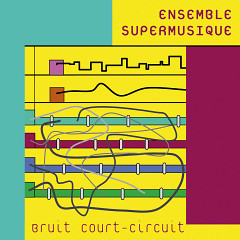
    Voici, enregistré en studio à l’automne 2012, le répertoire du plus récent concert de l’Ensemble Supermusique, Bruit court-circuit, créé au FIMAV 2012 puis repris à Montréal en octobre dernier. Six œuvres bruitistes pour un ensemble de neuf musiciens — des compositions impliquant partitions graphiques, opérations aléatoires, techniques étendues de toute sorte. Le bruitisme est ici acoustique, là électronique. Les deux pièces de Martin Tétreault opposent à bon escient rythme et déstructuration. SM: re-trait de l’abjection d’Alexandre St-Onge demeure une chose très étrange (et oui, c’est moi qui dis ça), qui n’arrive pas plus à me convaincre sur disque qu’en concert. Acouphènes en partage de Danielle Palardy Roger se distingue par la qualité de l’écriture et l’exécution soigneuse — du grand art actuel. Les deux autres pièces sont signées Joane Hétu et Jean Derome. Avec ce disque, Ensemble Supermusique repousse ses propres limites, poursuivant sa conceptualisation de la musique actuelle. Les œuvres sont déstabilisantes, souvent imprévisibles, et elles méritent réflexion.

    Ensemble Supermusique repousse ses propres limites, poursuivant sa conceptualisation de la musique actuelle. Les œuvres sont déstabilisantes, souvent imprévisibles, et elles méritent réflexion.

    La femme territoire ou 21 fragments d’humus dans Monsieur Délire

    «Journal d’écoute», François Couture, Monsieur Délire, 20 décembre 2012
    jeudi 20 décembre 2012 Presse

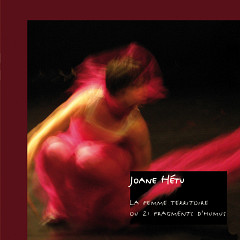
    La femme territoire est à la fois la suite logique de et diamétralement opposé à Filature, l’œuvre précédente de Joane Hétu. Alors que Filature était une production à grand déploiement, avec de nombreux musiciens, beaucoup de rythme, etc., La femme territoire se limite à cinq interprètes et se joue dans un décor spartiate mais hautement conceptualisé. Dans les deux cas, il s’agit d’œuvres multimédia, mais là où Filature en mettait plein la vue, La femme territoire offre moins pour dire plus, intégrant plus avant musique, poésie, danse, projections, scénographie et performance. Évidemment, ce disque ne restitue pas l’ensemble de l’œuvre (bien que le livret laisse voir bien des choses) et c’est pourquoi j’entretenais certaines craintes — j’ai eu le plaisir de voir la production complète de La femme territoire en octobre 2010. Or, la musique survit bien laissée à elle-même. Même qu’elle s’impose. Ces 21 fragments d’humus ne sont pas faciles à absorber, mais au-delà du dépouillement, de la déconstruction, du morcellement des éléments musicaux, on retrouve ce qui fait de Joane… Joane: les dichotomies mélodie/bruit, organisation/improvisation, tendresse/désir, réflexion/folie. Un disque d’une beauté troublante. Avec Susanna Hood, Alice Tougas St-Jak, Jean Derome et Isaiah Ceccarelli.

    Un disque d’une beauté troublante
  • 177
  • 178
  • 179
  • 180
  • 181
  • 182
  • 183
  • 184
  • 185