While new recordings of music by John Cage are always likely to find a rather niche market they are always welcome as far as I’m concerned. This is partly since performances of many of his works have to be unique events by the very nature of the ways they have been conceived and composed, and so the potential for surprise is always present.
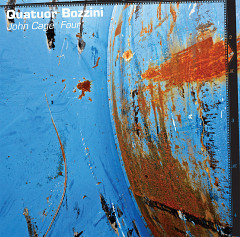
The three works for string quartet come from intriguing moments in the last half of Cage’s development as a composer, and it is nice to have them all together on one disc. The Bozzini Quartet has been a quality purveyor of contemporary music for string quartet since 1999, and their other titles, including Sens(e) Absence, are all worth seeking out. This recording can easily be had as a download, the CD otherwise arriving in a colourful but environment-friendly cardboard foldout envelope with texts in French and English.
As ever, the information from Cage’s own site sums up the content of each work very neatly. String Quartet in Four Parts “… consists of four movements: Quietly flowing along — Slowly rocking — Nearly stationary – Quodlibet … It is a work of great simplicity, reminiscent of Érik Satie and in a way a further step toward Cage’s abandonment of self-expression. As in his Sonatas and Interludes, it deals with the nine permanent emotions of Indian philosophy (see Sonatas and Interludes), as well as the Indian notion of the seasons, i.e. creation, preservation, destruction, and quiescence. In the first movement, the subject is Summer in France, in the second it is Fall in America. The third movement is about Winter, and the fourth, about Spring, is a welcome and quite sprightly quodlibet.” This is enigmatic but relatively approachable music with a feel of melodic shape and tonal resolution, even where there are dissonant clusters. Everything is pared-down. There are no wasted notes, and not as much stretching of time as will be found as a feature of the later works. It’s hard not to experience the first three movements as emotionally barren, but with their open intervals you can easily place them as in a line from something medieval. In these times of austerity the bare-bones approach is as relevant as it has ever been. The final Quodlibet is like an ancient and formal dance, Cage playfully concluding his piece with his sparing notes compacted into something with a smile.
The Cage website entry for Thirty Pieces for String Quartet is also revealing: “This work comprises four parts without overall score. Each player rehearses alone. During performance, they sit far apart at points surrounding the audience. This work takes its title from Cage’s Thirty Pieces for Five Orchestras. Cage says of this work: ‘Just as that work is a coincidence of chamber orchestras, this is a coincidence of solos.’” These solos have tonal, chromatic, and microtonal typed of music, and this is an early example of Cage’s technique of organising each piece into a time brackets. The result is a more extreme ‘squeaky-gate’ kind of music – the sort of thing which has most people running for the hills, and certainly the sort of work which delivers a different kind of value in live performance than with recordings. The Bozzini Quartet players enter this musical game with gusto however, making as convincing an argument as I’ve heard for this as a set of chance elements. These come together to catch us in their radically expressive and philosophical nets. Do we accept Cage’s world of pure-sound, or are we being hoodwinked by spectacular intellectual fakery? As Frank Zappa said, “without deviation from the norm, progress is not possible”, which gets us into that whole debate about the perceived reality of ‘progress’ as opposed to ‘change’. It’s all very interesting and stimulating, but the Thirty Pieces remain a tough nut to crack.
Four is an example of Cage’s Number Pieces, the number being determined by the number of performers; bringing us firmly into his late period. Cage’s instructions for the work are that, “the players sit in the conventional relation to each other”, followed by details about proportion with regard to repetitions and options for duration, including exchanges of parts between players. A live performance will always involve a certain amount of kerfuffle with this kind of moving around of pieces of paper, and I always wonder if Cage intended this to be part of the soundscape. The Bozzini Quartet is respectfully soundless in this regard, and their performance shows where the arc of enigmatic severity of writing landed from the earlier period to the late works, with admirably controlled sustained notes creating a wonderful sense of stillness.
John Cage’s string quartets are not unknown on recordings, and as you would expect, the Arditti Quartet — dedicatee of String Quartet in Four Parts was in there first with their complete edition in on the Mode label in the early 1990s. In general the Arditti version has a more introverted feel to it, making the Bozzini version of, for instance, the Quodlibet from String Quartet in Four Parts sound positively effusive, though this is also a side-effect of wider dynamic range and a more detailed and etched recorded sound. With a piece like Four the atmosphere is all-important, and the Arditti Quartet does a good job of making time stand almost still, the musical landscape emerging and receding with gradually evolving nuances. The more closely recorded Bozzini Quartet is also very good, exploring breathy and woody sonorities in their instruments, and the overall result being a little more edge-of-the-seat rather than basking in enigmatic beauty, but none the worse for that.