actuellecd

Blog

4946 results
  • 105
  • 106
  • 107
  • 108
  • 109
  • 110
  • 111
  • 112
  • 113
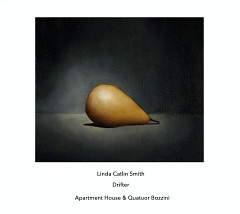
  • Drifter in Fluid Radio

    “Review”, Nathan Thomas, Fluid Radio, May 1, 2017
    Monday, May 1, 2017 Press

    Having much enjoyed composer Linda Catlin Smith’s Dirt Road release for UK label Another Timbre, as well as Eve Egoyan’s recordings of her piano music collected on Thought and Desire, I was very much looking forward to this new double album of pieces for solo and small ensemble from the Canadian composer. To cut to the chase, Drifter doesn’t disappoint: it takes everything I liked about previous releases and casts it into new contexts, drawing out new shades of colour from what is still quite a limited range of instruments. Impeccable playing from Apartment House and Quatuor Bozzini, the Barcelona and Real Madrid of small experimental music ensembles, and great quality recordings only add to the enjoyment.

    Though this is relatively quiet music, it is by no means sedentary: on the contrary, it’s constantly on the move, sometimes hurrying on by, sometimes caught in an aimless drift or relaxed meander. Smith’s melodies are often plaintive and built from a small selection of pitches, circling back without repeating themselves exactly. Like paths through the forest, you can follow them easily enough, without being sure where they will lead. At the same time, there’s a harmonic centre that remains constant throughout a piece, like the persistence of consciousness or personhood on an ever-changing path. What changes, and what stays the same — or perhaps merely contrasting rates of change, some fast enough to be audible and others not.

    The influence of folk music is often mentioned in reference to Smith’s music — perhaps even more so because it seems to belong in the woods and in the fields and on the mountain than because of any explicit use of folk music tropes — and this is no less relevant to the pieces collected on Drifter. What is perhaps less discussed is the tinge of jazz harmonies and syncopation that tints pieces such as Piano Quintet, heard in augmented chords, flurries of strings, and gusts of piano. Where two or more players are performing, melodic lines will often echo or mirror each other very closely: the effect, perhaps most clearly in evidence on the title track for guitar and piano, is like two identical translucent images that are laid one on top of the other and then rotated ever so slightly, so that the edges of the bottom layer are partially visible from underneath the top one. This subtle almost-identity makes me listen again, and listen more closely.

    The drowsy piano, cymbal crashes, and high whining violin of Moi qui tremblais (‘I Who Trembles’) evokes uneasy dreams, tossing and turning in the depths of sleep. It’s perhaps the most memorable piece on the album, and one of only two to feature an unstringed instrument — if there’s a criticism to be made of Drifter, it’s perhaps the lack of variety over its two-and-a-half hours. It’s a double-edged sword: listening to such complex and powerfully affective music being made from such constrained resources — a small selection of pitches, steady harmony, and a limited range of timbres — is a pleasure in itself. If this is what she can do with strings (and occasional percussion), I’d love to hear Smith’s compositions for a wider variety of instruments.

    Impeccable playing from Apartment House and Quatuor Bozzini, the Barcelona and Real Madrid of small experimental music ensembles…

    Drifter in Boring Like A Drill

    “Review”, Ben Harper, Boring Like A Drill, May 1, 2017
    Monday, May 1, 2017 Press

    In its own quiet way, this is one of the major events I’ve been looking forward to in 2017. Over the past year or so I haven’t been alone in noticing how much of the freshest, most intriguing and affecting music has been coming from Canadian composers. This week, there are three nights of music this week focusing on new music by these composers and more at Cafe Oto. The gigs are to launch the first five releases in a ten-disc Canadian Composers Series on Another Timbre. I’ve had all five on heavy rotation at home the last few days and will need to write more about them during/after hearing the live shows.

    The double CD of works by Linda Catlin Smith, Drifter, opens with a duet for viola and vibraphone. Cantilena ‘s instrumentation recalls the magnificent 70-minute violin and percussion Dirt Road Another Timbre put out last year and is a brighter, briefer work with fewer complications to mull over. Any suspicion that the album would offer diminishing returns are evaporated by the 2014 Piano Quintet and Drifter itself, another odd pairing of instruments, guitar and piano.

    The Quintet presents a hothouse atmosphere of lyrical flourishes in the strings, framed by restive, unresolved harmonies in the piano. It’s like a passage from romantic European chamber music at its ripest, held in suspense, their details enhanced while their function is diminished. When the strings finally break into sustained drones against the piano, it serves only to maintain the cool tension already achieved. In Drifter, the two instruments play in turn, the guitar as an echo of the piano, the same chords but transformed by the change in timbre and decay, surprising the unsuspecting listener with the way the harmonic material appears to be subtly transformed. Eventually, each takes turns in leading on the other, or playing in unison, an unhurried interplay of two partners sounding out each others’ qualities.

    Over ten pieces, Apartment House and Quatuor Bozzini present Smith as a composer capable of finding great diversity of expression within a single, coherent compositional voice that focuses on depth more than breadth. Suggestions and traces of other music styles are recalled, but never in pastiche. Those string arpeggios in the Piano Quintet relate equally to folk playing as to a salon. The clearly delineated phrases of the Ricercar for solo cello are modelled on Baroque music but do not imitate. Unexpected shifts in mood come in the strange processional Moi Qui Tremblais and in the final string quartet, Folkestone, a cycle of introspective fragments in fragile diminuendo.

    A small book of interviews has been published together with the CDs. From what I’ve skimmed so far, some common themes emerge between composers: the isolation, allowing them to work in blissful ignorance of more common theoretical hang-ups occupying colleagues’ minds in the US or Europe, is spoken of approvingly more than once. There’s also a repeated referral to the legacy of John Cage, particularly via Morton Feldman. Previous generations who might have claimed such an influence would frequently be stridently avant-garde, often more in style than in substance. While never sounding derivative, distinct traits can be observed that show a firm understanding of Feldman’s music. Ambivalence of mood, the embrace of traditional harmony while simultaneously rejecting its traditional structural function. The allowance of stasis, a musical ‘surface’ of sustained dynamics, typically tending towards the quiet. A careful consideration of instruments’ attributes, enabling otherwise unusual combinations of instruments to be heard in new ways, in contrast or in complement.

    Over the past year or so I haven’t been alone in noticing how much of the freshest, most intriguing and affecting music has been coming from Canadian composers.

    Drifter in The WholeNote

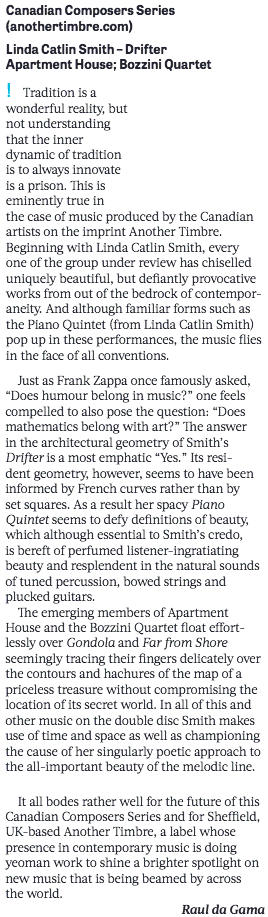
    “Review”, Raul da Gama, The WholeNote, no. 22:8, May 1, 2017
    Monday, May 1, 2017 Press
    … uniquely beautiful, but defiantly provocative works.

    Drifter in 5:4

    “Review”, Simon Cummings, 5:4, April 28, 2017
    Friday, April 28, 2017 Press

    The ten works contained on the double-album devoted to Linda Catlin Smith ‘s music — performed by Apartment House and the Bozzini Quartet — display a similarly beautiful, usually folk-infused, countenance. That being said, some of them are tougher nuts to crack. Both the 2013 Cantilena for viola and vibraphone and 2010’s Far From Shore for piano trio pose similar questions of connectivity to Arnold. The relationship between the parts in these pieces is often hard to define, gently massaged between tenuousness and credibility; again, there’s engagement to be found in this tension, though Smith’s soundworld is sometimes sufficiently aloof (though a better word might be introspective) that it can feel a touch alienating. Galanthus for solo violin is similar in this respect, not unattractive but hard to penetrate, whereas her 1999 string quartet Folkestone, while passing through periods of detachment also alights on some lovely episodes of waxing and waning counterpoint, its fragility countered by the unity displayed by the quartet as a whole. More potent by far is Smith’s short solo piano piece Poire, all the more striking for its entire focus on assertive monody, notes occasionally (gently) reinforced with octave doublings. A charming piece, that’s only bettered by the astonishing, insistent atmosphere of Moi Qui Tremblais, where low moody piano chords are softly pummelled and splashed by a bass drum and cymbal in conjunction with drawn-out streaks of violin pitch. It’s impossible not to be pulled deeply into its immersive, all-enveloping soundworld.

    … also alights on some lovely episodes of waxing and waning counterpoint, its fragility countered by the unity displayed by the quartet as a whole.

    Drifter in Sequenza 21

    “Review”, Christian Carey, Sequenza 21, April 27, 2017
    Thursday, April 27, 2017 Press

    Born in the US and residing in Canada for more than a quarter century, Linda Catlin Smith has become a fixture on that country’s cultural radar. She has been welcomed and feted as one of Canada’s own. For instance, she is only the second woman to win the Jules Léger Prize for Chamber Music and has had a long association with the ensemble ArrayMusic, whom she served as Artistic Director. Several recordings have been released of her music, but last year’s Dirt Road won her critical acclaim and belated notice in the United States, ending up on many critics’ “best of year” lists (mine included). Released by Another Timbre, Dirt Road was merely a foretaste of that label’s commitment to Canadian music. Another Timbre has recently released a set of five recordings in its Canadian Composers series (another batch of five is due later this year). Catlin Smith features prominently, with the double disc Drifter serving as Volume 1 in the series. Other composers include Martin Arnold, Isiah Ceccarelli, Chlyoko Szlavnics, and Marc Sabat.

    Drifter’s program is performed by two chamber groups: Apartment House and Bozzini Quartet. The “drifting” in question is not itinerant hitchhiking, but rather the placid tempo pathways frequently chosen by Catlin Smith. The piano trio Far from Shore, played here by Philip Thomas, Anton Lukiszevieze, and Mira Benjamin, is a case in point. Slow, soft music for the trio, often reminiscent of Morton Feldman’s approach (one that Catlin Smith acknowledges as a signature influence on her work) abides alongside passages of colorful piano chords. The spectrum moves from inexorably repeated constrained sets of pitches, to chromatic counterpoint, to whole washes of sound. The intuitive sensibility that Catlin Smith claims as her approach in preference to any dogmatic systemization clearly allows her to move through constantly changing musical terrain, all the while maintaining an organic sense of each piece. How does she manage this? An interview in the booklet accompanying the Canadian Composers set quotes her as saying, ”Listening. Lots of listening.” One could do worse as a composer in any style to listen as carefully as Catlin Smith does.

    Cantelina (2013) for viola and vibraphone, played by Emma Richards and Simon Limbrick, presents another of the composer’s interests, one in heterogenous instrumental pairings. Both here and in the Piano Quintet ( 2014), another of Catlin Smith’s predilections, exploring tightly knit counterpoint in close registral positions, is featured. The overlapping in Cantilena is quite fetching (it is a combination that should be explored by more composers and one I’ll keep in my own hip pocket) and it is equally affecting when writ large in the quintet. The title work is also for a seemingly challenging combination, piano and classical guitar, played by Philip Thomas and Diego Castro Magas, but Catlin Smith’s gentle daubs of coloristic harmony and unequal ostinatos work beautifully in this duo context as well. Mon Qui Tremblais (1999), played by Thomas, Benjamin, and Limbrick, has a pulse-driven piano part that is joined by sustained violin and bowed pitched percussion. An interesting notational device is used: rather than writing out all the notes and rhythms, the composer specifies that the musicians silently read a Rimbaud poem and use its speech rhythms to shape the musical work (for instance, the percussionist gets his attack points from the accented French syllables).

    Bozzini Quartet appears in two string quartets by Catlin Smith. Folkestone (1999) pits a persistently high violin line against blocks of slow articulated, syncopated chords played by the other three members (these have an almost accordion-like quality in their spacing). Gradually, other lines emerge from the texture, with the cello playing a poignant solo dissonant with the rest of the harmony. The chordal passages begin registrally to disperse, bringing the locus of activity closer to the violin’s sustained flautando melody. Mid-register lines now break free and the chords move in double time for a brief stretch before ceding the terrain to widely spaced and again slowly articulated harmonies. This alternation of patterns includes still more elements to be introduced: pizzicatos, duets, flashes of quartal harmonic brilliance, and a bass-register cello melody made truly weighty by the registers it has balanced against before. Clocking in at more than 32 minutes, Folkestone is a substantial and thoroughly captivating composition. Gondola involves members of the quartet coming in and out of unison and a gentle boat-rocking pacing that Catlin Smith describes thus: ”The title loosely refers to its slight undulation or floating qualities — a subtle motion or disturbance of the surface, like trailing the hand in water.”

    Evocative imagery for truly evocative music-making. Drifter is an album (a double-album at that) worth savoring.

    Evocative imagery for truly evocative music-making.
  • 105
  • 106
  • 107
  • 108
  • 109
  • 110
  • 111
  • 112
  • 113