actuellecd
  • This website is also available in English.

Blog

4946 results
  • 103
  • 104
  • 105
  • 106
  • 107
  • 108
  • 109
  • 110
  • 111
  • Christopher Butterfield: Trip in The Squid’s Ear

    “Review”, Brian Olewnick, The Squid’s Ear, June 28, 2017
    Wednesday, June 28, 2017 Press

    Butterfield (b. 1952) is a long-time teacher and composer, operating largely in Toronto and Montréal. As a teacher, he has a number of students working in various contemporary areas, including Wandelweiser-influenced, who assign him a great deal of credit for their development.

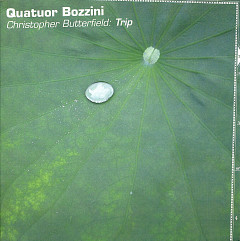
    The Quatuor Bozzini, which also works out of Montréal, presents five of his works ranging in origin from 1991 to 2013: two quartets, a sextet and two solo pieces, all of them bracing and enjoyable. Lullaby (1991) adds an additional viola and cello. It’s a somewhat disorienting lullaby, broken up at times by nightmarish shrieks, but by and large it wafts along with luscious, quavering harmonics, sometimes entering surprising, perhaps dreamlike song formations, reminding this listener of Ben Johnston’s work. Maybe some Tenney as well. Generally, Butterfield’s music, as represented here, often goes off in unexpected, delightful directions where one can hear (or think to hear) this or that reference but still comes away with more of a Butterfield-ness than anything else. Lullaby is an excellent example of this. beach whistle (1993) and Clinamen (1999) are solo works for cello and violin, respectively, the former a sober conversation of sorts between high and low, plucked and bowed, the later portions strangely melancholy and evocative while Clinamen is something of a dance, flitting from one light form to another (it’s constructed from 80 short phrases which the violinist can combine in any sequence he/she chooses).

    The final two pieces are for string quartet proper. As per the composer’s notes, fall (2013) is “(b)ased on the chromatic rotation of a four-note row” with a randomized dynamic range. The result is a hymn like structure but, as Butterfield says, “unpredictable ‘voice leading’ and a sense of undependable harmony.” One experiences a vivid spatial effect, the louder chards seemingly “nearer” than others, an otherwise self-similar landscape where perceived distance is the sonic qualifier. Additionally, the overall meditative aspect of the music itself permeates this landscape, somber and disquietingly beautiful. Trip (2008) is in four sections, the first three short (each less than 2:30) while the final lasts some 13 1/2 minutes. The three brief movements are brisk and rich (the first incorporating a talk radio capture), rather Neo-Romantic in flavor while the final (marked Adagio molto) is dark, scratchy, agitated and brooding, though not discarding an underlying tonality; I found myself thinking of Arnold Böcklin’s paintings.

    Overall an extremely satisfying release — absorbing music incisively performed by Quatuor Bozzini.

    Overall an extremely satisfying release — absorbing music incisively performed by Quatuor Bozzini.
    Trio in Le son du grisli

    “Critique”, Guillaume Belhomme, Le son du grisli, no. 116-117, June 17, 2017
    Saturday, June 17, 2017 Press

    C’est dans un autre trio guitare / basse / batterie que celui qu’il forme avec Chris Burns et Nicolas Caloia — récemment entendu sur Live: Taking a Shot, cassette Small Scale Music — que l’on trouve ici John Heward. Le temps de quatre improvisations enregistrées en Nouvelle-Écosse en juillet 2013 avec Arthur Bull (la guitare) et Adam Linson (la basse).

    Et ce trio diffère de l’autre, au gré d’intentions délicates qui n’imposent pas à l’improvisation l’allure forcée d’un jazz qu’on aimerait libre. C’est sans doute là l’expérience des intervenants, qui s’est forgée auprès de partenaires de taille: Steve Lacy, Lori Freedman, Malcolm Goldstein ou Joe McPhee pour Heward, Derek Bailey, Roscoe Mitchell ou Roger Turner pour Bull, John Butcher ou l’association Axel Dörner / Rudi Mahall / Paul Lytton pour Linson.

    La frappe mesurée — retenue, même, parfois — du batteur invite ainsi à un jeu courtois que respectent les feedbacks maîtrisés du guitariste comme les allers et retours turbulents de son médiator, les grands mouvements d’archet du contrebassiste comme ses fabuleux accrocs. Sur la deuxième improvisation, la plus longue (une douzaine de minutes), le ton montera quand même, pour permettre peut-être au contraste de parachever le tableau.

    La frappe mesurée du batteur invite ainsi à un jeu courtois que respectent les feedbacks maîtrisés du guitariste comme les allers et retours turbulents de son médiator, les grands mouvements d’archet du contrebassiste comme ses fabuleux accrocs.

    Avant in Voir

    “Chronique disques”, Réjean Beaucage, Voir, June 15, 2017
    Thursday, June 15, 2017 Press

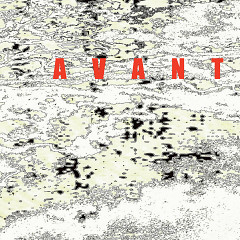
    Poursuivant leur projet amorcé l’année dernière avec le disque 1948 (Kohlenstoff Records), qui saluait le travail des pionniers de l’époque de l’invention de la musique concrète par Pierre Schaeffer, les deux bad boys de la musique actuelle nous arrivent avec un enregistrement en concert à Québec dans le même esprit, c’est-à-dire très noise. On est au cœur du glitch; l’aiguille du tourne-disque de Tétreault est au beau milieu de l’égratignure et le laptop de d’Orion, saturé à souhait, mord la poussière. Ces deux-là ont raffiné le produit depuis un bout de temps et leur noise est épuré; raison de plus pour regretter que le tout ne fasse guère plus de 25 minutes.

    On est au cœur du glitch; l’aiguille du tourne-disque de Tétreault est au beau milieu de l’égratignure et le laptop de d’Orion, saturé à souhait, mord la poussière.

    Parlures et parjures in Voir

    “Chronique”, Réjean Beaucage, Voir, June 5, 2017
    Monday, June 5, 2017 Press

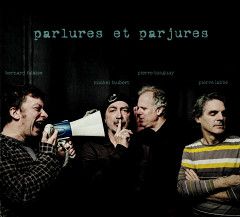
    Déjà trois ans que le saxophoniste Pierre Labbé donnait au Festival international de musique actuelle de Victoriaville (FIMAV) la création de son projet mêlant trad et musique actuelle avec le concours de Michel Faubert dans le rôle du «conteur électrique». La poésie de ses propos est magnifiée par les mélodies recherchées que tissent autour d’elles les musiciens (le guitariste Bernard Falaise et le batteur Pierre Tanguay appuient le souffleur). Comme en concert, on se laisse prendre tout de suite par l’énergie de l’ensemble, semblable à celle du groupe Papa Boa, auquel Falaise, Faubert et Labbé ont participé et dont Jean Baribeau revient faire un tour de piste ici. Un projet à surveiller s’il passe dans votre coin, et dont on espère des suites.

    Un projet à surveiller s’il passe dans votre coin, et dont on espère des suites.

    Rowetor in Vital

    “Review”, Frans de Waard, Vital, no. 1085, June 5, 2017
    Monday, June 5, 2017 Press

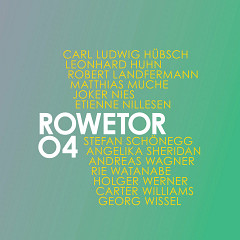
    On the website of Tour de Bras there is an explanation of this project: “Rowetor is a musical concept inspired by the guitar player Keith Rowe. The aim of the piece is to explore one static sound in the ensemble, to maintain it and in the same time interact with utmost care and openness for any necessary change”, and during two nights in 2015 and 2016 (September 30 and June 3), Carl Ludwig Hübsch, armed with his tuba, gathered a bunch of people on stage at the famous jazz club The Loft, in Cologne, Germany, to perform this. Maybe it’s something he did before, seeing this is ‘Rowetor 03’ and ‘Rowetor 04’? In the latter we have thirteen players, mostly names I didn’t recognize, and in the first we have two more players, of which I only recognized the names Sharif Sehnaoui on acoustic guitar and Phlip Zoubek on piano (but I admit I didn’t search the entire history of Vital Weekly for each individual player). Hübsch gets credit for the composition and the mix; hence he’s listed here in the header of the review. I am not sure to what extent it is actually composed, or whether there are a bunch of guidelines along which the players can act and have freedom to play. ‘03’ is thirty-three minutes and ‘04’ is forty-two minutes. In both of these pieces time moves very slowly and individual instruments are blurred in the bigger picture. It is very hard to recognize in here, say, an acoustic guitar, bass, alto clarinet, low percussion, viola d’amore on ‘movement (inaudible)’ as played by Phuong Bui. Everything buzzes and sustains, but it moves; there is no question of a standstill. Upon close inspection, there is more happening ‘Rowetor 03’ than in ‘Rowetor 04’, but I must admit I seemed to enjoy the long quiet second half of the latter better. Everything becomes dark and spooky, like something big is going to happen, but all it does it build a mild crescendo towards the end, and then a gentle fade out. ‘Rowetor 04’ had an almost sine wave character most of the times, whereas ‘Rowetor 03’ sounded more orchestral in approach. It is not a bad piece, far from it, as this is cloud of sound passing over, dark and ominous, but in terms of preference I’d go for ‘Rowetor 04, with it’s suppressed suspension. It could have fitted on a single CD but it makes sense to do it on two.

    Everything buzzes and sustains, but it moves; there is no question of a standstill.

    Trio in Jazz Word

    “Review”, Ken Waxman, Jazz Word, no. 128, June 1, 2017
    Thursday, June 1, 2017 Press

    Closely miked and closely knit, this eponymously titled CD captures four tracks of in-the-moment improvisations from Halifax-based guitarist Arthur Bull and visitors, Montréal drummer John Heward and American bassist Adam Linson. Like sophisticated linguists finally given a chance to speak the same language earlier studied in formal contexts, rapport is nearly instantaneous. Soon afterwards the three are unearthing a vein of connective musical inspiration like theoretical geologists discovering a valuable mineral deposit during a quarry visit.

    A picker, whose every timbre is outlined with crystal clarity like a diamond displayed on velvet, Bull’s echoing bent notes and slurred fingering usually establish the exposition, with Linson’s tremolo runs and thumping ostinato commenting on, contrapuntally challenging, or stretching the narrative still further. As unobtrusive as a pacifist at a National Rifle Association rally, Heward, also a noted visual artist, contents himself with the occasional distant rumble or ruff. Case in point is Improvisation (2), which works its way up from austere string plinks to spiccato top-of-scale thrusts from Linson, with the merest suggestion of electronic processing. Reaching a crescendo of drums slaps and rattles; sul ponticello double bass shrills; and staccato scurries along the guitar neck with chipmunk speed; the trio concludes the track with a distinctive balance between chicken-picking motions from Bull, that rest comfortably on top of Linson’s double bass string buzzes. Alternatively expanding the sound mixture to widening cascades or shrinking to microtones like an Alice in Wonderland potion, Improvisation (3) is the perfect prelude to the final track. Here Linson’s buzzing continuum, encompassing conservatory techniques steadies the tune’s foundation, while locking in with occasional drum patterns. Eventually the guitarist’s irregular twanging fastens tongue-and-groove with the bassist’s sideways string swipes, creating a crackling finale that’s both multiphonic and memorable.

    Bull often deals with more folk-based material; Heward is more oriented towards jazz; and Linson is an electronics experimenter. Yet together on this CD they manage to coordinate their ideas with the best qualities of a long-time working group.

    Like sophisticated linguists finally given a chance to speak the same language earlier studied in formal contexts, rapport is nearly instantaneous. Soon afterwards the three are unearthing a vein of connective musical inspiration like theoretical geologists discovering a valuable mineral deposit during a quarry visit.
  • 103
  • 104
  • 105
  • 106
  • 107
  • 108
  • 109
  • 110
  • 111