actuellecd

Blog

4946 results
  • 1
  • 2
  • 3
  • 4
  • 5
  • 6
  • 7
  • 8
  • 9
  • Birthdays

    Monday, August 31, 2026 General

    Today August 31 is the birthday of:

    More recent and upcoming birthdays:

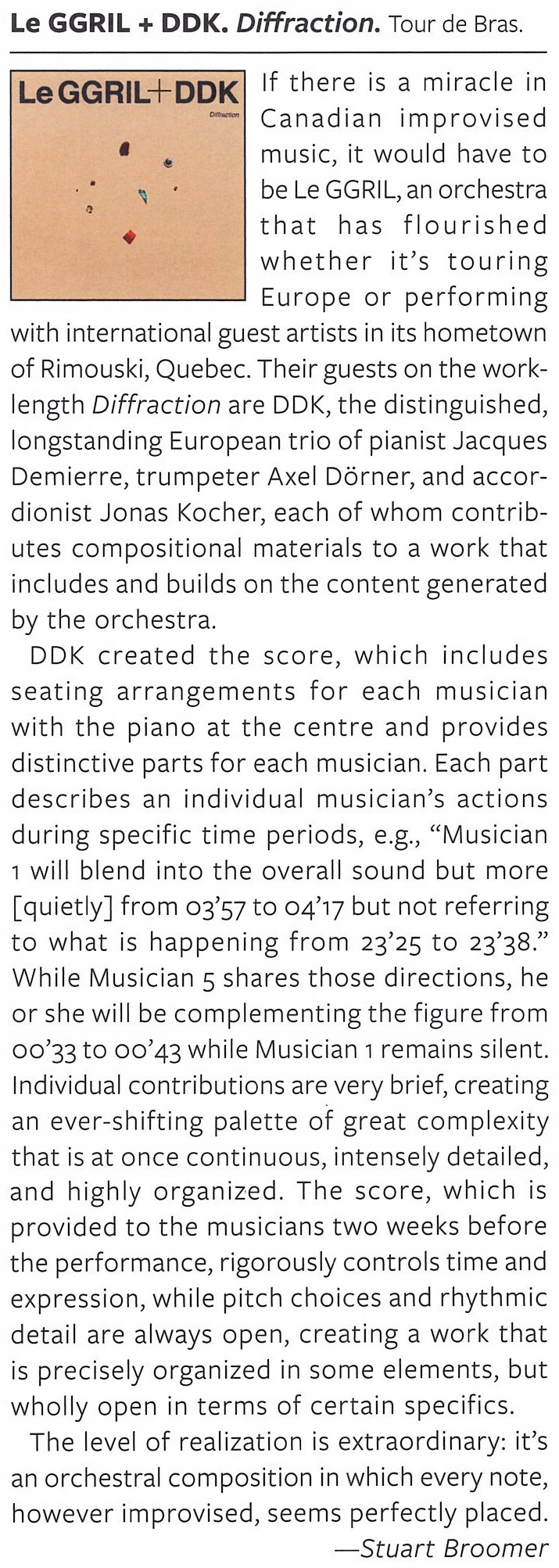
    Diffraction in Musicworks

    “Review”, Stuart Broomer, Musicworks, no. 154, August 1, 2026
    Wednesday, August 19, 2026 Press
    The level of realization is extraordinary: it’s an orchestral composition in which every note, however improvised, seems perfectly placed.

    Further Notice to Our Customers Residing in the USA

    Saturday, August 15, 2026 General

    Starting August 19 22, 2026, the United States of America government will levy a customs duty (Section 338 of the Tariff Act of 1930) on the value of some imported goods you place in your shopping cart. From our understanding the goods we offer remain exempt from customs duties. However a customs duty may be added to the total value of the goods of your order and paid directly to the United States Customs and Border Protection (CBP) through the intermediary chosen by Canada Post. We are monitoring the situation closely and we will adjust our shop’s behaviour accordingly.

    Digital products are not subject to this customs duty.

    Le sourire in Making a Scene!

    “Review”, Dee Dee McNeil, Making a Scene!, August 7, 2026
    Tuesday, August 11, 2026 Press

    This is improvised music, featuring the compositions of the iconic Steve Lacy. Lyricists have contributed words to some of his compositions. Lyrics are printed out in the accompanying booklet. They include the following writers: Anna Akhmatova, Samuel Beckett, Robert Creeley, Bob Kaufman and Judith Malina. The star of this show is Jean Derome with his innovative and improvised approach to experimental music on alto saxophone, bass flute, and also using his voice.

    This is Jean Derome’s second homage to the innovative composer and soprano saxophonist, Steve Lacy (1934-2004). The ensemble opens with Jack’s Blues featuring a stellar alto saxophone solo by Derome. His vocals blend with Karen Young, reminding me of 1960s and the Lambert, Hendricks & Ross style.

    Derome is the recipient of numerous awards including the Freddie Stone Award (1992), in 2014 the Prix Collegien de Musique Contemporaine, and six Prix Opus Awards. He continues his groundbreaking creativity on this newly released album.

    The nucleus of this production is Derome’s longtime trio members including bassist, Normand Guilbeault and Pierre Tanquay on drums. He added Alexandre Grogg on piano and Karen Young’s vocals.

    All the melodies of these songs are challenging, with unexpected intervals and difficult harmonics. This is experimental jazz that has spanned his fifty-year career. Jean Derome is an accomplished composer, a respected multi-instrumentalist and improviser whose discography celebrates over one-hundred album releases, with just as many compositions written for film, theater and dance.

    The Straight-ahead vocalese continues on Sands, 2: Jump sung in French by Young and Derome is an introduction into what I really enjoy hearing which is Jean Derome’s excellence on the alto saxophone. His inventive and infectious playing has been influenced by Ornette Coleman, Archie Shepp, Eric Dolphy, and Anthony Braxton, but reflects his own style and charisma. Alexandre Grogg offers an innovative piano solo.

    I’m always fascinated by musicians and composers who step totally outside the box to pursue their own expression and creativity in ways not-so-familiar. French Canadian avant-garde artist, Jean Derome, has been doing this for half a century. He is an individualist. Fasten your seatbelt!

    I’m always fascinated by musicians and composers who step totally outside the box to pursue their own expression and creativity in ways not-so-familiar. French Canadian avant-garde artist, Jean Derome, has been doing this for half a century. He is an individualist. Fasten your seatbelt!

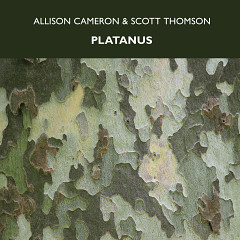
    Platanus in Musicworks

    “Review”, Stuart Broomer, Musicworks, no. 154, August 1, 2026
    Tuesday, August 11, 2026 Press

    The collaboration of composer Allison Cameron and trombonist Scott Thomson dates from the late 2000s, when Thomson presided over Somewhere There, a Toronto loft space used by creative, improvising musicians. Their new recording is dedicated to the late Nobuo Kubota, multimedia artist and member of long-running Toronto improvising groups the Artists’ Jazz Band and CCMC. Cameron inherited his crackle-box synthesizer. Those relationships between place, personalities, and instruments define the special ground of Platanus (the genus of plane trees or sycamores), three extended instrumental dialogues between Cameron on synthesizer, keyboards, and tapes and Thomson on trombone. Taproot, Bark, and Limbing represent three substantial chunks of wildly exploratory improvisation, running from fifteen to twenty-four minutes.

    The recording process admits repetition and simultaneous extractions and intrusions, which leads to music that is more temporally complex and polyvocal than one might initially imagine from a duo, stretching and connecting playful highs and subterranean lows into miracles of technology and technique. The final track, Limbing, initially matches the myriad glassy sonic events of the synthesizer with a quiet, barely articulated mumble from the trombone that might suggest small woodland creatures. These are sounds that will eventually expand their identities, as the keyboards’ layered bleeps and whirrs and the trombone’s more vocalic muted mutterings, all in some sense still lightly lyrical, assume their most abstract ultimate identities.

    … music that is more temporally complex and polyvocal than one might initially imagine from a duo, stretching and connecting playful highs and subterranean lows into miracles of technology and technique.

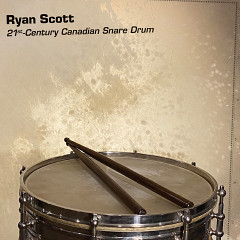
    21st-Century Canadian Snare Drum in Musicworks

    “Review”, Tim Powis, Musicworks, no. 154, August 1, 2026
    Tuesday, August 11, 2026 Press

    As the adventurous, formally trained Toronto percussionist Ryan Scott demonstrates with great skill on this two-CD set, many different sounds can be coaxed from a snare drum. The chain-mail-like snare that stretches across the drum’s underside can be switched on or off. The head of the drum can be struck—or rubbed, or scraped—with sticks, brushes, mallets, or, less conventionally, with a saxophone reed or a tuning fork. The rim and the shell are also there for the striking. Nevertheless, a 101-minute collection of fourteen snare-drum pieces by as many composers might strike even the most openminded music lover as a bit much. But fear not. Though that titular drum is dominant throughout, only Disc One’s hush, composed by Michael Oesterle, seems to be performed entirely, by more or less traditional means, on the snare drum—its press rolls and rata-tat-tat rim clicks evoking the instrument’s parade-band roots (marching to it, mind you, would be an insurmountable challenge).

    Elsewhere, other drums and percussion instruments have walk-on parts, along with non-percussive (often electronic) instruments and human voices. Possibly under the influence of Steve Reich’s Different Trains, Brian Current’s Infantry; which opens Disc Two, calls at times for Scott to mimic, on his drum, the rhythmic inflections of taped reminiscences from once embattled soldiers. Only intermittently — for instance, the brief, charging tom-tom intrusions in Sepals (composer: Amy Brandon) — do any of the pieces incorporate something resembling a groove or straightforward timekeeping. This is music that both acknowledges and seeks to transcend the historical limitations and martial origins of what, in Scott’s hands at any rate, is a compellingly versatile instrument.

    This is music that both acknowledges and seeks to transcend the historical limitations and martial origins of what, in Scott’s hands at any rate, is a compellingly versatile instrument.
  • 1
  • 2
  • 3
  • 4
  • 5
  • 6
  • 7
  • 8
  • 9