Sauter au contenu principal
actuellecd
  • This website is also available in English.

Blogue

4946 résultats
  • 186
  • 187
  • 188
  • 189
  • 190
  • 191
  • 192
  • 193
  • 194
  • Pink Saliva, La Formule Xyz dans The Sound Projector

    «Water Dragons», Ed Pinsent, The Sound Projector, 5 juillet 2012
    jeudi 5 juillet 2012 Presse

    We received a bundle of five items from the & Records label of Montréal which arrived here 20 January 2012. They all come in foldout silkscreen covers designed by Fabrizio Gilardino. Here are two of them.

    On Pink Saliva (&11), the trio of Pink Saliva perform 12 instrumentals live in the studio using a combination of trumpet, percussion, a bass guitar and a laptop, plus microphones for occasional wailing feedback effects and a lap-steel guitar. I was encouraged by the presence of Alexandre St-Onge on this one, as he made an intriguing “sleepytime” documentary record in 1999 called Une mâchoire et deux trous while wearing his “sound artist” beret. I enjoyed that one, but this record I find less compelling. The performances are mostly a vehicle for Ellwood Epps to play rather pointless raspberry-blowing effects through his trumpet, while the other two musicians provide listless backdrops of chuntery noise. I would welcome a bit more excitement or danger in the playing, but it feels very predictable — in spite of the obvious commitment to free-form playing. Things feel random, but not much fun; there is something self-important and solemn about the overall tone of these fellows which I mistrust.

    The record XYZ (&14) fares much better with me, with its stern no-nonsense discipline that at times feels as strong as iron. It was made by the trio of Martin Tétreault, Pierre-Yves Martel and Philippe Lauzier, all Montréal players to a man. I see they played before in 2008 on a CD called Disparition de l’usine éphémère, using not-dissimilar instrumentation but joined by the acoustic guitarist Kim Myhr. What we got here is the winning mixture of Lauzier’s woodwinds (bass clarinet and soprano sax) with live electronics — be it the feedback-static hum of Martel or the more complex set-up of Tétreault, which involves magnetic pickups, a mixing unit of some sort, and something called the Tétronic which is probably a device of his own making. Unlike the above record which hops about as though all the players have pants full of fleas, this disk just sits there and groans out monotonous and unnatural tones like a bad-tempered old turtle who missed his evening meal. No concessions made by the three brooding magicians here to variations in tempo, register, or pitch, and XYZ soon succeeds in wearing down your resistance. Even the very track titles refuse to acknowledge the listener’s humanity, alienating us with their alphabet soup of letters which resemble algebraic formulae. If these balmy summer days lead you to a hankering for some intensive Nakamura-styled feedback laser surgery but you’d also like to back it up a notch in the direction of Anthony Braxton or Jean-Luc Guionnet, then this is your next purchase. Succumb freely to these splendid close-knit wafers of electro-acoustic intensity, that’s my advice.

    Succumb freely to these splendid close-knit wafers of electro-acoustic intensity, that’s my advice.

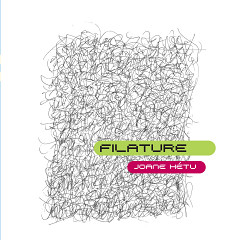
    Filature dans The Squid’s Ear

    «Heard In», Kurt Gottschalk, The Squid’s Ear, 3 juillet 2012
    mardi 3 juillet 2012 Presse

    It’s a funny thing listening to songs sung in foreign tongues. Whether it’s the delicate miniatures of Erik Satie or Haino Keiji screaming against the void, there is something lost to be sure but perhaps something else — something not necessarily intended by the artist even — to be gained. Such is the case for the audio tourist listening to Joane Hétu, who has been developing a strong voice as a writer of narrative and a composer of song cycles over recent years.

    The simple yet strangely abstract songs that make up Filature were recorded in 2006 and the suite was presented at the 2007 edition of the Festival International de Musique Actuelle de Victoriaville, just a few hours north of Hétu’s Montréal home but it is only now seeing release. The three-part suite follows in the stead of the three discs of “winter songs” she’s released over the last decade. All of these sets of songs are wonderfully theatrical, in this instance meaning something very different than “cinematic.” Hétu’s song cycles aren’t of the sweepingly dramatic form of the big screen but rather exist on small stages in small rooms. She uses large ensembles sparingly and vocal melodies cautiously, evoking (even without benefit of the syntax) dramatic scenes.

    Filature is based on Hétu’s work as a weaver when she was young, and indeed was presented with video of looms at work when it was staged at Victoriaville. The metaphor in composition becomes a fairly literal weaving of disparate qualities: of silence and dark, woody tones; of slow instrumental phrases and soft nonmusical sounds; of singing and speaking and less easily classified mouth-made sounds. Saxophonist Jean Derome (like Hétu a fixture of the Ambiances Magnetiques musician collective) delivers much of the text in an unaffected singing voice, plain and almost conversational. In a very different way, Hétu blurs the two, easily sliding between talking and singing.

    Hétu benefits from having a group of musicians who know how to read the sentimentality, playfulness and starkness of her work. Along with Derome, the tentet assemblage of L’Ensemble Supermusique heard here includes cellist Mélanie Auclair, bassist Normand Guilbeault, electronicist Diane Labrosse, and percussionists Danielle Palardy Roger and Pierre Tanguay, a strong cross section of Montréal’s pool of improvisers. There is, at times, so little music happening (a bass drone, percussive scrapes and slow, dual voice and violin melodies, for example, or abstract syllabication with occasional horn section interjections) that it seems Hétu must function at least as much as director of actors as she does a conductor of musicians. Part of the success of the work is the company that delivers it.

    There is more that could have been done with this release. Bob Hébert’s evocative video work seen in Victoriaville could have been included in a DVD package, and certainly a translated lyric sheet wouldn’t have been unwelcome (the lyrics printed in French are included). But even as it is to an outsider looking in, Filature is a striking and satisfying piece of work.

    … a striking and satisfying piece of work.

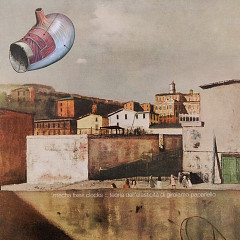
    Teoria dell’elasticità di Girolamo Papariello dans Blow Up

    «Altrisuoni», Stefano Isidoro Bianchi, Blow Up, no 170-171, 1 juillet 2012
    dimanche 1 juillet 2012 Presse

    Michel F Côté e il suo progetto personale allargato ai consueti amici e collaboratori (stavolta sono in undici) tornano a dar forma alle loro idee sommariamente cinematografiche; nella musica dell’ensemble convivono tradizione e soffice jazz d’atmosfera, musica da camera e piccole sfasature avant, quella che d’altronde è la misura più consona ai musicisti coinvolti (Stresses Due to Galactic Bending). Abilmente condotta dal batterista verso luoghi parzialmente distanti dai due dischi precedenti (direi più complessi), nostalgica quanto basta per sganciarsi dal presente ed evocare film felliniani (Don Slow et son attrape-fille électrique), curiosamente lussureggiante e misteriosa come una giungla piovosa e caldissima (L’hypnoglyphe est dans l’étable) fino a sfiorare gli umori di una ‘musica globale’ alla Rob Mazurek (Linear-Elastic Beams Will Not Pass Through The Centroid), la “Teoria dell’elasticità di Girolamo Papariello” (bislacco titolo se ce n’è uno) si ascolta con lo stesso piacere con cui si gusta uno scotch dopo una cena tra amici, di fronte al focolare domestico, a rimuginare tra passato e futuro.

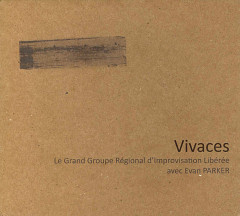
    Vivaces dans The WholeNote

    «Review», Ken Waxman, The WholeNote, no 17:10, 29 juin 2012
    vendredi 29 juin 2012 Presse

    Adding another voice to an established improvising ensemble is more precarious than it seems. With a group having worked out strategies allowing for individual expression within a larger context — and without notated cues — the visitor (s) must be original without unbalancing the interface. Luckily the sessions here demonstrate successful applications.

    Invited to Rimouski, Quebec to give a workshop, British saxophonist Evan Parker also participated in Vivaces (Tour de Bras TDB9006 CD), recorded with the 12-piece Grand groupe régional d’improvisation libérée (GGRIL) . Made up of players from different musical backgrounds living in the Lower Saint-Lawrence region, GGRIL is distinctive in that the group includes two electric guitarists, an electric bassist plus two accordionists, but only three horn players. Using these circumstances to best advantage, these tracks, alternately directed by Parker and GGRIL violinist Raphaël Arsensault, employ the accordionists’ tremolo pulsing and sweeping electronic oscillations to thicken the bottom. With upturned slices from the strings and barnyard cries from the squeeze boxes, two clarinets and the tuba, it’s often Parker’s restrained undertone that gives a linear shape to the improvisation. The best example of this is Marcottage that manages to include contributions from nearly every GGRILer. As Parker pushes forward with staccato split tones he’s backed by sympathetic grace notes from fellow guest, trombonist Scott Thomson, and skittering, slurring accordion lines. Triangle pings signal a timbral shift and presage a ferocious solo from the saxophonist. Band members’ responses range from rebounding percussion ratamacues, crackling electronic runs from the guitars and bass plus one accordionist sounding a faux balladic line as the other pumps powerfully. Finally the mass cacophony downshifts to a satisfying connective rumble.

    The sessions here demonstrate successful applications

    Jean René dans All About Jazz

    «Victoriaville 2012», Kurt Gottschalk, All About Jazz, 4 juin 2012
    lundi 4 juin 2012 Presse

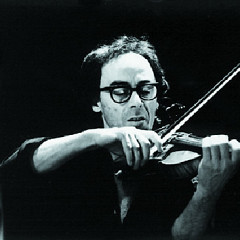
    The other part of Ambiances Magnétiques institutionalization came in the form of a sort of repertory group led by violist Jean René, who released the remarkable solo recording, Fammi (&records) in 2010. With violinist Joshua Zubot, fantastic drummer Pierre Tanguay and bassist Nicolas Caloia, René struck a Stéphane Grappelli bop that could melt and reform in quick minutes and turn to upbeat Québécois folk the next. The set list was comprised of an Ambiances Magnétiques songbook, with old and new pieces by Derome, Normand Guilbeault and René Lussier, as well as some of René’s own pieces. The quartet was lively and precise, and, along with Ensemble Supermusique, showed once again what a unique group of composers and interpreters there are under the Ambiances Magnétiques banner. […]

    The quartet was lively and precise, and showed once again what a unique group of composers and interpreters there are under the Ambiances Magnétiques banner.

    Vivaces dans Free Jazz Blog

    «Review», John Colburn, Free Jazz Blog, 1 juin 2012
    vendredi 1 juin 2012 Presse

    If you are a fan of longer, exploratory forms and large-group ensembles, this will be a very rewarding disc. Le Grand groupe régional d’improvisation libérée (GGRIL) is an improvisational collective based in Quebec, Canada, and Vivaces captures a live recording from a concert in Rimouski. Le GGRIL often hosts guest artists to head workshops and conduct the group, and this recording captures illustrious saxophonist Evan Parker conducting and playing with the GGRIL.

    The three songs on this recording display great willingness to explore the depths of each improvisation. The mixture of sounds in loose rhythm that open Vivaces gives a hint to the surprising textures at work in this ambitious recording. These are accomplished musicians, and the interactions between them progress in surprising ways. At times the structures remind me of Parker’s work in the Global Unity Orchestra, and like those recordings, the music here is consistently rewarding and occasionally difficult. The array of instruments and sounds present in each track creates a sonic map that shows us how the conductor’s thinking progresses and still manages moments of great lyrical beauty. We hear accordions, violins, voice, tuba, guitar and of course Evan Parker’s saxophone.

    The final third of opening track reaches a brilliant set of surprises and some magnificent saxophone work by Parker, but mostly he is conducting on the first two tracks. And in many ways the conductor is the star here, with Parker directing the sound by dropping instruments in or out of the music, and extending certain tones by bringing them to the forefront. As the second track, Boutrage, crescendos with a wonderfully demented and circus-like rhythm (yes, the tuba!) you feel the full potential of the improvisational large group. The music alternates between rhythmic propulsion and lyrical, floating tones, often involving the accordions. Organic textures provided by violin, voice and accordions often bring a very welcome dreamlike quality to passages in the recording.

    The second track covers so much territory, from lush to spare, from hypnotic to jarring, that it alone acts as a large-group improvisational workshop. It’s this 25 minute track that most intrigues me, especially because the musicians never seem to run out of new territory and the music often takes on a mind-altering quality. During the third track Parker’s playing provides space and melody for the other players to work off, and they often enough find sublime moments behind him.

    It’s been a long time since I’ve listened to a live recording with so many textures on it, and all this in only three songs. Congratulations to the GGRIL and to Evan Parker on this fine recording. The disc is nicely mixed and its live quality adds to that tightrope, highwire tension, that feeling that the musicians could slip up, take a wrong turn, disassemble. But of course there are no wrong turns, only opportunities for the next turn. Vivaces is a blueprint of sorts, a how-to for groups exploring large group improvisations. As a recording it is fascinating listening, and the GGRIL project is an excellent model for the development of a regional avant garde.
    It’s been a long time since I’ve listened to a live recording with so many textures on it
  • 186
  • 187
  • 188
  • 189
  • 190
  • 191
  • 192
  • 193
  • 194