Sauter au contenu principal
actuellecd

Blogue

4946 résultats
  • 102
  • 103
  • 104
  • 105
  • 106
  • 107
  • 108
  • 109
  • 110
  • Mikrokosmos Sz 107 dans The Squid’s Ear

    «Review», Dave Madden, The Squid’s Ear, 18 septembre 2017
    lundi 18 septembre 2017 Presse

    Quartetski’s interpretation of classic works has been a mixed approach in the best possible way. Their version of Stravinski’s Le Sacre du printemps adhered near 50% of the time to the mystical original, the other portion being a different type of genius musical accoutrement.* The group’s Prokofiev covers turned the Russian composer into a hard-bopping jazz man. Now the quintet (oh the irony) sifts through 96 acts that make up the first three books of “progressive piano pieces” by Béla Bartók’s Mikrokosmos and offers 25 greatest hits.

    The results here are… fun. They range from playful, naïve (per the simpler works intended as etudes for Bartók’s young son Péter) to mischievous to bold to sweet and stark. Livre I: I. Six mélodies à l’unisson wiggles out of the corner with Bernard Falaise’s gentle guitar melody. He hangs on a last note as Phillippe Lauzier’s bass clarinet and Isaiah Ceccarelli on xylophone meander in the delicate simplicity. Violinist Joshua Zubot offers a syrupy line and pause before the group — with Pierre-Yves Martel rounding out the mix on electric bass guitar — slams into a stint of rocking out. Turning on a dime, Lauzier is joined by a drifting melodica until a micro-burst of slinky jazz slips in. Livre III: XIII. Gamme pentatonique shimmers with a bloated pitch-shifting guitar (as in it sounds like someone skronking on a harmonizer pedal), slightly-out-of-tune synth and lively pizzicato from Zubot. An icy, wandering duet of wind instruments (soprano sax riffing that would make sense coming out of Evan Parker) meets lithe, mandolin-like strums, and the band slams back into the relatively pummeling, lugubrious rock; the mania of the sax persists as the rest of the crew hunker into a big ol’ groove.

    Livre II: VI. Accompagnement en accords brisés comes with slide whistle sounds, pick slides, sexy rhythmic patterns, fun accordion-like chords (more melodica), the work coming off as Tom Waits scoring a Jim Jarmusch flick; Livre II: X. Méditation adopts the same aesthetic, but adds sultry tremolo guitar to the fold. Livre II: Dialogue is 43 seconds of punctuating distorted crunch whose last pluck probably ended with tongue out and a devil horns hand pose.

    Makrokosmos, the final and longest piece at over nine minutes, is the quintet sinking into a wave of droning material with wispy gestures of bowed cymbals, squeaking harmonics and deep rumbles percolating to the surface. The juxtaposition of style here furthers the mystique of the album in that, sonically, it eulogizes the previous tracks. “Bartók, you are why we are gathered today, and this record is an artifact to the influence you had on us. Look at what your legacy produced!

    Technical virtuosity meets a virtuosity in cleverness is the best way to describe this music. Homage, respect, innovation: paint that on a banner and hang it at the next Quartetski show.

    *This is an album that will be included in my desert island bunker.

    Technical virtuosity meets a virtuosity in cleverness is the best way to describe this music. Homage, respect, innovation: paint that on a banner and hang it at the next Quartetski show.

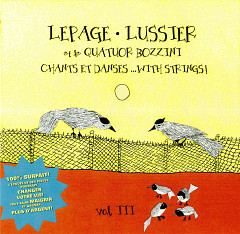
    Chants et danses… with Strings! dans Touching Extremes

    «Review», Massimo Ricci, Touching Extremes, 6 septembre 2017
    mercredi 6 septembre 2017 Presse

    We’re here reporting about the most recent effort by a pair of pillars of Québec’s scene, of whom this reviewer bought the vinyl version of their first collaboration — Chants Et Danses Du Monde Inanimé — shortly after it came out in 1984 (gasp). We never looked back, in case you’re asking.

    Conventum, ever heard of them? Le Trésor De La Langue, anyone? Does the title La Traversée De La Mémoire Morte ring any bell? There is time to do some homework, no problem. But please do it if you’re not acquainted with these perennially acute artists yet.

    The activities of Lepage and Lussier — quirkily proficient in clarinet and guitar respectively — are exquisitely complemented by Bozzini’s strings across a cycle of pieces long enough to give the idea of a fully formed concept and short enough to make sure that, once the picture has been drawn, there is no need to dwell on it more than necessary.

    It’s a clever choice, because this is unpredictable music who literally defies categories. Furiously arrhythmic and incredibly poised; strengthened by commitment and ironically derisive; replete with melodic sketches which, in a matter of seconds, melt individual meanings in a contrapuntal cauldron of distortion, dissonance and — for lack of a better description — unobtrusive clangor.

    Sometimes the mind’s gates get opened to sudden contemplative flashes. Those don’t last too much, either. Basically it’s all a “catch-a-glimpse” game: one may succeed or simply not realize what’s going on. When the ears manage to convey a precisely articulated message to the brain, chances are that Lussier, Lepage and the good people at Bozzini’s will find a way to disrupt whatever was learnt a moment before.

    And they always do that armed with a wry smile emerging from nowhere, perhaps in the middle of a semi-organized chunk that doesn’t fit in any mental archive.

    In another age, we could have stamped this album with a “sonic art for the modern times” definition. However, faint lights of yesteryear occasionally guided us along a path that exploits the memory as a catalyzer of transmissions related to some kind of “future”. A place where language is truly just the virus hypothesized by Bill Burroughs, exclusively curable through the use of instantaneous decisions dictated by instrumental adroitness.

    Let’s sing and dance ourselves, then — and raise our aerials up. Maybe we’re set to untie the knots of incommunicability, and we don’t even know it.

    The activities of Lepage and Lussier — quirkily proficient in clarinet and guitar respectively — are exquisitely complemented by Bozzini’s strings…

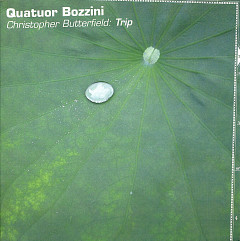
    Christopher Butterfield: Trip dans The WholeNote

    «Review», Paul Steenhuisen, The WholeNote, 29 août 2017
    mardi 29 août 2017 Presse

    For its 23rd CD, Quatuor Bozzini has produced a monograph recording with an almost-chronological retrospective of music by Christopher Butterfield. Spanning more than 20 years, it contains three pieces for solo strings and two string quartets. Clinamen (the Latin name Lucretius gave to the unpredictable swerve of atoms), for solo violin (1999), is made up of 80 cards, each containing a short musical phrase, combined according to the free will of the performer. Intentionally inchoate, the piece is bound together most prominently by the honey tone of Clemens Merkel’s playing, and yet, there are whispers of its compositional technique, as though related materials were sketched, bent through historical filters from classical music to modern, and then splayed by means of William S Burroughs’ cut-up technique.

    fallùù (2013), written for the full quartet, is the perfect vehicle for the Bozzinis’ signature non-vibrato playing. At times haunting and tense, their sound is also unadorned, unaffected and exquisite. Engaged in material processes of rotation and accumulation, the ensuing tone of the piece is plaintive and distantly evocative of Cage’s String Quartet in Four Parts. The eponymous Trip (meaning possibly all of: excursion, to dance or run lightly, to stumble or fall, to release and raise an anchor, and to hallucinate) is an outlandish journey from a short Scorrevole movement augmented by a random talk radio broadcast, through a moto perpetuo, to a swaying, recapitulatory Scherzo. The last movement, marked Adagio molto, is longer than the preceding movements combined, and sounds not simply slow but like a time-stretched recording, where the smallest, usually ordinary timbral deviation is magnified and burnished, while notes, lines and harmonies are expanded into tranquillizing beauty.

    At times haunting and tense, their sound is also unadorned, unaffected and exquisite.

    D’éclisses dans Mouton Noir

    «Critique», Geoffrey Lain, Mouton Noir, no 22:06, 1 juillet 2017
    samedi 1 juillet 2017 Presse
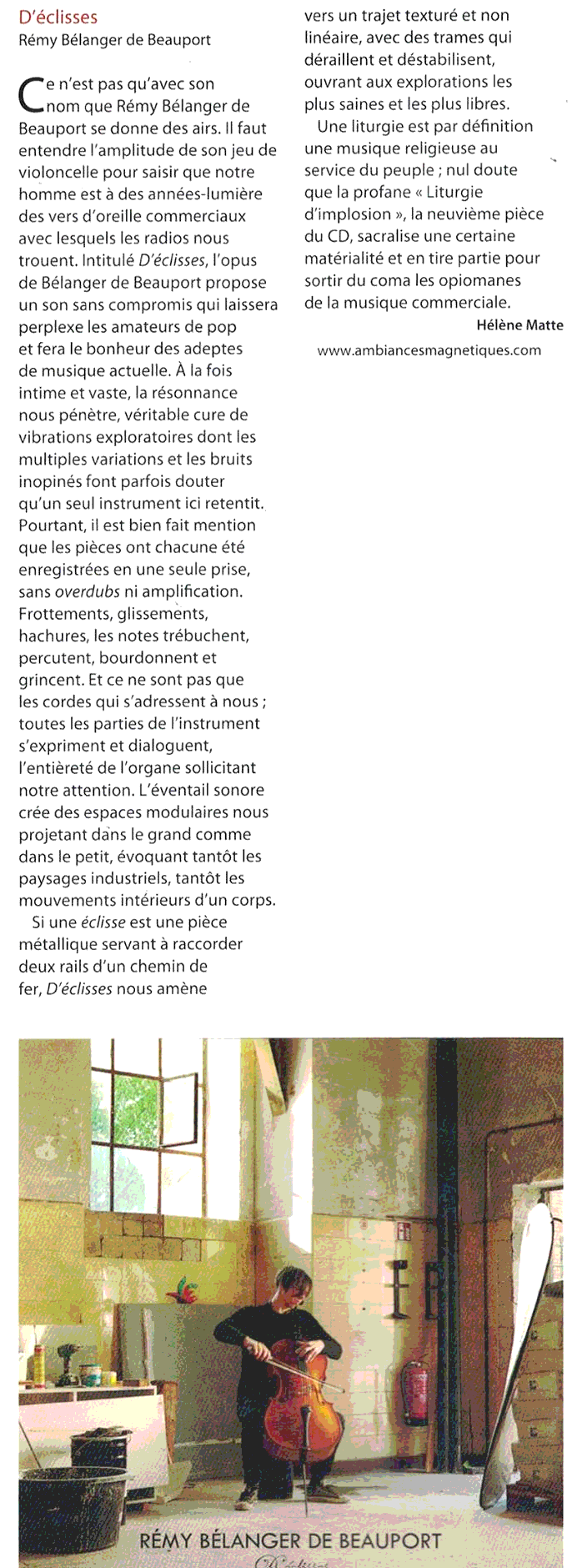
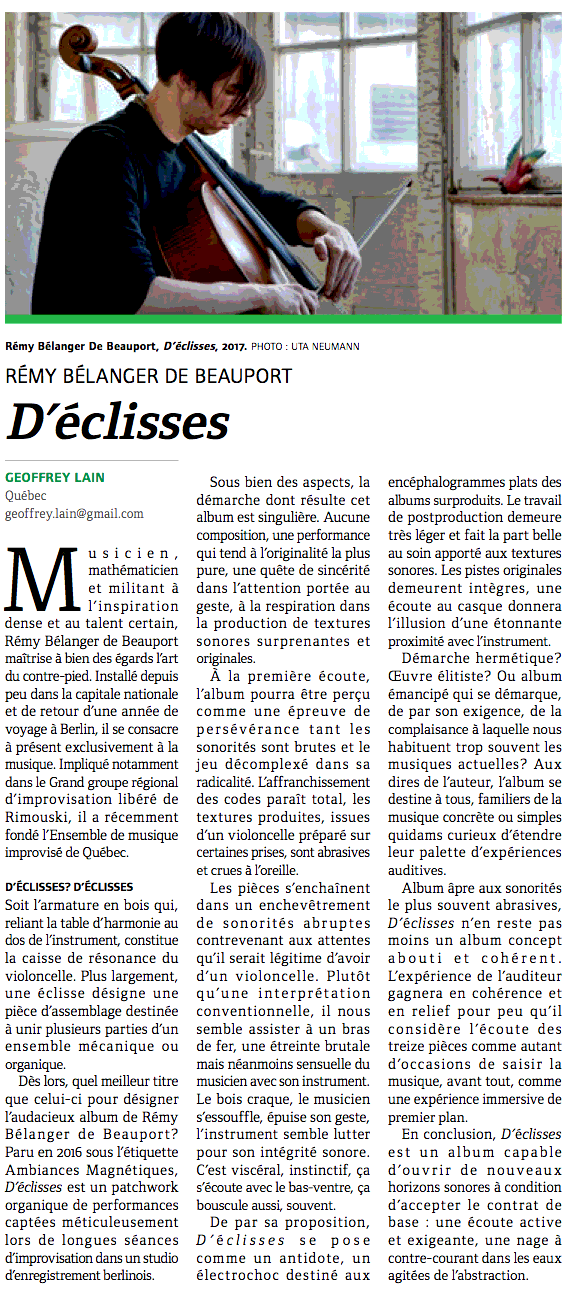
    D’éclisses est un album capable d’ouvrir de nouveaux horizons sonores à condition d’accepter le contrat de base: une écoute active et exigeante, une nage à contre-courant dans les eaux agitées de l’abstraction.
  • 102
  • 103
  • 104
  • 105
  • 106
  • 107
  • 108
  • 109
  • 110