actuellecd

Blog

4946 results
  • 30
  • 31
  • 32
  • 33
  • 34
  • 35
  • 36
  • 37
  • 38
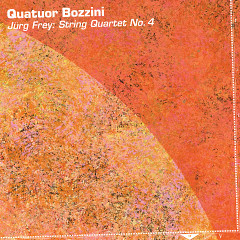
  • Jürg Frey: String Quartet No. 4 in The WholeNote

    “Review”, Andrew Timar, The WholeNote, no. 29:5, April 1, 2024
    Wednesday, April 17, 2024 Press

    About his String Quartet No. 4 (2021), Swiss composer Jürg Frey (b. 1953) laconically observed, “ My music is slow, sometimes static, often delicately shifting between standstill and movement. And yet, after more than an hour, this music has arrived at another place.” Music critic Alex Ross aptly compared Frey’s music to a “Mahler Adagio suspended in zero gravity.”

    One of Canada’s leading string quartets, Bozzini specializes in contemporary music with an impressive 36 releases to date. Fostering a long and deep working relationship with Frey, their premiere recording of his sprawling five-movement Quartet No. 4 is a remarkably poised musical testament to their collaboration. Beginning with whisps of sound the Bozzini morphs into a virtual, though still totally acoustic, orchestra. From pianissimo sustained string chords ghostly instrumental resemblances emerge; they sound like a French horn, harmonica, woodwinds, bandoneon and a soft pipe organ in succession. In Frey’s expansive soundscapes, timbral colour takes centre stage in the sonic field.

    “… little happens — it is this atmosphere from which my music emerges and to which it always returns,” explains the composer.

    Listeners can choose to lay back and relax in Frey’s sound world observing the timbral transformations, the attractive chord and shifting mood changes. But then — just as we were enjoying the slowly scuttling clouds on a sunny Swiss summer day — those mysterious insistent pulsed cello pizzicati at the very end emerge to remind us of … what? … the passage of time?

    … a remarkably poised musical testament…

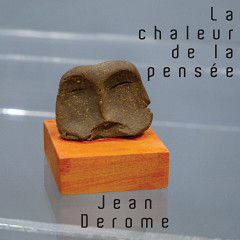
    La chaleur de la pensée in The WholeNote

    “Review”, Max Christie, The WholeNote, no. 29:5, April 1, 2024
    Wednesday, April 17, 2024 Press

    I looked at some images from the great early surrealist artist Francisco Goya while listening to the new release of quasi-improvisatory pieces by Jean Derome. Somehow the one activity made the other more terri-fying. It’s hard to express praise or admiration for this composer’s output, but the effectiveness of his creativity is undeniable. This is high-concept and/or/but high-quality artistic material.

    Derome provides a visual reference to Onze Super (petit) Totems: pictures of his own somewhat crude sculptures; protections, per the liner notes, against various evils. A through-composed sectional work, the totems are distinct sonic explorations, with one or two segues. The first one is full of mad birdsong alternating between chaotic twittering chirps and sustained chords of close treble voices, punctuated by deep huffing yells that spur the switching between those textures.

    The Tombeau de Marin Mersenne provides relief of a kind. Three movements (Tombeau, Rigaudon, Galope), materially determined by the arcane formulae of a16th century math-ematician. At first blush they just seem a bit mechanical and dispassionate. Perhaps that’s the point. I’m not sure how flattered I’d be by this Tombeau if I were the ghost of Mersenne, but Derome has a fascination with the crossover of music and math. The inaptly titled Galope hobbles from slightly up-tempo to the near opposite, like a click track disturbed by the percussive interjections to continuous running hemi- or semi-quavers in the piano.

    The title track features improvisatory responses to a middle C doinked or plunked out at varying intervals, a sort of torture for any mind given to expectation. Allowing one’s thoughts to warm up around the steady pitch is a more receptive attitude. And stay away from Spanish painters.

    … the effectiveness of his creativity is undeniable.

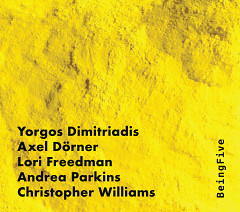
    BeingFive in The New York City Jazz Record

    “Review”, John Sharpe, The New York City Jazz Record, April 1, 2024
    Tuesday, April 2, 2024 Press

    The trumpeter [Axel Dörner] sports the same headgear on BeingFive, a 2022 session from the German capital, convened by Canadian bass clarinetist Lori Freedman, which also features Yorgos Dimitriadis (percussion), Andrea Parkins (accordion) and Christopher Williams (bass). Together the five musicians generate constantly morphing sound worlds, comprising selfless individual contributions. That approach attains its apogee on Miniatures, a sequence of ultra-concise vignettes linked by silent pauses, as much part of the kaleidoscopic fabric as the sounds. The extended techniques wielded by all involved are rendered yet more indeterminate by the electronics utilized by Dimitriadis, Dörner and parkins, such that the question of who does what becomes irrelevant. Not that the trumpet is inaudible — its strident skitter and breathy smears can be readily discerned at times on Amusic, a cut like its near namesake Amusic Bis, which almost has a rhythmic dimension thanks to Williams’ pizzicato and Dimitriadis’ regular pulsation.

    Together the five musicians generate constantly morphing sound worlds, comprising selfless individual contributions.

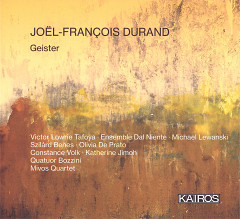
    Jürg Frey: String Quartet No. 4 in The Strad

    “A long-standing musical friendship is celebrated”, David Kettle, The Strad, March 25, 2024
    Wednesday, March 27, 2024 Press

    Swiss composer Jürg Frey — who turned 70 last year — has had a long association with the Montréal-based new-music specialists, the Bozzini Quartet, writing three quartets for it across a span of 20 years. That closeness and mutual understanding is more than evident in the Bozzini’s sensitive, thoughtful account of his hour-long, five-movement Fourth Quartet from 2020.

    It’s a remarkable piece: sparse, reflective, often just a step away from silence, and sounding as though classical gestures have been boiled down to their bare bones, ready for close inspection and contemplation. The Bozzini treads an expert path between almost mechanistic consistency across Frey’s sometimes barely changing musical ideas, while playing up subtle distinctions of light and shade, consonance and dissonance. Indeed, Frey makes more than a few nods to traditional quartet writing in the piece — for example in the second movement’s folk-like drones and ornamentations, and its rich minor-mode triads, which sound shocking after so much dissonance and so many unconventional sounds. The Bozzini embraces the breadth of Frey’s language with such conviction — and, it has to be said, such stamina and sustained intensity across his lengthy paragraphs — that the results are never less than persuasive.

    It’s a work that repays close listening and reflection, and Frey could hardly have hoped for a performance of greater insight.
    The Bozzini embraces the breadth of Frey’s language with such conviction…
  • 30
  • 31
  • 32
  • 33
  • 34
  • 35
  • 36
  • 37
  • 38