actuellecd

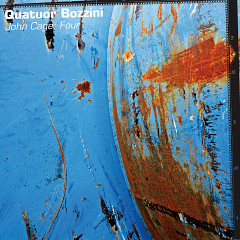
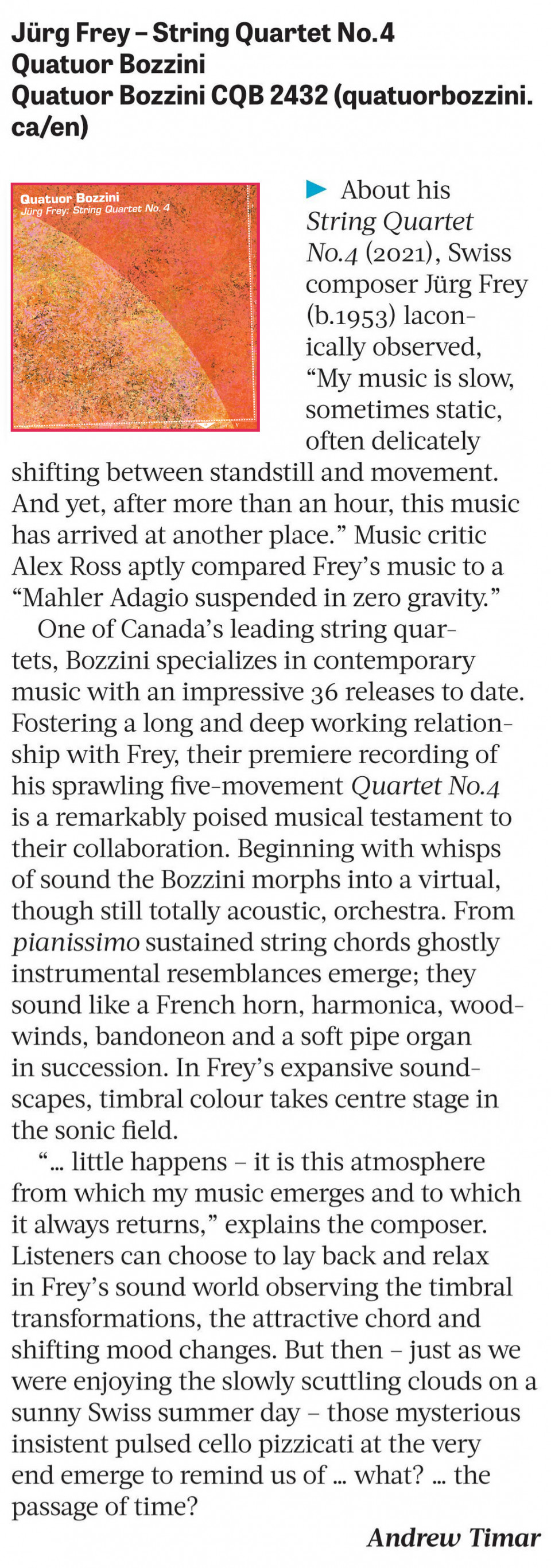
Jürg Frey: String Quartet No. 4

Bozzini Quartet / Jürg Frey

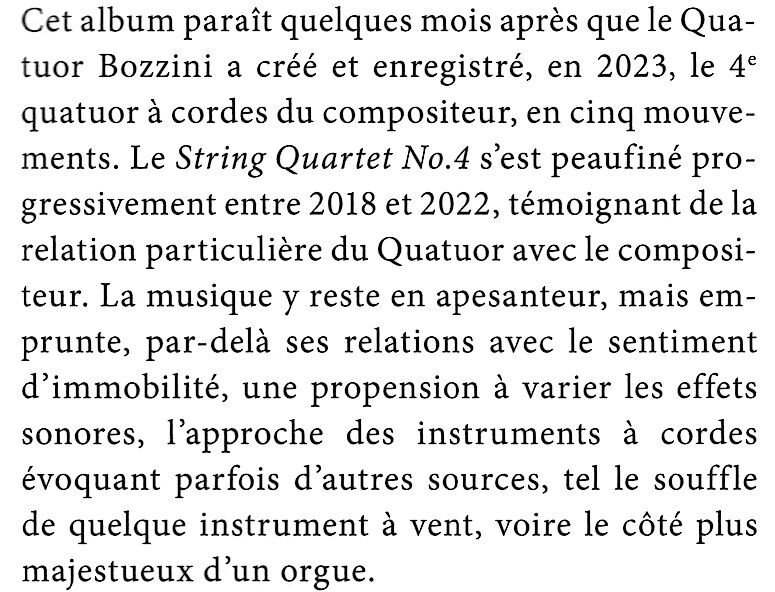
Le String Quartet No. 4 s’est peaufiné progressivement entre 2018 et 2022, témoignant de la relation particulière du Quatuor avec le compositeur. Revue & Corrigée, France

Frey has written marvelous string quartet music that contrasts the inherent delicacy of silence with careful, concentrated string playing. The great Bozzini Quartet has recorded all of his string quartet pieces so far… Bandcamp Daily, USA

Prix Opus 2023-24: Album de l’année — Finaliste

Swiss composer Jürg Frey writes masterful soundscapes, calm and vast. With his sensitive ear for colour, sound and precision, he composes music of great serenity and lyricism; a poetic weightlessness in search of silence in sound. “My music is slow, sometimes static, often delicately shifting between standstill and movement. And yet, after more than an hour, this music has arrived at another place. Standstill, little happens, — it is this atmosphere from which my music emerges and to which it always returns. Sometimes it just stays there. This is my world.” With these words, Jürg describes his String Quartet No. 4, the third quartet he has composed for us, marking over 20 years of collaboration and mutual trust. — Quatuor Bozzini

  • Aargauer Kuratorium
  • SODEC

CD (CQB 2432, 2024)

  • Label: Collection QB
  • CQB 2432
  • 2024
  • UCC 771028373222
  • Total duration: 62:49
  • Sympathique case
  • 126 mm × 126 mm × 5 mm
  • 35 g

On the web

Download (CQB 2432_NUM, 2024)

  • Label: Collection QB
  • CQB 2432_NUM
  • 2024
  • UCC 771028373284
  • Total duration: 62:49
Liner notes

Conversation with Jürg Frey about String Quartet No. 4

Emanuelle Majeau-Bettez (EMB): Perhaps a word about your (long-standing!) friendship with Quatuor Bozzini (QB), to put it in context for the readers?

Jürg Frey (JF): I have known Clemens since the early 1990s. He performed as a soloist in several concerts that I organized. Our first substantial collaboration was on the concerts and the recording of Ohne Titel (2 Violinen). Then, QB premiered my Streichquartett 2, a piece I had written before my time with the quartet. The basis for our collaboration was laid by the 2004 String Quartets recording.


EMB: I think there is something very special about QB’s relationship with their collaborators, in the sense that they perceive the string quartet as literally built through the process of collaboration — through each project. How did this unfold between you and QB?

JF: After these first quartet recordings, I didn’t immediately start composing a new quartet, as I was convinced that I wouldn’t be able to write anything for quartet after the 2nd string quartet. There were subsequently many performances, especially of the second quartet, and I was often invited to the concerts. However, our actual collaboration initially developed in the area of interpretation, and I played together with the Quartet as a clarinet player. I remember wonderful concerts with the quintets of Christian Wolff or Martin Arnold — occasionally Mozart was also on our program. It was a rich collaboration in which I experienced a beautiful musical harmony. The composition of the Streichquartett 3, which was premiered by QB in 2012, also falls into this period.


EMB: And how did this unfold during your collaboration on this specific string quartet? How did your work on String Quartet No. 4 differ, or was like, preceding collaborations with QB?

JF: The collaboration really only begins once the piece has been composed. I have to say that the string quartets occupy a special place in my work biography. They each expose a particularly prominent point in my work, as they represent the essence of a work phase particularly clearly. And that’s why it wasn’t always easy to bring the pieces to a satisfying conclusion.

I said that the collaboration only begins when the score is done. Yet, even when the score was finished, there were still details that seemed unclear to me. And there were further rehearsals, further performances, and we rehearsed details, and then at some point the moment comes when, despite rehearsals, and despite the sensitive cooperation with the musicians, it doesn’t get any better, and I say to myself as a composer, okay, then the problem must be in the composition. It takes time to find out which changes are real improvements. And QB gave me the time for this process. And this is my collaboration with the Quartet, it is absolutely essential for me to better understand my work.


EMB: I find this type of collaboration very inspiring — one that creates the space needed for both performers and composers to learn from each other, to communicate in a more horizontal, intuitive, and humble fashion. I feel this type of work is becoming increasingly recognized as an alternative to more hierarchical work between composers and ensembles, and I can’t help but think that composers such as yourself, and ensembles like QB, have played a chief role in this change.

JF: This non-hierarchical approach to my music has its roots in a way of composing. It very much reflects the way I think about composition. I don’t treat my sounds as “servants” who carry out what I think, but rather I am in a dialog with my sounds, I make them collaborators in my composition process. The result of this process is that my music is very clear, on the one hand, and at the same time it has openness. The elusive nature of my music comes from the way I think about composition. This has a deep influence on how musicians and I work together in rehearsals. It is a collaborative process, and the goal is to find out how to make the score sound and flourish.


EMB: Would you agree that there is an unavoidable degree of “fuzziness” that occurs when the music is translated from the composer’s inner mind to the medium of communication (the score, oral communication, etc.) chosen to converse back and forth with the performers, no matter how sensitive and thorough the rehearsals? I feel there is perhaps a certain degree of humility needed to really dig deep these uncertain passages, and finally accept a certain level of “fuzziness” in the musical output.

JF: I don’t think it is “fuzziness,” — it is “richness.” “Fuzziness” suggests that I have a fixed idea of how my music should be composed or played, and then, when it comes to the realization, “fuzziness” happens. But that is not how music is. I experience it in a much more complex way. I try to write music that turns any possible fuzziness into a positive area of richness. For this it has to be clear and explicit. But at the same time my music and my composing are open to different possibilities of how this richness appears in reality. That seems to be a contradictory. But it’s not in my music. It is the basis on which to work with my music.


EMB: Following up on your comments about how your string quartets exemplify a certain period in your work biography, I was wondering if you could elaborate on the cornerstone place that String Quartet No. 4 occupies in your catalog and, perhaps in a broader perspective, why the string quartet genre occupies such an important place in your creative output — why it functions, if I understand correctly, as an exemplar of a certain period in your career. Of course, this could be said of many composers, but I was wondering how it works out for you specifically.

JF: From No. 2 to No. 4, you can recognize a development in my work: from the static, monothematic 2nd quartet to the possibilities of giving my music a line, giving it a direction. The 3rd and 4th quartets are clear statements in this development. It’s a commonplace that a piece of music has directions and lines, phrases, goes forward. But not for me. For me, there are years of work behind it, from a monothematic standstill to an almost narrative attitude — and this development is most clearly reflected in the string quartets.


EMB: While listening to your music and to String Quartet No. 4 in particular, I often feel that sound and silence attract each other like magnets. Through their mutual attraction, they succeed in keeping each other in this liminal, fragile yet very firm zone that makes your music so distinct. Or to give another image, I feel that sound and silence seem to fill up each other’s space, somewhat like communicating vessels: at any time, one could be flooded by the other.

This constant, delicate, and almost organic oscillation between silence and sound in your music, as well as the one between movement and standstill, brings my listening capacities to its limits, to a space that, at times, I find challenging, that puts me on the edge, so to speak.

I find listening in such a way rewarding, but there can also be discomfort: it brings forth the limits of my capacities to listen, or not to listen, to drift and to pay deep, focused attention. And this is where I find common traits between your art and Éliane Radigue’s: it can reflect my current state of mind.

Is this something that resonates with your personal approach to composition?

JF: It’s very interesting to hear, and I have similar experiences when I listen to my music or the music of other composers like Éliane Radigue. My concentration wavers, my mind wanders, but that’s quite normal for me. I immerse myself in a part of the music, follow my feelings, I follow my reflections, and the music goes its own way, and when I come back from my thoughts, the music is in a different place. That’s one of the reasons why we can listen to music over and over again; listening is different every time.

But if and how this is connected with my approach to composition, it is difficult to say. Sure, I have a certain approach, but when I use that as an approach, I get into trouble. I have the feeling that my composing is mainly a hanging around, but when the piece is done, I see that it’s not like that, that there was obviously some kind of inner compass that my hanging around followed very strictly.


EMB: Did this theme come up in conversation between you and QB during your collaborations?

JF: Rarely is it about these topics.

It’s mostly about musical questions: what color is the sound, how is this phrase, where is the weight of the chord, how do you get into this pause, is it a pause or a silence, is there movement or is it standstill — these seem to be primarily technical questions, but in this way, we get further and further into the music and the quartet can express more and more of the essence of the piece. It’s a process of working out, of trying things out — what musicians do in the ensemble, and for me it’s a great pleasure to be there and help along the way.


EMB: To continue on this theme of fragility, I admire how, in QB’s artistic approach, fragility is not considered as something negative, or weak. I think it is perhaps one of the reasons why they thrive in challenging musical works such as yours: there is a definite virtuosity that is needed to perform your music, a certain instrumental and mental bravura in staying in this intensive zone, again, between silence and sound, and between movement and stillness. There must be a deep sense of trust between you and QB.

How would you qualify this fragility in your music, and how do you feel it resonates with QB’s artistic identity?

JF: The fragility comes from the fact that my music always remains connected to silence. You could think it is reduced music. More and more reduction from a plurality, and in the end this fragility remains. But it’s not like that, it goes in the other direction: it starts from nothing, and then something is added. It is a much more positive feeling than the idea of a reduction. And everything happens on this basis, the composing, and also the playing. Players can do a lot in my music: timbres, dynamics, phrasing, smile, sadness, surprise — as long as they feel that it is connected to this kind of nothingness behind the music. That influences the attitude, the playing, everything. And yes, QB is a great fortune for me. It also took me many years to discover and understand that this is an essential part of my music, and QB was an important partner in this process.


EMB: I previously mentioned what I felt were some inspiring challenges in your music. And yet, I find there are highly accessible aspects of your art. In your String Quartet No. 4, for example, the harmonies are beautiful, and in the pace between silence and sound, one can take the time to take in the textures, the colors, and the melodic contours of the music. There is an almost natural breathing pulse, and a definitely moving poetry.

I am curious to hear your thoughts on the cohabitation (perhaps this is not the best wording for it) of accessible aspects and the challenges in your compositions.

JF: Simply put, it is the simultaneity of two seemingly contradictory aspects: On the one hand, a trust in my intuitive musicality, and on the other, resistance to this kind of musicality. I am glad that in the last few years I have come to write music that is completely in tune with my musicality. But what I call “musicality” or a “musical feeling” is always in danger of just being conventional and preventing me from writing what I want to write. That’s why there is this resistance to musical feeling. So, this combination of musicality and resistance allows the piece to find its identity. And I think this resonates then in my music as accessibility and challenge.

— Email interview conducted by Emanuelle Majeau-Bettez in January 2024 [i-24]

Some recommended items
In the press

Critique
Pierre Durr, Revue & Corrigée, no. 146, December 1, 2025
Le String Quartet No. 4 s’est peaufiné progressivement entre 2018 et 2022, témoignant de la relation particulière du Quatuor avec le compositeur.

Review

George Grella, Bandcamp Daily, March 10, 2025

The instruments and sounds that seem at first to not fit into the Wandelweiser world come from strings—a bowed note held continuously until the musician can no longer perform the stroke. Yet Frey has written marvelous string quartet music that contrasts the inherent delicacy of silence with careful, concentrated string playing. The great Bozzini Quartet has recorded all of his string quartet pieces so far, this colorful, fiercely quiet performance being the most recent.

Frey has written marvelous string quartet music that contrasts the inherent delicacy of silence with careful, concentrated string playing. The great Bozzini Quartet has recorded all of his string quartet pieces so far…

My 40 Favorite Albums of 2024, part 2

Peter Margasak, Peter Margasak, January 7, 2025

The connection between Swiss composer Jürg Frey and the Montréal string ensemble Quatuor Bozzini keeps strengthening, as each party gains additional intimacy, introspection, and intuition for the other. There’s always the danger that such familiarity could breed laziness, and while the fourth string quartet by the composer might not feel as radical or daring as its predecessors, the rigor, beauty, and thoughtfulness have not become victims of the strengthening relationship. Bozzini have a way of articulating the composer’s most fragile passages with unerring sensitivity and lyric fragility, imbuing Frey’s darkly luminescent harmonies and sorrowful progressions with a lightness of touch that doesn’t preclude a sumptuous viscosity and grain, sound morphing with seamless ease, colors swirling and swelling.

The connection between Swiss composer Jürg Frey and the Montréal string ensemble Quatuor Bozzini keeps strengthening, as each party gains additional intimacy, introspection, and intuition for the other.

Review

Andrew Timar, The WholeNote, no. 29:5, April 1, 2024

About his String Quartet No. 4 (2021), Swiss composer Jürg Frey (b. 1953) laconically observed, “ My music is slow, sometimes static, often delicately shifting between standstill and movement. And yet, after more than an hour, this music has arrived at another place.” Music critic Alex Ross aptly compared Frey’s music to a “Mahler Adagio suspended in zero gravity.”

One of Canada’s leading string quartets, Bozzini specializes in contemporary music with an impressive 36 releases to date. Fostering a long and deep working relationship with Frey, their premiere recording of his sprawling five-movement Quartet No. 4 is a remarkably poised musical testament to their collaboration. Beginning with whisps of sound the Bozzini morphs into a virtual, though still totally acoustic, orchestra. From pianissimo sustained string chords ghostly instrumental resemblances emerge; they sound like a French horn, harmonica, woodwinds, bandoneon and a soft pipe organ in succession. In Frey’s expansive soundscapes, timbral colour takes centre stage in the sonic field.

“… little happens — it is this atmosphere from which my music emerges and to which it always returns,” explains the composer.

Listeners can choose to lay back and relax in Frey’s sound world observing the timbral transformations, the attractive chord and shifting mood changes. But then — just as we were enjoying the slowly scuttling clouds on a sunny Swiss summer day — those mysterious insistent pulsed cello pizzicati at the very end emerge to remind us of … what? … the passage of time?

… a remarkably poised musical testament…

A long-standing musical friendship is celebrated

David Kettle, The Strad, March 25, 2024

Swiss composer Jürg Frey — who turned 70 last year — has had a long association with the Montréal-based new-music specialists, the Bozzini Quartet, writing three quartets for it across a span of 20 years. That closeness and mutual understanding is more than evident in the Bozzini’s sensitive, thoughtful account of his hour-long, five-movement Fourth Quartet from 2020.

It’s a remarkable piece: sparse, reflective, often just a step away from silence, and sounding as though classical gestures have been boiled down to their bare bones, ready for close inspection and contemplation. The Bozzini treads an expert path between almost mechanistic consistency across Frey’s sometimes barely changing musical ideas, while playing up subtle distinctions of light and shade, consonance and dissonance. Indeed, Frey makes more than a few nods to traditional quartet writing in the piece — for example in the second movement’s folk-like drones and ornamentations, and its rich minor-mode triads, which sound shocking after so much dissonance and so many unconventional sounds. The Bozzini embraces the breadth of Frey’s language with such conviction — and, it has to be said, such stamina and sustained intensity across his lengthy paragraphs — that the results are never less than persuasive.

It’s a work that repays close listening and reflection, and Frey could hardly have hoped for a performance of greater insight.

The Bozzini embraces the breadth of Frey’s language with such conviction…

Review

Ben Lunn, Morning Star, February 19, 2024

In 2023, Jürg Frey celebrated his 70th Birthday, and the modestly captivating Swiss composer had numerous celebrations across the globe. This new album released in Winter 2023, is a treasure which demonstrates the power a long-term relationship can have between a composer and an ensemble.

Frey’s quartet is the third written especially for the Bozzini Quartet over the span of 20 years. In the five movements of the work time feels frozen, to the point that the almost grandiose final movement flies by, despite being three times longer than the preceding movements.

Frey’s music can be naively described as simplistic as notes hang lost in space and time — but the music it is not “easy music.” The great contradiction in Frey’s work — complex simplicity — is what draws the ear in, and Bozzini’s ability to play this with passion and skill that it feels like they inhale and exhale Frey’s delicate tones.

The great contradiction in Frey’s work — complex simplicity — is what draws the ear in, and Bozzini’s ability to play this with passion and skill that it feels like they inhale and exhale Frey’s delicate tones.
★★★★★

Review

Eyal Hareuveni, Free Jazz Blog, February 17, 2024

String Quartet No. 4 is the third string quartet Frey composed for Canadian, Montréal-based contemporary ensemble Quatuor Bozzini (first violinist Alissa Cheung, second violinist Clemens Merkel, violist Stéphanie Bozzini and cellist Isabelle Bozzini) over twent years of collaboration (the first one, String Quartets, was recorded in 2004, Edition Wandelweiser Records, 2006). This 65-minute, five-movement composition was written between 2018 and 2020 (and completed before Frey composed Les signes passagers). It was first premiered — virtually — at the MaerzMusikl Festival in Berlin in March 2021 and performed live for the first time at the Only Connect Festival in Oslo in April 2022 and refined during the recording with Quatuor Bozzini in Montréal in May 2023.

Frey describes this composition as “slow, sometimes static, often delicately shifting between standstill and movement. And yet, after more than an hour, this music has arrived at another place. Standstill, little happens, — it is this atmosphere from which my music emerges and to which it always returns. Sometimes it just stays there. This is my world”.

String Quartet No. 4 is a calm and beautiful composition that radiates a rare sense of poetic weightlessness in search of silence in sound, with a profound emotional effect. It is developed slowly, with minimalist and slow shifts and almost transparent dissonances, always hinting about its deeper, secret wonders, evoking a musical garden that asks you to appreciate its delicate, changing colors as they blossom in their own accord. And, like all Frey’s compositions, it is performed masterfully by Quatuor Bozzini with precise sensitivity for color, sound and silence in Frey’s aesthetics.

… performed masterfully by Quatuor Bozzini with precise sensitivity for color, sound and silence in Frey’s aesthetics.

Review

Peter Margasak, Bandcamp Daily, January 30, 2024

The elevation of veteran Swiss composer Jürg Frey, a key figure of the post-Cagean Wandelweiser Collective, came after Montréal’s Quatuor Bozzini premiered Frey’s second string quartet back in 2001. In the decades since, they’ve continued to work together — most recently on last year’s sublime Continuité, fragilité, résonance, where they formed a gauzy, heavenly alliance with the reed ensemble Konus Quartett. The arrival of Frey’s fourth string quartet is grounds for celebration. The intensely intimate, gently voiced epic doesn’t necessarily unveil new procedures or ideas — the molasses-slow pace and harmonic grandeur of the early works felt radical at the time — but it does feel like a stunning refinement and a generous expansion of those sounds. Most of the five-movement work is hushed, the strings producing a faint glow of sound that radiates a gauzy rainbow of color. Naturally, in music designed to be relatively static and still, any change or shift carries weight. When the quartet raises the intensity, as in the opening passages of the third movement, the sound hits hard, like a sudden explosion cracking open new possibilities—including an arrestingly beautiful solo violin line drifting through the sorrowful tumble of stately chords. But when nothing is happening, that emptiness is exquisite, carving out a space for contemplation that creates the most ravishing place on earth during its placid unfolding.

… carving out a space for contemplation that creates the most ravishing place on earth during its placid unfolding.

Kritiek

Ben Taffijn, Nieuwe Noten, January 28, 2024

The collaboration between Frey and Quatuor Bozzini is close. Violinist Clemens Merkel and Frey have known each other since 1990. Furthermore, the quartet previously premiered the second string quartet from the late 1990s and recorded the first three quartets for Ediotion Wandelweiser. With this five-movement fourth quartet, the collaboration went a step further, Frey explicitly involving the string quartet in the process of composing. The first movement is very slow, but also very even, with the sounds coinciding remarkably. Also special are the subtle but very exciting string movements in this first movement. The second movement stands out in particular for its repetitive pattern, sounding pretty much like a siren, while the third movement, which begins quite brightly, stands out for its melodic content, something we don’t often encounter with Frey. Following this, the fourth movement again sounds broodingly exciting, with its hushed string movements. Finally, we hear the impressive fifth movement, which at over 30 minutes is about as long as the first four movements. Beautiful, quite similar patterns, like a quietly flowing river.

Translated from Dutch.

Original text

De samenwerking tussen Frey en Quatuor Bozzini is hecht. Violist Clemens Merkel en Frey kennen elkaar al sinds 1990. Verder bracht het kwartet eerder het tweede strijkkwartet uit eind jaren ’90 in première en nam het de eerste drie kwartetten op voor Ediotion Wandelweiser. Bij dit uit vijf delen bestaande vierde kwartet ging de samenwerking nog een stap verder, Frey betrok het strijkkwartet nadrukkelijk in het proces van componeren. Het eerste deel is zeer langzaam, maar ook zeer gelijkmatig, waarbij de klanken opvallend samenvallen. Bijzonder zijn ook de subtiele, maar zeer spannende strijkbewegingen in dit eerste deel. Het tweede deel valt met name op door het repetitieve patroon, zo ongeveer klinkend als een sirene, terwijl het derde deel, dat vrij fel begint, opvalt vanwege het melodische gehalte, iets wat we bij Frey niet zo vaak tegenkomen. Het vierde deel klinkt aansluitend weer broeierig spannend, met zijn verstilde strijkbewegingen. Tot slot klinkt het imposante vijfde deel, dat met zijn ruim dertig minuten ongeveer net zo lang is als de eerste vier delen. Mooie, vrij sterk aan elkaar gelijke patronen, als een rustig stromende rivier.

Beautiful, quite similar patterns, like a quietly flowing river.

Review

Vanessa Ague, The Quietus, January 23, 2024

In Jürg Frey’s world, stillness is motion. Throughout the Swiss composer’s String Quartet No. 4, Quatuor Bozzini pull their bows so gradually that it feels as if each note is stopped in time. Yet they aren’t: With each reiteration, these tones gradually expand, taking up every inch of the quartet’s wooden instruments. Each slight change feels faint, but they accumulate; it’s like the shifting of a glacier over thousands of years. This is the world Frey has come to embody across his career, and his fourth string quartet continues to explore the engulfing atmospheres he crafts out of thin air.

Quatuor Bozzini, a Montréal-based string quartet that comprises violinists Alissa Cheung and Clemens Merkel, violist Stéphanie Bozzini, and cellist Isabelle Bozzini, are expert interpreters of Frey’s conscientious works. The group has a twenty-year relationship with the composer. His second string quartet was also written for and recorded by them. First performed in a virtual premiere in 2021, the five-movement fourth quartet often deals in similar swaths as the second, venturing from moments of delicacy to broader, more expansive harmonies. But here, Frey allows the music to feel a little rougher around the edges. Each chord basks in its dissonances and a cloudy haze circles around every whispered note.

While Frey often writes diaphanous music, the most striking moments of String Quartet No. 4 lean into bold dissonances. Though the piece opens in wisps, it blooms into piercing tones that interweave and clash. The quartet plays every hushed phrase with great attention to detail, but they shine in these moments of resonance, letting them hang wherever they are, even if they never resolve. Each note spirals into the next, giving the feeling of motion and standstill all at the same time. It’s similar to the way Frey’s most hushed sounds feel, yet amplified and expanded.

But it’s when Frey’s music returns to quietude, that his world feels most intimate. Here, each moment invites close listening to the tiniest flutters. Towards the end of the piece, there are a series of rests that feel one in the same as the moments of sound; it ends where it began, emerging from nowhere and disintegrating into a pool of dust. Of the quartet, Frey writes: “Standstill, little happens — it is this atmosphere from which my music emerges and to which it always returns.” Music can be found where it might not have existed before, and Frey invites us to discover it with him.

… his fourth string quartet continues to explore the engulfing atmospheres he crafts out of thin air.

Review

Ben Harper, Boring Like A Drill, January 21, 2024

There was a lot of excited chatter around when Quatuor Bozzini gave the UK premiere of Jürg Frey’s Fourth String Quartet in Huddersfield in November. For those of us who missed it, the Bozzinis’ recording of String Quartet No. 4 from last May is now commerically available. Composed over a couple of years, its gestation proceeds from that of his String Trio, recently recorded by Apartment House. Like the trio, the quartet is a large work, made all the more imposing in substance through consisting of five movements instead of one elongated span. Frey’s longer works have often taken on the form of a journey, with episodes, incidents and detours, but with this quartet the sense of movement has been sublimated while the questioning aspects remain.

In a way not readily apparent before, Frey lets a curious lop-sidedness define this composition from the outset and then tries to find a balance between the incongruous forces at play. The overall structure even suggests this, with the fifth movement taking up a little over half of the quartet’s hour-plus duration. His early tendency towards silence and his later one towards romanticism are set against each other throughout the piece. The opening movement even falls into two halves, when the reduced heart rate of the slow-breathing chorale that begins the work suddenly drops into a period of whispered, near-pitchless bowing. For the rest of the piece, you’re left wondering if a similar gap in the sound will re-open. Subsequent movements contrast moments of prolonged stillness with more classically-motivated interplay between the instruments, albeit in Frey’s characteristic manner of distilling such passages to their most essential, in slow motion. The second movement takes fragile gestures from unaccompanied and builds them into something articulate and expressive, while the third begins with a more assertive chorale before dissolving into brooding, introspective solos. That long final movement consolidates the preceding tendencies into a coherent statement, but without resolving any of the contradictions, finding it to be achievement enough to give expression to the complexities inherent to the composition. Heard in isolation, the movement could be taken as a self-sufficient and eloquent work in its own right, but what we’ve heard before exposes us to the tensions that animate the music.

This is a troubled work, where Frey has stripped away more of the artifice that has previously constrained his expressive tendencies behind a facade of impassive observation. It shows us more of a composer wrestling with imbalances and contradictions, in turn requiring the listener’s involvement far beyond what would have once been assumed as little more than contemplation of an impeccable surface. Quatuor Bozzini excel at revealing these difficulties without drawing attention to their own labour. They excel at distinguishing between the finest gradations of dark and light, infusing greater colours into a work with such an attenuated range of dynamics. In their performances of older repertoire, I’ve always been struck at how they find a timeless element in the music. For Frey’s latest quartet, their ear is attuned to Schubert and Webern.

Quatuor Bozzini excel at revealing these difficulties without drawing attention to their own labour. They excel at distinguishing between the finest gradations of dark and light, infusing greater colours into a work with such an attenuated range of dynamics. In their performances of older repertoire, I’ve always been struck at how they find a timeless element in the music. For Frey’s latest quartet, their ear is attuned to Schubert and Webern.
Blog