actuellecd
  • This website is also available in English.

Blog

4946 results
  • 203
  • 204
  • 205
  • 206
  • 207
  • 208
  • 209
  • 210
  • 211
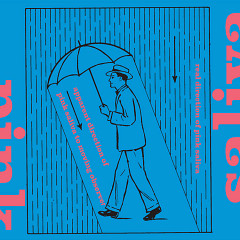
  • Pink Saliva in The WholeNote

    “Review”, Ken Waxman, The WholeNote, no. 17:2, October 5, 2011
    Wednesday, October 5, 2011 Press

    […] Someone who took lessons with Bill Dixon and — at least in choice of band name — has inherited the older man’s impudence, is Ellwood Epps, whose Pink Saliva trio (& Records &11), is filled out by Alexandre St-Onge on electric bass and laptop and Michel F Côté on drums, microphones and lap steel guitar. Although Dixon only dabbled in electronics, Epps, a Toronto native, and his Québécois confrères, embrace it wholeheartedly, adding oscillated wave forms and crackling drones to everything they play. Negotiating the line between indie-rock and jazz-improvisation, the CD is studded with irregular ruffs and drags on Côté’s part, rumbles and pops from St-Onge’s string set and dial-twisting buzzes. At points overdubbed, Epps’ trumpet soars over these wiggling sequences, repeatedly shifting from low-pitched inner-horn gurgles to piercing trills, adding additional touches of soaring lyricism.

    Someone who took lessons with Bill Dixon and — at least in choice of band name — has inherited the older man’s impudence, is Ellwood Epps

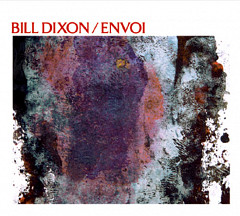
    Envoi in The WholeNote

    “Review”, Ken Waxman, The WholeNote, no. 17:2, October 5, 2011
    Wednesday, October 5, 2011 Press

    Praised and reviled in equal measure during his 40-year career, Vermont-based trumpeter Bill Dixon was finally recognized as one of improvised music’s most original stylists and theorists before his death at 84 in June 2010. Fittingly his final concert took place a mere three weeks previously at Quebec’s Festival International de Musique Actuelle de Victoriaville, where a hand-picked octet played this composition under his direction. Luckily the performance has been released as Envoi (Victo Records, VICTO 120). Not only do the two sections illuminate Dixon’s particular mixture of formalism and freedom, but with a horn section of four playing cornet, bugle and flugelhorn, Envoi also demonstrates Dixon’s influence on a younger generation of brass players.

    Famously prickly and opinionated, Dixon organized The Jazz Composers Guild, one of jazz musicians’ first self-help organizations in the mid-1960s. A long-time professor at Bennington College in Vermont, Dixon recorded sparingly over the years, which makes this session doubly valuable. Impressionistic and dramatic, Envoi is organized with classical precision in varied sequences. Most involve muted, shaded bent notes from the brass players in counterpoint to the spiccato string swipes of cellist Glynis Loman and bassist Ken Filiano, or, in the first section, tart slurs from Michel Côté’s bass clarinet. Additional unifying motifs come from Warren Smith’s resounding kettle drumming, and, in the second section, his ringing vibes, which soften the interface as it moves forward. In that same section the unison strings maintain a menacing undertow, breached only occasionally by heraldic brassiness or dissonant grace notes, plus at one point echoing stillness from Graham Hayes’ bugle. True to Dixon’s style, most of the brass tones are segmented sound shards which waft pure air through the horns. Following nearly 40 minutes of quivery tremolo theme variations, a spectacular example of the trumpeter’s measured art arrives near the end. After one cornetist sounds heraldic tones at a higher pitch among the others’ capillary whispers, all harmonize for a protracted section of legato impressionism, only scattering at the end as one puffs quietly while another exposes plunger tones. Finally, call-and-response vamping from all marks the climax.

    Envoi also demonstrates Dixon’s influence on a younger generation of brass players.

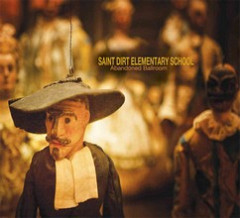
    Abandoned Ballroom in CISM

    “Lounge pour alcooliques extravertis”, Pierre-Jean Lavigne, CISM, October 2, 2011
    Sunday, October 2, 2011 Press

    Ça c’est la musique que tu écoutes quand tu quittes un party de bureau dans lequel tu as trop bu. Pas «ah, j’ai trop bu, demain je ne pourrai peut-être pas aller faire du hiking au Vermont à 7 heures du mat». Nonononon. Je parle de «Ah, j’ai trop bu! J’ai dansé tout seul sur le nouveau single de Maroon 5 et conté des jokes vraiment déplacées à mes supérieurs avant de faire un tour de calèche pour dégriser, mais, en revenant, j’ai tout fait pour attirer les collègues dans la salle de conférence pour leur faire un show de karaoké, puis, j’ai été malade dans la salle de bains du sous-sol (comme un agent secret) pour par la suite faire un black-out dans le bureau du vice-président.» Après ces tristes événements, on t’attache tes souliers, puis on te pousse dans la bonne direction, ipod aux oreilles avec Saint Dirt qui joue à 10. Tant bien que mal, tu te rends chez toi, pleins de bleus et de regrets avec le peu de conscience qu’il te reste pour dormir sur le côté afin de ne pas t’étouffer sur ta bile en dormant. Mais c’pas grave, ti-gars, le lendemain tu te réveilles, les lumières allumées, encore habillé, avec un seul verre de contact dans les yeux pour trouver dans tes poches un certificat de 50$ à la SAQ gagné la veille quand ton nom a été pigé dans un chapeau. T’es un winner et la journée est encore jeune.

    T’es un winner et la journée est encore jeune.

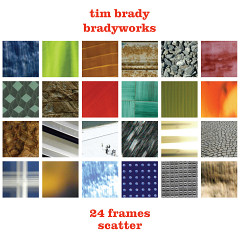
    24 Frames — Scatter in Monsieur Délire

    “Listening Diary”, François Couture, Monsieur Délire, September 26, 2011
    Monday, September 26, 2011 Press

    It took Tim Brady five years to complete 24 Frames, a series of 24 solo and duo pieces for electric guitar and electronics. On record, 24 Frames is split across two separate releases. Released earlier this year, 24 Frames: Trance features the last six “frames” on a CD accompanied by a DVD. 24 Frames: Scatter features pieces 1 through 18 on two CDs. Disc 1 contains six duos with members of Bradyworks and Quasar, plus other musicians. Jazz singer Karen Young is the most surprising duettist here, in Frame 1: Scatter, but the best track is Frame 2: In Almost Unison with baritone sax player Jean-Marc Bouchard. Disc 2 features 12 short pieces for solo electric guitar grouped in three cycles, with and without electronics — a tour de force that brings back the fact that, beyond his symphonies and multimedia projects, Tim Brady remains an exceptional guitarist and a commanding composer for his instrument. Recommended.

    … a tour de force that brings back the fact that, beyond his symphonies and multimedia projects, Tim Brady remains an exceptional guitarist…

    Envoi in The Squid’s Ear

    “Heard In”, Florence Wetzel, The Squid’s Ear, September 26, 2011
    Monday, September 26, 2011 Press

    In a recent article on the late great trumpeter Bill Dixon (1925-2010), the newspaper’s purported photo of Dixon was actually a photo of multi-instrumentalist Giuseppi Logan. Jazz fans were understandably miffed by the blatant error; as Squid’s Ear writer Kurt Gottschalk wryly noted on Facebook, “Giuseppi Logan looks about as much like Bill Dixon as a saxophone looks like a trumpet.”

    And yet, it’s highly probable that Dixon would have been amused by the snafu. In jazz historian Ben Young’s essential bio-discography Dixonia, Dixon states, “The way to get me away from something is have everybody dig it — then I’m off and running.” Dixon was a man who always went his own way, often spending years ignoring the public eye and the music marketplace. This is one of the reasons why someone of his enormous talent and intelligence is not better known, despite his major contributions to jazz history, which include his role as organizer and producer of the seminal October Revolution in Jazz in 1964, as well as founder of the equally seminal Jazz Composers Guild in 1965.

    Releases by Dixon have always been cause for celebration, and that’s particularly true now with Envoi. A recording of Dixon and a staggeringly talented band at the 2010 Victoriaville Festival in Quebec, this turned out to be Dixon’s last concert and last recording — in fact, he died a few weeks after the festival. Envoi consists of two long sections performed by nine musicians, including Taylor Ho Bynum, Ken Filiano, and the luminous Warren Smith. Dixon provided the music and the direction, and although he didn’t actually play at the concert, he provided a brief prerecorded solo at the beginning of Section II entitled Shrike. The solo is a powerhouse: Dixon shreds sound, and then shreds those shreds in an absolute burning fury.

    Overall Envoi is a stunningly beautiful work that the listener will return to again and again. The work has the grandeur and mystery of the Miles Davis-Gil Evans’ masterpiece Sketches of Spain, but unlike that work, where a perfectly aligned orchestra provides a steady foil for Davis, the horns here have no security whatsoever. Foreground and background shift constantly as the brass drops back and the rhythm section moves forward, and beautiful melodic lines often end abruptly or dissolve into distortion. Dixon has created a field of sound where just about anything can emerge, and as each section unfolds the listener is entranced by the harmonic interweaving, and enfolded into the music’s profound emotional depths.

    The word “envoi” means a brief stanza that concludes certain forms of poetry, and one can certainly look at this concert as a work that concludes a long and important career. The CD itself also has an envoi: at the end of the concert the audience breaks into enthusiastic applause, and then Dixon makes the following statement: “It is not so easy to attempt doing what you want to do in front of people who know what they would like for you to do. So, one does one’s best, always, and one hopes for the best, always. Thank you.”

    Envoi is an indispensable release. Period.

    Envoi is an indispensable release. Period.
  • 203
  • 204
  • 205
  • 206
  • 207
  • 208
  • 209
  • 210
  • 211