actuellecd
  • This website is also available in English.

Blog

4946 results
  • 122
  • 123
  • 124
  • 125
  • 126
  • 127
  • 128
  • 129
  • 130
  • Les accords intuitifs in Rock progresivo

    “Crítica”, Master Kob Legendario, Rock progresivo, July 16, 2016
    Saturday, July 16, 2016 Press

    De vuelta está el gran ensamble de Montréal: la convención de expertos en materia de improvisación registra otro disco en su apreciable trayectoria. Lideriados por Danielle Roger y Joane Hetu, esta vez se dieron a la tarea de ejecutar 5 piezas compuestas entre el período de 1976-2015. La suma de los esfuerzos de gente de Justine, Klaxon Gueule, Quartetski y otros músicos increíbles da por resultado un trabajo electro-acústico fenomenal, con tendencias de improvisación demasiado libres y para una buena variedad de instrumentos. El contenido vanguardista se presenta en algunas fases de música drone, donde la maquinaria roba protagonismo y los instrumentos se comportan mecánicamente. Muy poco le deben a la música docta contemporánea o al jazz de estándares, ésta gente se descuadra de géneros y convenciones para poner en práctica lo que les venga en mente: un libertinaje musical total. El molde estructural de cada track obedece al máximo riesgo creativo, y el curso de las composiciones siempre es impredecible. Y justo cuando la dirección de un tema parece tener más cohesión y ritmo, es en ese momento que aparece su sentido extraterrestre de como hacer contrapuntos entre instrumentos y máquinas. Lo único que parece sonar más humano es el swing del comienzo del último track, pero en poco tiempo lo deconstruyen y mal viajan gracias a elementos disonantes, discordantes e improvisatorios. Y el highlight del álbum me parece que es precisamente ese: así es como tiene que se sonar el jazz de vanguardia de este siglo.

    Invisible Backgrounds in The Squid’s Ear

    “Heard in”, Paul Serralheiro, The Squid’s Ear, July 11, 2016
    Monday, July 11, 2016 Press

    Philippe Battikha is a trumpeter who travels the Montréal-NYC axis and is a sometime resident of either city. In Montréal he has been a vital part of the improvised music scene, helping to set up a couple of spaces devoted to presenting this music. In this introspective yet, ironically, outward-looking solo album of original works featuring mainly Battikha’s lovely, open horn sound — grainy at times, at others a pure rounded shape, or an airy fancy — the lingering effect of the music is of peace. This is a soothing set of compositions/improvisations: even when they use archival street sounds of NYC, or noise loops, these serve as broad counterpoint to the lyrical gesture, with an effect similar to hearing surf on a nearby shore. Along with trumpet, Battikha also takes up the keyboard for some simple yet effective backdrops/accompaniments to his trumpet lines, and on two tracks he is joined by bassist Jonah Fortune.

    The titles of the pieces strike me as humorous and seem at times a kind of Dadaistic compliment or contrast to the actual music. The first track, for instance, which sets a beautiful lyrical, meditative mood, is called Plantain. A quiet low-fi noise piece called Super 8 seems to allude to the rolling sound of film in a projector. A stirring piece by the name of Time for New Hands stands out due to its featuring a segment from a speech by Nelson Mandela, saying “It is time for new hands to lift the burdens.” A piece of wisdom amid a treasure of gems such as these glowing, warm and deep offerings from Battikha and his trumpet to the muse, inspired by the muse.

    A beautiful album.

    A beautiful album.

    Ensemble SuperMusique (ESM), Grand groupe régional d’improvisation libérée (GGRIL) in Musicworks

    “Festival International de Musique Actuelle de Victoriaville, 32nd Edition”, Stuart Broomer, Musicworks, no. 125, July 1, 2016
    Friday, July 1, 2016 Press

    The Festival International de Musique Actuelle de Victoriaville (FIMAV) arrives with the late, brief spring of Quebec’s central region, an energizing jolt between winter and summer that sees the flowering of older vines and new life bursting through the earth. This year’s instalment of FIMAV did what it has done very well for many years: present challenging music that can find a substantial audience, while also testing the frontiers with little-known but significant musicians. […]

    Events ranged from afternoon sound artists to late-night avant-rockers, with listeners creating their own paths through the festival’s nineteen performances. Composer-trombonist George Lewis once declared, “what I always wanted: music as a space for reflection on the human condition.” That’s a lofty goal and a rare event, but several groups were able to do it, whether working with or without a script, playing with associates they had either known for fifty years or had just encountered.

    One such work was Friday night’s Saumon Bleu, a conduction by French musician Olivier Benoit, directing an ensemble that combined seven members of Montréal’s SuperMusique with seven members of Rimouski’s GGRIL, two of Quebec’s distinguished large improvising ensembles. It was a work of brilliant simplicity that began and ended with the quietest sizzle of scratched strings and softly blown reeds strongly suggesting human breath, ultimately crafting a space in which audience and band were one. […]

    It was a work of brilliant simplicity that began and ended with the quietest sizzle of scratched strings and softly blown reeds strongly suggesting human breath, ultimately crafting a space in which audience and band were one.

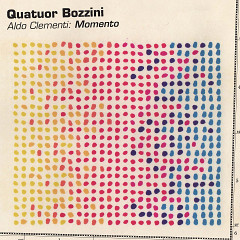
    Aldo Clementi: Momento in Musicworks

    “Recording”, Nick Storring, Musicworks, June 21, 2016
    Tuesday, June 21, 2016 Press

    The press release for Quatuor Bozzini’s new Aldo Clementi portrait disc alludes, in the form of a quote from the composer, to a peculiar sort of metamusical morbidity that was allegedly integral to his thinking. While his eldritch outlook is documented elsewhere as well, what is transmitted more clearly through this typically lucid Bozzini recording is an eccentric vitality.

    Contextualizing Clementi amidst other parallel composers is no simple task. A common trait of many twentieth-century works is that the music itself, by virtue of its compositional language, tends to instruct its audience in how to listen to it. Clementi’s music, on the other hand seems reticent to guide listeners toward its particular features — even its own flatness of perspective. It neither bombards the listener with stimuli, nor is precious about detail; yet all the while it’s exceedingly subtle and frequently rife with ideas. Its harmonic world is often tight and chromatic, but it’s devoid of the expressionist narrative gravity that suffused the work of many of Clementi’s contemporaries.

    Reticolo (1968) offers different strata of interlocking activity that are woven closely together in a manner that obfuscates change, yet produces sufficient energy to drive the work’s full eight minutes. The most recent work on the disc, the eighteen-minute Momento (2005), carries a similar effect of folding in upon itself. Framed in a more luminous harmony, it operates from a slow, continuous base. This texture is periodically both thinned out into single instrumental voices and punctuated with accents. Over its course it reveals material that paradoxically feels as though it’s constantly changing, while remaining perpetually familiar. Eventually, this obscure process is channelled through a more sibilant timbre, saturated with odd, overtone-rich lustre.

    Knowing Quatuor Bozzini’s repertoire, one can understand their attraction to Clementi’s singular vision. Their investment is palpable on this recording, and their impeccably clear, mostly vibratoless inflection flatters Clementi’s remote yet generous work.

    Their investment is palpable on this recording, and their impeccably clear, mostly vibratoless inflection flatters Clementi’s remote yet generous work.
  • 122
  • 123
  • 124
  • 125
  • 126
  • 127
  • 128
  • 129
  • 130