actuellecd

Martin Tétreault

156 results
  • 18
  • 19
  • 20
  • 21
  • 22
  • 23
  • 24
  • 25
  • 26
  • Martin Tétreault in The Wire

    “Turntable Hell”, Anne Hilde Neset, The Wire, no. 221, July 1, 2002
    Monday, July 1, 2002 Press

    “We are the Cartridge Family!” exclaimed an enthusiastic Martin Tétreault to a hall filled to the rafters with vinyl devotees. In the wake of Christian Marclay and Invisibl Skratch Piklz, it has become commoaly accepted that turntables are instruments for generating music as well as the hi-fi connoisseur’s playback machine of choice. Yet tonight’s concert, organised by the Contemporary Music Network, was the first experimental turntable meeting to hit London on a large scale. Curated and conducted by Québécois sound/installation artist Tétreault, Turntable Hell assembled eight musicians into a turntable orchestra: vinyl wrecker Paul Hood, Improv drummer and LMC stalwart Steve Noble, muiti-instrumentalist and general non-conformist Lepke B, composer, installation artist and Sheer Frost Orchestra ringleader Marina Rosenfeld, triphonic turntable inventor Janek Schaefer, Sydney based electronic artist Martin Ng, and, last but not least, Otomo Yoshihide, noise maestro and turntable thrasher par excellence.

    Expecting to see a series of solo sets with the possibility of a jam at the end, it was surprising to be confronted with a stage full of turntable tinkerers hunched over their tools. The first half was taken up with a single, loosely held together abstract piece. Starting as a drone of vinylderived whirrs and hums, it eventually peaked into a scratch frenzy before relapsing into near silence. The second half featured a series of shorter pieces, each directed by a single performer who would cue in the other musicians according to the piece’s requirements, thus enforcing more of a group dynamic. Tetréault’s Pass The Loop was like a game of Chinese whispers: as the loops passed through different performer’s hands, they developed into a cacophonous murmur of spinning vinyl. Rosenfeld’s bouncy and frenetic Evil Twin was the soundtrack for Tom & Jerry in hell. Traces of original music from the source vinyl occasionally bubbled to the surface, like repressed children out to create mayhem before the sound controller’s strict regiment brought them back down to a melancholy purr.

    In contrast to laptops or electronic boxes, where the source of their multylayered output is difflcult to identify, the simple, unadorned turntable renders the sound source transparent for the audience, especially when cameras are positioned above each turntable as they were tonight. Multimedia artist Ben Drew controlled these real-time visuals, fading between close-ups of performers’ actions and more abstract imagery. The constant broadcast of the musicians’ hand movements made for a literal experience, shifting the emphasis from the poetic to the mechanics of the performance. An orchestra consisting only of one (relatively unusual) type of instrument tends to underline its novelty value rather than the music it produces. Much like the Pure release The End Of Vinyl (Mego), which consists of runout grooves of various vinyl records, the production method and sound source threaten to become more important than the music itself.

    By the end of the show, the stage looked like a radio theatre studio filled with engineers rustling around feverishly for the appropriate noise: bneathing into microphones, cartndges drumming on the turning plate, bowing vinyl. Even so, the music stayed on the polite side. After an evening of scratching, it was left to Otomo to ease the audience’s itch with a surge of raw noise. Breaking ranks with the politely seated performers and audience, he plunged the night into chaos. Holding the turntable against his waist like a guitar, he shook the turntable arm like a whammy bar in a desperate hunt for crushing feedback, before smashing down his instrument and slapping his handshell suitcase or top of it as he left the stage. It was a refreshing gesture at the end of a night dominated by too much well tempered turntable, with too little roon for the individual, energetic, Tourette-like outbursts that make improv such a spontaneous and exhilarating music.

    Curated and conducted by Québécois sound/installation artist Tétreault, Turntable Hell assembled eight musicians into a turntable orchestra

    Martin Tétreault, Ambiances Magnétiques in AllMusic

    “Portrait: Martin Tétreault”, François Couture, AllMusic, June 15, 2002
    Saturday, June 15, 2002 Press

    In the late ’80s and early ’90s, Martin Tétreault was the quietest member of Ambiances Magnétiques, Montréal’s influential new music collective. He was providing strange turntable collages to the projects of his colleagues and released a couple of mind-boggling solo albums. When minimal techno and experimental electronica hit the museums at the turn of the millennium, he became the label’s biggest international name, multiplying collaborations with the likes of Otomo Yoshihide, Kevin Drumm, Xavier Charles, and Janek Schaefer. This career boom was accompanied by a stylistic shift from vinyl quotation to an approach of the turntable as a “pure” sonic device. In the process, what he lost in sense of humor, he gained in harsh intensity.

    Tétreault has a background in fine arts. Much like the Czech radical artist Milan Knizak, he began to work with vinyl because paper led him to a dead-end. In 1984, for the first time he took an LP, cut it in half, flipped one piece over, pasted it back together, and played the result on a turntable. Tétreault continued to experiment at home, developing cutting and skipping techniques and collecting hundreds of cheap records he found at fleamarkets. Three or four years later, his next-door neighbor overheard his shenanigans. It was Ambiances Magnétiques guitarist André Duchesne, who quickly introduced Tétreault to his group of musician friends. Michel F Côté enrolled him in his ensemble Bruire. The turntablist’s first appearance on record can be found on the 1989 LP Le Bbarman a tort de sourire. He remained with the group throughout the 1990s and beyond. He also played with René Lussier, Jean Derome, and Diane Labrosse.

    His first large-scale album, Des pas et des mois, came out in 1990. Then, besides the occasional Bruire album, Tétreault kept a rather low profile. Things changed in 1997-1998 when he began to let go of quotation and cut-ups to develop a more textural style that eventually saw him throw away the record to play the turntable itself, sticking the tone-arm in the motor, placing the needle directly on the platter, etc. These new developments were at the heart of his duo with René Lussier, introduced by the highly abstract and noisy Dur noyau dur in 1998. A participation to the Japanese project Four Focuses opened doors; so did a subsequent duo session with Yoshihide (21 Situations, 1999) and a solo CD for the Belgian label Audiophile (La nuit où j’ai dit non, 1998). By then, the turntable had become a trendy instrument of avant-garde expression and Tétreault embarked on a busy touring and recording schedule. In 2002, he curated the “Turntable Hell” tour (in England) financed by the Contemporary Music Network.

    … what he lost in sense of humor, he gained in harsh intensity.

    June 21 – July 5, 2002: Live DAME musicians

    Thursday, June 13, 2002 In concert

    Many DAME musician will be performing this summer. First, the Fanfare Pourpour will take part in Saint-Fortunat’s incredible music festival, June 21 and 22. Then, at the Festival international de jazz de Montréal, L’Orkestre des pas perdus will play outside from July 3 to 7. Also playing during the festival at the museum of contemporary arts, Les Projectionnistes July 3 and world renowned guitar player René Lussier July 6. This edition of L’OFF Festival de Jazz de Montréal also proposes plenty of DAME-related shows. Jean Derome will play at Lion d’Or June 27, July 3 and 5. Pierre St-Jak June 27. Rouge ciel June 29. Normand Guilbeault with an hommage to Mingus July 1. Martin Tétreault and Pierre Cartier July 3. Lee Pui Ming in duo with Joane Hétu aith also the {nbio:derome_je}-{nbio:guilbeault_no}-{nbio:tanguay_pi} trio July 5. Go see them all!

    Snipettes!, Martin Tétreault in AllMusic

    “Review”, François Couture, AllMusic, June 1, 2002
    Saturday, June 1, 2002 Press

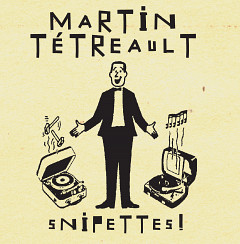
    This cassette must be Martin Tétreault’s rarest album. It came out in 1992, in Ambiances Magnétiques’ short-lived series “Archives Magnétiques,” in a limited edition of 250 copies. At the time the turntable wizard was still widely unknown outside the province of Quebec and had only one album to his credit (Des pas et des mois, 1990). In two continuous suites of 20 minutes each, Tétreault rummages through his record collection to find the weirdest pieces of pressed petroleum. Citations, strange confrontations, and medium destruction come together for pure enjoyment of the ears. In 1992, Tétreault had not yet pushed his art below the record to work in the turntable’s insides, but he was cutting up records to paste unrelated pieces together and using creative skipping techniques. In Snipettes, the cast of the original TV series Star Trek (Spock: “I have never heard anything quite like it”), a Time-Life collection on the space race, a muzak rendition of “South of the Border” and various records of classical and electronic music (including the infamous Perrey & Kingsley trilogy) form a twisted narrative. In “Morceaux Choisis” excerpts from self-help records (psychology, relaxation and such) provide a loose structure for noise-based improvisations and a feature for glued LPs. The narrative contents of this piece will be lost on English-speaking listeners, but the English samples and the type of humor found in Snipettes can appeal to a wider audience (even the non-experimental type). Let’s just say this cassette presents Tétreault at his most irreverant.

    This cassette must be Martin Tétreault’s rarest album! Let’s just say this cassette presents Tétreault at his most irreverant.
  • 18
  • 19
  • 20
  • 21
  • 22
  • 23
  • 24
  • 25
  • 26