actuellecd

Martin Tétreault

156 results
  • 15
  • 16
  • 17
  • 18
  • 19
  • 20
  • 21
  • 22
  • 23
  • Read & Listen Sound Art

    Friday, January 9, 2004 General

    In Montréal on January 20, 2004, Éditions Artextes launched S:on, Sound in Canadian Contemporary Art, an anthology compiled by Nicole Gingras. Amongst the artists represented on this publication we find Pierre-André Arcand, Georges Azzaria, Steve Heimbecker, Hugh Le Caine, Christof Migone, Hélène Prévost, Jocelyn Robert, R Murray Schafer, Michael Snow, Alexandre St-Onge, Martin Tétreault, and Hildegard Westerkamp.

    Ohmix, Carnets de voyage, Tout le monde, Speechless, Upbeat, Grain, Chansons d’un jour, Sautons ce repas de midi, Maison douce maison, Studio — Analogique — Numérique, Fanfare Pourpour, Fred Frith, Klaxon Gueule, Frank Martel, Martin Tétreault in actuellecd.com

    “A Gift Idea: Expand Someone’s Horizons”, François Couture, actuellecd.com, November 25, 2003
    Tuesday, November 25, 2003 Press

    The Holidays are closing in. Are you wondering what gifts to buy this year? You’re looking for the original gift, the one that will surprise and please? Why not expand the musical horizons of a loved one, a colleague at work, or a cousin you haven’t seen since last Christmas? Here’s my highly personal selection of gift ideas to introduce someone (or yourself, you’re allowed to indulge from time to time!) to the wonderful world of “musique actuelle.”

    That good ol’ song

    It may seem a bit easy, but everyone likes a good song. That said, we don’t all have the same definition of what a good song is. And the artists in DAME’s catalog take some liberties with this format — that’s what makes things exciting. But Geneviève Letarte’s Chansons d’un jour will please anyone looking for songs with intelligent, accessible melodies and poetic lyrics. The soft melancholy of Chants des adieux, chants de la solitude will profoundly move dreamers in search of a different voice (Lou Babin’s, irresistible).

    You don’t understand French? The lyrics of Jerry Snell’s album Life in the Suicide Riots will make you think hard about the world we live in. And the chugging guitar riffs of André Duchesne ’s Locomotive will catch the attention of any rock fan, even one deaf to French. Speaking of rock, the deconstructed rock of the all-female group Justine can keep you busy for a while, lyrics or no lyrics. Their first album (Suite) is a powerful mixture of progressist rock, while their second Langages fantastiques leans more toward improvised songs. If you want a taste of what songwriting avant-garde artists can come up with, try the compilation album Chante! 1985-2000, a wide and wild selection of unusual songs.

    Party time

    A time for celebrating, letting off steam, and disobedience, the party when applied to music can give way to a distortion of admitted rules. L’Orkestre des pas perdusinjects a new form of circus life into fanfare music, an infectious R ’n’ B (rhythm ’n’ brass, of course) that will refresh any parade. Its cousin Les Projectionnistes (both bands are led by Claude St-Jean) trades circus for rock and the brass section transforms from funny fanfare to frenetic funk. Taking a different approach, the Fanfare Pourpour leaves the official parade attire behind to favor the spontaneity of a street fanfare. It’s music for “everyone” (Tout le monde, the title of their first album) without dropping to the lowest common denominator.

    In a similar spirit, but adding an East-European flavor and an incredible dose of energy is the group Interférence Sardines, which features two members of the neo-trad group Les Batinses. Jean Derome et les Dangereux Zhoms walks a jazzier road, but its frivolous side easily becomes delightfully exuberant. The group’s three albums are all highly recommended, but Carnets de voyage remains an excellent place to start. And I find the same spirit of excessiveness and raw emotion in La boulezaille (Pierre Langevin and Pierre Tanguay) and Plinc! Plonc! (Jean Derome and Pierre Tanguay), two albums where world music, jazz and free improvisation collide.

    And to boldly go where few have gone before

    Maybe you would like to go further and hook someone on a kind of “musique actuelle” that is more daring and abstract. Here are a few key albums from DAME’s catalogue in improvised and electronic music.

    Martin Tétreault is one of the most fascinating experimental artists right now. His technique at the turntable spins 45 questions per minute. His recent album with Diane Labrosse, Parasites, puts disquieting quiet sounds under the microscope. And Studio — Analogique — Numérique, his fresh collaboration with the Japanese mastermind Yoshihide Otomo, proposes cutting-edge sonic research in very original packaging: a box set of three 3” CDs.

    A pillar of the avant-garde music scene since the early ‘70s, Fred Frith remains the favorite of many connoisseurs. The two albums by the Fred Frith Guitar Quartet (with René Lussier, Nick Didkovsky and Mark Stewart) are essential listens. DAME also distributes the titles released by Frith’s own Fred Records.

    One of the first groups from the DAME stables to have explored electroacoustic improvisation, the Klaxon Gueule trio revels in noisy textures and demanding pleasures. Their last two albums Muets and Grain met critical acclaim. And I also want to mention the Ohmix compilation album, a daring electronic project where select artists (including Martin Tétreault, David Kristian, John Oswald, Terre Thaemlitz, and Ralf Wehowsky) remix the albums of the label Avatar.

    Finally, instead of sending out the usual Christmas cards, consider the sound post cards produced by the label Ouïe-Dire. These are regular post cards accompanied by 3” CDs from French experimental artists. And happy Holidays!

    Otomo Yoshihide, Martin Tétreault in The Original Soundtrack

    “Live review”, Geeta, The Original Soundtrack, October 31, 2003
    Friday, October 31, 2003 Press

    […] I swung by Tonic and saw Otomo Yoshihide play a turntable-noize set with Martin Tétreault. They sat on stage making a furious din with their mangled Technics decks, while the assembled crowd sat in chairs, watching them quietly and utterly RESPECTFULLY, sometimes speaking to each other in awed hushed tones between sets. That is what unnerves me, I think, about improvised music in that sort of venue, and is why I prefer to get my noise fix from going to Lightning Bolt shows. You’d think with that kind of extremely ugly and powerful music — and I really like a lot of Otomo Yoshihide’s work — you’d be pushed by it into the physical realm, to dance or at least move, but not just sit there. I couldn’t bear sitting down so I stood up, drinking beer and fidgeting while watching them spin warped records, scraping tone arms into grooves under extreme amplification. After the set I went up and looked at their setup; the tone arms had been cut and gouged and taped up with springs hanging out, the 45s used for the performance had titles like ‘Lesson #29’. When I looked at the wrecked decks I couldn’t help but feel like it was a waste to ‘adjust’ a table like that, even for a noise project; I’d been so conditioned by a lifetime of loving record players and fixing broken garage-sale ones to treat them with care and calibrate them precisely, so to see expensive Technics 1200s with their guts hanging out seemed, well, so decadent, and shocked me in a way that seeing a wrecked guitar wouldn’t. (I remember reading an interview with Kraftwerk from the late 70s where they bemoaned people who smashed guitars, talking about how long it had taken them to save for Hohner amps and how they couldn’t comprehend smashing up their own gear.) I think another reason why I feel this way about tables is that in DJing, you’re often interested in smoothness, perfection, a continuous mix, getting things beatmatched exactly. (in other words, a lot of work in an attempt to make everything look effortless!) Even in scratching, perfection is key; there’s good scratching and bad scratching, and in hip-hop you still have to stay within the bounds of rhythm. But seeing the brutalized Technics being forced to vomit up horrible noise made me realize that they’d made the record players their own, that they were, after all, just machines to be used by people, not people to be used by machines, and that the flinching they provoked in me when they smashed an expensive tone arm into a virgin piece of vinyl was perhaps part of the point.

    … the flinching they provoked in me when they smashed an expensive tone arm into a virgin piece of vinyl was perhaps part of the point.

    Otomo Yoshihide, Martin Tétreault in Hour

    “The “other” turntablism”, Mike Chamberlain, Hour, October 23, 2003
    Thursday, October 23, 2003 Press

    Martin Tétreault liked elementary school. A lot. Which might be one reason why he has a fondness for using the Calliphone turntables used in schools in the ’60s and ’70s.

    The story of how Tétreault went from visual arts to turntablism is more or less well known, how he took a vinyl album, cut it in half, and glued the pieces back together backward, thus producing an instant “symphony.” This was the mid-’80s, and he knew nothing of the turntable experimentalism of people like Christian Marclay. But he was soon brought up to speed when guitarist André Duchesne, a neighbour, heard what Tétreault was up to and drew him to the attention of the Ambiances Magnétiques collective.

    Today, he answers a compliment on his considerable improvising skills rather modestly, saying, “I was lucky because I was able to develop my improvising by working with the best people in Montréal right away, people like Jean Derome, René Lussier, Diane Labrosse, Michel F Côté and Robert Marcel Lepage.”

    Tétreault’s method involves a deconstruction of the turntable and the vinyl recording, though these days he no longer uses vinyl for the music on them. “For one thing, I don’t have to worry about copyright issues anymore,” Tetreault says, half-jokingly.

    Tétreault’s approach has been influential, not least on Otomo Yoshihide, arguably Japan’s best improvising musician. When Yoshihide saw the duo of Tétreault and Labrosse at the Angelica Fest in Italy in 1997, his music took a turn in a minimalist direction. He disbanded Ground Zero, which had been at the core of his musical activity, to pursue smaller-sized projects.

    Yoshihide and Tétreault have so far recorded three albums together — two duos, Studio-Analogique-Numérique (Ambiances Magnétiques, 2003) and 21 Situations (Ambiances Magnétiques, 1999), and a trio with Philip Jeck, last year’s Invisible Architecture #1 (Audiosphere).

    In April of this year, the duo toured Europe, and Tétreault hopes that an album will come out of the recordings of the concerts.

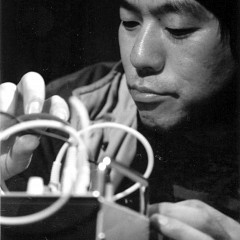
    Yoshihide plays with two modified Technics turntables and a guitar amplifier that he uses for feedback. Tétreault uses a three-tone arm turntable with three pedal volume controls. No reverb, no delay.

    “It’s visual. When we do a move, what you see is what you hear.” But what you hear might not sound like what you expect, Tétreault explains. “It’s not electronic, it’s completely analog, but it may sound electronic.”

    “It’s a very good energy between us,” Tétreault states. “Our concerts are completely improvised. We never, during the tour, talk about music. We never discuss pacing or things like that.”

    The duo’s appearances in Quebec City (October 28, 2003) and Montréal (October 29, 2003) are the Canadian leg of a four-city tour that will go to New York and Boston the next two evenings. Because of certain travel restrictions, Tétreault will be using turntable motors, tone arms and prepared vinyl in New York and Boston. They will be his first performances in those cities. It will also be the first time that he will perform with those devices.

    A bit of a risk, no? “These days, I like to take more risks. If I find I can make a new sound, I don’t explore it, I just try it out in a concert.”

    For Tétreault, his deconstructive experimentalism takes him back to his school days. “The turntable is usually only treated as a passive object, but there are a lot of hidden sounds it makes as an object. The sounds in the turntables were always there in the classroom.”

    Tétreault’s approach has been influential…

    October 30, 2003: Tétreault and Yoshihide on Tour

    Tuesday, September 30, 2003 In concert

    The three terrible turntablists Martin Tétreault, Yoshihide Otomo and Philip Jeck will rock the 3rd Göteborg Art Sounds (GAS-Festival) (Sweden) on October 14, 2003. Tétreault and Otomo then moves to North America for concerts in Québec October 28, Montréal October 29 and at famous Tonic (New York City) October 30.

    Studio — Analogique — Numérique, Otomo Yoshihide, Martin Tétreault in The Squid’s Ear

    “Heard Out”, Phil Zampino, The Squid’s Ear, September 1, 2003
    Monday, September 1, 2003 Press

    The state of turntablism has undergone rapid transformation over the last decade or so. No longer content with manipulating vinyl in unexpected ways, some artists have now turned on the tables themselves, utilizing every inch of the case, platter, motor, tone arm and stylus of the venerable record player.

    Martin Tétreault, part of Montréal’s Ambiances Magnétiques collective, is one such artist. He began this evening with a solo turntable set. Looking something like an impish scientist he sat pensively behind his mixer and two turntables, if turntables you can call them. In fact, one was simply a spinning platter raised high on the table, a piece of rotating metal with a disembodied stylus and tone arm that he used to probe various items at hand. His other turntable was a standard Technics, although Tétreault often eschewed vinyl in preference to metal plates, and he often used open RCA cables in deference to the stylus to generate rumbly, sparking and oddly explosive sounds. He ended one piece by throwing a 7” record onto a pile of objects he had built up on his stylus, eliciting audience laughter, though his more frequent slamming of the tone arm would cause a serious vinyl addict to cringe in horror. At times his approach seemed chaotic or even spastic, while at other times he built revolving grooves that were glitchy and intense. It’s difficult to call Tétreault a DJ in this context, but as a turntablist he sees many unexpected possibilities.

    It was clear from the two Technics decks on Yoshihide’s table that he would focus on the turntables, so it came as a bit of surprise that Yoshihide played much of his solo set on guitar, playing through a blond Marshall amp. His playing was drenched in feedback, starting with a buzzy intro that crescendoed into a ringing harmonic pallette, growling and angry. His playing was urgent, piercing, and vicious, a dirty blues with strong tremolo. Out of this slowly emerged the strains of Ornette Coleman’s ”Lonely Woman,” drifting in the feedback, a languorous rendering of the song. This slowly receded as Yoshihide began applying clips and various tools to his strings to effect, generating blocks of feedback and rich tones that rung and dropped under his thoughtful control. Yoshihide then turned to the tables to complete his solo set. He began by slamming on a disc, generating strong feedback, shaking the decks and probing at his discs to create long looping harmonic grooves punctuated with sudden collisions, unlikely beats and internote interference. The set ended with something sounding like an alien death ray, a fitting end to a charged set.

    After an intermission the players returned as a duo, with both players at their turntables. The similarities in style were as striking as the contrasts: both used their styli as a probe, striking at objects that occasionally included vinyl records, but also included metal plates, cymbals, and seemingly anything loose and nearby. Yoshihide had springs mounted on his styli to force them into repetetive grooves. Tétreault picked up a vinyl record and scratched at it with a free stylus as though it were a guitar. Both developed long grooves over which they busily worked, but generally Yoshihide tended towards more patient development of sounds relying often on delays, including an extended interaction with the package from a battery against his tone arm, making a wailing melodic cry. Meanwhile Tétreault jumped between sound sources in percussive and disruptive ways. As the set developed both settled into grooves, and the point of applying their approaches to turntables as opposed to any other solid object became apparent, as the rhythmic, cycling nature of their sound became more obvious. Dueling airplanes, industrial washing machines, droning noise with the beating of construction nightmares married and exploded, the factory gone haywire under the hands of these two noise pilots. The sheer feedback, interbeats and thunderous sounds threatened to change the listener’s body chemistry, a satisfying and jarring experience.

    The sheer feedback, interbeats and thunderous sounds threatened to change the listener’s body chemistry, a satisfying and jarring experience.
  • 15
  • 16
  • 17
  • 18
  • 19
  • 20
  • 21
  • 22
  • 23