Sauter au contenu principal
actuellecd
  • This website is also available in English.

Blogue

4946 résultats
  • 168
  • 169
  • 170
  • 171
  • 172
  • 173
  • 174
  • 175
  • 176
  • Victoriaville mai 2011 dans The Squid’s Ear

    «Heard In», Massimo Ricci, The Squid’s Ear, 16 septembre 2013
    lundi 16 septembre 2013 Presse

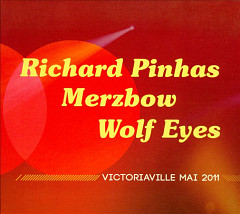
    “The noisiest concert of FIMAV 2011” is an unsurprising press release designation as soon as you take a look at the names behind this document. However, Victoriaville Mai 2011 comprises “spontaneous compositions” that seem to be born from quietness: the set begins with rarefied synthetic signals and small background noises, to end instead in a type of reasonably regimented mayhem where each of the components is given a proper role. A process of nuclear fission observed from safe distance, in a way.

    There are at least two factors that prevent the music to cross the borders of utter chaos. Pinhas’ all-encompassing guitar loops are — rather evidently — the main anchor for the whole sonic ship to stay within the waters of harmonic tolerability, whereas the occasional pulsations produced (presumably) by Masami Akita’s electronics throw an ounce of virtual steadiness to distorted heaps, uncontainable oscillations and straying feedbacks. Yet it’s not easy to establish where exactly supreme noise and functional sound meet in the Japanese’s arsenal.

    On the other hand, Wolf Eyes are definitely a fundamental addition to this rite of cathartic discharge, perfectly put in plain detail by Nathan Young’s filtered screaming. On the contrary, unobtrusively condensed lumps of sax and guitar collocate a few sections of the improvisation straight into Tranceville, slight echoes of early minimalism crossing the mind as one imagines benign smiles by Terry Riley and Tony Conrad should they ever stumble upon the “calmer” traits of this record. But when the reins are let loose — it happens quite often, especially in the 9 1/2 minutes of the encore — it’s still better to step back a little to avoid the flames.

    … when the reins are let loose — it happens quite often, especially in the 9 ½ minutes of the encore — it’s still better to step back a little to avoid the flames.

    Arômes d’ailleurs dans The WholeNote

    «Something In The Air: The Guelph Jazz Festival Turns 20», Ken Waxman, The WholeNote, no 19:1, 1 septembre 2013
    dimanche 1 septembre 2013 Presse

    Twenty years after its modest beginning, the Guelph Jazz Festival (GJF), which this year takes place September 3 to 8, has grown to be one of this country’s major improvised music celebrations. Unlike many other so-called jazz fests which lard their programs with crooners masquerading as jazz singers, tired rock or pop acts, or so-called World or C&W performers who make no pretense of playing jazz, the GJF continues to showcase committed improvisers in sympathetic settings including during the fourth installment of the dusk-to-dawn Nuit Blanche. […]

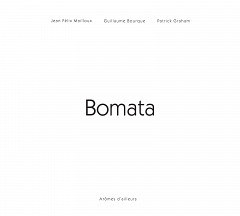
    Outstanding double bass work from closer to home is on tap during a free Market Square afternoon concert that same day when Montréal bassist Jean Félix Mailloux performs his compositions from Bomata Arômes d’allieurs Malasartes mam 016 with his associates, percussionist Patrick Graham and Guillaume Bourque playing clarinet and bass clarinet. A trio which has internalized “scents from elsewhere” — the translation of the CD title, Bomata’s unhurried performances reference various ethnic styles without becoming the subservient to any. A fine instance of this mixing is Cardamome when cross pulses from Graham and second drummer Phillippe Melanson move contrapuntally alongside a walking bass line, providing a trembling rhythm to Bourque’s mid-range, Klezmer-like overlay. The reedman’s mercurial high-note skill is on display on Shaman, with the bass taking on a slinky oud-like resonance and guest frame drummer Ziya Tabassian adding hard thwacks to toughen the beat. Yet as intense as the bassist’s and clarinetist’s improvisations become neither disrupts the basic thematic flow. Pianist Jérôme Beaulieu, who joins Bomata on a couple of tracks, is a little too decorous, creating a crystallite Nordic feel which clashes with Bourque’s ney-like sound on Nuit Blanche. Although with 13 tracks, sameness sets in at points, most performances argue well for the band’s continued evolution from this 2012 CD. Chinoiseries could offer one path, with the arrangement open enough to allow the reedist some altissimo smears even as the theme stays linear, with the end product suggesting both Eastern European concertina-like riffs plus a swinging jazz-like interface. […]

    A trio which has internalized “scents from elsewhere” — the translation of the CD title, Bomata’s unhurried performances reference various ethnic styles without becoming the subservient to any.

    Hemlock dans The Sound Projector

    «We Conquered the Mountain Horizontally!», Stuart Marshall, The Sound Projector, 3 août 2013
    samedi 3 août 2013 Presse

    In Ken Kesey’s widely-read One Flew Over The Cuckoo’s Nest, the antagonist — the hatchet faced Nurse Ratched — is depicted as a spider, ‘in the centre of her web (of) wires like a watchful robot… with mechanical insect skill, (knowing) every second which wire runs where and just what current to send up to get what she wants…’. Just one letter (and much sadism) removed from this creation, the Ratchet Orchestra resembles a similarly organised regime.

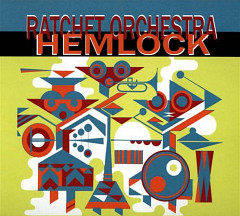
    As exercises in man-management go, this chamber jazz band is an ambitious proposition indeed. Having burgeoned from a handful to some 30 Montréal musicians of the first water over the last decade and a half, the logistical and democratic considerations of distributing them evenly over a mere 9 pieces (most of which hover around the 5-minute mark) fries my mental circuits. But the task is ably executed by leader Nicolas Caloia as he provides a showcase for all but preferential treatment to none. As a result of such exacting exigencies, there’s nary a moment wasted by this muscular unit: from careful canter to clattering cacophony, the only sound phenomenon left unexplored is silence, though you’ll probably look into that one once the CD has ended.

    Being a big band jazz unit with an unabashed devotion to Sun Ra (they first celebrated his birthday in 1998), their sound will evoke little surprise: loping woodwinds provide a launchpad for the shriller excesses of the horn section; a soaring string section melts in the warm buzz and burble of a mute trumpet while an electric piano takes the stairs; a spidery, skittering fuzz guitar becomes swiftly serrated from climbing too many grass blades — hacks and slices at everything around it. Walt Disney is invoked and banished. Keeping shy of the minute barrier, a roustabout plays the cup & ball game with the words KICK, MAN & HABIT. Everything roars and fades with finality.

    Though the musical motifs of Sun Ra, Alice Coltrane and the like are distinctive, this is not to say it’s an exercise in emulation — far from it. That said, if the group’s star-bound curiosity fails to ignite the transcendent inner dimensions of its forbearers, it’s precisely for the reason that it lacks the spiritual discipline: working to a timetable, no one has more than their allotted 5 minutes to shine, both as individuals and team players. The 9 tracks constitute a collection (a very varied one, albeit), rather than a narrative. Thus, the Ratchet Orchestra resolves itself as an exercise in short-term showmanship, in which respect it fulfils its mandate admirably. Appreciate this detail and you’ll walk away the winner.

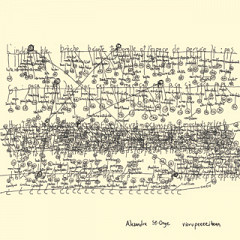
    The Ratchet Orchestra resolves itself as an exercise in short-term showmanship, in which respect it fulfils its mandate admirably. Appreciate this detail and you’ll walk away the winner.
  • 168
  • 169
  • 170
  • 171
  • 172
  • 173
  • 174
  • 175
  • 176