Sauter au contenu principal
actuellecd

Blogue

101 résultats
  • 1
  • 2
  • 3
  • 4
  • 5
  • 6
  • 7
  • 8
  • 9
  • Dream of Heat dans Musicworks

    «Review», Tim Powis, Musicworks, no 154, 1 août 2026
    mardi 11 août 2026 Presse

    With what felt, even to the heartiest among us, like a cruel and endless winter now safely tucked away in our collective memory (for a few months anyway), along comes Dream of Heat, a chilly, occasionally chilling musical evocation of the unfairest season. Montréaler Ida Toninato, who plays baritone sax and synthesizers, and Winnipeg-based Jennifer Thiessen, on viola and synths, originally created the precursor to D of H as a concert piece called Winter[City]Speaks. (On the album, producer Jason Sharp also plays synths.) And indeed, speaking voices—as well as some lovely singing by Thiessen and Toninato — are a prominent ingredient of the music. Over a mournfully descending viola figure and the (synthesized) sound of a distant but persistent arctic wind, the album opens with Thiessen, shivery and desperate, pleading, “I need warmth… I need shelter… l need heat.” On the album’s penultimate and most unsettling track, amid a crowded soundscape of growling, slowly pulsing synth, anxious chanting, scraping noises, and animalistic utterances, Toninato insists repeatedly, in a rhythmic near whisper, “I am… suffocating,” both before and after a ghastly series of screams issues forth from somewhere deep in the mix. Overall, though, the prevailing mood is more one of celestial melancholy or gentle foreboding than panic-stricken claustrophobia, with sax, viola, and voices offering intimations of warmth that contrast nicely with the icier, more ethereal synthetic textures. The seasons are, after all, a handy metaphor for the cycle of life and death, and ultimately Dream of Heat seems to affirm the former.

    Dans l’ensemble, cependant, l’atmosphère qui prévaut relève davantage d’une mélancolie céleste ou d’un léger sentiment d’appréhension que d’une claustrophobie paniquée, le saxophone, l’alto et les voix apportant des notes de chaleur qui contrastent agréablement avec les textures synthétiques plus froides et plus éthérées.

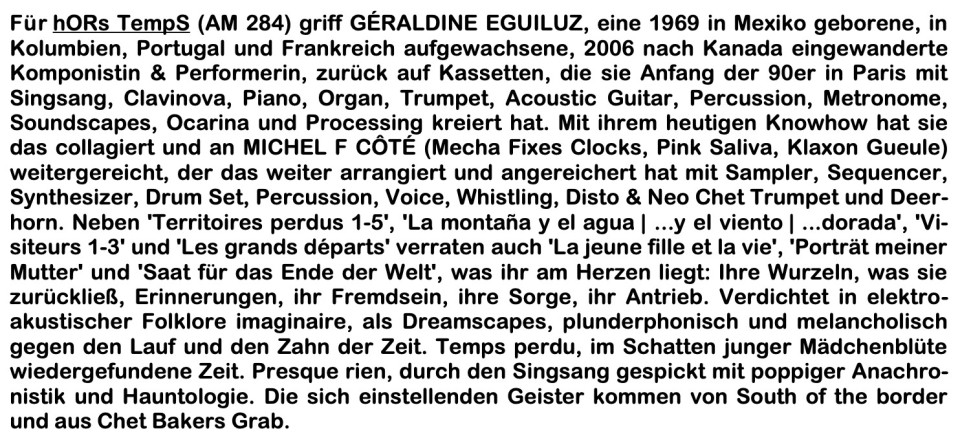
    Le buffet dans Bad Alchemy

    «Kritik», Rigobert Dittmann, Bad Alchemy, 1 décembre 2025
    mardi 11 août 2026 Presse
    C’est incroyable de voir comment un ton de conversation prosaïque se transforme, de manière tout à fait capricieuse et avec un rythme linguistique vertigineusement rapide, en un OverPop jazzé avec une virtuosité exceptionnelle qui, bien que puisé dans le quotidien, sonne pourtant merveilleusement sophistiqué et drôle.

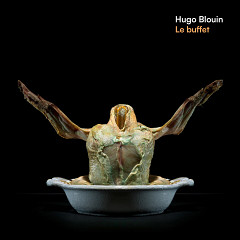
    hORs TempS dans Bad Alchemy

    «Kritik», Rigobert Dittmann, Bad Alchemy, 1 décembre 2025
    mardi 11 août 2026 Presse
    … révèlent également ce qui lui tient à cœur: ses racines, ce qu’elle a laissé derrière elle, ses souvenirs, son sentiment d’étrangeté, ses inquiétudes, sa motivation. Condensés en un folklore imaginaire électroacoustique, sous forme de paysages oniriques, plunderphonique et mélancolique, à contre-courant du temps qui passe.

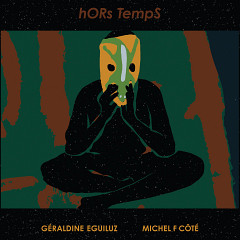
    21st-Century Canadian Snare Drum dans The Arts Desk

    «Review», Graham Rickson, The Arts Desk, 1 août 2026
    mardi 11 août 2026 Presse

    My one gripe with this interesting double album is the lack of sleeve notes; there’s a track listing and a brief overview but nothing else. I did find a useful interview with percussionist Ryan Scott on Canada’s Ludwig Van Toronto website, Scott explaining that he chose to use the snare drum “because it’s really the mother instrument of percussionists” — if you can master the snare drum, it’s likely that you’ll be able to master other percussion instruments. 14 contemporary composers were commissioned to write new works, Scott setting them no limits. There’s an enjoyably eclectic mixture here, various pieces adding extra instruments or electro-acoustic enhancements. Frequently you can’t quite believe what you’re hearing, especially when listening through headphones. Sections in Bekah SimmsSkinscape IV are like being caught in a blizzard, while the opening of Vincent Ho’s Snap Noir could be mistaken for lowing cattle.

    Scott’s own breath and voice become increasingly prominent in Emilie Cecilie LeBel’s heirloom and we hear him singing and whistling in The Far Night.fm by Nichole Lizée. A prominent electronic drone in Christina Volpini’s only ghosts threatens to steal Scott’s thunder, the two voices eventually finding equilibrium, and a resonant bass drum rings out, bell-like like in Sepals by Amy Brandon. Scott’s playing is superb throughout, his concentration and sense of intent palpable. Riveting stuff, then, and stunningly engineered — if you fancy stepping out of your comfort zone this weekend, try this.

    Le jeu de Scott est superbe du début à la fin; sa concentration et sa détermination sont palpables. Un spectacle captivant, donc, et d’une réalisation époustouflante…

    Platanus dans All About Jazz

    «Review», Glenn Astarita, All About Jazz, 6 juillet 2026
    vendredi 7 août 2026 Presse

    Toronto composer, performer, and improviser Allison Cameron has carved out a distinctive niche in Canadian new music since the mid-1980s, her work marked by an instrumental kaleidoscope and gentle waywardness that tends to elude quick summary. Born in Edmonton and trained at the University of Victoria and York University, she settled in Toronto in 1989, eventually earning a Bang on a Can All-Stars commission that brought her piece November to Lincoln Center in 1994. Montréal trombonist Scott Thomson needs little introduction in these circles: co-founder of AIMToronto, former head of the Guelph Jazz Festival, current Artistic Director of FIMAV, and a player whose allegiance to open improvisation runs bone-deep. The two first crossed paths in 2007 in a trio with the late Toronto polymath Nobuo Kubota. It took the better part of two decades for a proper duo record to materialize. Better late than never.

    The instrument at the center of Platanus is not the trombone. It is a plywood-cased, homemade crackle synthesizer that once belonged to Kubota and eventually made its way to Cameron. When Thomson heard her playing it in 2022, he promptly dubbed it the “Cadillac Cracklebox” — a name that does most of the descriptive work on its own. The album is dedicated to Kubota’s memory, and something of his restless, mischievous spirit seems to have followed the instrument into the studio.

    Three extended pieces work through Platanus with deliberate arboreal logic, moving from grounded rumble to more exposed terrain. Thomson coaxes breaths, squeaks, and near-melodic smears from his horn with the patience of a player who treats silence as a viable option. Cameron’s arsenal — Cracklebox, additional keyboards, and scattered tapes—answers with clicks, white noise, timbral eruptions and Thomson’s multiphonics that arrive on their own schedule. What sets Cameron and Thomson apart from the broader electroacoustic free improvisation pile is the quality of listening between them—genuinely responsive, at times conversational, elsewhere resembling a quiet disagreement between people who respect each other too much to raise their voices.

    Platanus is prickly, patient, and not for the faint of ear—which is precisely what recommends it. Cameron and Thomson have waited nearly twenty years to make this record, and the restraint that shaped that timeline shows up in the music itself. Nothing here is rushed, nothing overstated. It is a small ensemble by any measure, but the sonic world these two construct is anything but.

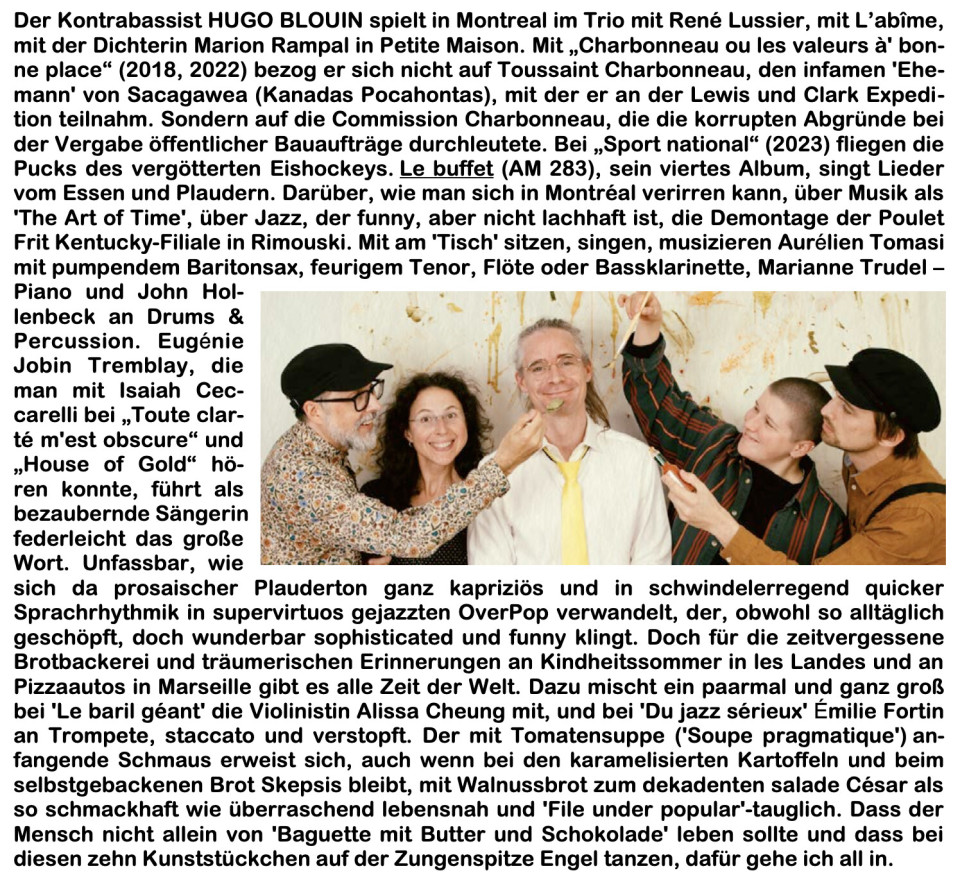
    Ce qui distingue Cameron et Thomson de la masse des artistes pratiquant l’improvisation libre électroacoustique, c’est la qualité de leur écoute mutuelle: véritablement réactive, tantôt conversationnelle, tantôt s’apparentant à un désaccord discret entre deux personnes qui se respectent trop pour élever la voix. Platanus est un album épineux, patient, qui n’est pas destiné aux oreilles sensibles — et c’est précisément ce qui fait son intérêt.

    Le buffet dans Take Effect

    «Review», Tom Haugen, Take Effect, 4 juillet 2026
    vendredi 7 août 2026 Presse

    This 4th album has the multi-instrumentalist Hugo Blouin brings along some friends for the songs that surrounds his friend’s favourite recipes and childhood memories, which makes for a buffet of sounds and ideas.

    The lively mood of Soupe pragmatique starts with Aurélien Tomasi’s bright sax that suits Eugénie Jobin Tremblay’s animated voice which guides the energy, and La patate au sucre follows with John Hollenbeck’s colorful drumming in both busy and calm moments.

    In the middle spot, Un art du temps benefits from Marianne Trudel’s expressive keys amid the unpredictable textures, while La sauce allows for Blouin’s clever bass to complement the pretty vocals.

    Arriving near the end, Du jazz sérieux enlists Émilie Fortin’s well timed trumpet that helps make this the album’s best via the creative jazz climate, and Un camion pizza exits with Marion Rampal’s elegant voice and clarinette basse’s soothing clarinet helping cultivate a mature and cozy finish.

    An eclectic effort that pulls from soul, jazz and avant-garde nods, Blouin’s vision is humorous, intimate, rich and memorable from beginning to end.

    Une œuvre éclectique qui puise dans la soul, le jazz et l’avant-garde. La vision de Blouin est pleine d’humour, intime, riche et mémorable du début à la fin.
    8/10
  • 1
  • 2
  • 3
  • 4
  • 5
  • 6
  • 7
  • 8
  • 9