Sauter au contenu principal
actuellecd

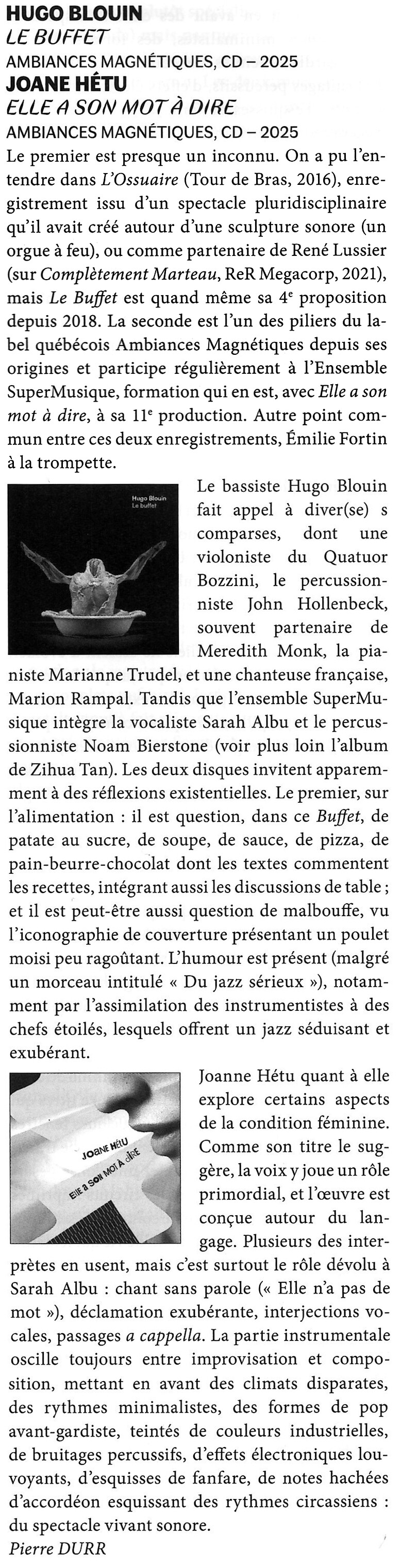
Le buffet

Hugo Blouin

Une œuvre éclectique qui puise dans la soul, le jazz et l’avant-garde. La vision de Blouin est pleine d’humour, intime, riche et mémorable du début à la fin. Take Effect, ÉU

Ces rythmes irrésistibles, séduisants, swing et funky viennent rehausser et compléter les plaisirs sensuels de la table et mériteraient à eux seuls une étoile Michelin. Ce buffet va sans aucun doute aiguiser votre appétit, nous pousser tous vers la cuisine et nous donner envie de reprendre nos propres aventures culinaires. Salt Peanuts, Norvège

Le quatrième album d’Hugo Blouin, Le buffet, se délecte de l’excentricité pure et simple du jazz gastronomique. Le bassiste et compositeur montréalais n’en est pas à son premier coup d’essai dans le domaine des albums conceptuels, puisqu’il explore depuis longtemps la musicalité inhérente à la langue québécoise, ayant déjà abordé des sujets tels que le hockey (Sport national) et la Commission Charbonneau (Charbonneau ou les valeurs à’ bonne place, volumes 1 et 2) dans ses précédents albums primés.

Ici, avec la nourriture comme thème, Blouin se montre à la fois ludique et personnel, utilisant des recettes réelles recueillies auprès de ses amis ainsi que des entretiens avec eux, et intégrant des plaisanteries autour des repas dans les grooves anguleux qu’il déploie. Au milieu des lignes vocales agiles et des structures compositionnelles complexes, les auditeurs se voient servir divers accompagnements délicieux – anecdotes, commentaires à chaud et réflexions – qui imprègnent la virtuosité imaginative de l’album d’une légèreté joviale. Le travail vibrant et espiègle de Blouin présente une vision unique de la musique actuelle, une collision entre le swing urgent du post-bop, des rythmes effrontés de type prog et des détours structurels, des ballades équilibrées, des explosions de forme libre et une touche des mélodies calquées par la parole inaugurées par René Lussier dans Le trésor de la langue en 1989.

  • SODEC • Conseil des arts et des lettres du Québec

CD-R (AM 283, 2025)

  • Étiquette: Ambiances Magnétiques
  • AM 283
  • 2025
  • UCC 771028128327
  • Durée totale: 53:15
  • Boîtier sympathique
  • 126 mm × 126 mm × 5 mm
  • 45 g

Téléchargement (AM 283_NUM, 2025)

Notes liminaires

À propos

Pour ce quatrième album, j’ai fait parler mes proches. Ils m’ont raconté leurs recettes préférées, des souvenirs d’enfance, ce qu’ils ont fait la semaine passée… On a aussi parlé d’art. J’ai composé ces dix pièces à partir du repiquage de leurs récits. C’est un buffet de chansons extravagantes, drôles, intimes, que j’ai eu le bonheur de préparer avec un groupe de chefs étoilés. Vous m’en donnerez des nouvelles!

Hugo Blouin [xi-25]

Vidéos
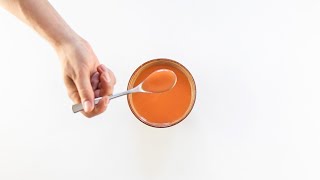
  • Vidéoclip: Hugo Blouin: Soupe pragmatique; vidéo: Hugo Blouin; En français; octobre 2025; 6:00
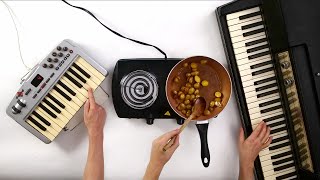
  • Vidéoclip: Blanche Baillargeon, Hugo Blouin: La patate au sucre; vidéo: Hugo Blouin; En français; octobre 2025; 4:31
Quelques articles recommandés
La presse en parle

Review

Tom Haugen, Take Effect, 4 juillet 2026

This 4th album has the multi-instrumentalist Hugo Blouin brings along some friends for the songs that surrounds his friend’s favourite recipes and childhood memories, which makes for a buffet of sounds and ideas.

The lively mood of Soupe pragmatique starts with Aurélien Tomasi’s bright sax that suits Eugénie Jobin Tremblay’s animated voice which guides the energy, and La patate au sucre follows with John Hollenbeck’s colorful drumming in both busy and calm moments.

In the middle spot, Un art du temps benefits from Marianne Trudel’s expressive keys amid the unpredictable textures, while La sauce allows for Blouin’s clever bass to complement the pretty vocals.

Arriving near the end, Du jazz sérieux enlists Émilie Fortin’s well timed trumpet that helps make this the album’s best via the creative jazz climate, and Un camion pizza exits with Marion Rampal’s elegant voice and clarinette basse’s soothing clarinet helping cultivate a mature and cozy finish.

An eclectic effort that pulls from soul, jazz and avant-garde nods, Blouin’s vision is humorous, intimate, rich and memorable from beginning to end.

Une œuvre éclectique qui puise dans la soul, le jazz et l’avant-garde. La vision de Blouin est pleine d’humour, intime, riche et mémorable du début à la fin.
8/10

Review

Eyal Hareuveni, Salt Peanuts, 27 mars 2026

Québecois, Montréal-based double bass player and composer Hugo Blouin has an insightful, ironic perspective on life in the supposedly calm and extremely polite Canada, as already expressed in his previous albums — Charbonneau ou les valeurs à’ bonne place, dedicated to the scandals in Québec’s construction industry and Sport national, dedicated to Canada’s national sport, ice hockey (Multiple Chord Music, 2022 and 2023).

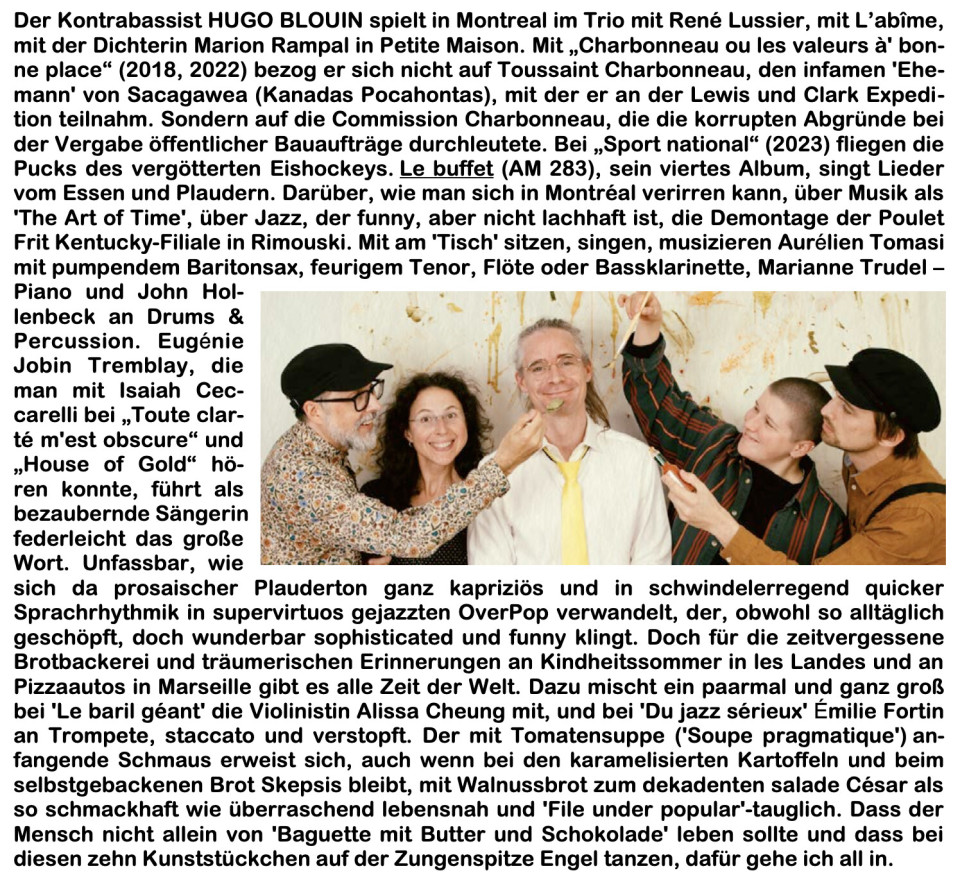
On Le buffet, Blouin shares his own and his friends’ insights on their favourite recipes and childhood food memories, packed into a cycle of ten extravagant, funny, and intimate songs. These songs were cooked up with world-class chefs like drummer John Hollenbeck, lead vocalists Eugénie Jobin Tremblay and Marion Rampal, pianist Marianne Trudel, and lyricists Blanche Baillargeon, Robin Servant, and Olivier Therriault. The cover photo of a third chicken is by Viennese photographer Klaus Pichler.

These witty, delicious, and nourishing story-like songs (all sung in French, but the album’s booklet offers an English translation) remind us that we all need «a lot of good faith, a little time, and a great big smile» when preparing the perfect tomato soup (as seen in the attached video), reveal the recipe for a good, decadent Caesar salad, and discuss the desire for a tasty butter and chocolate baguette, among other culinary delights. The irresistible and seductive, swinging-funky grooves charge and complement food’s sensual pleasures and deserve a Michelin star of their own. Le buffet, no doubt, will charge your hunger, send us all to the kitchen, and inspire us to resume our own culinary journeys.

Ces rythmes irrésistibles, séduisants, swing et funky viennent rehausser et compléter les plaisirs sensuels de la table et mériteraient à eux seuls une étoile Michelin. Ce buffet va sans aucun doute aiguiser votre appétit, nous pousser tous vers la cuisine et nous donner envie de reprendre nos propres aventures culinaires.

Interview — Hugo Blouin: Jazz Sérieux, Jazz Fun

Katchie Cartwright, All About Jazz, 16 mars 2026

Growing up in southern Québec, not far from the US border, Hugo Blouin studied music from an early age in school. Both parents were writers, so creative work came naturally. “It was normal to do art,” as he put it. As a bassist, Blouin describes himself as an “auto-didact,” but he studied piano in primary and secondary school, wrapping his head and fingers around Schumann and Debussy, practicing seriously. In his first round of college, he studied and worked in communications, but it did not stick. After spending time in Canada’s Yukon territory, he turned to the bass for the more “jam-ful” bluegrass and folk music circles it allowed him to enter. He then went back to school in Québec, at the University of Sherbrooke, where he studied jazz and composition for a couple of years.

Blouin’s fascination with the musicality of speech is a through-line in his work. Rene Lussier and Hermeto Pascoal were important influences, both of whom have explored spoken language as a melodic resource. Blouin first followed Lussier (who, in turn, was influenced by Pascoal), listening to his early works and Le Trésor de la Langue (Ambiances Magnétiques, 1989). Blouin was struck by “both the complexity, or the depth, and the humor of the pieces,” as well as “the political nature of the works.” He asked Lussier to be the artistic producer of his first album, which Lussier declined “in a way that still led to further collaborations and friendship.”

In conversation with All About Jazz, Blouin focused primarily on his 2025 release, Le buffet, on Ambiances Magnétiques records, the contemporary Montréal-based label founded by Lussier in 1983, touching on upcoming projects and previous works briefly toward the end. An edited transcript is below.

A serious place of music early on

All About Jazz: I just love Le Buffet. This is my first introduction to your music, which is fantastic, so I’ve been listening to a few different things and reading online. Thanks for sending the lyrics with translations. I couldn’t find anything on your education.

Hugo Blouin : It’s minimal, that’s why. I first went to university in another subject. I studied communications and worked there, became bored, and got back to music. So I went back to the University of Sherbrooke to do part of a first cycle—I’m not sure of the English equivalent—but a one-year university diploma in jazz performance. And then I started a second cycle, like a master’s degree, but they offered a shorter program. So I tried that out, but I didn’t stay around; so about two years of university back in Sherbrooke. It was a moment where I just wanted to go back to school and get the most playing and learning condensed into a short amount of time, and also to complement the auto-didact path that I was on. I was playing a lot and trying to write, trying to experiment with new stuff. That moment really helped just to get me on a track, and then I left the institution.

AAJ: I understand that, having stopped and started school a couple of times before going the full way. But did you study as a child?

HB: Yeah, I had a chance to be in a fulltime music program that was embedded in a regular school.

AAJ: Ah, good.

HB: So, yes, there was a serious place of music early on in my life. And that allowed me to—not go to school but—still get completely into music.

AAJ: So was bass your first instrument?

HB: No, piano was my first instrument. So I was really into piano, trying to get a hold of Schumann and Debussy. And I started bass as an auto-didact, traveling into the Yukon, where there was a lot of bluegrass music, and then back home in Québec, playing with singers and songwriters. Really, I started back with the bass in a really simple and jam-ful experience, and then got back to school, and then thinking, “Maybe I can write some jazz, too.”

AAJ: I hear some of that in the stuff you did with Maz and also with the group Petite Maison. It’s so beautiful.

HB: Oui. Marion Rampal, she’s the project leader and singer on Petite Maison and has a really powerful voice, but also artistic incarnation and really leads this thing towards beautiful moments.

AAJ: And the YouTube of Y’a une étoile pour vous (There is a star for you) is so enchanting, with that lovely little girl dancing and everyone singing at the end…

HB: That’s Marion’s little girl.

AAJ: I can hear, now, some of your sensibility coming from that. It seems very strong. Did you grow up listening to that kind of music in Sherbrooke?

HB: I didn’t listen to much music when I was young. I guess playing and learning it was enough. And I still see that in the moments where I’m playing, writing, involved in projects. I stop listening to stuff and suddenly the music I’m working on takes the full space. I suppose that the folk influences came from when I took the bass as an instrument and tried to play with other people and there was a lot of folk around me.

AAJ: What about your parents? Any musicians in your family?

HB: Not at all, but they are artists, too. They are both writers. So the major thing that I inherited from them was that it was normal to do art (laughs). So when I first had the idea of it, I didn’t find it ridiculous. I just thought, “Oh, I know how to do that.”

Hermeto Pascoal and Le Buffet

AAJ: Ok, great. Also, the melodies, the vocal melodies on Le Buffet really remind me of Hermeto Pascoal. He was an influence?

HB: Of course.

AAJ: But you’re taking a different approach. In his som da aura pieces, he would record someone speaking, extract the melody from that, then play both together, speech and instrumental melody. But you have that sound on Le Buffetonce removed, because you substitute a singer for the original speaker, doubling her with another instrument. And your singer, Eugénie!

HB: Eugénie Jobin. She’s great.

AAJ: Yes. She must have perfect pitch?

HB: She has magic powers.

AAJ: Haha. I think that might be one of her magic powers. The melodies are so tricky, and she does them really effortlessly.

HB: I’m not sure that this is conveyed in the English documentation, but—similarly to how Hermeto Pascoal, who is getting his melody—I worked with the melody of speech to find the melodies. So when Eugénie sings about La Sauce, the Caesar salad dressing, it’s the melody of my friend Jean-François telling it to us.

AAJ: Ah, you did! OK.

HB: It’s all in there, not necessarily 100% faithful to the original, since I don’t have to. But the inspiration comes from there, and often parts of the arrangement. In La Sauce, the riff comes from a little part of Jean-François’ speech, where he’s telling us how great this sauce is.

AAJ: Oh, yeah. Two things happen when I listen to this record. One is that I want to go to Montréal, and the other is that I want to eat all this food!

HB: Haha. Yes!

AAJ: Except maybe for the popcorn. How did the popcorn get in there, in La Patate au Sucre?

HB: That’s a cheap video trick. It’s a challenge to create—my God, I was going to say “content” (makes a sour face)… It’s a challenge to create a video to go along with a jazz piece because there is a big empty moment where we are just listening to the solo and, quite frankly, I don’t want to steal the spotlight away from the solo. So, in the two clips for Le Buffet, I was looking for introspective visuals, something that would allow us to get into the solo, even though we are looking at funny images. So that’s how the popcorn got in there. I thought maybe we could use the pan to start something else. And that’s what happens in the solo.

AAJ: It’s great. And also in La Patate au Sucre, I love that you used the midi keyboard as a spatula. Were you playing those little lines on the keyboard?

HB: I was playing for the clip, but Marianne Trudel was playing them on the record for sure.

The Ensemble

AAJ: Your band is incredible. The trumpeter, Émilie Fortin, with the balloon on Du Jazz Sérieux! I was trying to figure out what it was that she was playing, then I saw her. It was fabulous to see the live video performance, because you can watch the band. And it is truly serious, you know.

HB: Laughs. Yes, she is doing a full-on solo, a serious solo. And I’m glad you like that part, because this juncture point between the different improvisational musics to me is something really obvious, but it’s not obvious in real life with different players and different ways of thinking. So saying “let’s play free” to the jazz band is very different than playing free with free players. I’m trying to find ways to be able to do both, which is hard and really serious stuff. And also to make the two play together. So Émilie’s solo on the album and then live, which was even greater live, is an example of that.

There is also that on the previous album, the hockey one. I don’t know if you saw that ( Sport national, Multiple Chord Music, 2023). There are a couple of songs with Jean Derome, a great Québec flutist and saxophonist, also a great composer, and he’s one to have studied the jazz tradition and is also very well-versed in the free-improv scene. He does this very inspired flute solo over a choir on Sport National. It’s just those little moments to try to make the people meet and make my different influences co-habit.

And that’s one thing that’s funny about Émilie Fortin’s place on the album. When we recorded it, the take that we kept, everything went wrong. During the solo, I stepped on my earphone jack and stopped hearing everything. We had some problems with monitoring at the studio, and so I thought everything crashes… I’m looking everywhere, trying to fix it, and I see the band is still continuing so obviously they are hearing everything. So the sound engineer rushes to me and we figure a way and we play everything back. It’s been maybe a minute or a minute and a half and they are just playing by themselves and kind of pedaling. But this urgency that’s adding to the late stage of the solo kind of made it go back to life. Finally, we go on with the song and, by far, that was the best take that we could choose. So that’s a fun story about that song in particular.

AAJ: Interesting! And, again, I’ve been kind of cramming in a non-systematic way, but I did listen to bits of individual people from the band do their own things. First of all, you have two singers, Eugénie Jobin and Marion Rampal, who sings on just one tune?

HB: Alors, Marion, she sings on the last one, Un Camion Pizza.

AAJ: “Za za za,” that’s her? I love that.

HB: Yes, and the song is from her own story.

AAJ: That’s such a tender story, about the the pizza truck and the family tradition. So, especially in the little bits I saw of Émilie and also Eugénie, I kept thinking that the situations you put them in make everything really come alive in ways that I wasn’t really hearing in other bits. I’m sure they have brilliant tracks elsewhere, but here, in your ensemble, the whole seems greater than the sum of the parts.

HB: They are asked to go all in, also. Or they have no choice, either because of the complexity of what they’re playing—although they are very skilled players; I’m not saying that my music is harder than anyone else’s, but it’s often not the context that they are used to playing in because of either the crazy melodies or different genres. Maybe it’s even more true when we play live. They have to dive in. I talked with Eugénie after the last show and she was like, “Oh my God, I was doing gestures and trying to support the lyrics. I’ve never done that in my life. Now, I’m telling a story about recipes. I kind of need to make the recipe and forget about the intervals and just go for it.” It’s just an anecdote but, to me, it was her telling me how deep she was there, forgetting herself in front of the crowd to make the music happen.

AAJ: And I love the fact that one of your band members had on an apron and another had on a chef’s hat. Very good. But the amount of practice, tell us a little bit about that. How did you prepare these things? How often did you rehearse?

Preparing to record and perform

HB: It is a jazz setting. So the performers are way too good for me, and so we haven’t rehearsed much. This particular band, especially with John Hollenbeck and Marianne Trudel, they are very experienced and skilled players and composers in their own right, and so they arrived ready to make some noise. So there were maybe six rehearsals for the album. And for the show, we were fortunate enough to have two. I feel that we could have done it without it, but it’s really helpful, as you know (laughs).

It’s my first time with these musicians. The previous albums were done with another band, with people more close to me, so the context was a bit different. We could rehearse more easily and more frequently. So there was a shift in the way to bring the music to life, finding the way to do it with less time, and maybe more freedom for the players.

AAJ: And what did you give them? What do your charts look like? Do you have anything you can show me?

HB: Sure. Any particular one in mind?

AAJ: Any of them. Maybe start with the first one, Soupe Pragmatique? That’s one that you did transcribe the voice, pretty much, of your friend?

HB: Yes! And it begins with it; it begins with him. So you can hear a bit of him, and he’s like (sings), Alors, pour faire la bonne, bonne soupe. And it kind of spurs the riffs that will arrive later on. So, let’s see. I have a score here I’ll share.

AAJ: What do you use, Sibelius?

HB: I’m a Finale guy, still. I found a Finale that still works on a recent Mac OS, so it exists…

In the score, as you can see, the drum part is really sparse. I’m indicating a pulse. But most of the time he won’t have a lot of indications; maybe shots. The parts are really crowded, often, for the melodic instruments. Marianne has all sorts of indications, harmonic indications and melodies to double. So I think the piano role in this band is especially tricky, because she is the harmony and melodic support, and sometimes doubling the bass as well. So she has the three-part brain.

AAJ: But on Du Jazz Sérieux, the accompaniment was extremely unusual, I thought.

HB: Yes.

AAJ: Is that in the instructions you’re giving her, the way she lays things underneath? It’s not like typical comping in any way, but it’s very supportive.

HB: You’re right. That’s interesting that you note it, because in the Jazz Sérieux there are moments where her instruction is “laugh with your instrument.” It’s the little solo moments she has with Émilie. And then, at some points she ignores the charts and comps how she sees fit. There was other stuff written. She inserts herself in support, but in an elusive way, but that’s of her own devising. But then the solo is… they have no indications, so I’m just glad to see something develop with Marianne and John while we see Émilie get away with it. It’s special because it’s a strong piece, but it’s the only one where Émilie plays on the record. So I guess I’ll have to do other music with her.

AAJ: I hope so. And it’s so wonderful to watch Marianne while Émilie put more air in the balloon, waiting to see, “Is she done yet?” So attentive. So much joy, particularly in that piece. It perfectly captures the kind of joy in seriousness that’s involved in making something of this complexity. And also of this emotional depth. It’s ridiculous, and yet…

HB: And yet—yes, I agree. The meeting of very serious and very funny, and the total involvement of everybody, makes for a very powerful moment, and something I’m looking for in music, for sure.

AAJ: I also was enthralled by your conducting, unconventional gestures, laying your body way back, then waiting and moving forward to indicate when it was time to play. And, at the end of Du jazz sérieux, are they still counting—at the very end there—or are they just going by feel in those little pauses between hits?

HB: There’s like two endings. First, a free drum solo over those little shots that are written to be missed. So we’re kind of counting them, but—one by one—the players have stopped counting, including me. And then there is this outro that is written in time, so there are pauses that are intended then, finally, it’s more of little cues. Initially, I wanted to make it more of a corny jazz ending; making fun of what serious jazz might be. But then it’s beautiful. It doesn’t feel corny at all.

AAJ: No, it doesn’t. And that makes sense. The pauses feel more flexible, and yet they’re right there, on the mark.

Beyond Le Buffet

AAJ: I want to hear more of your stuff! I see that we have some things of yours on All About Jazz, but no reviews.

HB: No, I tried with the second album, but it’s harder with the lyrics in French. It’s a bit of an adventure to get the work known, to get people to listen to it outside of my bubble. But on every album, there are some new ears that discover it, either in Europe or in the States, that give some hope that we can play this music outside of here.

AAJ: Well, it’s great to hear your new album, see the videos, and speak with you about it. And you are doing other things. What do you have coming up?

HB: With a collective led by a pianist friend, Jonathan Turgeon, who was playing on all my previous albums; a good friend and collaborator on many albums. So this collective is called l’Abîme, the abyss ( l’Abîme, Multiple Chord Music, 2021). So it’s the second album of this band. It’s instrumental jazz, but really groovy rock-prog stuff. Even the saxophones are going through pedals, so everything is transformed. Very beautiful pieces by Jonathan, so that’s a new album I have just collaborated with.

And then there is more Petite Maison stuff coming. I’m going to France in April for more shows. And hoping to write some new stuff this year for trios. So I’ve been writing a lot for five, six, and seven pieces; bands, bigger bands. But now I think it’s a good time to write for smaller bands so we can tour them.

Sport National

AAJ: Can we talk for a second, just before we go, about Sport National?

HB: Yes! That previous album was about hockey, something very important for Canadians. But when I started writing the pieces, I couldn’t care less about the sport. I had played when I was a young kid. I wasn’t good at it, so I put it away, never looked at it again. Even when the Canadiens, our Montréal team, were good—which they have not been for a while—I didn’t follow any of it. So I thought, “This is a big cultural object, and it has links to recent history. It’s part of the society, it’s part of the ecosystem, so why not look at it through what transpires from the archives?” I was working from the archives, looking for any interviews, any parts of games; anything that could tell me something about me or about Québec. And so it became this kind of jazz documentary or a path to rediscover what this could be, this national sport, while writing songs from these archives. So it goes from “how did the Montréal Canadiens come to be created”—there were some documentaries or radio shows, so a song is composed from that.

There are some historical moments from Maurice Richard, a great player in the ’50s, and who was also an icon for a lot of the folk here in Montréal and Québec. He was some kind of demi-god of the times. And at some point, his actions and his declarations were interacting with the society’s evolution, and kind of predicted some of the evolution in society that would come later on. So there’s a few moments like that in the album, with pieces. Also the Summit Series in ’72, where Canada faced Russia, something that generated a lot of media attention, because it was still the Cold War. What interested me most about this episode is the vocabulary that was used was that of war. And we’re just talking about hockey. But the games, and the fuss over it was very political.

AAJ: We’re seeing that now.

HB: We’re seeing that now, again. And the songs take a new value now, with what’s happening. So everything becomes triple entendres, with a lot of layers of meaning. And so an interview after a game by the captain, where he’s saying “this is war,” magnifies—not necessarily what the sport is but—what people see in the sport, or what people see in themselves. So there is that on Sport National, that one on Phil Esposito’s speech is called “This is War.” It’s one of the few English language songs on the album.

AAJ: And “Manon,” the little girl.

HB: Yes, there is also a song about Manon Rhéaume. She’s the only one to have played in an NHL game.

AAJ: She played with men?

HB: Yeah, but it was in a pre-season game. And she’s really lucid about it. It was a marketing stunt for a new team, but she’s been really outspoken about how this sport has treated her—so bad—and all the sexism she has had to face just to play her sport. The song is not just about her, but kind of laughs… I’m picking up some of the comments that she received and exposing them just to see how silly and ridiculous it can be. And, at the end, the song is funny. The lyrics of the chorus just go, “Yeah, sure, men and women aren’t alike. Men, they have their appareils génitaux (genitals) more showing off. And it’s from an interview with a scientist who says, “Well, you know, technically there is nothing wrong with women playing sports. If something is wrong, it should be with men because they are more at risk; their genitals are on top.” So I’m trying to expose, also, the conservatist way of thinking that is often associated with sport, and with sport management, and with men in general. So I’m exposing it to not just celebrate hockey but also hoping it gets better.

AAJ: Thank you. And there was another album.

HB: Yeah, there were two previous albums, both on the same subject, but it’s a really Québec-centric subject ( Charbonneau ou les valeurs à’ bonne place, vol 1., Self Produced, 2018; Charbonneau ou les valeurs à’ bonne place, vol. 2, Multiple Chord Music, 2022). There was a political scandal where people found out that there was corruption with the awarding of public contracts for construction. So, after years of turmoil, they opened a political inquiry, and it went on for years, live on TV.

AAJ: So it became a reality show.

HB: It feels like a reality show, but it was a real audience with judges and a real jury.

AAJ: You have two volumes of this?

HB: Yeah, there are two volumes of this, because some songs couldn’t fit on the first album because they had more complex vocal arrangements. So the second volume has vocal quartets playing with the band. So there are some great quotes to find in there. We should have another meeting. But since the Zoom is going to end by itself, I will send you the recording, and don’t hesitate for any questions after that.

AAJ: Fair enough. Looking forward to it.

Il y a deux choses qui me viennent à l’esprit quand j’écoute cet album. D’une part, j’ai envie d’aller à Montréal, et d’autre part, j’ai envie de goûter à tous ces plats!

Critique

Pierre Durr, Revue & Corrigée, no 147, 1 mars 2026
Les deux disques invitent apparemment à des réflexions existentielles.

Review

Dave Sumner, Bandcamp Daily, 6 février 2026

As a testament to art’s ability to spring from even the most mundane circumstances, Hugo Blouin’s latest release was inspired by a gathering of friends—talking about their day, conversing about art, and sharing recipes. Those conversations were transformed into the lyrics of Le buffet, a smorgasbord of sources and topics and inspirations. With primary lead vocals by Eugénie Jobin Tremblay (plus guests like Marion Rampal), drums & percussion by John Hollenbeck, wind instruments from Aurélien Tomasi, pianist Marianne Trudel, and Blouin’s double bass, the music has an eccentric personality, quirky at times, lyrical always.

… la musique a une personnalité excentrique, parfois étrange, mais toujours lyrique.

Recensione

Claudio Baroni, press10, 26 janvier 2026
Des conflits intérieurs qui déchirent l’âme. Une bataille ouverte pour une déstabilisation douloureuse… Ce sont des périodes féroces…

Review

Jon Worley, Aiding & Abetting, 5 janvier 2026

Hugo Blouin’s instrument is the double bass. To my ear, jazz centered on the bass tends to be more creative. It’s almost certainly more bouncy. And for someone like Blouin, who apparently never dismissed an idea for being too wacky, the sound can trend toward a bounding.

The ten songs on this album were inspired by conversations with friends. I think snippets of those are included, but my French is 40 years gone and my seventh grader (a second-year French student) walked out of the room when the music started playing. In any case, that alone might illustrate what the listener is in for here.

Manic? To a fault, though it’s a fault that makes my heart race. Blouin is clearly having a good time playing with this idea, and he thrashes through any number of jazz idioms (and plenty more after that) in fleshing out these conversations. There are a couple of contemplative moments, but even those are suffused with the spirit of experimentation. Blouin does not like to sit still.

I’m here for it. This is not free jazz. Blouin clearly composed and arranged these pieces. I imagine that some of his conversational partners also helped him flesh out this conversation-as-song conceit as well. Their obvious connection deepens the meaning of these pieces. Do I know what it’s all about? Of course not. In some ways, that mystery makes this even more alluring. The music, of course, is far more than enough.

Ça fait battre mon cœur à toute vitesse. (…) Est-ce que je comprends tout? Bien sûr que non. [Mais] la musique suffit amplement.

Review

Russell A Trunk, Anne Carlini, 1 janvier 2026

For those not in the know, for this fourth album, Hugo Blouin got his friends and family to talk. They told him about their favorite recipes, childhood memories, what they did last week and more. They also talked about art.

He then composed these ten pieces from the repetition of their stories. It is a buffet of extravagant, funny and intimate songs that he had the pleasure of preparing with a group of world-class chefs.

The whole thing is carried by a decadent band, with Eugénie Jobin, John Hollenbeck, Marianne Trudel, Aurélien Tomasi and guests Marion Rampal, Alissa Cheung and Émilie Fortin.

Double bassist and sound artist, Hugo Blouin — and man very much interested in tradition, improvisation and experimentation — opens up this new recording on the frenetically charged Soupe pragmatique (Pragmatic Soup) and the skat-tastic La patate au sucre (The Sugar Potato) before we are next brought forth the smoothly souled Plantée de chemin (Planted with a path), the emotive Après tu manges (After you eat) and the jaggedly electric Un art du temps (An Art of Time).

Along next is the mid-tempo finger-snapper La sauce (The Sauce) and the doleful, yet beautiful Pain-beurre-chocolat (Bread-Butter-Chocolate) and they are in turned followed by the furtively scamp-like Du jazz sérieux (Serious Jazz), the atmospherically soaring Le baril géant (The Giant Barrel), coming to a close on the ardently emboldened Un camion pizza (A pizza truck).

C’est un buffet de chansons extravagantes, drôles et intimes…

Critique

Arnaud G Veydarier, Sorties Jazz Nights, 1 janvier 2026

L’année commence en force avec Le buffet (2025), quatrième offrande aussi loufoque qu’irrésistible du bassiste et compositeur Hugo Blouin. Après avoir mis en musique la commission Charbonneau sur Charbonneau ou les valeurs à’ bonne place volumes 1 (2018) et 2 (2022) et l’univers du hockey sur Sport national (2023), le musicien montréalais explore cette fois les conversations autour de la bouffe avec un ensemble de haut vol formé d’Eugénie Jobin Tremblay (chant), Marianne Trudel (piano), John Hollenbeck (batterie) et Aurélien Tomasi (vents).

Au fil des dix nouvelles pièces de Le buffet (2025), Hugo Blouin exalte nos jasettes culinaires et obsessions gourmandes au son d’un jazz exubérant et plein d’esprit.

Soupe pragmatique, Un art du temps et La sauce

Soupe pragmatique met la table avec son humour perché, ses éclats vocaux, son piano funky et ses vents espiègles, le tout tenu avec aplomb par le bassiste. Plus loin, Un art du temps explore des accents latins aérés et effervescents, alors que La sauce s’amuse à tirer la recette vers un jazz plus classique, mais jamais prétentieux, où l’on sent que le groupe prend véritablement et collectivement son pied. Preuve que la mayonnaise prend, l’écoute est sans effort et le sourire nous vient spontanément.

Du jazz sérieux et Plantée de chemin

On retrouve également l’humour décalé du bassiste sur Du jazz sérieux, des textes loufoques jusqu’au solo de balloune gonflable (brillamment exécuté) de la trompettiste invitée Émilie Fortin. Les textes chantés par Eugénie Jobin Tremblay embrassent pleinement la langue d’ici, la tordant et la chantant, toujours de manière très théâtrale. À travers ces détours, Hugo Blouin revendique un jazz qui refuse la prétention, comme sur Plantée de chemin où le groupe prend visiblement plaisir à faire déraper chaque convention au moment où on la croit établie.

Après tu manges et Pain-beurre-chocolat — l’humour d’Hugo n’est pas sans rappeler Frank Zappa

Pourtant, Le buffet (2025) n’est pas qu’une rigolade à prendre au cinquième degré. Il dévoile aussi de tendres bouchées, comme la ballade Après tu manges ou Pain-beurre-chocolat, souvenir sucré-salé chargé d’émotion sur fond de jazz feutré. À la fois absurde et satirique, l’humour musical de Hugo Blouin n’est pas sans rappeler celui de Frank Zappa, qui se plaisait à déconstruire les codes musicaux tout en livrant une performance impeccable. De même, le bassiste nous rappelle que la musique nourrit tout autant le cœur et l’esprit qu’elle peut dilater la rate.

Véritable festin pour qui aime un jazz aventureux, conceptuel, mais étonnamment accessible, Le buffet (2025) nous plonge dans un univers décalé à souhait, d’où l’on ressort le sourire aux lèvres avec l’envie de se resservir.

Véritable festin pour qui aime un jazz aventureux, conceptuel, mais étonnamment accessible, Le buffet (2025) nous plonge dans un univers décalé à souhait, d’où l’on ressort le sourire aux lèvres avec l’envie de se resservir.

Critique

Philippe Renaud, Le Devoir, 19 décembre 2025

Mais qu’est-ce que c’est que ce délire? C’est du Hugo Blouin, évidemment: après deux albums sur le thème de la commission Charbonneau et ce Sport national (2023) autour du hockey, le trublion du jazz québécois a assemblé un nouvel orchestre pour ce disque moins inspiré de la gastronomie que de nos conversations autour d’elle. Un peu comme chez René Lussier, la langue québécoise et française inspire au compositeur de complexes mélodies chantées par Eugénie Jobin Tremblay. Sur La patate au sucre, Marianne Trudel (piano) rehausse la section rythmique (John Hollenbeck à la batterie, Blouin à la basse), qui se transforme brusquement en swing (revisité ailleurs, sur Plantée de chemin, puis en jazz tout délicat, sans virer en ballade comme sur la très belle Après tu manges). Au saxophone, à la flûte et à la clarinette, Aurélien Tomasi s’illustre en fantaisie sur Du jazz sérieux, un titre, comme la conversation qui l’a fait naître, à prendre au second degré: Blouin a assurément créé avec ses brillants collaborateurs un album complexe, contemporain, mais vif et plein d’esprit.

Blouin a assurément créé avec ses brillants collaborateurs un album complexe, contemporain, mais vif et plein d’esprit.
★★★★

Critique

Patrick Dallongeville, Paris-Move, 19 décembre 2025

Le contrebassiste montréalais Hugo Blouin a tourné des années durant avec les groupes MAZ et Brasser Brassens, et fait entendre son travail aux États-Unis, au Mexique, en France, en Suisse, en Belgique, en Pologne et au Ghana. Il se produisait dernièrement au sein du trio de René Lussier, du Quintette de Christine Tassan, du Collectif Dalgaréal, de l’autrice-compositrice-interprète France Bernard, ainsi qu’avec le groupe L’Abîme, la poétesse Véronique Bachand et avec Marion Rampal dans Petite Maison, et il a contribué à une trentaine d’albums à ce jour, que ce fût au titre d’interprète, de compositeur ou de producteur. Le Buffet est son quatrième disque de «chansons originales et délurées». Après trois LPs consacrés au hockey et à la commission Charbonneau (célèbre commission d’enquête financière ayant défrayé la chronique en son pays), il a choisi cette fois de mettre en musique certaines recettes de ses proches, au travers de leurs récits et confidences. Composées à partir du repiquage d’entretiens avec ses amis, les chansons du Buffet se succèdent ainsi comme les plats et sujets de discussion d’un repas festif. Recettes, débats sur l’art, anecdotes et souvenirs d’enfance sont ainsi servis dans le désordre et non sans humour. L’album rassemble un groupe de musiciens étoilés de renommée internationale, «de vrais chefs avec qui il fait bon se mettre les pieds dans les plats». Auprès de Hugo à la contrebasse, on retrouve donc John Hollenbeck à la batterie (six fois nominé aux Grammys), Eugénie Jobin à la voix, Aurélien Tomasi aux instruments à vent, Marianne Trudel au piano (Prix Opus 2025 de l’Album jazz de l’année et de la Compositrice de l’année), ainsi que les invitées Alissa Cheung au violon (Quatuor Bozzini), Émilie Fortin à la trompette et Marion Rampal à la voix (Artiste vocale de l’année 2022 aux Victoires du Jazz en notre Hexagone, et récemment chroniquée ICI et ICI). Aussi ludiques et débridées que le présagent leurs titres (Soupe pragmatique, La patate au sucre, Pain-beurre-chocolat, Un camion pizza, Après tu manges ou Le baril géant), ces dix plages ne sont à l’évidence recommandées ni aux ultra-rationnels, ni aux pisse-froid (qui pourraient y friser l’apoplexie), mais transpirent à contrario un salutaire esprit de liberté, comme on n’en rencontra jadis que chez Monk (Plantée de chemin) ou Brigitte Fontaine période Art Ensemble of Chicago. On y songe à nos propres Campagnie Des Musiques À Ouïr et autres Fondeur de Sons, voire à Gong et ses voisines galaxies (Hadouk Trio, Matching Mole et le premier Soft inclus). Ce n’est pas la première fois que la pataphysique rencontre ainsi les élans du free jazz (Un art du temps, Du jazz sérieux), et cet apparent bordel organisé n’en révèle pas moins au fil des écoutes une surprenante cohésion. Laissez-vous y donc emporter: è non pericoloso sporgiersi!

Aussi ludiques et débridées que le présagent leurs titres, ces dix plages ne sont à l’évidence recommandées ni aux ultra-rationnels, ni aux pisse-froid (qui pourraient y friser l’apoplexie), mais transpirent à contrario un salutaire esprit de liberté, comme on n’en rencontra jadis que chez Monk ou Brigitte Fontaine période Art Ensemble of Chicago.

Critique

Olivier Dénommée, Critique de salon, 6 décembre 2025

Depuis plusieurs années déjà, le nom du contrebassiste Hugo Blouin est associé à des projets hors norme de jazz basé sur des citations souvent extravagantes (on se souviendra de Charbonneau ou les valeurs à’ bonne place transformant en musique des enregistrements de la commission Charbonneau!), et il reste fidèle à sa réputation avec son 4e album de chansons originales, Le buffet, où il repique les paroles de ses proches qui parlent de bouffe, d’art, de souvenirs et du quotidien. Ainsi, après 2 albums au thème plus politique et un sur le hockey ( Sport national ), sport sur lequel tout le monde a son opinion, il se lance dans une approche plus «intimiste» en faisant parler son propre monde, mais sans perdre de son mordant.

Quand il se lance dans ses projets fous, Blouin n’est jamais seul et il a avec lui plusieurs musiciens talentueux qui donnent vie à sa vision. On n’est pas du genre à faire trop de namedropping, mais quand tu as John Hollenbeck à la batterie, Marianne Trudel au piano et Aurélien Tomasi aux vents (sax, clarinette basse, flûte) dans ton projet, tu sais que tu pars sur de très bonnes bases! Mention aussi à celles qui donnent leur voix à la cause: Eugénie Jobin pour la quasi-totalité de l’opus, et Marion Rampal pour la dernière piste.

Notre écoute débute en force sur Soupe pragmatique. L’introduction passionnée met bien la table (!) au jazz syncopé que la chanson nous propose. Dur de dire ce qui nous marque le plus entre les mélodies surprenantes de la chanteuse ou le groove indéniable d’Aurélien Tomasi, mais ça fonctionne! Marianne Trudel a aussi son moment pour briller dans une longue improvisation, nous rappelant que cela reste du jazz ici! Un solo légèrement écourté n’aurait toutefois pas fait mal, comme l’attrait principal du projet est d’entendre les textes.

Le début de La patate au sucre causera des sourires, garanti: «C’tait pas pire, c’tait pas pire, c’était pas euh… étonnamment, euh, dégeulasse», chanté avec juste assez d’incertitude pour recréer ce qu’on devine être le commentaire original. Le reste de la chanson alterne entre segments tendus et d’autres plus discrets, donnant une dynamique assez intéressante. Mention à Blouin qui se permet de chanter un bref moment pendant son solo de contrebasse! S’ensuit Plantée de chemin, une histoire surprenante de mauvais sens de l’orientation sur un jazz en montagnes russes. On se doit de soulever un problème technique dans certaines versions de la chanson: on a constaté que sur des plateformes telles que Spotify et YouTube, la chanson fait un saut dans le temps évident à 3min15. Et, la fin est aussi répétée, à partir de 3min53 — c’est plus subtil cette fois, mais quand on s’en rend compte, on ne peut plus ne plus l’entendre! C’est heureusement rare qu’on voit passer ce genre d’erreurs, et on espère que la bonne version sera uploadée très rapidement à la suite de cette critique pour que le public puisse écouter ce qu’Hugo Blouin et sa troupe avaient véritablement en tête et non une version déformée!

On a droit à une Après tu manges plutôt feutrée et très bien ficelée, avant de revenir à un jazz plus nerveux avec Un art du temps. On retient davantage le propos savoureux de La sauce, une des chansons aux textes qui nous restent le plus facilement en tête, avec en prime une musique inspirée pour l’accompagner. Pain-beurre-chocolat reste dans le registre feutré, qui s’écoute presque aussi bien. On sourit ensuite le temps de la très ludique Du jazz sérieux, que l’on conseille vivement d’écouter au moins une fois! La percussive Le baril géant est probablement la chanson le plus intense que vous entendrez au sujet de la fermeture d’un PFK, notamment avec la forte présence d’un violon dans la piste. Enfin, l’exercice se conclut sur Un camion pizza, morceau très lent relatant les souvenirs de pizza (et des camions les vendant un peu partout) de la chanteuse Marion Rempal. De faire appel à une chanteuse française donne un certain prestige supplémentaire au projet, mais on sent qu’il n’en avait même pas besoin pour atteindre sa cible!

L’album Le buffet nous confirme hors de tout doute qu’Hugo Blouin sait ce qu’il fait avec son jazz déjanté et que ses premiers albums n’étaient pas que des coups de chance de par leur côté hautement médiatisé. Cela reste évidemment un projet niché, mais même si vous vivez sous une roche depuis 20 ans, vous ne pourrez pas rester complètement indifférent face à certaines des chansons relatant des recettes de façon passionnée. Une autre sortie audacieuse qu’on conseille quand vous avez envie d’essayer quelque chose de plus champ gauche pour vous changer les idées… vous peut-être vous ouvrir l’appétit!

une […] sortie audacieuse, […] plus champ gauche, […] qui vous ouvrira l’appétit
7,8/10

Critique

Louis-Philippe Labrèche, Le canal auditif, 5 décembre 2025

Avez-vous faim? En tout cas, je vous suggère de vous prendre un petit snack avant de tomber dans Le Buffet d’Hugo Blouin. Le surprenant jazzman revient avec une œuvre qui s’attarde à la fois aux recettes de ses amis, mais aussi à des discussions qui pourraient se dérouler autour de la table dans un souper entre amis.

Ensuite, ça prend aussi
Beaucoup de bonne volonté
Un peu de temps
Un beau grand sourire, et surtout
En amont de tout ça, un outil
Appelé l’extracteur à jus
— Soupe pragmatique

Bon, ça devient mélangeant sur Le Buffet. Est-ce qu’on critique la recette ou la chanson? Parce que faire une gaspacho avec du vinaigre de riz, c’est un drôle de choix. Les Espagnols prendraient plus du vinaigre de xérès. Mais bon, si ses intervenants se trompent d’ingrédients, Hugo Blouin, lui, n’a pas fait de faute sur cette entraînante pièce qui lance Le Buffet. Il faut dire qu’en plus des ingrédients qui sont les bons, il livre aussi un plat travaillé avec de «bons chefs», comme il dit lui-même: Eugénie Jobin Tremblay qui chante avec tout l’humour léger nécessaire à la démarche, John Hollenbeck à la batterie est à la fois nuancé et dynamique, Marianne Trudel joue un piano ludique et funky alors qu’Aurélien Tomasi rajoute sa touche avec de nombreux instruments. Ça demeure que la colonne vertébrale de tout ça est la contrebasse d’Hugo Blouin qui bop sur un moyen temps.

Parmi les meilleurs moments de Le Buffet, on retrouve la comique Du jazz sérieux qui s’amuse avec la notion de l’humour dans la musique jazz. À travers les paroles, mais aussi à travers la trompette d’Émilie Fortin qui la fait rire quelques fois, les éclats de rire surjoués et le sentiment général que le groupe réussit à transposer, on traite de manière bien intéressante de la notion. Même si la rigolade est toujours un peu en filigrane sur Le Buffet, il y a aussi des moments touchants comme Pain-beurre-chocolat où ça parle de sandwich au chocolat mangé sur le bord de la mer sur fond de jazz feutré.

C’est sûr qu’il y a quelques acrobaties musicales dans la proposition d’Hugo Blouin, mais ça demeure son sens de l’humour aiguisé qui séduit. C’était vrai pour les deux tomes de la Commission Charbonneau ou les valeurs à’ bonne place et sur Sport National, ce l’est encore sur Le Buffet. Comme dans le choix d’ Après tu manges qui trouve le moyen de nous créer l’anticipation et qui nous offre le même sentiment de satiété quand, enfin il est temps de manger. C’est long faire du pain.

Pour ceux qui aiment le jazz moins sérieux qui joue à la fois sur un certaines sonorités classiques du genre, mais qui ne s’y limitent pas et qui se permet des aventures parfois folles, c’est un album idéal. Il y a, une fois de plus, de belles petites perles enfouie sous deux tasses de farine.

Pour ceux qui aiment le jazz moins sérieux qui joue à la fois sur certaines sonorités classiques du genre, mais qui ne s’y limitent pas et qui se permet des aventures parfois folles, c’est un album idéal.
8/10

Critique

Clair & Obscur, 4 décembre 2025

Le buffet, d’Hugo Blouin, délicieusement original, propose un voyage culinaire à travers dix morceaux de jazz vifs et incisifs, interprétés par un ensemble de musiciens exceptionnels. Cet album s’inscrit dans la continuité du travail de Blouin, qui mêle avec brio une fantaisie conceptuelle à une écriture jazz agile, teintée de progressif.

Cet album s’inscrit dans la continuité du travail de Blouin, qui mêle avec brio une fantaisie conceptuelle à une écriture jazz agile, teintée de progressif.

Critique

Louis-Philippe Labrèche, Le canal auditif, 3 décembre 2025

Après avoir passé deux fois plutôt qu’un à travers la commission Charbonneau et s’être penché sur le hockey, voici que le funky Hugo Blouin a décidé de faire l’exercice avec des recettes d’amis et des discussions émanant de souper entre chum.me.s (un chum, c’t’un chum après tout). Une fois de plus, il y a aura autant d’audace musicale que d’humour ici.

Une fois de plus, il y a aura autant d’audace musicale que d’humour ici.

Kritik

Rigobert Dittmann, Bad Alchemy, 1 décembre 2025
C’est incroyable de voir comment un ton de conversation prosaïque se transforme, de manière tout à fait capricieuse et avec un rythme linguistique vertigineusement rapide, en un OverPop jazzé avec une virtuosité exceptionnelle qui, bien que puisé dans le quotidien, sonne pourtant merveilleusement sophistiqué et drôle.

Hugo Blouin à la Maison de la culture Claude-Léveillée — Un joyeux festin roboratif

Jérôme Daviau, Sors-tu.ca, 29 novembre 2025

En ce vendredi soir, nous retrouvons Hugo Blouin à la Maison de la culture Claude-Léveillée pour le lancement de sa quatrième offrande sur disque intitulée Le buffet, où il continue sa réinterprétation de la parole en musique. Cette fois-ci, les recettes de cuisine en sont le thème principal, et non, Ricardo n’était pas là! Un concert de jazz original, qui sait être ludique et où l’on ne s’ennuie pas une minute.

Le contrebassiste et compositeur Hugo Blouin a une feuille de route bien remplie. C’est déjà son quatrième album qu’il nous présente ce soir. Il continue dans sa recherche d’interprétation musicale du langage, comme une prolongation de l’héritage du Trésor de la langue (1990) de René Lussier. D’ailleurs, on a pu croiser Blouin accompagnant Lussier ces dernières années, la boucle est bouclée!

Après les deux volumes consacrés à la commission Charbonneau ( Charbonneau ou les valeurs à’ bonne place en 2018 et en 2022) et celui sur le Hockey ( Sport national en 2023), il nous revient cette fois avec le thème des recettes de cuisine, même si, cette fois, il se laisse plus de latitude pour déborder ailleurs.

Lorsque nous rentrons dans la salle, nous sommes accueillis par l’audio de l’émission française La Cuisine des mousquetaires, notamment l’épisode où la cuisinière Maïté nous explique comment manger un ortolan, un monument de sensualité incongrue et malaisante. La table est dressée!

Sur une scène dépouillée, sans décor ni projection, Hugo Blouin est derrière sa contrebasse, à la direction et au chant. Marianne Trudel est au piano et John Hollenbeck est à la batterie, deux piliers réputés des scènes jazz aux riches carrières. En remplacement d’Aurélien Tomasi, présent sur l’album, mais parti en vacances au Mexique, c’est le toujours très efficace et inspiré Alex Dodier qui est aux instruments à vent, équipé de son tablier de cuisine. C’est avec un grand plaisir que je retrouve Eugénie Jobin Tremblay au chant et aux acrobaties vocales, que l’on a déjà entendue entre autres dans son projet Ambroise, le trio Dolman / Rossy / Jobin ou la formation Lune très belle.

La musique présentée ce soir reste dans la même veine des précédentes productions de Blouin, avec toutefois un certain relâchement voulu autour du thème principal des recettes, comme nous l’explique le contrebassiste lors d’une de ses interventions. On peut comprendre que la contrainte peut-être lourde et qu’il se permet de déborder sur une tentative d’explication du jazz sérieux ou du temps qui prime sur le son. On retrouve également la recette d’une soupe froide de tomates, d’une patate au sucre ou le goûter français de mon enfance, le pain-beurre-chocolat.

La parole est transcrite en note avec un rythme qui suit la scansion des mots, ce qui donne des formules rythmiques à la fois originales et surprenantes. Ces mots sont d’ailleurs repris et chantés par Eugénie Jobin, qui se frotte à une partition loin d’être évidente, où les notes naviguent un peu partout sur la portée. Divulgâchage: elle s’en sort très bien, avec facilité, même, avec ce beau timbre qui lui est propre.

Bien sûr, on reste dans un univers jazz, et les solos et échanges sont nombreux. Je note particulièrement les interventions riches au piano de Marianne Trudel et la complémentarité avec la batterie inventive de John Hollenbeck: ça crève les yeux (ou les oreilles?) que ces deux-là jouent très régulièrement ensemble. Alex Dodier est égal à lui-même, c’est-à-dire un modèle d’efficacité avec un sens pointu du titre. Hugo Blouin prend un plaisir visible à jouer ses morceaux, le sourire toujours présent et le geste large et enjoué, chantant avec enthousiasme et relançant régulièrement son équipe avec entrain.

Deux invités viennent ponctuer la soirée: Émilie Fortin est à la trompette sur le titre Du jazz sérieux et nous présente un solo de balloune particulièrement bien placé et maîtrisé, plein de dérision et jouissivement iconoclaste. Alissa Cheung vient jouer du violon sur trois titres et livre notamment un long solo décadent plein d’envolées imaginatives.

Cette nouvelle offrande d’Hugo Blouin, qu’il nous a présentée ce soir, reste dans la continuité de ses précédents albums. Certains titres s’écartent du thème principal, mais ça ne s’appelle pas «le buffet» pour rien! Le contenu est toujours ludique et musical, avec une gaieté et une jovialité qui donnent le sourire. Ajoutez à cela un équipage de musiciens de qualité supérieure qui se joue des difficultés de la partition avec malice et aisance, et nous avions tous les ingrédients pour une soirée particulièrement goûteuse et savoureuse!

Le contenu est toujours ludique et musical, avec une gaieté et une jovialité qui donnent le sourire.

Hugo Blouin annonce un quatrième album: Le buffet

Siméon Dumont, Le canal auditif, 16 octobre 2025

Ce disque culinaire paraîtra le 5 décembre prochain, alors qu’un lancement se tiendra à la Maison de la culture Claude-Léveillée le 28 novembre.

Le compositeur et contrebassiste montréalais Hugo Blouin s’inspire de la cuisine et d’entretiens avec des proches dans la création de son album jazz Le buffet. Après s’être concentré sur le hockey et la Commission Charbonneau sur ses projets antérieurs, le musicien présentera, sur sa nouvelle galette, des morceaux animés par des recettes, des débats sur l’art et des anecdotes.

Pour l’occasion, Blouin s’entoure d’autres musiciens talentueux, soit John Hollenbeck (batterie), Eugénie Jobin (voix), Aurélien Tomasi (vents) et Marianne Trudel (piano).

Aujourd’hui, il dévoile également un premier extrait intitulé Soupe pragmatique, une chanson jazz ponctuée par la voix de Jobin et qui nous explique comment faire une délicieuse soupe tomatée.

La liste des chansons n’a toutefois pas été dévoilée encore.

Aujourd’hui, il dévoile également un premier extrait intitulé Soupe pragmatique, une chanson jazz ponctuée par la voix de Jobin et qui nous explique comment faire une délicieuse soupe tomatée.
Blogue
  • mardi 11 août 2026 / Presse

    C’est incroyable de voir comment un ton de conversation prosaïque se transforme, de manière tout à fait capricieuse et avec un rythme linguistique vertigineusement rapide, en un OverPop jazzé avec une virtuosité exceptionnelle qui, bien que puisé dans le quotidien, sonne pourtant merveilleusement sophistiqué et drôle. Suite

  • vendredi 7 août 2026 / Presse

    Une œuvre éclectique qui puise dans la soul, le jazz et l’avant-garde. La vision de Blouin est pleine d’humour, intime, riche et mémorable du début à la fin. Suite

  • vendredi 7 août 2026 / Presse

    Il y a deux choses qui me viennent à l’esprit quand j’écoute cet album. D’une part, j’ai envie d’aller à Montréal, et d’autre part, j’ai envie de goûter à tous ces plats! Suite