actuellecd
  • This website is also available in English.

Blog

4946 results
  • 187
  • 188
  • 189
  • 190
  • 191
  • 192
  • 193
  • 194
  • 195
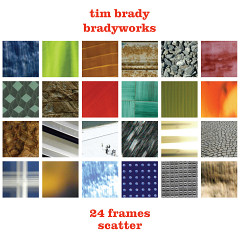
  • 24 Frames — Scatter in Musicworks

    “Review”, Chris Kennedy, Musicworks, no. 113, June 1, 2012
    Friday, June 1, 2012 Press

    Tim Brady’s 24 Frames series (this double CD and its companion 24 Frames—Trance, from 2010) is about precision and virtuosity. Billed as a larger project of “24 compositions… atmospheres… scenarios… [and] ways of playing guitar,” the Scatter discs offer six duos and twelve miniatures (solo pieces) composed by Brady. All are finely crafted, note perfect, and are performed with a pristine timbre— perhaps too pristine for my taste. Brady’s duets expand the virtuosity that’s at play, with him often challenging his fellow musicians to duals with his fret board.

    Jean-Marc Bouchard (baritone sax), Lori Freedman (bass clarinet) and Karen Young (voice) all take the challenge and keep pace with Brady’s sizzling fingers on their respective instruments. Young’s vocal range is particularly impressive and at points she perfectly matches the texture of the distortion that Brady adds to his sounds. The highlight of the duets is a lovely piece with violist Pemi Paull. The warmth of his playing adds a particularly good counterpoint to Brady and encourages a beautiful interlude between some of the more ostentatious work.

    The miniatures disc shows even more of Brady’s talents, with a bit of warm flare overcoming some of the previous showiness. Threefold Scordatura finds him creating nice Frissell-like forays around his guitar, while Delay Tactics sees him creating wild sonic escapades out of the possibilities of four types of delay pedals. Finally, Five Colours ends the collection with a series of descriptive sound colours that end the project on a particularly warm note.

    … finely crafted, note perfect, and… performed with a pristine timbre…

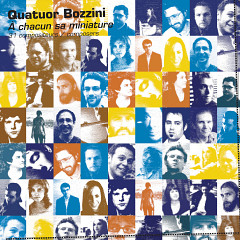
    À chacun sa miniature in Musicworks

    “Review”, Nick Storring, Musicworks, no. 113, June 1, 2012
    Friday, June 1, 2012 Press

    Since 2005 Montréal’s Quatuor Bozzini—leading interpreters of new string-quartet music—have hosted the Composer’s Kitchen, a workshop for emerging composers, where they hone their craft. In 2011 the ensemble approached previous workshop participants, and harvested thirty-one miniatures to celebrate the workshop and to be incorporated into the ensemble’s repertoire. This disc captures this large and widely varied body of pieces.

    The double CD serves as a rare snapshot of Canadian talent born 1969–1985 and features the likes of Cassandra Miller, Emilie LeBel, Olivier Girouard, eldritch priest, and Taylor Brook. While the interests and sound worlds of the individual composers are radically individual, the album’s curation causes it to flow together seamlessly, as though it were one long work, making for a satisfying yet perplexingly uniform listening experience.

    It’s not, however, without moments of surprise. In fact, in spite of the sly, smooth sequencing of the tracks, each piece is still its own tiny discreet world. Eric KM Clark employs blended vocal doublings of the strings amidst a stark microtonal sound world. Jeff Morton’s use of motivic pizzicati interspersed with oddly choked bowed notes is quite striking. Ghislain Lecroulant fleetingly touches upon material with strong ties to Ravel’s String Quartet. Daniel Brandes’ work takes luminous harmonic chords glazed with whistling from the quartet and intercuts the gestures with sharp bursts of noise. The Girouard piece masterfully deploys various techniques to create a cloud of mysterious, purring friction, with few moments that resemble string playing at all.

    As always, the quartet’s execution is clean, precise, and radiant, making this a real treat to listen to, especially since the highlighted composers are seldom recorded elsewhere!

    As always, the quartet’s execution is clean, precise, and radiant…

    Vivaces in Improv Sphere

    “Critique”, Julien Héraud, Improv Sphere, May 31, 2012
    Thursday, May 31, 2012 Press

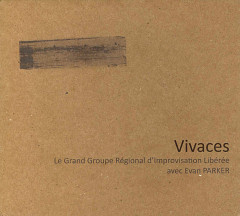
    Pour des raisons souvent aussi économiques qu’esthétiques, l’improvisation se pratique bien plus en petite formation qu’en orchestre à l’heure actuelle. C’est certainement pourquoi je n’avais pas entendu d’improvisation collective, dirigée ou non, mais sous forme orchestrale, depuis maintenant pas mal de temps. C’est donc plutôt avec plaisir que j’ai découvert le GGRIL, accompagné ici d’Evan Parker et de Scott Thomson, un orchestre de 11 musiciens québécois réunis autour d’Éric Normand. Je ne sais pas vraiment si l’initiative de ce projet lui revient, mais Vivaces a néanmoins été publié sur son propre label, et il est le seul musicien que je connaisse à l’intérieur de cet orchestre. Côté instrument, on trouve deux violonistes, deux clarinettistes et un percussionniste, deux guitares et une basse électriques, deux accordéons, un tuba et un trombone, ainsi que les saxophones soprano et ténor d’Evan Parker.

    Ma première surprise en écoutant Vivaces fut tout d’abord l’absence notoire de saxophonistes (hormis Evan Parker, mais qu’on ne peut considérer comme un membre régulier de cet orchestre), et c’est peut-être la première fois que j’entends un orchestre d’improvisation libre où ne se côtoient pas tous les types de saxophones, qu’on pense seulement à l’orchestre d’Alan Silva aussi bien qu’au Globe Unity Orchestra. Fait peut-être anecdotique étant donné la présence d’Evan, mais je ne peux m’empêcher de le signaler étant donné mon amour pour cet instrument…

    La deuxième chose qui m’étonne, en comparaison surtout avec les deux orchestres précités, c’est la facilité avec laquelle s’écoute ces improvisations, et la joie présente dans ces improvisations, deux éléments qui rapprochent le GGRIL du côté de l’ICP plus que des deux précédents orchestres. En tout cas, les improvisations (dirigées par Evan Parker sur la seconde piste, et Raphaël Arsenault sur la troisième, ou totalement libres) sont plutôt massives, sans pour autant manquer d’aération. On se croirait d’ailleurs assez souvent à une séance de sound-painting, notamment sur la troisième piste, qui est peut-être la meilleure du fait qu’Evan Parker assume la fonction de soliste durant son intégralité, mais également grâce à la direction assez fracturée et originale d’Arsenault…. Plus denses qu’intenses, il ne s’agit pas de produire le plus fort volume sonore, ou de multiplier des couches criardes, mais plutôt de construire des pièces où s’empilent des blocs sonores massifs, assez conséquents et souvent énergiques tout de même. Des improvisations pleines de spontanéité, de liberté, et d’écoute, dirigées de manière à ne jamais fatiguer et à nettement entrecouper les différents tableaux. L’improvisation libre marque très fortement cet orchestre, qui n’est cependant pas forcément rigide et n’exclut pas de ses improvisations des lignes mélodiques, des ostinatos, des cycles rythmiques, différentes combinaisons instrumentales et certains autres éléments rejetés parfois trop systématiquement par les européens.

    Des improvisations pleines de spontanéité, de liberté, et d’écoute, dirigées de manière à ne jamais fatiguer et à nettement entrecouper les différents tableaux.

    Jean René in Downtown Music Gallery

    “Victo 2012”, Bruce Lee Gallanter, Downtown Music Gallery, May 30, 2012
    Wednesday, May 30, 2012 Press

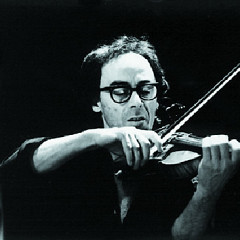
    From a different perspective, the next set also faetured three strings but was completely different. The last set of Day 2 featured a quartet led by Jean René on viola with Joshua Zubot on violin, Nicolas Caloia on acoustic bass and Pierre Tanguay on drums. The sound of this ensemble was like a twisted string quartet with the drums as an equal part. Whereas Zorn’s string players were articulate and tight, this quartet had a looser earthiness, which was wild and chaotic at times. The quartet blended partially written material with frenzied sections and sparse moments as well. Mr. René’s writing seemed to draw from folk/rock as well as the odd classical influence. Sometimes all three strings buzzed together intensely while longtime AM drummer Pierre Tanguay balanced both rhythmic and subtle melodic counterpoint. What was surprising about this set was that you never knew what direction was coming next. Both Josh Zubot on violin and Jean René on viola took a number of inspired solos while the group interplay that was filled with many odd twists and turns. This was music that will take some time to get used to so it is probably a good idea to get Mr. René’s disc on AM (sic!) and dig in deeper.

    What was surprising about this set was that you never knew what direction was coming next.
  • 187
  • 188
  • 189
  • 190
  • 191
  • 192
  • 193
  • 194
  • 195