actuellecd
  • This website is also available in English.

Blog

4946 results
  • 169
  • 170
  • 171
  • 172
  • 173
  • 174
  • 175
  • 176
  • 177
  • We are Back Online!

    Monday, July 15, 2013 General

    Down since Saturday morning July 13, 2013, our website and our emails are again fully operational as of Monday evening July 15. If you have tried to join us by email and your message bounced, you can now write again. We are sorry for all these inconvenients, thank you for your comprehension.

    La femme territoire ou 21 fragments d’humus in The Squid’s Ear

    “Heard in”, Matt Schulz, The Squid’s Ear, July 10, 2013
    Wednesday, July 10, 2013 Press

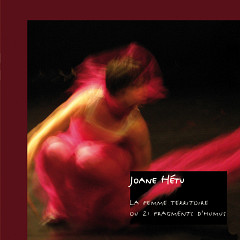
    Joane Hétu’s La Femme territoire ou 21 fragments d’humus is a multi disciplinary piece dedicated to the female experience; sex, death, loss, and the joy of life itself enjoy aural designation on these 21 tracks. Hétu wrings limitless emotion from a myriad of sources with the help of Susanna Hood, Jean Derome, Isaiah Ceccarelli, and Alice Tougas St-Jak. Voice, accordion, woodwinds, and strings interact with field recordings, electronics, and spectral percussion, which in addition to prose and dance add up to a varied and complex work. Every facet of the piece is informed by an avant garde aesthetic as elements of free jazz, musique concrète, and early electronic composition support a vocal narrative that is an intense world of sound unto itself. The vocalists scream, mumble, whisper, and growl (not to mention actually sing), expressing an incredible range of emotion and timbre, even when the words are free of their literal meaning. I do not speak French, so I am missing an entire dimension of this recording, but it’s quite a rich listening experience regardless.

    These diverse elements repeatedly coalesce into sublime vignettes, such as on L’amoureuse, which is a tour de force of vocal gymnastics. Male and female voices advance the limits of human ability beginning with broken, sputtering non-language that closely resembles the bushmen’s chatter from The Gods Must Be Crazy. This particular “fragment” alternates between passages of unison recitation and extended vocal and musical techniques before resolving into a dizzying climax of whispering. Fragment amour saunters in like an elephant on roller skates with alien sounds that could be air escaping a balloon or tape manipulation, followed by sensuous breath and arcing, bent saxophone notes. Nue features interesting moments where unison voices strike harmonies with each other and produce chords that eventually waver in and out of pitch. The song eventually falls into a dissonant refrain before returning to more vocal harmonizing. This CD is remarkable in every way, with an exceptional recording capturing some truly remarkable pieces of sound art. Not to be missed.

    Not to be missed.

    Annunciations in Revue & Corrigée

    “Chronique”, Cyrille Lanoë, Revue & Corrigée, July 1, 2013
    Monday, July 1, 2013 Press

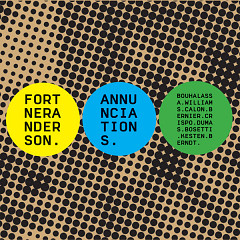
    Fortner Anderson est un poète performer originaire du Midwest américain vivant à Montréal. Un exil qui dure et qui a trouvé plusieurs connexions dont celle avec la bouillonnante scène montréalaise autour des activités du lieu La Casa del Popolo, qui a vu naitre notamment les projets autour du groupe post-rock-progressif Godspeed you! black emperor. Des connexions aussi avec sa scène des musiques électroacoustiques via des collaborations avec Alexandre St-Onge et Sam Shalabi. Quatrième disque à son actif, Annunciations est construit sur un système de “commande”, un peu comme le disque de Thurston Moore Root (lo-recordings, cd/lp, 1999) sur lequel le guitariste convoque trente artistes à remixer des parties guitares créées par Thurston pour l’occasion. La variante ici est que l’on a donné des textes à lire au poète et qui ont ensuite été remis à plusieurs artistes issus principalement des sphères des musiques électroacoustiques au sens large: Ned Bouhalassa, Andy Williamson, Christian Calon, Nicolas Bernier, Martine Crispo, Chantal Dumas, Alessandro Bosetti, Christian Kesten et John Berndt pour en faire bien sur bon usage, dans des créations sonores qui sonnent évidemment poésie sonore et musique électroacoustique. Trois cd encartonnés et un livre (que je n’ai pas eu avec la copie promo et dont je ne peux évidemment moins vous parler). Une présentation à s’y méprendre avec les structures en place telles DAME et Empreintes Digitales. Nous ne sommes malgré tout pas véritablement dans de la poésie sonore telle qu’on l’entend (ne vous attendez pas à du Paul Dutton par exemple), mais plus dans de la lecture, dans le spoken word. Lecture de textes choisis à tendance environnementale et politique. Autour de textes sur les changements climatiques, sur Guantanamo ou encore sur des rapports de missions spatiales, Fortner Anderson a toutefois réinterprété ces textes sous une forme poétique. Surtout sur la pièce de Chantal Dumas, It’s a small world. Celle d’Alessandro Bosetti est plus que surprenante, virant chanson minimale proche de Ghedalia Tazartés ou David Fenech, voire Robert Wyatt. Quand je vous dit surprenant. Dans l’écoute chronologique des trois cds, cette pièce It Is Amazing (C’est surprenant, en français, ndlr) (Gesualdo’s waterboarding) tombe à pic. Et annonce le meilleur cd des trois. Non pas que je m’ennuie, mais pas forcément surpris jusque là. Dû surement aussi au texte pas facile à digérer puisque très pregnant, pour nous non-anglophones. Donc on s’en remet au sonore, qui lui était jusque là un peu formel, sans éclat. Décidément ce troisième cd compile les trois pièces les plus expérimentales, celle de Christian Kesten avec un vrai remix et un travail sur les hésitations et le souffle naturel de Fortner Anderson, qui prend à contre-pied tout le monde, personne n’y ayant pensé jusque là. Pour finir sur une composition plus tendue par John Berndt. Parfois proche du spoken word de Jello Biafra (ex Dead Kennedys) qui a lui aussi travaillé sur Guantanamo sur son disque Jello Biafra & the Guantanamo School of Medicine, voire Henry Rollins. J’ai mis beaucoup de temps à essayer de comprendre ce disque. Pas véritablement facile d’accès pour moi. Bien content malgré tout d’avoir insisté et découvert ce formidable troisième disque.

    … formidable troisième disque.

    Hemlock in The New York City Jazz Record

    “Globe Unity Canada: Ratchet Orchestra”, Ken Waxman, The New York City Jazz Record, July 1, 2013
    Monday, July 1, 2013 Press

    Characterized by Americans as polite northern cousins who enjoy universal health care and little gun violence, Yanks don’t appreciate the current of outright quirkiness that courses through many Canadian endeavors, especially when it comes to creative music. It may be because Canuck popsters from Paul Anka to Justin Bieber as well as the likes of Rush and Joni Mitchell are quickly subsumed into the Yank music industry, but remembering that comedians such as Jim Carrey and Mike Myers hail from North of the 49th parallel may provide a glimpse of some Canadians’ mindsets.

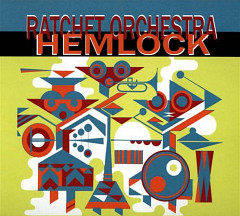
    Take for instance the releases here. During the performance by Montréal’s Ratchet Orchestra conducted by Nicolas Caloia, the group wraps textures from a legato string section around not only multifold rhythms referencing rock and Latin music, but strong soloists and eccentric arrangements that would be at home in any contemporary big band. Often intimations of one genre are quickly superseded by the next. Dusty for instance appears ready to become A Train until altissimo reed squeals that could come from Sun Ra’s Arkestra meld with gutbucket trombone slurs and cross-pulsed guitar passages to dissolve and reconfigure the theme. Similarly near-baroque flute flutters, harmonized with linear clarinet puffs and vibraharp pulsations which make up the moderato and legato melody on Safety move out of their safety zone as quivering horn vibrations or string glissandi menacingly and contrapuntally color or comment on the exposition. Although other tracks centre around exciting strategies ranging from marching-band replications to a face-off between Afro-Cuban percussion and triple spiccato string lines, the session-defining showcase is the two-part title track. Resounding from earth-shaking vibrations to those which could baffle a dog’s hearing, cacophonous and multiphonic smears, screeches and whistles pull back to reveal nuanced finger-style guitar licks and vibrating electric piano lines. Hearty percussion thumps are muted and horn squeaks fades until a final spiritual-like lyric line from a single violinist signals the end point. […]

    Each of these notable discs could destroy any outsider’s supposition about the conventionality of Canadian created music. As a matter of fact it may cause jazzers to wonder just what a Canuck has in his or her instrument case.

    Each of these notable discs could destroy any outsider’s supposition about the conventionality of Canadian created music. As a matter of fact it may cause jazzers to wonder just what a Canuck has in his or her instrument case.

    Bruit court-circuit in The Squid’s Ear

    “Heard in”, Dave Madden, The Squid’s Ear, June 19, 2013
    Wednesday, June 19, 2013 Press

    When is one allowed a free pass to use “super” in the title of his / her band name? If you boil down the CV of those participating in Bruit court-circuit, you get a PhD in art, one in composition, collaborators with Jandek, Chris Cutler, Fred Frith, Joëlle Léandre, Zeena Parkins; a co-founder of Ambiances Magnetiques, a former touring member of Gilles Ste-Croix’s horse circus Cheval-Théâtre, an educator of improvised music (presented to 4th and 5th grade classes) and the lynchpin triangle of Michel F Côté, Alexandre St-Onge and Martin Tétreault, a trio connected five degrees or less with everything exciting in Montréal during the past decades. Violin (Guido Del Fabbro), cello (Émilie Girard-Charest), turntables (Tétreault), microphone manipulation (Côté), saxophones and objects (Jean Derome, Joane Hétu), lots of percussion (Danielle Palardy Roger, Côté), synth (Vergil Sharkya’), electric bass (St-Onge) — SuperMusique works for me.

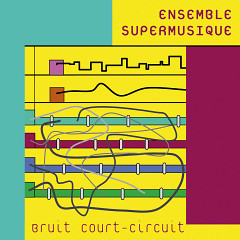
    Bruit court-circuit is not so much a story but a theatrical event where abrupt scene (ry) and costume changes and blurring performer lines keep the audience in continual transport (the clues of pending shifts are roughly scrawled graphic scores on the cover art). For example, the opener “Malgré tout face A” begins with an uninspired rock drum groove, but we’re only four bars in before the discord of a two-minute rivulet of declarative, dotted bursts from all participants skews the direction; each player’s multi-variations here, from hardbop runs to R&B licks to fizzing wah-wah to pointillism to hints of Serialism to Bartok quotes to someone’s metal growl of “électrocution!”, declare “prepare to be astounded”. Without notice, the work breaks with an intermission of tapping / blips / sforzando and moves to a soothing female spoken-word performance with the ensemble punctuating and creating subtle intrigue alongside the recitation. Just as the drama is about to peak, the woman’s voice skips, continues on with just the repetition of “le spécimen moderne” and the sound a turntable makes when you bump into it, and you note the illusion and play on recorded medium (presumably) Tétreault just pulled. Clever boy.

    Acouphènes en partage (translated as “sharing in tinnitus”) breathes like passive Gagaku with a group effort of high-pitched, sustained notes and “natural” (as in the random “placement” sounds you hear walking down the street) thumps and ticks, the players eventually embellishing with vibrato and breaking the steady tandem texture as an overwhelming deep tone sneaks in underneath. And then a switch to rumbling motors and a sine wave to mess with your tinnitus, and then passages of warbling reeds, a culminating blend of these elements, a disruption of Del Fabbro and Girard-Charest pinching and grinding strings.

    On paper, Bruit court-circuit appears confusing and odd — in a bad way; summaries of individual tiles that are “occasional down-on-the-prairie fiddle duo sweetness ties an abandoned, irradiated city together” (Poème à faible résistance) and “a repeating squeal works into an arcade game Boss Battle theme” (Le fruit du hasard) are curious and accurate, but don’t do justice to the aural representation and pattern of the mosaic. Unfortunately for those who aren’t following along with the music in their ears, this unique, vibrant, genre-splattering mix begs a listen to appreciate the meld of Ensemble SuperMusique’s technical and creative prowess and virtuosic structural / improvisation narrative. So get on that.

    unique, vibrant, genre-splattering mix
  • 169
  • 170
  • 171
  • 172
  • 173
  • 174
  • 175
  • 176
  • 177