actuellecd
  • This website is also available in English.

Blog

4946 results
  • 129
  • 130
  • 131
  • 132
  • 133
  • 134
  • 135
  • 136
  • 137
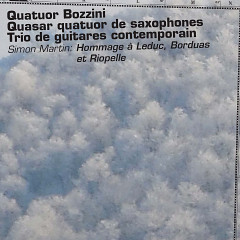
  • Simon Martin: Hommage à Leduc, Borduas et Riopelle in Voir

    “Critique”, Réjean Beaucage, Voir, January 6, 2016
    Wednesday, January 6, 2016 Press

    Simon Martin est un jeune compositeur de musique d’art (terme qu’il préfère à «musique de concert» ou «musique contemporaine», entre autres). Les trois pièces recueillies ici sont le fruit de réflexions sur des œuvres de grands peintres québécois: Ozias Leduc (L’heure mauve, 1921), Paul-Émile Borduas (le texte Projections libérantes, 1949) et Jean-Paul Riopelle (la série des Icebergs, 1977). Elles sont interprétées avec brio, respectivement par le Trio de guitares contemporain, le quatuor de saxophones Quasar et le Quatuor Bozzini. Il s’agit d’invitations à la contemplation dans lesquelles, comme l’explique le compositeur, le sonore a préséance sur le musical. Inspirant. Le programme sera repris intégralement par ces mêmes interprètes le 20 mai prochain au Festival des musiques de création, à Jonquière.

    Il s’agit d’invitations à la contemplation dans lesquelles, comme l’explique le compositeur, le sonore a préséance sur le musical. Inspirant.

    Rêves de béton in Vital

    “Review”, Frans De Waard, Vital, no. 1007, January 1, 2016
    Friday, January 1, 2016 Press

    From Canada hails Galerie Stratique, also known as Charles-Emile Beullac, and this is fourth release, in fifteen years. He calls himself a sound hunter and his music is all about applying concrete sounds to electronics, and perhaps vice versa. There is a small booklet inside ‘Dreams of Concrete’, as the title translates, in which he explains his influences, a list of stuff (which includes gongs, clay bells, metal bowls filled with some water, but also a Commodore 64, drum machines, effect pedals and roll paper towels. To Galerie Stratique everything is music. There are twenty-one pieces on the first CD, which is the main thing in this package. On the other disc, ‘Archives Volume 1’, there is a bunch of ambient lullabies from his earlier days, that weren’t good enough for his previous releases, but now, polished and refined, are. What I like about the first disc is the simply approach Galerie Stratique has going per piece. Twenty-one songs in forty minutes that equals, say, two minutes average per track. That makes that all of this is short and to the point.

    A few bangs here and there, feeding them through a modular set-up and play around with these sparse elements for two minutes is sometimes really enough. To be concise is not easy, but Galerie Stratique does things very well. Each piece is made with quite some imagination, and also the variation is well considered on this album. An excellent mixture of electronic tunes, melodic, witty at times, and a majority of more abstract pieces, that quirky, sad, uplifting, alien and sometimes tedious. With such a variety that is likely to happen.

    The bonus disc contains also forty-one minutes, but then ten pieces, so here all is a bit longer and we are promised more ambient like music. That’s what we get indeed. Lots of synthesizers, a bit of drum machines and it seems there is a lot less of electronic processing of acoustic sound material. There is a more minimal approach towards composition here, with synth washes being an obvious connection, but it’s not exclusively like that. Galerie Stratique also plays out some harshertones and tunes such as in the fifth piece (no titles for the pieces on this bonus disc). When he employs a rhythm, I must say I am a little less interested, but luckily those tracks are kept to a minimum. In general this is all a bit different than the first CD, and even while there is a bit of variation in these pieces, I am also inclined to think it’s perhaps a bit superfluous, but surely fans would disagree with me.

    To be concise is not easy, but Galerie Stratique does things very well.

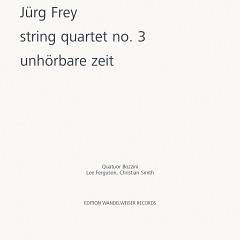
    String Quartet No. 3; Unhörbare Zeit in Fluid Radio

    “Review”, Nathan Thomas, Fluid Radio, January 1, 2016
    Friday, January 1, 2016 Press

    It begins, I suppose, with a title. For his third string quartet, Swiss composer Jürg Frey combines elements immediately recognisable to anyone who’s been following his work over the past decade or two with ones that might initially surprise, even if they too seem strangely familiar. So there’s the opening slow homophonic chords separated by long pauses, followed by a very quiet shimmering as the Quatuor Bozzini gently scratch their bows across their strings. So far, so Frey. But the chords sometimes fall into patterns that draw on cadences and sequences so common to Western classical music that they could have been lifted from a piece by Beethoven or Schubert — a tendency perhaps often latent in Frey’s music, but never so explicit (as far as I’ve heard) than here. Then there’s the gorgeous, swooning, long descent by a violin, like a falling ray of light, that gets passed on to the viola. Has the music of the Wandelweiser group’s most Romantic composer ever been more Romantic than this?

    That title, though. Can it be possible today to write a string quartet without trying to work through a relationship to the history of the form and, by extension, pretty much the whole of Western orchestral music? Those familiar cadences and patterns strain for weightlessness — the ahistorical presence of light and volume. They don’t quite make it. Yet the shortfall, the gap between the certainty and inevitability they aim for and the precarity they land in, would itself seem part of the work, a negative space in which time runs backwards. I’m thinking of Rachel Whiteread’s House (1993), a concrete cast of the inside of a Victorian terraced house, with the imprint of doors, windows, and fireplaces left visible: architecture gaining historical consciousness. Could a string quartet become similarly self-aware? Listen to those chords: they are not random, certain among them repeat, so obviously that even I can hear it. They recall not just each other, but also a certain way of belonging together in time, a belonging that is itself a reference to another age of possibilities. These sounds remember, even as they strive for instantaneity. They desire both remembering and fading into silence, two times at once. For how much longer will anyone be able to write string quartets, anyway?

    The second piece on the Bozzini recording, Unhörbare zeit, adds two percussionists to the ensemble, and emphasises the string quartet’s Romantic leanings with its contrastingly more open and exploratory style. There’s lots of shimmering, rumbling constellations of sound, an indistinct haziness that beguiles the ear. A call-and-response section of sorts is followed by high-pitched, almost screeching chords, then more gently, a sort of tip-toeing around. The work ends with a repeated two-chord dirge followed by a third, tense chord. Compared with the string quartet, Unhörbare zeit doesn’t shower the listener with beautiful melodies or overt Romantic references, nor does it wrestle with its relationship to the ghosts of music past; perhaps this results in a less challenging listen, though nonetheless an absorbing one.

    There’s lots of shimmering, rumbling constellations of sound, an indistinct haziness that beguiles the ear.

    String Quartet No. 3; Unhörbare Zeit in The Guardian

    “Jürg Frey: Third String Quartet CD review — an audaciously fragile performance”, Kate Molleson, The Guardian, December 17, 2015
    Thursday, December 17, 2015 Press

    Swiss composer Jürg Frey said recently that all good music should be felt in some part of the body, and that his music is intended to be felt just inside of the ear drum. It’s a neat image from the master of calm instrumental textures — a Wandelweiser group composer who explores silence as much as sound and writes egoless music that feels as though it’s always existed. Montréal’s Bozzini Quartet gave a virtuosically still performance of his Third String Quartet at this year’s Huddersfield Contemporary Music festival, and the group’s recording of the half-hour piece is beautiful for the up-close, quiet, grainy realness of the string timbres, every bow hair and every arm quiver audible. It’s an audaciously fragile performance. Also on the disc is an earlier Frey work, Unhörbare Zeit (Inaudible Times), made of danker chords and even longer open vistas.

    The group’s recording of the half-hour piece is beautiful for the up-close, quiet, grainy realness of the string timbres
  • 129
  • 130
  • 131
  • 132
  • 133
  • 134
  • 135
  • 136
  • 137