actuellecd

Blog

101 results
  • 8
  • 9
  • 10
  • 11
  • 12
  • 13
  • 14
  • 15
  • 16
  • 21st-Century Canadian Snare Drum in HörBar

    “Kritik”, Martin Hufner, HörBar, March 12, 2026
    Friday, March 20, 2026 Press

    Good heavens. A double CD of contemporary Canadian music for snare drum. Is this even acceptable? Can anyone stand it? What? You can, you must, you should. Absolutely. Don’t worry. Even though the snare drum, played by Ryan Scott, is at the center of this “project” funded by the Ontario Arts Council and the Canada Council for the Arts, other percussion instruments also feature, such as the bass drum, large drum, cymbal, metal plates, and various types of recorded tracks.

    But the result is a really awesome musical puzzle. Even though it actually starts on CD 1 with pure snare drum sound played using completely conventional drumming techniques. Yeah, and at first that fuels the fear that you’re going to be stuck with this super-boring stuff for the next few hours. Think so? You better listen!

    But these worlds that Ryan Scott and the fourteen composers develop, unravel, and weave together are, in a figurative sense, like strolling through an exhibition of contemporary visual art. Each composition stands on its own—or rather, sounds on its own—and invites quiet contemplation, or rather, attentive listening. Sometimes it’s delicate, sometimes epically hazy, and sometimes crystal clear.

    A must-listen! A kaleidoscope of sound and percussion artistry, free of any self-pity or pretentious posturing; a celebration of diversity that’s a joy to experience.

    A must-listen! A kaleidoscope of sound and percussion artistry, free of any self-pity or pretentious posturing; a celebration of diversity that’s a joy to experience.
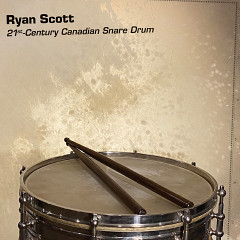
    21st-Century Canadian Snare Drum in Seismograf

    “Anmeldelser”, Simon Heggum, Seismograf, March 9, 2026
    Tuesday, March 10, 2026 Press

    Let’s be honest: when you think of composed music for solo instruments, the snare drum is probably not the first thing that comes to mind. It may be the noisiest member of the percussion family and has been setting the volume level in everything from classical music to pop for decades. That’s why I pricked up my ears when the Canadian percussionist Ryan Scott announced an entire album of works for snare drum — written by 14 different composers. A full hour and a half of music, no less. And yes, that sounds like a lot for a record that mainly consists of a single drum. But there is definitely something to discover here.

    The opening, Andrew Staniland’s ANTIGRAVITYDRUM, blends free jazz with inspired use of percussive vibraphone, while Beka ShappsSkinscape IV sends the drum strokes through ring modulation and extensive sound processing, bringing us close to musique concrète. Christina Volpini’s only ghost slips into horror territory with march-drum-inspired bursts and ghostly use of the snare drum’s high register, while Amy Brandon’s Time and Effort almost becomes a demonstration of the instrument’s technical possibilities.

    Fourteen works over ninety minutes is a substantial mouthful. The snare drum’s limited tonal vocabulary means that you occasionally lose focus, even after several listens, and the contrast between drum strokes and silence is repeated a little too often. That said, Ryan Scott and the composers get just about as much out of what is essentially a glorified marching drum as one could hope for. I was both entertained and intrigued along the way. As an experiment, the idea is strong — but in the long run also a bit too insistent for me to return to often. Still, one should not underestimate the versatility of a good old-fashioned snare drum.

    … definitely something to discover here […] I was both entertained and intrigued…

    21st-Century Canadian Snare Drum in Bandcamp Daily

    “Review”, Peter Margasak, Bandcamp Daily, March 6, 2026
    Tuesday, March 10, 2026 Press

    Percussionist Ryan Scott, a longtime fixture on the Toronto contemporary music scene, commissioned a slew of fellow Canadians to write pieces for him that placed the snare drum at their center. The 14 resulting pieces collected on this double CD respond to his prompt in a dizzying variety of ways—whether drawing in electronics, spoken word samples, or extended techniques, reflecting modern percussion aesthetics or dipping into style-colliding excursions. The visceral Bekah Simms piece Skinscape IV revolves around friction to underline the connection between the musician and an electronically-mediated iteration of their instrument. Scott generates a kaleidoscopic array of sounds produced by scratching a saxophone reed across the surface of snare amid the din of electronically-processed, snare-derived gestures. Brian Current’s Infantry draws out the snare’s role in military culture, transcribing into snare parts the vocal patterns in performed texts that were drawn from historical letters of soldiers, a la Peter Ablinger’s Voice and Piano. On the other hand, Michael Oesterle’s Hush opts for limited means, an all-acoustic dynamo of intricate, shape-shifting pattern variations using only drumsticks on the snare surface and the rims, a raucous reduction that’s among the most transportive works on the album. It’s a lot to take in at once, but the variety and range of the collection—which also includes strong work from Jason Doell, Christina Volpini, and Kati Agócs, among others — is impressive considering the humble core of the music.

    The 14 resulting pieces collected on this double CD respond to his prompt in a dizzying variety of ways—whether drawing in electronics, spoken word samples, or extended techniques, reflecting modern percussion aesthetics or dipping into style-colliding excursions.

    21st-Century Canadian Snare Drum in Aiding & Abetting

    “The drum is the thing”, Jon Worley, Aiding & Abetting, March 2, 2026
    Friday, March 6, 2026 Press

    Um, this is fourteen new compositions played by Ryan Scott on a snare drum (with occasional accompaniment). That’s it. This is not a complicated album.

    Gotcha! Scott utilizes a wide variety of techniques and plays parts of the drum in unusual ways. These pieces sound less like percussion overload than adventures in sound, period. In other words, if you think you know snare, you really don’t.

    Having known a number of percussionists over the years (including folks who play in symphonies, etc.), I can attest that every single one of them has dreamed of a project like this. Most have screwed around with their equipment in many (if not all) of the ways Scott does here. But to take those random experiments and use those sounds to play real compositions? That’s kinda mindblowing.

    Oh yes, this is one of those “music critics just like weird shit” albums. Of course. But peel back that layer, and this is also a set of modern compositions that not only push the performative power of the percussionist but also succeed as powerful pieces of music as well. Sometimes when the weird get going, greatness happens. Wild, inventive and a true blast to contemplate.

    … this is also a set of modern compositions that not only push the performative power of the percussionist but also succeed as powerful pieces of music as well. Sometimes when the weird get going, greatness happens. Wild, inventive and a true blast to contemplate.

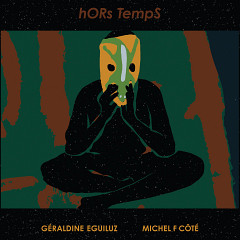
    hORs TempS in The WholeNote

    “Review”, Yoshi Maclear Wall, The WholeNote, no. 31:4, March 1, 2026
    Friday, March 6, 2026 Press

    Reversed tape loops, strummed micro gestures and percussive elements sourced from increasingly esoteric places encircle some­thing less akin to a pulse than some greater subtextual unifying logic. The source of these seemingly endless subtle sonic events — be it primary or found — does not grab you as much as the question of their seamless coexistence.

    This is music that journeyed quite a ways to get here; somehow all that you are hearing is born from the early 1990s when Géraldine Eguiluz was in Paris, and recorded some sounds on cassettes. Returning to one’s work after a prolonged span of time can perhaps come with an inherent freshness and Eguiluz warped, molded, deconstructed, recontext­ualized and eroded the sounds on these tapes through collage which is another category of introspective creation. Take Territoires perdus #3 for instance, where from a handful of vocal tracks stem harmonies that feel like they are only attained through this medium, as sustained breathy backgrounds envelop heavily edited streams of gibberish, creating a unique atmosphere of uncanniness and one of the many inscrutably hyper specific feel­ings achieved throughout this project. Adding Michel F Côté ostensibly adds an entire additional process to the creative mix, as he is another universe in himself with all the audial information he is able to generate through countless means. Around track five, the “how” becomes less enthralling than the “what.”

    Take Territoires perdus #3 for instance, where from a handful of vocal tracks stem harmonies that feel like they are only attained through this medium, as sustained breathy backgrounds envelop heavily edited streams of gibberish, creating a unique atmosphere of uncanniness and one of the many inscrutably hyper specific feeings achieved throughout this project.
  • 8
  • 9
  • 10
  • 11
  • 12
  • 13
  • 14
  • 15
  • 16