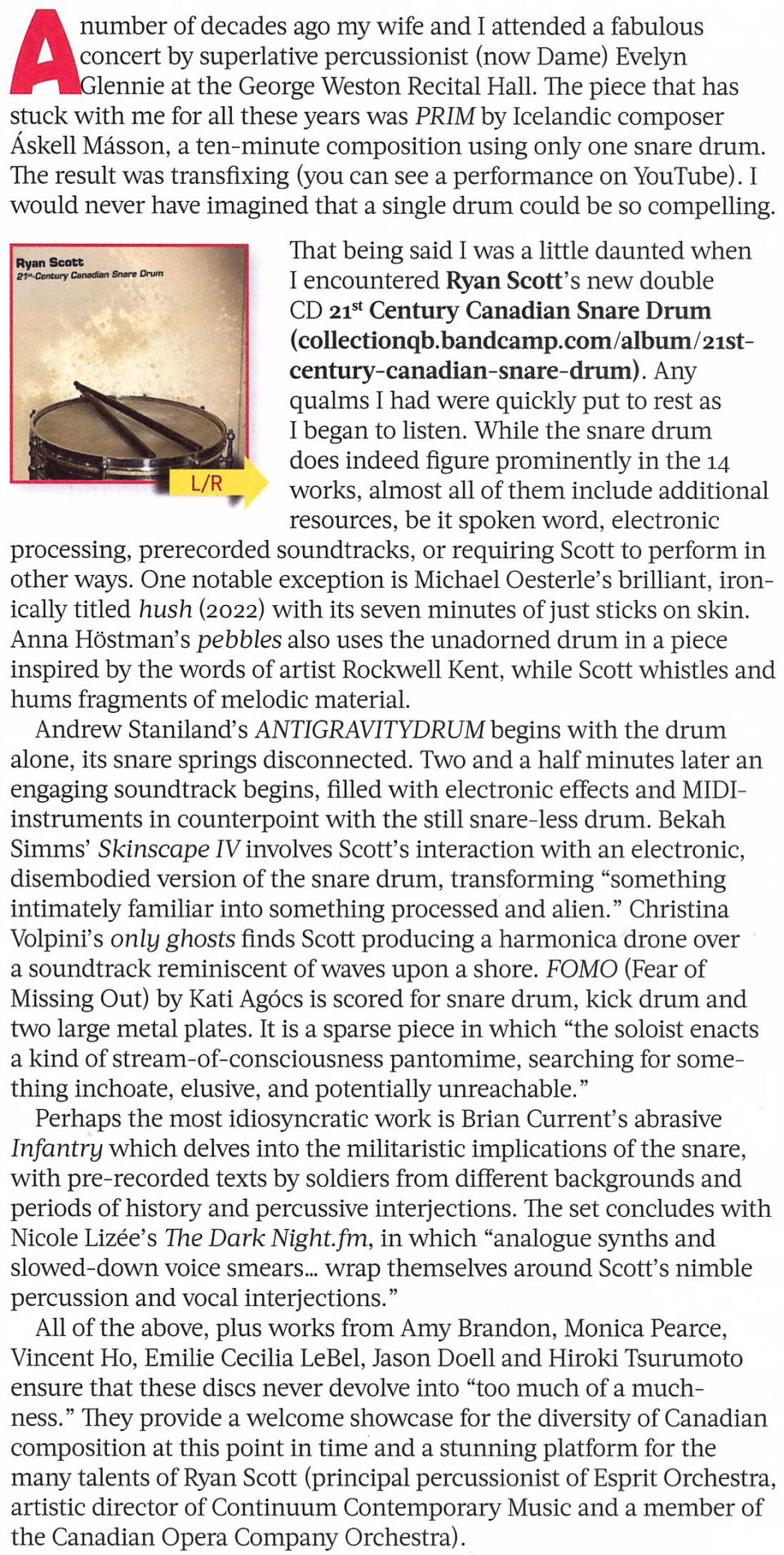
actuellecd

21st-Century Canadian Snare Drum

Ryan Scott

This is music that both acknowledges and seeks to transcend the historical limitations and martial origins of what, in Scott’s hands at any rate, is a compellingly versatile instrument. Musicworks, Canada

Scott’s playing is superb throughout, his concentration and sense of intent palpable. Riveting stuff, then, and stunningly engineered… The Arts Desk, UK

Ryan Scott, championed by Gramophone as “a chameleon-like virtuoso,” presents 21st-Century Canadian Snare Drum, a double-disc release of solo snare drum pieces. The instrument is the centrepiece throughout the album—it’s about the art of the drumming itself, but most works include minimal auxiliary instrumentation, electroacoustics, vocalizations or some combination thereof, alongside a wide variety of techniques spanning traditional virtuosity to inquisitive-minded peculiarity. As such, the snare drum solo serves almost as a conceptual restriction to stimulate the imaginations of its exceptional and internationally-recognized cast of commissioned Canadian composers.

  • Ontario Arts Council (OAC)

2 × CD-R (CQB 2637, 2026)

Disc 1

Disc 2

  • Label: Collection QB
  • CQB 2637
  • 2026
  • UCC 771028373727
  • Total duration: 101:25
  • Sympathique case
  • 126 mm × 126 mm × 5 mm
  • 50 g

Download (CQB 2637_NUM, 2026)

  • Label: Collection QB
  • CQB 2637_NUM
  • 2026
  • UCC 771028373789
  • Total duration: 101:25
Liner notes

About this album

This project centres on the snare drum — an instrument heard daily around the world and, for percussionists, a benchmark of technical precision. Toronto-based percussionist Ryan Scott presents the premiere of fourteen new solo works by Canadian composers, each created specifically for this project through commissions supported by the Canada Council for the Arts.

The collection spans a wide range of approaches. All works emphasize traditional and extended snare drum techniques in acoustic practice, while some also incorporate electronics and alternative sound sources.

Together, these pieces add new solo works to the international percussion repertoire. For performers, they offer material reflecting the challenges and possibilities of contemporary practice. For listeners, they reveal the snare drum as a solo instrument of depth and versatility, while providing a compelling portrait of Canadian composition today.

— [i-26]

Some recommended items
In the press

Review
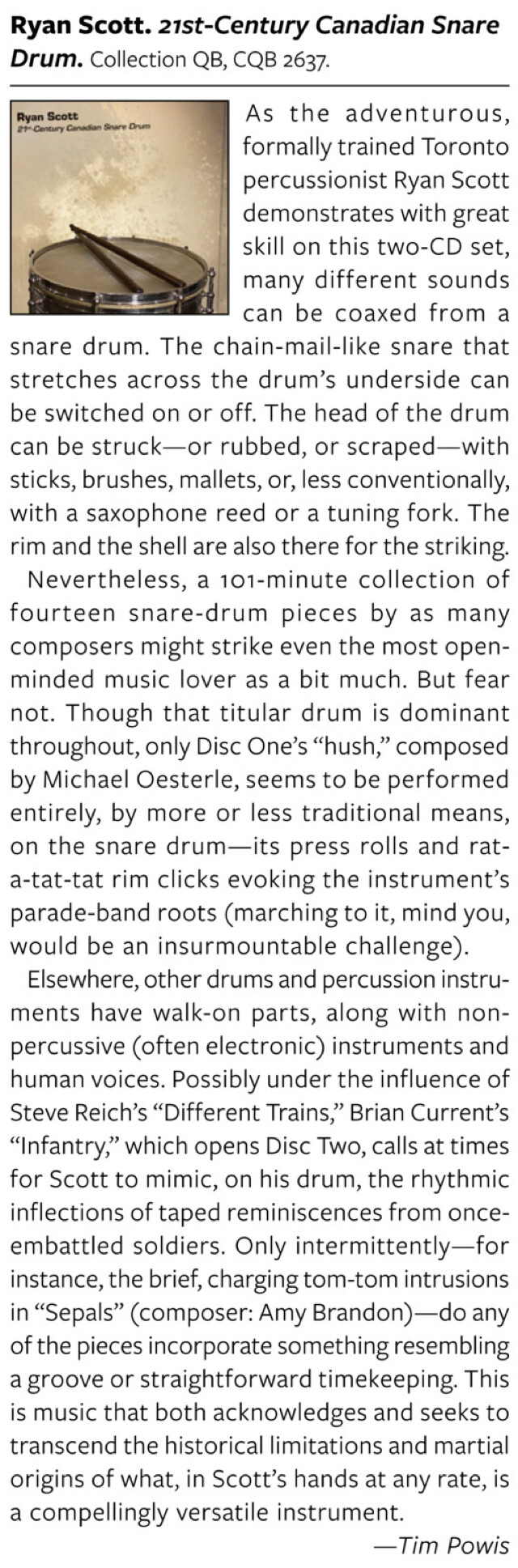
Tim Powis, Musicworks, no. 154, August 1, 2026

As the adventurous, formally trained Toronto percussionist Ryan Scott demonstrates with great skill on this two-CD set, many different sounds can be coaxed from a snare drum. The chain-mail-like snare that stretches across the drum’s underside can be switched on or off. The head of the drum can be struck—or rubbed, or scraped—with sticks, brushes, mallets, or, less conventionally, with a saxophone reed or a tuning fork. The rim and the shell are also there for the striking. Nevertheless, a 101-minute collection of fourteen snare-drum pieces by as many composers might strike even the most openminded music lover as a bit much. But fear not. Though that titular drum is dominant throughout, only Disc One’s hush, composed by Michael Oesterle, seems to be performed entirely, by more or less traditional means, on the snare drum—its press rolls and rata-tat-tat rim clicks evoking the instrument’s parade-band roots (marching to it, mind you, would be an insurmountable challenge).

Elsewhere, other drums and percussion instruments have walk-on parts, along with non-percussive (often electronic) instruments and human voices. Possibly under the influence of Steve Reich’s Different Trains, Brian Current’s Infantry; which opens Disc Two, calls at times for Scott to mimic, on his drum, the rhythmic inflections of taped reminiscences from once embattled soldiers. Only intermittently — for instance, the brief, charging tom-tom intrusions in Sepals (composer: Amy Brandon) — do any of the pieces incorporate something resembling a groove or straightforward timekeeping. This is music that both acknowledges and seeks to transcend the historical limitations and martial origins of what, in Scott’s hands at any rate, is a compellingly versatile instrument.

This is music that both acknowledges and seeks to transcend the historical limitations and martial origins of what, in Scott’s hands at any rate, is a compellingly versatile instrument.

Review

Graham Rickson, The Arts Desk, August 1, 2026

My one gripe with this interesting double album is the lack of sleeve notes; there’s a track listing and a brief overview but nothing else. I did find a useful interview with percussionist Ryan Scott on Canada’s Ludwig Van Toronto website, Scott explaining that he chose to use the snare drum “because it’s really the mother instrument of percussionists” — if you can master the snare drum, it’s likely that you’ll be able to master other percussion instruments. 14 contemporary composers were commissioned to write new works, Scott setting them no limits. There’s an enjoyably eclectic mixture here, various pieces adding extra instruments or electro-acoustic enhancements. Frequently you can’t quite believe what you’re hearing, especially when listening through headphones. Sections in Bekah SimmsSkinscape IV are like being caught in a blizzard, while the opening of Vincent Ho’s Snap Noir could be mistaken for lowing cattle.

Scott’s own breath and voice become increasingly prominent in Emilie Cecilie LeBel’s heirloom and we hear him singing and whistling in The Far Night.fm by Nichole Lizée. A prominent electronic drone in Christina Volpini’s only ghosts threatens to steal Scott’s thunder, the two voices eventually finding equilibrium, and a resonant bass drum rings out, bell-like like in Sepals by Amy Brandon. Scott’s playing is superb throughout, his concentration and sense of intent palpable. Riveting stuff, then, and stunningly engineered — if you fancy stepping out of your comfort zone this weekend, try this.

Scott’s playing is superb throughout, his concentration and sense of intent palpable. Riveting stuff, then, and stunningly engineered…

Review

David Olds, The WholeNote, no. 31:6, July 1, 2026

A number of decades ago my wife and I attended a fabulous concert by superlative percussionist (now Dame) Evelyn Glennie at the George Weston Recital Hall. The piece that has stuck with me for all these years was PRIM by Icelandic composer Áskell Másson, a ten-minute composition using only one snare drum.

The result was transfixing (you can see a performance on YouTube). I would never have imagined that a single drum could be so compelling.

That being said I was a little daunted when I encountered Ryan Scott new double CD 21st-Century Canadian Snare Drum. Any qualms I had were quickly put to rest as I began to listen. While the snare drum does indeed figure prominently in the 14 works, almost all of them include additional resources, be it spoken word, electronic processing, prerecorded soundtracks, or requiring Scott to perform in other ways. One notable exception is Michael Oesterle’s brilliant, ironically titled hush (2022) with its seven minutes of just sticks on skin.

Anna Höstman’s pebbles also uses the unadorned drum in a piece inspired by the words of artist Rockwell Kent, while Scott whistles and hums fragments of melodic material.

Andrew Staniland’s ANTIGRAVITYDRUM begins with the drum alone, its snare springs disconnected. Two and a half minutes later an engaging soundtrack begins, filled with electronic effects and MIDI-instruments in counterpoint with the still snare-less drum. Bekah SimmsSkinscape IV involves Scott’s interaction with an electronic, disembodied version of the snare drum, transforming “something intimately familiar into something processed and alien.” Christina Volpini’s only ghosts finds Scott producing a harmonica drone over a soundtrack reminiscent of waves upon a shore. FOMO (Fear of Missing Out) by Kati Agócs is scored for snare drum, kick drum and two large metal plates. It is a sparse piece in which “the soloist enacts a kind of stream-of-consciousness pantomime, searching for something inchoate, elusive, and potentially unreachable.”

Perhaps the most idiosyncratic work is Brian Current’s abrasive Infantry which delves into the militaristic implications of the snare, with pre-recorded texts by soldiers from different backgrounds and periods of history and percussive interjections. The set concludes with Nicole Lizée’s The Dark Night.fm, in which “analogue synths and slowed-down voice smears… wrap themselves around Scott’s nimble percussion and vocal interjections.”

All of the above, plus works from Amy Brandon, Monica Pearce, Vincent Ho, Emilie Cecilia LeBel, Jason Doell and Hiroki Tsurumoto ensure that these dises never devolve into “too much of a much-ness.” They provide a welcome showcase for the diversity of Canadian composition at this point in time and a stunning platform for the many talents of Ryan Scott (principal percussionist of Esprit Orchestra, artistic director of Continuum Contemporary Music and a member of the Canadian Opera Company Orchestra).

All of the above… ensure that these discs never devolve into “too much of a much-ness.” They provide a welcome showcase for the diversity of Canadian composition at this point in time and a stunning platform for the many talents of Ryan Scott.

Review

Baze Djunkiii, nitestylez.de, May 23, 2026

Another recent album put out on the circuit on the Collection QB label on February 13th, 2k26 is 21st-Century Canadian Snare Drum, a nearly 100 minutes spanning 2CD longplay release by Toronto’s percussion icon that is Ryan Scott who, instead of presenting an extended solo take on his instrument of choice, a sole showcase of virtuosity, precision and his innate technical mastery, chose a different path, commissioning composers to write pieces with a distinct emphasis on the snare drum, yet with — for the most part that is — complimentary layers, minimalist often, yet also clearly distinguishable, adding depth, meaning and atmosphere to a body of work consisting of fourteen brand new works laid out and conceived between 2k21 and 2k23. Opening with Andrew Staniland’s ANTIGRAVITYDRUM the first CD starts with an intense, almost threatening metallic roll of a distinct piercing quality followed by an highly dynamic ebb and flow of feathering rythmatic changes and chiming layers of additional electronics of both percussive and playful retrofuturistic nature whereas Bekah Simms’s Skinscape IV seemingly focuses on swirling electro-acoustic explorations and manipulations of the drumhead more adjacent to experimental electronic music — Glitch, Cold Ambient and Illbient come to mind here — than traditional drumming and Christina Volpini’s Only Ghosts amalgamates suffocating low end movements, spine-tingling electrical buzzings of ever changing intensity and emerging swarms of drum rolls for an extra eerie nocturnal feel which surprisingly dissolves into Ambient’esque harmonies later on. CD 2 starts with Brian Current’s Infantry, a piece as militant, Industrial-leaning and energetic as its title suggests, layered with cut up vocal fragments and drum instructions as a means of spine-tingling sonic storytelling which also might resonate with those following the musings of the FoundSound x collage scenes and therefore probably one of our personal favorites on here whilst Jason Doell presents a series of complex polyrhythms backed by what seem to be percussive emulations of submarine sonar pings followed by extended periods of silence in Of Material Signs And Breaks, Hiroki Tsurumoto experiences an enchanted episode of mystical Ambient underwater magic backed by harsh, aggressive drum bursts and rumbles in Equipo De Sonido before Nicole Lizee’s The Far Night.FM rounds things off with the crystalline beauty of Electronica-infused synth harmonies and live drums which fall together in an almost AFX like manner and atmosphere just to lay out a rough framework of what’s to be expected from this one which will probably resonate with followers of Electroacosutic Composition and other adjacent electronic experimentalisms more than with those expecting a classic and traditional approach to drumming. Intredasting.

… swirling electro-acoustic explorations… spine-tingling electrical buzzings… spine-tingling sonic storytelling… probably resonate with followers of Electroacosutic Composition and other adjacent electronic experimentalisms more than with those expecting a classic and traditional approach to drumming.

Kritik

Martin Hufner, HörBar, March 12, 2026

Good heavens. A double CD of contemporary Canadian music for snare drum. Is this even acceptable? Can anyone stand it? What? You can, you must, you should. Absolutely. Don’t worry. Even though the snare drum, played by Ryan Scott, is at the center of this “project” funded by the Ontario Arts Council and the Canada Council for the Arts, other percussion instruments also feature, such as the bass drum, large drum, cymbal, metal plates, and various types of recorded tracks.

But the result is a really awesome musical puzzle. Even though it actually starts on CD 1 with pure snare drum sound played using completely conventional drumming techniques. Yeah, and at first that fuels the fear that you’re going to be stuck with this super-boring stuff for the next few hours. Think so? You better listen!

But these worlds that Ryan Scott and the fourteen composers develop, unravel, and weave together are, in a figurative sense, like strolling through an exhibition of contemporary visual art. Each composition stands on its own—or rather, sounds on its own—and invites quiet contemplation, or rather, attentive listening. Sometimes it’s delicate, sometimes epically hazy, and sometimes crystal clear.

A must-listen! A kaleidoscope of sound and percussion artistry, free of any self-pity or pretentious posturing; a celebration of diversity that’s a joy to experience.

Translated from German.

Original text

Mein lieber Schwan. Eine Doppel-CD mit aktueller kanadischer Musik für Snare Drum. Kann man das verantworten, ist das auszuhalten? What? Man kann, man muss, man sollte. Unbedingt. Keine Sorge. Auch wenn die Snare Drum, gespielt von Ryan Scott, im Zentrum dieser vom Ontario Arts Council (Support) und dem Canada Council for the Arts (Auftrag) geförderten «Projekts» steht, spielen auch noch weitere Schlagwerke mit wie die Bass Drum, Große Trommel, Cymbal, Metallplatten und Zuspielungen diverser Art.

Werbung

Herausgekommen ist aber damit ein richtig geiles Musikpuzzle. Obwohl es ja wirklich auf CD 1 mit purem Snare-Drum-Klang in ganz konventioneller Schlagtechnik beginnt. Ja, und das nährt zunächst die Furcht, es mit seiner superlangweiligen Sache für die nächsten Stunden zu tun zu haben. Denkste wohl? Hörste besser!

Aber diese Welten, die Ryan Scott und die vierzehn Komponist:innen da entwickeln, auswickeln, einwickeln, ist, im übertragenen Sinn, wie das Wandeln durch eine Ausstellung aktueller zeitgenössischer bildender Kunst. Jede Komposition hängt, beziehungsweise sounded für sich und will in Ruhe betrachtet, beziehungsweise an- und abgehört werden. Mal ganz fitzelig, mal episch vernebelt, mal zackigklar.

Eine absolute Hör-Empfehlung! Ein Kaleidoskop der Ton- und Schlagkunst ohne alle Wehleidigkeit oder Bekenntnisquatscherei; eine Vielfaltbezeugung, die Freude macht.

A must-listen! A kaleidoscope of sound and percussion artistry, free of any self-pity or pretentious posturing; a celebration of diversity that’s a joy to experience.

Kritik

Frank P Eckert, Groove, March 10, 2026

Contemporary compositions for solo percussion are not exactly commonplace, neither in academic contemporary music nor in free jazz, improvisation or DIY experimental contexts somewhere in between. Canadian snare virtuoso Ryan Scott, a friend and occasional collaborator of the Canadian string quartet Quatuor Bozzini, consequently gathers the compositions on 21st-Century Canadian Snare Drum (Collection QB, 13 February) from all corners of the scene and beyond. The often central, but not always dominant, instrument is a military-style snare drum, from which Scott has, however, banished all martial elements. It is impressive what works here, and interesting what does not — and what a wealth of timbre can be drawn from purely percussive sounds.

Translated from German.

Original text

Zeitgenössische Kompositionen für Solo-Schlagzeug sind nicht gerade alltäglich, weder in der akademischen Neuen Musik noch in Free Jazz, Improv oder in DIY-experimentellen Zusammenhängen irgendwo dazwischen. Der kanadische Snare-Virtuose Ryan Scott, Freund und gelegentlicher Kollaborateur des kanadischen Streichquartetts Quatuor Bozzini, sammelt die Kompositionen auf 21st-Century Canadian Snare Drum (Collection QB, 13. Februar) daher konsequenterweise kreuz und quer über Szenen und jenseits von ihnen. Das oft zentrale, aber nicht immer dominante Instrument ist eine Snare der Variante Military Drum, welcher Scott allerdings alles Martialische ausgetrieben hat. Beeindruckend, was hier geht, und interessant, was eben nicht — und welch Reichtum an Klangfarbe sich doch aus dem rein Perkussiven herausholen lässt.

It is impressive what works here, and interesting what does not — and what a wealth of timbre can be drawn from purely percussive sounds.

Anmeldelser

Simon Heggum, Seismograf, March 9, 2026

Let’s be honest: when you think of composed music for solo instruments, the snare drum is probably not the first thing that comes to mind. It may be the noisiest member of the percussion family and has been setting the volume level in everything from classical music to pop for decades. That’s why I pricked up my ears when the Canadian percussionist Ryan Scott announced an entire album of works for snare drum — written by 14 different composers. A full hour and a half of music, no less. And yes, that sounds like a lot for a record that mainly consists of a single drum. But there is definitely something to discover here.

The opening, Andrew Staniland’s ANTIGRAVITYDRUM, blends free jazz with inspired use of percussive vibraphone, while Beka ShappsSkinscape IV sends the drum strokes through ring modulation and extensive sound processing, bringing us close to musique concrète. Christina Volpini’s only ghost slips into horror territory with march-drum-inspired bursts and ghostly use of the snare drum’s high register, while Amy Brandon’s Time and Effort almost becomes a demonstration of the instrument’s technical possibilities.

Fourteen works over ninety minutes is a substantial mouthful. The snare drum’s limited tonal vocabulary means that you occasionally lose focus, even after several listens, and the contrast between drum strokes and silence is repeated a little too often. That said, Ryan Scott and the composers get just about as much out of what is essentially a glorified marching drum as one could hope for. I was both entertained and intrigued along the way. As an experiment, the idea is strong — but in the long run also a bit too insistent for me to return to often. Still, one should not underestimate the versatility of a good old-fashioned snare drum.

Translated from Danish.

Original text

Lad os være ærlige: Når man tænker kompositionsmusik for soloinstrumenter, tænker man ikke på lilletrommen. Den er måske det mest larmende medlem af slagtøjsfamilien og har i årtier sat lydniveauet i alt fra klassisk til pop. Derfor spidsede jeg ører, da den canadiske percussionist Ryan Scott annoncerede et helt album med værker for lilletromme — skrevet af 14 forskellige komponister. Endda halvanden times musik. Og jo, det lyder som meget for en plade, der primært består af én tromme. Men der er bestemt noget at komme efter.

Andrew Staniland s åbner, ANTIGRAVITYDRUM, der blander freejazz med inspireret brug af percussiv vibrafon, mens Beka ShappsSkinscape IV sender trommeslagene gennem ringmodulation og omfattende lydbehandling, så vi er tæt på musique concrète. Christina Volpinis only ghost sniger sig ind i horror-territorium med marchtrommeinspirerede stød og spøgelsesagtig brug af lilletrommens diskant, mens Amy Brandon s Time and Effort næsten bliver en demonstration af instrumentets tekniske muligheder.

14 værker over halvanden time er en stor mundfuld. Lilletrommens begrænsede tonale vokabular gør, at man indimellem falder af, selv efter flere gennemlytninger, og kontrasten mellem trommeslag og stilhed gentages lidt for ofte. Når det er sagt, får Ryan Scott og komponisterne omtrent så meget ud af en glorificeret gardertromme, som man kan. Jeg var både underholdt og tankevækket undervejs. Som eksperiment er idéen stærk — men i længden også så insisterende, at jeg næppe vender tilbage. Alligevel: Man skal ikke undervurdere alsidigheden i en god gammeldags lilletromme.

… definitely something to discover here […] I was both entertained and intrigued…

Review

Peter Margasak, Bandcamp Daily, March 6, 2026

Percussionist Ryan Scott, a longtime fixture on the Toronto contemporary music scene, commissioned a slew of fellow Canadians to write pieces for him that placed the snare drum at their center. The 14 resulting pieces collected on this double CD respond to his prompt in a dizzying variety of ways—whether drawing in electronics, spoken word samples, or extended techniques, reflecting modern percussion aesthetics or dipping into style-colliding excursions. The visceral Bekah Simms piece Skinscape IV revolves around friction to underline the connection between the musician and an electronically-mediated iteration of their instrument. Scott generates a kaleidoscopic array of sounds produced by scratching a saxophone reed across the surface of snare amid the din of electronically-processed, snare-derived gestures. Brian Current’s Infantry draws out the snare’s role in military culture, transcribing into snare parts the vocal patterns in performed texts that were drawn from historical letters of soldiers, a la Peter Ablinger’s Voice and Piano. On the other hand, Michael Oesterle’s Hush opts for limited means, an all-acoustic dynamo of intricate, shape-shifting pattern variations using only drumsticks on the snare surface and the rims, a raucous reduction that’s among the most transportive works on the album. It’s a lot to take in at once, but the variety and range of the collection—which also includes strong work from Jason Doell, Christina Volpini, and Kati Agócs, among others — is impressive considering the humble core of the music.

The 14 resulting pieces collected on this double CD respond to his prompt in a dizzying variety of ways—whether drawing in electronics, spoken word samples, or extended techniques, reflecting modern percussion aesthetics or dipping into style-colliding excursions.

The drum is the thing

Jon Worley, Aiding & Abetting, March 2, 2026

Um, this is fourteen new compositions played by Ryan Scott on a snare drum (with occasional accompaniment). That’s it. This is not a complicated album.

Gotcha! Scott utilizes a wide variety of techniques and plays parts of the drum in unusual ways. These pieces sound less like percussion overload than adventures in sound, period. In other words, if you think you know snare, you really don’t.

Having known a number of percussionists over the years (including folks who play in symphonies, etc.), I can attest that every single one of them has dreamed of a project like this. Most have screwed around with their equipment in many (if not all) of the ways Scott does here. But to take those random experiments and use those sounds to play real compositions? That’s kinda mindblowing.

Oh yes, this is one of those “music critics just like weird shit” albums. Of course. But peel back that layer, and this is also a set of modern compositions that not only push the performative power of the percussionist but also succeed as powerful pieces of music as well. Sometimes when the weird get going, greatness happens. Wild, inventive and a true blast to contemplate.

… this is also a set of modern compositions that not only push the performative power of the percussionist but also succeed as powerful pieces of music as well. Sometimes when the weird get going, greatness happens. Wild, inventive and a true blast to contemplate.

Critique

Frédéric Cardin, PAN M 360, March 1, 2026

En musique contemporaine d’avant-garde, tout est possible. Mais un album (double!) de compositions pour caisse claire (snare drum) solo? Même ça, je ne l’avais pas vu venir. Je me dis que si certains grincent des dents à l’idée d’un récital de clavecin seul, que feront-ils devant cet instrument limité en possibilités timbrales? Et que dire de son potentiel mélodique et harmonique? Inexistant, bien sûr.

Eh bien, à cela je répondrai que, si vous avez un minimum de curiosité, vous irez jeter une ou deux oreilles à ce 21st-Century Canadian Snare Drum du Torontois Ryan Scott. Vous risquez fort d’en revenir surpris, étonné, et certainement plus respectueux de la musicalité de cet instrument.

Caisse claire et cie

Disons d’abord que ladite caisse claire n’est pas 100% du temps seule. Ryan Scott lui adjoint parfois un bass drum, des cymbales ou d’autres objets percussifs. Quelques bidouillages électros sont aussi occasionnellement ajoutés par les différents compositeur-trices. Plusieurs pièces sont donc plus foisonnantes en termes de textures, bien que la vaste majorité des sons entendus proviennent bel et bien du modeste instrument.

C’est donc un exploit assez impressionnant d’avoir réussi à commander autant d’œuvres (quatorze!) pour la caisse claire à autant de compositeurs et compositrices d’aujourd’hui. Et pas des moindres: Andrew Staniland, Michael Oesterle, Vincent Ho, Nicole Lizée, Bryan Current, Monica Pearce, Emilie Cecilia LeBel, et j’en passe.

Étonnante diversité

Contre toute attente (des préjugés en vérité), Ryan Scott, à travers ces commandes prestigieuses, accomplit une sorte de miracle en déployant un panorama très diversifié de musiques mettant en vedette son instrument. Les rythmes sont bien sûr au centre des différentes expressions, mais aussi l’exploration des textures grâce à des techniques avancées (frottements, frappes des rebords, des côtés, utilisations de différentes sortes de baguettes, etc.).

Plusieurs pièces se concentrent sur le jeu purement musical, et la création de décors sonores intéressants, voire intrigants. La meilleure réussite en ce sens est ANTIGRAVITYDRUM de Andrew Staniland, mon coup de cœur du programme. Le compositeur crée une trame rythmique entraînante, sans banalité, à laquelle il ajoute des granules électroniques rebondies et bellement colorées. Le résultat est une pièce extrêmement réjouissante, que j’ai eu envie de réécouter de nombreuses fois. Je pense que ce sera le cas pour vous également.

À noter aussi des titres comme Skinscape IV de Bekah Simms, qui exploite les différentes façons de souligner le fait que la surface d’une caisse claire est un peau. Celle-ci peut être frottée, grattée, frappée, etc. Ou encore, le dédale rythmique de Michael Oesterle dans Hush, les fascinants délires nocturno-urbains, électroacoustiques, de Nicole Lizée dans The Far Night, ou la construction fragile, tout en pointillisme graduellement densifié de Emilie Cecilia LeBel dans Heirloom.

Here, undoubtedly, is an astonishing album that will transform your perception of an instrument that seems as thankless as the snare drum, with proposals that are as original as they are varied. Hats off.

Review

Russell A Trunk, Anne Carlini, March 1, 2026

For those unaware, this project centers on the snare drum — an instrument heard daily around the world and, for percussionists, a benchmark of technical precision.

Toronto-based percussionist Ryan Scott presents the premiere of fourteen new solo works by Canadian composers, each created specifically for this project through commissions supported by the Canada Council for the Arts.

The collection spans a wide range of approaches. All works emphasize traditional and extended snare drum techniques in acoustic practice, while some also incorporate electronics and alternative sound sources.

Together, these pieces add new solo works to the international percussion repertoire. For performers, they offer material reflecting the challenges and possibilities of contemporary practice.

For listeners, they reveal the snare drum as a solo instrument of depth and versatility, while providing a compelling portrait of Canadian composition today.

A genuine stalwart figure in the Toronto contemporary music community and who has performed in over 400 world premieres, we are first gifted the rhythmically articulate ANTIGRAVITYDRUM and the industrially cultivated Skinscape IV and then we get the more regimented hush, sonically astute only ghosts, the impassioned Sepals, before the shuntingly emotive Time and Effort and the captivating growth of Snap Noir are brought forth.

Along next is the aptly titled, spoken word-imbibed Infantry and the mechanized heirloom and they are in turn backed by the melodious of material signs and breaks, the ethereally absorbent equipo de sonido, before the set rounds out on the veritably crystalline, at first, fervent latterly FOMO, the disciplined pebbles, coming to the a close on the spatial awareness of The Far Night.fm.

Together, these pieces add new solo works to the international percussion repertoire. For performers, they offer material reflecting the challenges and possibilities of contemporary practice. For listeners, they reveal the snare drum as a solo instrument of depth and versatility, while providing a compelling portrait of Canadian composition today.

Critique

Clair & Obscur, February 14, 2026

Ryan Scott, percussionniste torontois (Canada) de renom et figure incontournable de la musique contemporaine, propose 21st-Century Canadian Snare Drum (Riparian Media), un double album à paraître chez Quatuor Bozzini’s Collection QB. Bien que centré sur un instrument à la palette sonore relativement restreinte, cet ouvrage offre une variété remarquable et met en valeur la polyvalence et la malléabilité de la caisse claire.

… this work offers remarkable variety and highlights the versatility and malleability of the snare drum.

Interview — 21st-Century Canadian Snare Drum: Percussionist Ryan Scott Talks About His New Album

Anya Wassenberg, Ludwig Van Toronto, February 10, 2026

The 21st-Century Canadian Snare Drum might seem like a fairly limited category. It’s also the name of the upcoming release by Toronto percussionist Ryan Scott, and after having a listen, limitation is definitely not the idea that comes to mind.

The album is available on February 13, 2026, on the Montréal-based Collection QB, the label created by Quatuor Bozzini, and distributed by DAME.

Scott is a marimba and multi-percussionist, and currently the Artistic Director of Continuum Contemporary Music. He’s performed extensively at contemporary music festivals in North America, Europe, Japan, China, Indonesia, South Africa, the UK and The Netherlands. He’s a frequent guest performer with ensembles such as Esprit Orchestra, the National Arts Centre Orchestra, and The Austin Symphony, among others.

Ryan studied at the University of Toronto, where he earned a Bachelor’s, Master’s and PhD degrees in percussion. Today, he teaches at the Faculty of Music, University of Toronto, and at the National Youth Orchestra of Canada.

We caught up with Scott to talk about his two-disc CD, featuring commissioned works by 14 Canadian composers.

Ryan Scott: The Interview

The release features new music by Nicole Lizée, Anna Höstman, Bekah Simms, Michael Oesterle, Andrew Staniland, Emilie Cecilia LeBel, Amy Brandon, Monica Pearce and others.

The humble snare drum is where many percussionists’ journeys begin, and it’s in common use around the world. The album showcases the wide breadth of possibilities for the instrument, as it showcases the work of Canadian composers.

“First of all, I chose the snare drum because it’s really the mother instrument of percussionists,” Scott begins. He points out that capability on the snare drum is key to percussion techniques overall.

That’s why it’s typically used for drummer’s auditions. “They start with snare drum, because you can tell right away if they have the skills necessary for the job,” he says. “It’s a tradition that goes back hundreds of years.”

The Music

He chose a group of 14 celebrated Canadian composers for a reason — to come up with a diverse range of music.

“This is not a CD of a bunch of percussion composers writing for the drum,” he says. “Each piece is so unique. It’s really 14 different voices.”

He gave each free rein to come up with their own ideas. “When I commissioned all the composers, I didn’t specify to them any limitations whatsoever.”

As a result, their approaches vary widely. About half use electronic enhancement or elements, while the rest don’t. “I met with most of them and worked with them on the material before the pieces were created.”

The compositions were premiered live in 2023. The commissions actually resulted in 15 pieces originally. As he notes, the only percussion composer he’d approached, Russell Hartenberger, broke the rules, i.e. that it be a work for solo snare drum. “He wrote for four percussion and ensemble,” Scott says. “That became its own CD, and is being played all over the place.”

Andrew Staniland’s composition was written for Ryan as a gift as he was completing his doctorate. “It’s been performed all over the place,” he notes.

Part of the impetus for the album is to add to the global repertoire for solo drum. “We don’t have a lot of repertoire that is transportable,” he notes of percussionists in general. Music for solo snare drum is one of the more significant exceptions.

“It’s incredibly appealing to percussionists,” he says. As a percussionist, it’s an opportunity to savour. Typically, performance means either hauling or accessing a daunting series of instruments that can be heavy, bulky, and awkward to carry. “I call it a lifestyle.”

The Composers

How did he come to choose these 14 composers?

“I’m also the artistic director at Continuum,” Scott explains. He’s a very active member of the contemporary music community both in Toronto and beyond, and he’s maintained great relationships with composers and others after working in the industry for 30 years. He was looking for a diverse range of music, and found it in this group. “These composers would be a very interesting mix,” he thought. “[It’s] Canadian repertoire that will have a global impact.”

The music speaks for itself. “It’s not like one piece is necessarily better than another.”

As he points out, some composers looked to explore percussion techniques, while others adopted a more conceptual approach. “It’s just a really interesting exploration of what’s possible with the instrument.”

Nicole Lizée, for example, uses what’s called a gravity blast roll in her piece The Far Night.fm. It’s a technique used by heavy metal drummers. “Just to get that technique down, it took me seven or eight months,” he says.

The album’s impact should spread well beyond the percussion community per se. He says that the live performance was sold out, and audience comments afterwards were revealing. “Often times, a lot of the comments came from some of the more introspective pieces,” he says.

Naturally, assembling a body of 14 original commissioned pieces was no small feat. It began with the funding, which came from a Canada Council grant of a type that was new at the time. “I was awarded that in December 2020 right in the heart of the pandemic.”

He gave the individual composers flexible deadlines, and says most of the works were completed within two years. “I think the last work came in a couple of months before [the September 2023 live premiere].”

The recording project came immediately after. “Three days later I went into the studio with Paul Talbott,” he says. Talbott, a recording engineer, is the spouse of composer Emilie Cecilia LeBel. “We recorded it over two days.

Final Thoughts

“I’m really grateful to the Canada Council for the Arts,” Scott says. “It was a dream to do this project. I dreamt about it for years,” he adds. “I was really delighted that it happened at all.”

Additional support from the Ontario Arts Council supported the recording. “I broke even,” he laughs.

“Ultimately, a lot of gratitude,” he adds. “My gratitude is to the composers. No one said no.” He says they all approached it with excitement. “It’s beyond my imagination.”

It was a challenge to keep up with 14 different approaches to the instrument. “They really kicked my ass,” he says. “They’re all really genuine works. As the art goes, it is genuine and unique, and it is a meaningful contribution to the repertoire.”

He’s looking forward to the album’s release.

“I’m glad that five year so on, it’s finally off my desk, and on to something else.”

It’s just a really interesting exploration of what’s possible with the instrument.

Recensione

Fabio Leggere, Europa e cultura elettronica, February 3, 2026

The acclaimed Toronto-based percussionist Ryan Scott is set to release his upcoming album, 21st-Century Canadian Snare Drum, which features a wealth of diverse approaches and composers. An album presenting an extraordinarily varied set, featuring electronics, extended techniques and auxiliary instrumentation. Spanning everything from Nicole Lizée’s reference-rich electroacoustics to Anna Höstman’s delicate eccentricity, from Bekah Simms’s deep textural explorations to Michael Oesterle’s rhythmic puzzles, the 14 commissioned tracks also include contributions from Andrew Staniland, Emilie Cecilia LeBel, Amy Brandon, Monica Pearce and others, each offering a unique perspective on the instrumentation chosen by Scott.

Translated from Italian.

Original text

L’acclamato percussionista di Toronto Ryan Scott pubblicherà il suo prossimo album 21st-Century Canadian Snare Drum che comprende una pletora di approcci e compositori diversi. Un album che presenta un set straordinariamente vario, con elettronica, tecniche estese e strumentazione ausiliaria. Abbracciando tutto, dall’elettroacustica ricca di riferimenti di Nicole Lizée alla delicata eccentricità di Anna Höstman, dalle profonde esplorazioni materiche di Bekah Simms ai puzzle ritmici di Michael Oesterle, i 14 brani commissionati includono anche contributi di Andrew Staniland, Emilie Cecilia LeBel, Amy Brandon, Monica Pearce e altri, ognuno dei quali offre una visione singolare per la strumentazione scelta da Scott.

Spanning everything from Nicole Lizée’s reference-rich electroacoustics to Anna Höstman’s delicate eccentricity, from Bekah Simms’s deep textural explorations to Michael Oesterle’s rhythmic puzzles, the 14 commissioned tracks also include contributions from Andrew Staniland, Emilie Cecilia LeBel, Amy Brandon, Monica Pearce and others, each offering a unique perspective on the instrumentation chosen by Scott.
Blog
  • Tuesday, August 11, 2026 / Press

    This is music that both acknowledges and seeks to transcend the historical limitations and martial origins of what, in Scott’s hands at any rate, is a compellingly versatile instrument. More

  • Tuesday, August 11, 2026 / Press

    Scott’s playing is superb throughout, his concentration and sense of intent palpable. Riveting stuff, then, and stunningly engineered… More

  • Friday, August 7, 2026 / Press

    … swirling electro-acoustic explorations… spine-tingling electrical buzzings… spine-tingling sonic storytelling… probably resonate with followers of Electroacosutic Composition and other adjacent electronic experimentalisms more than with those expecting a classic and traditional approach to drumming. More