actuellecd

Blog

304 results
  • 22
  • 23
  • 24
  • 25
  • 26
  • 27
  • 28
  • 29
  • 30
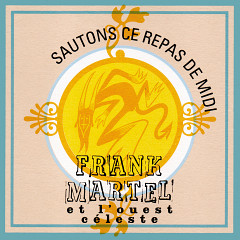
  • Sautons ce repas de midi in L’Express

    “Ne sautons pas la poésie”, Dominique Denis, L’Express, July 1, 2004
    Thursday, July 1, 2004 Press

    Quand un poète se met à la chanson (on pense a Péloquin, Francoeur ou, plus près de nous, Marc LeMyre), il vaut toujours la peine de tendre l’oreille. Parce que chez ces gens-là, comme disait Brel, on est sensible a la musicalité des mots.

    La quarantaine bien entamée, une poignée de recueils de poésie en librairie et deux albums de poésie chantée à son actif, Frank Martel s’inscrit dans cette singulière lignée. S’il ne risque pas de concurrencer Bruno Pelletier sur le plan vocal (qui s’en plaindrait?), Martel assume ses limites en choisissant des styles — cabaret, country où l’interprétation prime sur la performance.

    Récent récipiendaire d’un Mimi (les Félix de la scène alternative québécoise — pour ceux qui, comme moi, n’étaient pas dans le coup), Sautons ce repas du midi (Ambiances magnétiques/SRI) est de ces albums joyeusement déconcertants, qui méritent d’être prolongés sous les projecteurs, ne serait-ce que pour voir la tête de Martel quand il balance des perles du genre «Chu toujours dans tes jambes/Mais jamais dans tes bras», avec sa voix de Cassonade Faulkner. Faussement naïf? Peut-être. Vraiment attachant? You bet!

    Sautons ce repas du midi…est de ces albums joyeusement déconcertants, qui méritent d’être prolongés sous les projecteurs…

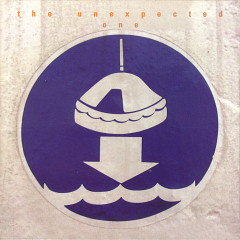
    The Unexpected One in Vital

    “Review”, Dolf Mulder, Vital, no. 429, June 30, 2004
    Wednesday, June 30, 2004 Press

    Vancouver meets Montréal! Ron Samworth (electric guitar) and Dylan van der Schyff (drums) from Vancouver join forces with Bernard Falaise (electric guitar) and Pierre Tanguay (drums) from Montréal. Ron Samworth and Dylan van der Schyff are leading figures of the Vancouver new music/improv scene with connections to the likes of George Lewis, Louis Sclavis, Vinny Golia, Barry Guy, Evan Parker and involvement in the NOW Orchestra, Hard Rubber Orchestra, François Houle ensembles and many more. Bernard Falaise and drummer Pierre Tanguay are Montréal composers and improvisers associated with television, theatre, dance, Les Projectionnistes, Dangereux Zhoms, etc. In a word all four of them are improvisers with great expertise and reputation. On this first meeting all four members of this quartet — or double duo if you want — demonstrate a similar interest in improv and improv rock. They talk the same language. Subtle and quiet passages on the one hand, intense and noisy and quasi-melodic outbursts at the other. We hear some very nice battles, like between the two guitarists in Oh My!. In general the interplay between the four is very concentrated and rich. All four take part in the sound explorations, so that one can say it’s really a well-balanced group improvisation. Together they lay down a wide spectrum of sounds extracted from their instruments through a diversity of extended techniques and attributes.

    They talk the same language. Subtle and quiet passages on the one hand, intense and noisy and quasi-melodic outbursts at the other.

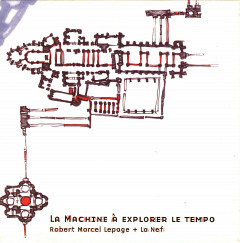
    La machine à explorer le tempo in Splendid E-Zine

    “Review”, Jason Kirk, Splendid E-Zine, June 24, 2004
    Thursday, June 24, 2004 Press

    Often detached, dusty and irrevocably divorced from the context in which they were hatched, live albums tend to be museum-quality the moment they leave the mastering suite. Occasionally, though, a concert recording escapes the hobbling likelihood of staid sexlessness and captures as much animated verve as any studio project. Take Robert Lepage’s collaboration with Montréal’s La Nef. This three-part extravaganza, recorded at Quebec’s premier new music festival in March of 2003, begins with an eclectic cache of instrumental textures and ends with a portable version of Lepage’s most recent opus, which loses almost nothing in translation.

    La Machine…’s thematic premise is simple. The composition begins with three idiomatic understandings of time (time passes, time flies, time slips by — called “Paradoxes” here) and uses each to guide a long musical movement from the outlands of avant-inscrutability home to the motherland of meaning. The result is stunning. Aided by La Nef, an ensemble of ten (including common chamber instruments and percussion, as well as guitar, banjo, tenor sax, viola da gamba, sackbut and live sampling) spools out the instrumentally dense compositions. The sheer conglomeration of the ensuing sounds would be enough to snare the open minds of many a curious listener, but the resonant respect for the audience inherent in Lepage’s complicated composition truly wins the day.

    After an introductory address spoken in French over a pastiche of cuckoos, whistles and other frenetic clock noise, Confitures de sable eases in the proceedings with an armature of swaying, repetitious bass, splashing auxiliary percussion and gentle string swells. Loosely played flute and brass wash across the foundation with gentle, exploratory touch of a lover in patient heat. Then, like a freak parade in a conservatory, Le Tamponneur de triolet crashes in with a stomping insistence that, for all its initial bravado, ends up degenerating into a trombone and electronic effects duet that pulls off a wholly charismatic simultaneity of cranky savvy, flirtatious cloying and technical wizardry.

    A seriously laid-back island vibe sets in with La Nef en bateau, at which point the remarkably organic fluctuation of disparate moods that informs the work is firmly established. Without ever interrupting the piece’s rum-cocktail fluidity, lazily plucked slide guitar, wispy flute, wandering violin and smarmy shaker dominate. Chronotopie du Cancer could be a Danny Elfman score, if only he weren’t stuck in the same always-recognizable chordal modes we’ve heard in countless Tim Burton films. The palatable insanity of the mood treads the line between intention and caprice without a missed step, and in closing the first movement, the track is a flat blast — and perfect punctuation.

    In the second movement, Ennio Morricone rises from the grave, albeit through the funhouse mirror that refracts the entirety of La Machine…. Banjo, guitar, major chords and fickle entropy rise to the fore in the six tracks of this middle “Paradoxe,” whose highlight is Le Coup d’archet est toujours plus vert dans la cour du voisin, a gritty and heavily effected string solo that puts any all-star fiddling on live Yanni discs straight to shame. The movement wraps with a delicate waltz that may be the disc’s most derivative two-and-a-half minutes, but remain no less lovely for their lesser challenge.

    “Time” indeed “slips by” in the “Troisième paradoxe.” Short, elegant and appropriately ethereal, the movement’s five tracks (excepting a break to introduce the musicians) work like a lubricated rub-down in the wee hours after a long, happily challenging day. The closer (Oups! J’ai échappé ma boîte d’accords majeurs!) slides through varying tempos while lightly hammering a two-beat alternation that brings this mad masterwork to an ideal denouement, as if Montréal weren’t already the front-runner for the Most Steamy North American Hotbed of the New Millennium Musical Vanguard Award. Phew! Now go towel off.

    The result is stunning.

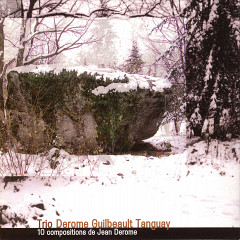
    10 compositions in Splendid E-Zine

    “Review”, Matt Pierce, Splendid E-Zine, June 24, 2004
    Thursday, June 24, 2004 Press

    The official history of jazz, with its New-Orleans-to-swing-to-bop-to-cool-to-fusion-to-free-to-?? continuum, reads like an evolutionary epic, and contemporary fans who like to think of jazz as a living, even controversial art form, rather than a chapter in a high school textbook on American history, might balk at the fact that this French-Canadian trio play swing, play notes, play songs, when that sort of thing went the way of the dinosaur after Ornette Coleman dropped Free Jazz way back in 1960. But on this bare-bones recording, Jean Derome (sax, flutes), Normand Guilbeault (bass) and Pierre Tanguay (drums) prove that a visit to a couple of old forms doesn’t have to rest on a bed of nostalgia, that walking bass and key changes don’t necessarily preclude freer sounds, and, most importantly, that good jazz is less a style than a spirit, a way of interacting and playing that swings, in the most liberal sense of the word.

    Marcher Sur Des Braises starts the album off with a spare shuffle from Tanguay and a little in-joke from Guilbeault, who plucks a rudimentary version of those three chords you can find in every Guide to Playing Rock Guitar under “Blues Chug” or some such heading, as if to say, “Rock can get away with the same thing decade after decade, so why can’t we?” Derome follows up with a low, crystal-clear theme straight from the Coltrane songbook, and when Guilbeault walks away from his blues progression into higher registers, Derome follows with a minimal but hard-hitting solo that touches a few blue notes in between its more refined runs. Both Vérone and Pangolin keep up this hard-boiled, hard-thinking approach to swing, the first with dark and gorgeous open chords from Guilbeault, unassuming melodicism from Derome and a punchy beat with a generous bass end from Tanguay, and the second with Tanguay’s slow and spacious drum work and Derome’s slinky turn on baritone sax, which erupts into a few Dolphy-like squeals near the end of the track. When the trio decide to take on worlds outside the explicit parameters of swing, they take their focus with them and make every exploratory minute worth the trip: refer to the loosely-bound mini-epic L’Africaine, on which Derome takes off for high-altitude abstractions, and Fluide, an exercise in classical serialism.

    In spite of their straight-up beat, rockish bass touches and moments of clear melody, this trio plays anything but NPR jazz. Their approach is hard-hitting and well-versed in the sort of rebellious, free-thinking spirit that infects all types of jazz. As a result, 10 Compositions is an intense success.

    … hard-hitting and well-versed in the sort of rebellious, free-thinking spirit that infects all types of jazz.

    DAME at the Festival international de jazz de Montréal

    Wednesday, June 23, 2004 In concert

    Several artists from DAME will be in concert for the next Festival international de jazz de Montréal. Rouge ciel will be live ,July 1, 2004, at Montréal’s museum of contemporary arts, Marilyn Lerner ,July 2, at Gesù, L’Ensemble Pierre Labbé ,July 4,, Noma ,July 9, and The Unexpected ,July 10, will all play at Montréal’s museum of contemporary arts and last but not least Antoine Berthiaume will play live ,July 11, at the festival’s main stage in front of Place des Arts.

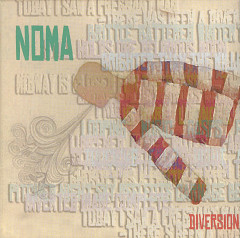
    Diversion in Vital

    “Review”, Dolf Mulder, Vital, no. 428, June 23, 2004
    Wednesday, June 23, 2004 Press

    Diversion is the title of a excellent new work by the Canadian trombonist and composer Tom Walsh. Walsh is a prominent musician in the Canadian avant garde and jazz scene. As a classically trained musician he started his career as trombonist in a Newfoundland symphony orchestra. Later Walsh started to play with a many canadian rock bands. Rock bands became jazz and improv projects. And that’s the context Walsh is working in nowawdays. He played with national (Rene Lussier, Michel F Côté) and international (Bern Nix, Gerry Hemingway, Fred Frith, Iva Bittova, Phil Minton) jazz and improv musicians. Walsh is involved in several groups. With saxplayer Richard Underhill he has a duo, with Pierre Tanguay he takes acoustic and digital adventures as Midi Tapant, etc. etc. In 1988 he started his very own NOMA-project. Jazz is the keyword here. Musicians involved in this project came and went. It was never meant as a permanent group. On the other hand the musicians with their personal possibilities and energy were very important to Walsh, as NOMA is about the energies that everybody brings in. Diversion is played by two small ensembles. Some pieces are played by The Côté Cour ensemble featuring Guy Kaye (el. guitar), Alan Baculis (el. bass) and François Chauvette (drums). Other pieces are played by the Côté Jardin ensemble that has Rainer Wiens on electric guitar, Normand Guilbeault on contrabass plus Pierre Tanguay on drums. Both ensembles have Tom Walsh on trombone and sampler. Recordings were made on two different occasions. But on the CD all is very well edited into one whole. As a composer draws from many different styles and idioms, which explains the title of this CD. The compositions refer to funk, improv, rock, avantgarde jazz, fusion, etc. Some pieces stay within well-known boundaries, at other moments Walsh paints abstract figures with strange colours. Walsh melted these influences together with vision and suppleness into a coherent and well balanced work. Together with convincing and energetic playing Diversion is a very enjoyable listening experience.

    Walsh melted influences together with vision and suppleness into a coherent and well balanced work.
  • 22
  • 23
  • 24
  • 25
  • 26
  • 27
  • 28
  • 29
  • 30