
La machine à explorer le tempo
Robert Marcel Lepage / La Nef
If the music makes you smile, it will have accomplished its aim… — Coda Magazine, Canada
Pari réussi, haut les mains pour nos délicieux délinquants québécois. — ImproJazz, France
Recorded live at the Festival Montréal/Nouvelles Musiques 2002, La Machine à explorer le tempo, Robert Marcel Lepage’s latest release, is a work written for the early music ensemble La Nef. Lepage and his 10 musicians are lively, derisive and delinquent
La Machine à explorer le tempo (The Tempo Machine) will allow our courageous chrononauts to visit three music-time Paradoxes
First Paradox
Second Paradox
Third Paradox
- Composer(s): Robert Marcel Lepage
- Performer(s): La Nef
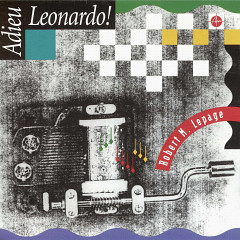
- Cover image: Félix Lepage
- Graphic design: Jean-François Denis
CD (AM 116, 2003)
- 1
- 1
- 2Confitures de sable, 5:04
- 3Le Tamponneur de triolet, 5:46
- 4La Nef en bateau, 4:52
- 5
- 6Chronotopie du Cancer, 3:49
- 7
- 7
- 8Le Bivouac, 2:28
- 9Le Pied-tendre, 3:54
- 10
- 11
- 12
- 13
- 13
- 14Hygiène des rebuts, 1:26
- 15Le Chat dans le tordeur, 3:04
- 16La Villa des loups, 2:48
- 17
- 18
- Label: Ambiances Magnétiques
- AM 116
- 2003
- UCC 771028111626
- Total duration: 61:49
- Sympathique case
- 126 mm × 126 mm × 5 mm
- 45 g
On the web
Some recommended items
-
-
-
-
-
-
-
 Various artists
 -
-
 Various artists
 -
-
-
In the press
Critique
Review
In this hour-long suite of 18 items penned by
Critique
Kritik
Review
Often detached, dusty and irrevocably divorced from the context in which they were hatched, live albums tend to be museum-quality the moment they leave the mastering suite. Occasionally, though, a concert recording escapes the hobbling likelihood of staid sexlessness and captures as much animated verve as any studio project. Take
La Machine…’s thematic premise is simple. The composition begins with three idiomatic understandings of time (time passes, time flies, time slips by — called “Paradoxes” here) and uses each to guide a long musical movement from the outlands of avant-inscrutability home to the motherland of meaning. The result is stunning. Aided by La Nef, an ensemble of ten (including common chamber instruments and percussion, as well as guitar, banjo, tenor sax, viola da gamba, sackbut and live sampling) spools out the instrumentally dense compositions. The sheer conglomeration of the ensuing sounds would be enough to snare the open minds of many a curious listener, but the resonant respect for the audience inherent in Lepage’s complicated composition truly wins the day.
After an introductory address spoken in French over a pastiche of cuckoos, whistles and other frenetic clock noise, Confitures de sable eases in the proceedings with an armature of swaying, repetitious bass, splashing auxiliary percussion and gentle string swells. Loosely played flute and brass wash across the foundation with gentle, exploratory touch of a lover in patient heat. Then, like a freak parade in a conservatory, Le Tamponneur de triolet crashes in with a stomping insistence that, for all its initial bravado, ends up degenerating into a trombone and electronic effects duet that pulls off a wholly charismatic simultaneity of cranky savvy, flirtatious cloying and technical wizardry.
A seriously laid-back island vibe sets in with La Nef en bateau, at which point the remarkably organic fluctuation of disparate moods that informs the work is firmly established. Without ever interrupting the piece’s rum-cocktail fluidity, lazily plucked slide guitar, wispy flute, wandering violin and smarmy shaker dominate. Chronotopie du Cancer could be a
In the second movement,
“Time” indeed “slips by” in the “Troisième paradoxe.” Short, elegant and appropriately ethereal, the movement’s five tracks (excepting a break to introduce the musicians) work like a lubricated rub-down in the wee hours after a long, happily challenging day. The closer (Oups
Review
La machine à explorer le tempo is an epic and narrative work. Cinema turned into music. Not so strange since
Review

Review
The body of work from
This work was commissioned by the
The resulting music is an absorbing combination of genres and styles, reflecting both
Critique
Quand le compositeur
Review
Disque de la semaine
Enregistré le 8 mars 2003 dans le cadre du festival Montréal/Nouvelles Musiques, alors que La Nef lançait son secteur “musiques nouvelles” afin, essentiellement, de susciter une rencontre entre les compositeurs d’aujourd’hui et la musique ancienne. Bien sûr, l’instrument ne fait que ce qu’on lui commande de faire et l’on peut aussi bien jouer du blues sur une viole de gambe, aussi les amateurs de musique ancienne ne trouveront pas leur compte ici. Parce que Robert Marcel fait du Lepage, une indéfinissable musique “contractuelle”, comme il le dit si bien, et avec un très bel ensemble de 10 musiciens plus jazzmen que ménestrels. Viole, violon et contrebasse