
Je suis calme et enragé·e
Nour Symon / Collectif Ad Lib, Ensemble SuperMusique (ESM)
The unfolding of the entire work triggers a succession of chapters divided between tension and relaxation, generating instant surprises. — Citizen Jazz, France
A truly iconoclastic affair that embraces noise, poeticism, jazz and chamber nods,
Nour Symon ’s vision is entirely their own, and that’s a big part of the appeal. — Take Effect, USA
The scores are performed by the four vocalists who intone the music in chorus, intimately recite the text and weave counterpoints that explore the sound of today’s music. The vocalists are accompanied by two instrumental soloists from
- Composer(s): Nour Symon
- Writer(s): Roxane Desjardins
- Performer(s): Collectif Ad Lib, Zéa Beaulieu-April, Gabriel Dharmoo, Laura Doyle Péan, Vincent Ranallo, Émilie Mouchous, Benjamin Tremblay-Carpentier, Ensemble SuperMusique (ESM), Guido Del Fabbro, Émilie Girard-Charest, Stéphane Diamantakiou, Craig Pedersen, Cléo Palacio-Quintin, Corinne René
- Cover image: Nour Symon
- SODEC • Conseil des arts et des lettres du Québec • Canada Council for the Arts • Conseil des arts de Montréal
CD (AM 281, 2025)
- This item can be downloaded and/or listened to at ambiances-magnetiques.bandcamp.com.
- 1Collectif Ad Lib (Zéa Beaulieu-April, voice
; Gabriel Dharmoo, voice; Laura Doyle Péan, voice; Vincent Ranallo, voice; Émilie Mouchous, synthesizers; Benjamin Tremblay-Carpentier, harmonicas, electronics); Ensemble SuperMusique (ESM) (Guido Del Fabbro, violin; Émilie Girard-Charest, cello; Stéphane Diamantakiou, double bass; Craig Pedersen, trumpet; Cléo Palacio-Quintin, flute; Corinne René, percussion)- 1
- 2J’espère être absoute, 4:01
- 3Affalée sur le sol, 4:17
- 4
- 5
- 6
- Label: Ambiances Magnétiques
- AM 281
- 2025
- UCC 771028128129
- Total duration: 57:23
- Sympathique case
- 126 mm × 126 mm × 5 mm
- 35 g
Download (AM 281_NUM, 2025)
- This item can be downloaded and/or listened to at ambiances-magnetiques.bandcamp.com.
- 1Collectif Ad Lib (Zéa Beaulieu-April, voice
; Gabriel Dharmoo, voice; Laura Doyle Péan, voice; Vincent Ranallo, voice; Émilie Mouchous, synthesizers; Benjamin Tremblay-Carpentier, harmonicas, electronics); Ensemble SuperMusique (ESM) (Guido Del Fabbro, violin; Émilie Girard-Charest, cello; Stéphane Diamantakiou, double bass; Craig Pedersen, trumpet; Cléo Palacio-Quintin, flute; Corinne René, percussion)- 1
- 2J’espère être absoute, 4:01
- 3Affalée sur le sol, 4:17
- 4
- 5
- 6
- Label: Ambiances Magnétiques
- AM 281_NUM
- 2025
- UCC 771028128181
- Total duration: 57:23
Some recommended items


In the press
Critique
Préparez-vous à un déferlement de sensations intrigantes et dérangeantes qui visent à vous stimuler mentalement. La partition composée par
Ce sont avant tout les voix de
Le Printemps érable de 2012, grève étudiante la plus importante de l’histoire du Québec, de même que le désastre écologique en cours, nourrissent des interactions entre la phonétique française et un matériau sonore élaboré. Si une forme de désespérance se répand dans le concept de cette création,
Review
These 6 tracks from
A truly iconoclastic affair that embraces noise, poeticism, jazz and chamber nods,
9/10
Kritik
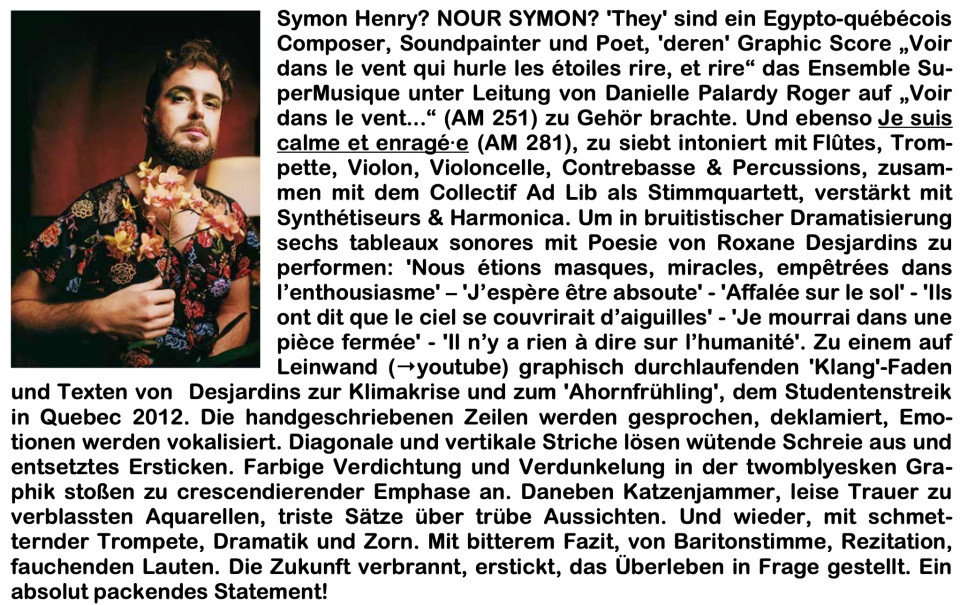
Review
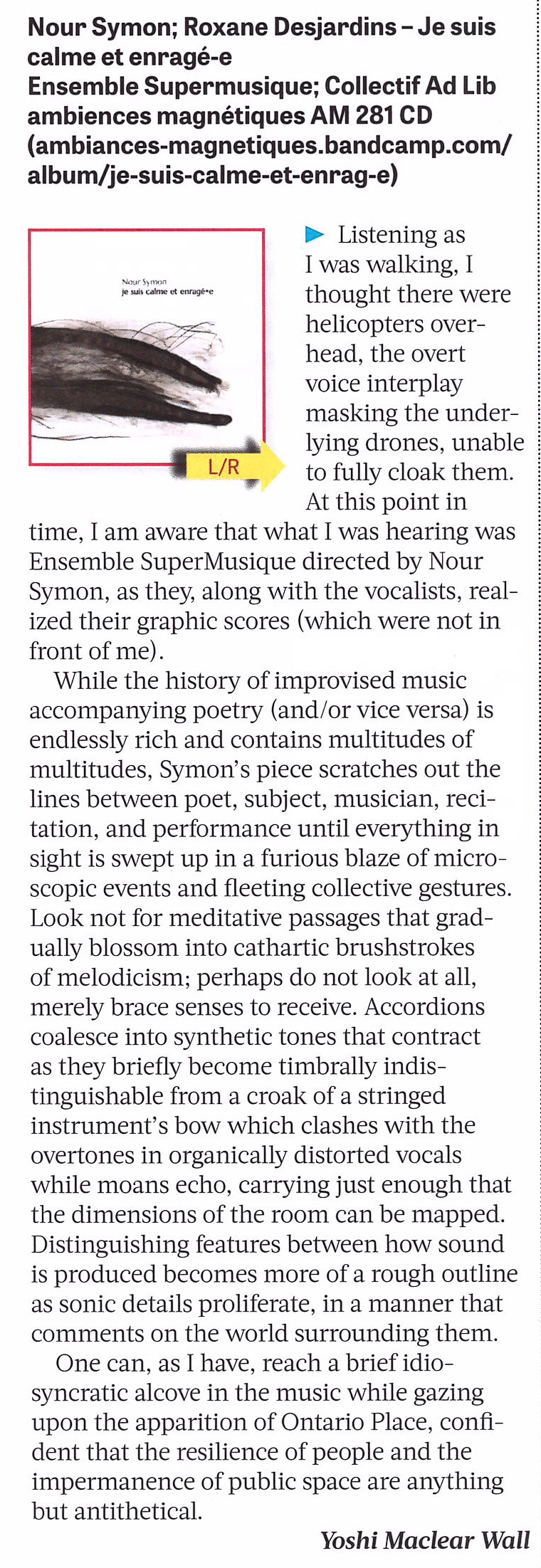
Recenzje
After a solo album and two quartets, it’s time for a large line-up, here twelve to be exact, pieced together from two formations. There is, of course, also a composer, here inspired by some very contemporary poems. And it is impossible not to give the album credits.
The wholly monumental, meta-opera work opens with a balanced but already quite expressive polyphony, underpinned by a low-kneed string narrative. Electronica reigns in the background, building tension, asking questions, occasionally inspiring. The dense, edgy storytelling, however, is not devoid of a note of mysterious reverie. The second movement is initially a kind of lazy muscle-stretching — the instrumental-vocal flow seems to flow a little higher. It quickly gains power and explodes with the force of a free-jazz orchestra. In the foreground, however, is the narrator, who distributes roles and enforces commitments with a firm voice. Things get definitively edgy in the third movement — shouts, instrumental salvos, broken, twisted rhythms, operatic highs and decadent lows.
The beginning of the fourth poem is woven with instrumental trifles. Trumpet, flute and strings all have their roles here. A pack of churlish vocalists doesn’t appear until the fifth minute and begins to wreak considerable havoc. Here is the drunken crew on the side of a wave-swept ship starting quite a party. The whole thing resembles a well-predefined… free improvisation. The climax is as melodic and post-baroque as it is raspy and shrill. The fifth story is sometimes a prayer, sometimes a studied meditation, it oozes melody and filth. The narrator plays his or her important role willingly, although everyone here can shout, sing and feel the scent of a shared journey. The story effectively builds up and transforms into an almost freejazz pile-up. The beginning of the final poem is droning — vocal, stringed and underpinned by anxious harmonics. The story transforms rather quickly into an edgy, theatrical polyphony, remaining cooled in the instrumental layer, though steeped in mysterious rhythms. The rocking meditation eventually encounters a chorus of angry lunatics, refugees from a burning opera house. This vocal peak implies more activity on the part of the instrumentalists. The finale of this frenzied performance is free, expressive, played with a full ensemble, with voices that seem to cede the field to the instrumental sphere on the final straight.
Translated from Polish.
Original text
Po albumie solowym i dwóch kwartetach czas na duży skład, tu dokładnie dwunastoosobowy, sklecony z dwóch formacji. Jest oczywiście także kompozytor, tu zainspirowany pewnymi jakże współczesnymi poematami. Aż nie sposób w tym wypadku nie oddać pola albumowemu credits.
Cokolwiek monumentalne, metaoperowe dzieło otwiera wyważony, ale dość już ekspresyjny wielogłos, pod który podczepia się narracja strunowa na nisko ugiętych kolanach. W tle panoszy się elektronika, która buduje napięcie, zadaje pytania, niekiedy inspiruje. Gęsta, nerwowa opowieść niepozbawiona jest jednak nuty tajemniczej zadumy. Druga część, to początkowo rodzaj leniwego rozciągania mięśni — instrumentalno-wokalny flow zdaje się płynąć nieco wyższym pasmem. Szybko nabiera mocy i eksploduje siłą freejazzowej orkiestry. Na pierwszym planie jest jednak narrator, który zdecydowanym głosem rozdaje role i egzekwuje zobowiązania. W trzeciej części sytuacja robi się definitywnie nerwowa — okrzyki, instrumentalne salwy, łamana, pokrętna rytmika, operowe wzloty i dekadenckie upadki.
Początek czwartego poematu tkany jest z instrumentalnych drobiazgów. Swoje role mają tu trąbka, flet i strunowce. Wataha czupurnych wokalistów pojawia się dopiero w piątej minucie i zaczyna siać spory zamęt. Oto pijana załoga na burcie rozhuśtanego falami statku zaczyna niezłą zabawę. Całość przypomina dobrze predefiniowaną… wolną improwizację. Puenta jest tyleż melodyjna i post-barokowa, co zgrzytliwa i krzykliwa. Piąta opowieść bywa modlitwą, bywa wystudiowaną medytacją, syci się melodią i brudem. Swoją ważną rolę ochoczo odgrywa narrator, choć każdy może tu krzyczeć, śpiewać i odczuwać woń wspólnej podróży. Opowieść efektownie narasta i przepoczwarza się w niemal freejazzowe spiętrzenie. Początek finałowego poematu jest dronowy — wokalny, strunowy, podparty niepokojem harmoniki. Opowieść dość szybko przeistacza się w nerwowy, teatralny wielogłos, pozostając w warstwie instrumentalnej wystudzona, choć nasączona tajemniczą rytmiką. Rozkołysana medytacja napotyka w końcu na chór złorzeczących szaleńców, uciekinierów z płonącej opery. Ów wokalny szczyt implikuje większą aktywność po stronie instrumentalistów. Finał tego szalonego spektaklu jest swobodny, ekspresyjny, grany pełnym składem, z głosami, które na końcowej prostej zdają się oddawać pole sferze instrumentalnej.
Review
Put out on the circuit via the Ambiances Magnetiques imprint as their cat.no. 281 on March 7th, 2k25 is
Critique
It’s the kind of music that sadly drives away the traditional mass media, and makes those like PanM 360 so indispensable.
Translated from French.
Review
You could say that the expressions, the sonic and orchestral devices, the use of voices and poetry, of manifesto and barricade rattling are all just as prescient in the aftermath of the pandemic as they were thirteen years ago when a groundswell of support grew up around demonstrations against the proposed doubling of tuition fees in the province
Despite various setbacks — the lockdowns had a knock-on effect for this project, forcing an abandonment of the original plan to work with the
Ambitious and covering a multitude of disciplines from visual and text art (a graphic score was conceived to communicate the concept) to performance, orchestral transmogrification, opera and video, I am calm and angry uses a host of renowned, prize nominated poets, soloist musicians and ensembles
Recognisable instruments from the wind, strings and brass sections join together with artistic impressionistic symbolism, percussion and electronic elements to evoke forebode, the unearthly, dramatic, mooning, unbalanced and abstract. Reference points within that overlapping sphere of influences and musical threads/connections includes (to these ears anyway)
Unbalanced with the ground constantly shifting below, the tumultuous and agitated are invoked and revoked in a musical experiment of plummets, falls and rises. A mix of French, amorphous and descriptive languages is adopted in a successful attempt to merge the poetic arts with protest, manifesto and performance, whilst physically stimulating the emotions and trauma of such protest.
Blog
-
Thursday, August 6, 2026 / Press
An absolutely gripping statement
! More -
Wednesday, January 7, 2026 / Press
The unfolding of the entire work triggers a succession of chapters divided between tension and relaxation, generating instant surprises. More
-
Wednesday, January 7, 2026 / Press
A truly iconoclastic affair that embraces noise, poeticism, jazz and chamber nods,
Nour Symon ’s vision is entirely their own, and that’s a big part of the appeal. More