actuellecd

Blog

101 results
  • 1
  • 2
  • 3
  • 4
  • 5
  • 6
  • 7
  • 8
  • 9
  • Le sourire in Anne Carlini

    “Review”, Russell A Trunk, Anne Carlini, May 1, 2026
    Thursday, August 6, 2026 Press

    For those unaware, Steve Lacy was a quintessential artist of late modernism. His body of work is ample evidence of his refusal to bypass his forebears in pursuit of so-called ‘innovation.” He had to work through them. He called himself a “materialist,” an idiosyncratic use of the word describing his obsession with the material from which he made his music —— his saxophone as well as the countless artists whose work his œuvre synthesized.

    Through such a crystalizing process, his music grew increasingly singular, while always also paying homage to his antecedents, working through the material of, to name but a few, Sidney Bechet, Thelonious Monk, Mark Rothko, or Samuel Beckett.

    “I don’t know if Jean Derome would call himself a “materialist,” but such a Lacyan ethic adheres throughout his own notable body of work,” says Scott Thomson, Montréal [x-25]. “So, it felt apt when he delved into Lacy songs on Somebody Special (2019), which introduced this superb quintet.”

    Le sourire represents a deeper dive, extending Jean’s loving attention to the material at hand, with Lacy’s settings of Beckett poems in French (the little-known Sands suite) at its core. Along the way, the band touches on key elements in Lacy’s vast discography: Rushes and Packet (from which the songs that set Akhmatova and Malina derive) with Irene Aebi and Frederic Rzewski, and the two-volume Futurities, nonet settings of Robert Creeley poems and arguably his finest single-author project.

    As the sounds refract through the exquisite poem-lyrics that the music animates, Jean Derome & Somebody Special open their new collective work on the playful Jack’s Blues and the staggered The Smile and then we get the lushly dulcet The Cuckoo and the three-part Sands: the first part being the affecting beauty of Stand, then we get the joyfully vivacious Jump, the set culminating on the hauntingly ethereal Fall.

    Along next is the rhythmically paced Love and Politics which is itself backed seamlessly by the jazzy blues vibe of I Heard the Indian Sage, the improvised feel to the layered brilliance of Morning Joy, the music rounding out on the robustly enigmatic As Usual, coming to a close on the artfully hazed Heaven.


    Le sourire represents a deeper dive, extending Jean’s loving attention to the material at hand…

    Le sourire in Issues

    “Review”, DJ Elbowlicker, Issues, no. 108, May 1, 2026
    Thursday, August 6, 2026 Press
    An eccentric approach to smoky, cocktail-land jazz.

    Elle a son mot à dire in Bad Alchemy

    “Kritik”, Rigobert Dittmann, Bad Alchemy, December 1, 2025
    Thursday, August 6, 2026 Press

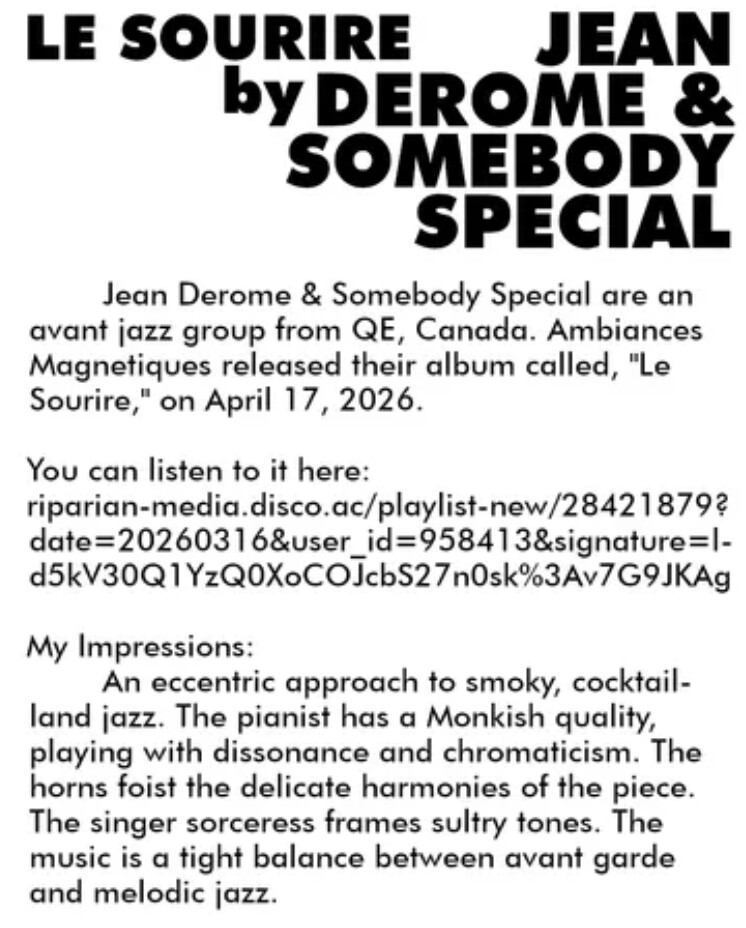
    Auch Elle a son mot à dire von Joane Hétu wird dargeboten mit dem Ensemble SuperMusiqueÉmilie Fortin, trompette, Luzio Altobelli, accordéon, Noam Bierstone, percussions, Michel F Côté, percussions & électronique und Hétu selber, als cheffe an saxophone alto. Als Sammlung kurioser Songs, angestimmt von Sarah Albu, mit ihrem Knowhow im Vokalensemble Phth, auf „According to the Moon“ (2023) als Interpretin von Gayle Young, auf „Voix Jetées“ (2024) von Nico Muhly, Missy Mazzoli, Keiko Devaux, Nicole Lizée und Jared Miller. Elle n’a pas de mot noch wortlos zu Whirliesound. Mot elle a mit bedrücktem und insistentem Sang zu nur Drums & Percussion. Elle n’est pas un animal als anarchistische Babbelbande mit Akkordeon, Pfeifen, Spielzeug. Un idéal nur die Grrrls a cappella. Avoir le motton erst nur Altosax und Trompetengrowls, dann mit Albu und Drums. Bis sie als zarathustrische SuperWoman der Schlange den Kopf abbeißt und ausspuckt. Vivante erklingt mit Sprechgesang, der zu Simpelgroove ins Delirium abzweigt. Lumière folgt mit verstopfter Trompete, Akkordeon, mondstichigem Singsang. Chant à elle singt Hétu feierlich allein. Jojo dit nur Männer-nonsense zu Elektrononsense und ein Paar Zügen des Akkordeons. Elle n’est pas un animal bringt bruitistisch-surreal verspielte Tierporträts à la „Ceci n’est pas une pipe.“ Bei Elle a dit oui lallen, haspeln, jaulen alle und verlangen dit oui a elle, di wi a L. Elle a son mot à dire schießt mit Vogelpfeifen den Vogel ab. Und Elle qui est-elle? kratzt die Federn zusammen, alle miteinander melancholisch, mit Trübsal blasender Tuba (Julie Houle), wonnigem Akkordeon, der phantastischen Sarah Albu im Tanz um Elle, Zapfenstreich der Trompete. Als kollektive Huldigung der Sphinx. Als toller Streich von Hétu. Und die Entdeckung einer extraordinären Vokalistin.

    … a stroke of genius from Hétu.

    Je suis calme et enragé·e in Bad Alchemy

    “Kritik”, Rigobert Dittmann, Bad Alchemy, December 1, 2025
    Thursday, August 6, 2026 Press

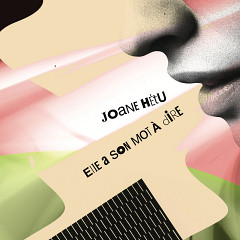
    Symon Henry? Nour Symon? ’They’ sind ein Egypto-québécois Composer, Soundpainter und Poet, ’deren’ Graphic Score „Voir dans le vent qui hurle les étoiles rire, et rire“ das Ensemble SuperMusique unter Leitung von Danielle Palardy Roger auf „ Voir dans le vent… “ (AM 251) zu Gehör brachte. Und ebenso Je suis calme et enragé·e (AM 281), zu siebt intoniert mit Flûtes, Trompette, Violon, Violoncelle, Contrebasse & Percussions, zusammen mit dem Collectif Ad Lib als Stimmquartett, verstärkt mit Synthétiseurs & Harmonica. Um in bruitistischer Dramatisierung sechs tableaux sonores mit Poesie von Roxane Desjardins zu performen: Nous étions masques, miracles, empêtrées dans l’enthousiasmeJ’espère être absouteAffalée sur le solIls ont dit que le ciel se couvrirait d’aiguillesJe mourrai dans une pièce ferméeIl n’y a rien à dire sur l’humanité. Zu einem auf Leinwand (→youtube) graphisch durchlaufenden ’Klang’-Faden und Texten von Desjardins zur Klimakrise und zum ’Ahornfrühling’, dem Studentenstreik in Quebec 2012. Die handgeschriebenen Zeilen werden gesprochen, deklamiert, Emotionen werden vokalisiert. Diagonale und vertikale Striche lösen wütende Schreie aus und entsetztes Ersticken. Farbige Verdichtung und Verdunkelung in der twomblyesken Graphik stoßen zu crescendierender Emphase an. Daneben Katzenjammer, leise Trauer zu verblassten Aquarellen, triste Sätze über trübe Aussichten. Und wieder, mit schmetternder Trompete, Dramatik und Zorn. Mit bitterem Fazit, von Baritonstimme, Rezitation, fauchenden Lauten. Die Zukunft verbrannt, erstickt, das Überleben in Frage gestellt. Ein absolut packendes Statement!

    An absolutely gripping statement!

    Platanus in PAN M 360

    “Review”, Frédéric Cardin, PAN M 360, August 1, 2026
    Tuesday, August 4, 2026 Press

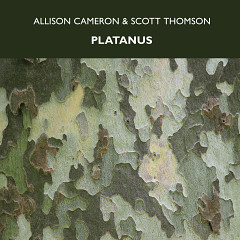
    Trombone and “homemade” synthesizer, this is the improbable duo that Platanus showcases for the most discerning music lovers. It is indeed ultra-free music, noise-driven but playful most of the time, featuring wacky sounds from the two instrumentalists present, Scott Thomson on trombone and Allison Cameron on synthesizer. The Montréaler and the Torontonian shatter all imaginable systems over the course of three long, largely improvised pieces. Squeaks, breaths, clicks, white noise, sometimes vaguely “melodic” lines, all the possibilities generated by extended techniques on the trombone and the particular timbres of Cameron’s synthesizer (an instrument built by a friend and colleague of both artists, which Thomson calls the “Cadillac Cracklebox”), intertwine in atomistic settings traversed by waves and some more or less vehement eruptions.

    A music that is as contemporary and demanding as it gets, but satisfying, for receptive and adventurous ears.

    A music that is as contemporary and demanding as it gets, but satisfying, for receptive and adventurous ears.
  • 1
  • 2
  • 3
  • 4
  • 5
  • 6
  • 7
  • 8
  • 9