Sauter au contenu principal
actuellecd

Blogue

86 résultats
  • 1
  • 2
  • 3
  • 4
  • 5
  • 6
  • 7
  • 8
  • 9
  • Mistpouffers dans Noise Not Music

    «Review», jckmd, Noise Not Music, 20 novembre 2018
    mardi 20 novembre 2018 Presse

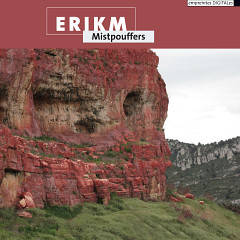
    French improviser and composer eRikm is one of the few artists whose work has been a consistent element in my journey into experimental music. His collaborative CD with Jérôme Noetinger, What a Wonderful World, was one of the first Erstwhile releases I heard and introduced me to the field of electroacoustic improvisation, and Zygosis made me realize the power of the turntable as an instrument in an avant-garde context. Mistpouffers, consistent with Empreintes Digitales’ focus on acousmatic music, collects three pieces that were composed and arranged from 2013 to 2016. Draugalimur, commissioned by the French music office, incorporates several spoken word segments within its immersive ambient soundscapes, including excerpts from traditional Icelandic folk writings. Poudre and L’aire de la Moure 2 are both explorations into a very physical stereo space; the former’s treated recordings of firework explosions and the latter’s electric whirring and airplane engines are equally breathtaking.

    … the former’s treated recordings of firework explosions and the latter’s electric whirring and airplane engines are equally breathtaking.

    Mistpouffers dans Music Map

    «Recensione», Piergiuseppe Lippolis, Music Map, 6 novembre 2018
    mardi 6 novembre 2018 Presse

    Mistpouffers, appena uscita per Empreintes Digitales, è la raccolta di tre composizioni realizzate tra il 2014 e il 2016 dall’artista e improvvisatore francese eRikm. I tre pezzi durano quasi venti minuti ciascuno e sono, in qualche modo, collegati da una sorta di filo narrativo che crea un ideale legame al netto della tripartizione. Draugalimur si apre fra suoni rarefatti e tuoni sempre più forti, che segnalano l’approssimarsi di una tempesta, mentre l’elettronica di base scorre lieve e rarefatta. Suoni di passi e voci sussurrate, in un sottofondo temporalesco, suggeriscono un immaginario quasi cinematografico e un senso di pathos che permea tutto il brano, chiuso poi da una chitarra scordata e da qualche morbida nota di piano che pare stemperare la tensione. Poudre torna nella tempesta e poi vira verso fuochi artificiali, con annessi urla e applausi di approvazione da parte della folla, cambiando anche nettamente l’umore del disco. L’Aire de la moure 2 sembra riportare la calma, in quasi venti minuti di suoni più piatti, scheletriche conversazioni fra una voce maschile e una femminile e qualche sporadico suono naturale, soprattutto animalesco, che contribuisce a tenere viva l’idea di una narrazione cinematografica più che di un album musicale in sé. La forza di Mistpouffers sta proprio nella sua capacità di raccontare qualcosa che, evidentemente, non è neanche scritto e definito, alimentando l’immaginazione e permettendo interpretazioni soggettive.

    La force de Mistpouffers réside dans sa capacité à dire quelque chose qui, évidemment, n’est même pas écrit et défini, nourrissant l’imagination et permettant une interprétation subjective.

    Just So dans The WholeNote

    «Review», Stuart Broomer, The WholeNote, no 24:3, 1 novembre 2018
    jeudi 1 novembre 2018 Presse
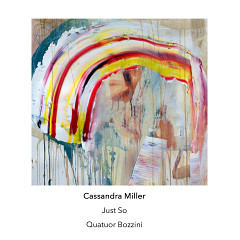
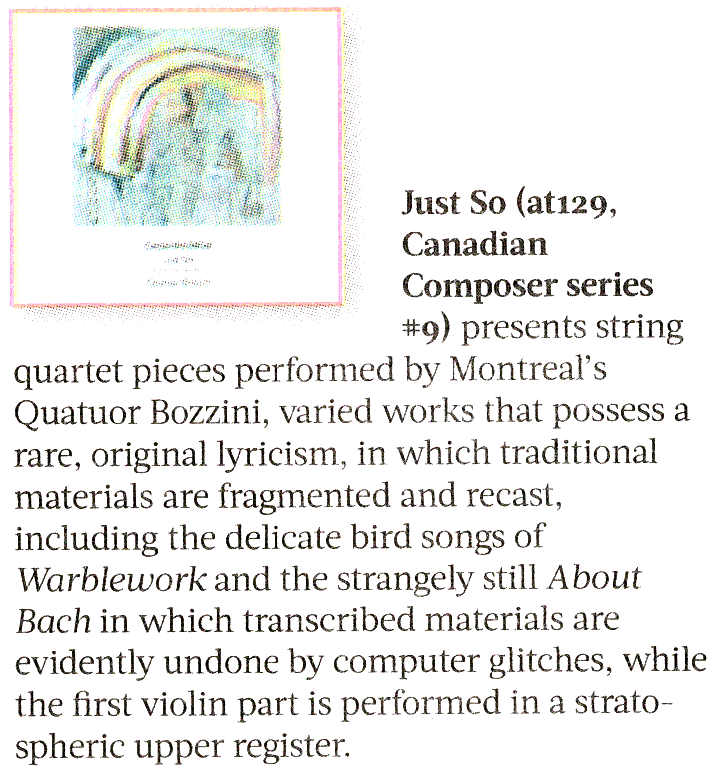
    … varied works that possess a rare, original lyricism, in which traditional materials are fragmented and recast…

    Gyula Csapó: Déjà? Kojâ? dans The Squid’s Ear

    «Review», Brian Olewnick, The Squid’s Ear, 31 octobre 2018
    mercredi 31 octobre 2018 Presse

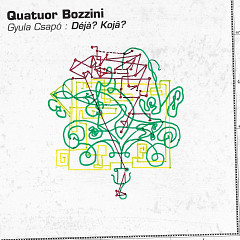
    Csapó is a Hungarian-born composer (b. 1955) living in Canada since 1990 who studied with Morton Feldman at SUNY Buffalo and also with John Cage. His Déjà? Kojâ? (’Already? Where [to]?’), for string quartet, is presented in three sections totaling about 73 minutes long.

    As the brief notes from Csapó point out, it’s essentially a dirge, though one which fluctuates from sorrow to ecstasy. The “Kojâ” in the title comes from a ghazal by Hafez, which seems to posit human life as a “threshold” before true existence. I find it very difficult to otherwise describe the music. It’s not very much akin to that of Feldman (especially the string quartets) and even less like (most) Cage. Though we hear lines that are pulled and stretched, there’s far more changeability in melodic line and attack crammed into any given 30-seconds than you’d find in an hour of Feldman. More importantly, Csapó, if not quite wearing his emotions on his sleeve, doesn’t shy away from content that is almost necessarily heard first as emotional, then abstractly. The strings surge, offer plaints, sigh and subside; it’s fundamentally sad, stirring music. The structure is flowing and loose, like a slow camera pan over a troubled landscape. The first movement works itself up to quite a fever pitch about 3/4 the way through — one can easily imagine the thrashing about of grieving souls — before settling back down to a more general level of despondency, ending with high, ghostly whines.

    Second Parte is pitched somewhat higher, contains more agitation, with pizzicato scurries and brief, clipped lines and overlapping glissandi voiced in the violins’ upper registers. It gradually shifts to the most subdued music in the piece, plaintive sighs studded with questioning plucks. The final portion is actually calm, perhaps even resigned. The texture is thick and creamy, very complex and lovely, the phrases almost conversational, as though discussing and contemplating that aforementioned threshold, but doing so with little apprehension. It ends with quiet acceptance.

    The texture is thick and creamy, very complex and lovely, the phrases almost conversational, as though discussing and contemplating that aforementioned threshold, but doing so with little apprehension. It ends with quiet acceptance.
  • 1
  • 2
  • 3
  • 4
  • 5
  • 6
  • 7
  • 8
  • 9