actuellecd

Blog

3585 results
  • 16
  • 17
  • 18
  • 19
  • 20
  • 21
  • 22
  • 23
  • 24
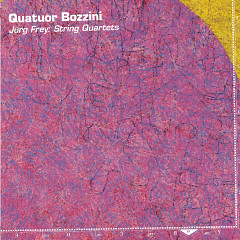
  • Jürg Frey: String Quartets in Trybuna Muzyki Spontanicznej

    “Recenzje”, Trybuna Muzyki Spontanicznej, May 9, 2025
    Tuesday, May 13, 2025 Press

    A notable composer of contemporary music, an equally notable classical quartet from Canada and five compositions dating back to the previous century, performed at the beginning of the next and now re-edited. The first two last a dozen minutes each, the next two are miniatures of a few tens of seconds, while the last is almost half an hour long, a uniquely beautiful epic of fading sounds.

    The first story is a kind of painful trepidation, a tearful, joyless lullaby, in the form of constant repetition built up by oppositions, both in terms of sound and drama. The narrative undulates, adhering with full determination to the idea of minimalism and sometimes constitutive reductionism. Silence plays an important role here, which from time to time smuggles in scraps of fading melody. The second track seems to reach for the aesthetics of early music, is more brooding, and is definitely the most classical in the album set. The seemingly straightforward narrative undergoes a systematic breakdown here, but it does not lose the mark of a mellow exposition. It often takes one step forward and then two back. It swallows small portions of melody, chews on them and then puts them back. The very ending seems to carry a note of mysterious optimism. Of the annotated miniatures, the first seeks a bottom, the second shines with a screeching post-baroque. The fifth track occupies half the album and definitively constitutes its quality. It flows from the very bottom of the dark crypt, straining through clenched teeth, reminiscent of a procession of the dead. It is unspeakably beautiful, although built with extremely reductionist methods. A great omission that moves mountains. A life that has long borne the mark of an irretrievable death. It smells of early music, the perfect soundtrack to an exceptionally slow dying.
    … unspeakably beautiful…

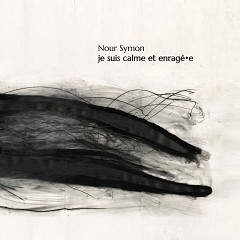
    Je suis calme et enragé·e in Trybuna Muzyki Spontanicznej

    “Recenzje”, Trybuna Muzyki Spontanicznej, May 9, 2025
    Tuesday, May 13, 2025 Press

    After a solo album and two quartets, it’s time for a large line-up, here twelve to be exact, pieced together from two formations. There is, of course, also a composer, here inspired by some very contemporary poems. And it is impossible not to give the album credits. Je suis calme et enragé·e (I am calm and angry), is a transdisciplinary piece that begins with these exact words by Roxane Desjardins. This ambitious yet fragile project presents six sound paintings — visual music scores composed by Nour Symon — for six poems exploring positions of distress and malaise in response to History, the scale of humanity and looming environmental disasters.

    The wholly monumental, meta-opera work opens with a balanced but already quite expressive polyphony, underpinned by a low-kneed string narrative. Electronica reigns in the background, building tension, asking questions, occasionally inspiring. The dense, edgy storytelling, however, is not devoid of a note of mysterious reverie. The second movement is initially a kind of lazy muscle-stretching — the instrumental-vocal flow seems to flow a little higher. It quickly gains power and explodes with the force of a free-jazz orchestra. In the foreground, however, is the narrator, who distributes roles and enforces commitments with a firm voice. Things get definitively edgy in the third movement — shouts, instrumental salvos, broken, twisted rhythms, operatic highs and decadent lows.

    The beginning of the fourth poem is woven with instrumental trifles. Trumpet, flute and strings all have their roles here. A pack of churlish vocalists doesn’t appear until the fifth minute and begins to wreak considerable havoc. Here is the drunken crew on the side of a wave-swept ship starting quite a party. The whole thing resembles a well-predefined… free improvisation. The climax is as melodic and post-baroque as it is raspy and shrill. The fifth story is sometimes a prayer, sometimes a studied meditation, it oozes melody and filth. The narrator plays his or her important role willingly, although everyone here can shout, sing and feel the scent of a shared journey. The story effectively builds up and transforms into an almost freejazz pile-up. The beginning of the final poem is droning — vocal, stringed and underpinned by anxious harmonics. The story transforms rather quickly into an edgy, theatrical polyphony, remaining cooled in the instrumental layer, though steeped in mysterious rhythms. The rocking meditation eventually encounters a chorus of angry lunatics, refugees from a burning opera house. This vocal peak implies more activity on the part of the instrumentalists. The finale of this frenzied performance is free, expressive, played with a full ensemble, with voices that seem to cede the field to the instrumental sphere on the final straight.

    … wholly monumental… dense, edgy storytelling…

    Jürg Frey: String Quartets in nitestylez.de

    “Review”, Baze Djunkiii, nitestylez.de, April 26, 2025
    Tuesday, April 29, 2025 Press

    Released via the Quatuor Bozzini run and headed Collection QB label on March 7th, 2k25 is String Quartets, a collaborational release which sees the ensemble take on pieces by Swiss composer Jürg Frey. Originally put out on the circuit via Edition Wandelweiser in 2006 the recent re-issue was driven by the ensembles 25th anniversary the hour long album features a total of four compositions written in the period from 1988 to the year 2000, opening with Streichquartett — an eleven minutes spanning exploration of repetitive yet ever so slightly shifting Minimal Music with all four instruments playing in perfect unison whilst continuously meandering around a seemingly set set of parameters when it comes to pitch and sustain. With (Unbetitelt) VI we’re taken into a stripped down, yet emotionally touching world of Contemporary Classical composition whereas the two micro-pieces in Zwei allerletzte SächelchenMailied and Vorbei weigh in a brief excursion into unscathed rural beauty before the albums main piece Streichquartett 2 rounds things off in a surprisingly Dark Ambient-leaning manner, serving stripped down, yet highly fascinating, hypnotic and time-dissolving micro-movements at the very brink of the audible spectrum which therefore turn out to be quite an essential piece of contemporary Deep Listening Music for all genre aficionados. Go check!

    … an essential piece of contemporary Deep Listening Music for all genre aficionados.

    Je suis calme et enragé·e in nitestylez.de

    “Review”, Baze Djunkiii, nitestylez.de, April 21, 2025
    Tuesday, April 29, 2025 Press

    Put out on the circuit via the Ambiances Magnetiques imprint as their cat.no. 281 on March 7th, 2k25 is Je suis calme et enragé·e, the second full length album conceived for the label by composer Nour Symon who delivers a total of six pieces over the course of 57 minutes, performed by an entire ensemble of artists on both classical and electronic instruments of which some are operating under the name of Ensemble SuperMusique, with lyrics written and provided by poet Roxane Desjardins which, given our admitted lack of knowledge of the French language, to us provide just another sonic layer without being able to dive deep into their meaning. This being said, the opening piece that is Nous étions masques, miracles, empêtrées dans l’enthousiasme opens on a pretty intense, brooding and dissonant tip with its rumbling, low end-heavy Dark Ambient movements, sharp and somewhat angry poetry citations and nerve-wrecking dynamic bursts setting the vibe for the subsequent cut J’espère être absoute following — as well as the rest of the album — on a similar path leading ever deeper into deepest depths and hidden subsurface vaults of what could be described as unsettling, explorative, nightmare inducing and unsoothing Avantgarde music, probably even crossing the fringes of sanity at times as far as proper ’ensemble music’ might go for the untrained listeners ear, bringing forth spine-tingling scrapings, warped sirens blown over from afar, crossing barren lands whilst regular instruments — or better: regularly used instruments — only occasionally emerge out of hyper-dense sonic swamps before disappearing into the dark once again where joined by skittish creatures and ominous entities never seen by anyone, yet still being anchored as tell tale factualities in stories our elders have been told about many many centuries ago. This album is a werkschau of contemporary Avantgarde of the highest order and sonic intensity, for a niche audience only and not to be consumed by fractured and broken souls for many a reason. Keep away from minors.

    This album is a werkschau of contemporary Avantgarde of the highest order and sonic intensity…

    Je suis calme et enragé·e in Monolith Cocktail

    “Review”, Dominic Valvona, Monolith Cocktail, March 7, 2025
    Tuesday, April 29, 2025 Press

    Nour Symon’s orchestrated and instigated reification of angst, rage and activism speaks just as much about the present decade’s movement against authoritarianism, the State commodification of education and health, and the erosion of civil rights as it does about this work’s main inspiration, the “Printemps érable” protests of 2012.

    You could say that the expressions, the sonic and orchestral devices, the use of voices and poetry, of manifesto and barricade rattling are all just as prescient in the aftermath of the pandemic as they were thirteen years ago when a groundswell of support grew up around demonstrations against the proposed doubling of tuition fees in the province: increasingly expanding the remit, widening the disgruntlement, everyone from labour unions to environmentalists, leftists and marginalised groups ended up supporting a growing resentment, the ranks of which numbered around 250,000 at its peak.

    Despite various setbacks — the lockdowns had a knock-on effect for this project, forcing an abandonment of the original plan to work with the Montérégie Youth Symphony Orchestra — the Egyptian-Quebec composer transforms the energy and directs an abstract despair into an avant-garde electroacoustic and experimental voiced theatre of the absurd, dramatic, expressionist and pained. In many ways a cross-generational grief and pull of despair, political activism and action, this album’s notable contemporary poet collaborator Roxanne Desjardin draws upon the 1980s and 1990s countercultural writings of the iconic Quebec poets Denis Vanier and Josée Yvon.

    Ambitious and covering a multitude of disciplines from visual and text art (a graphic score was conceived to communicate the concept) to performance, orchestral transmogrification, opera and video, I am calm and angry uses a host of renowned, prize nominated poets, soloist musicians and ensembles; far too many to mention in detail here, but all integral to conveying the very real emotional maelstrom and rage of protest. Across six tracks, divided liberally into the Ensemble SuperMusique and Collective Ad Lib groupings, mewling, contorting, accented, untethered, enunciated and experimental theatre-like voices circle and ride the contours, rises and quirks of a fusion between the classical avant-garde, experimental arts, Musique concrète, and, of all things, a removed version of freeform jazz.

    Recognisable instruments from the wind, strings and brass sections join together with artistic impressionistic symbolism, percussion and electronic elements to evoke forebode, the unearthly, dramatic, mooning, unbalanced and abstract. Reference points within that overlapping sphere of influences and musical threads/connections includes (to these ears anyway) Charlie Morrow, Stockhausen, Cage, György Ligeti, Xenakis, the Art Ensemble of Chicago, Don Cherry and on the heralded, whip-cracked and concertinaed collective agonised ‘I will die in a closed room’, a strange fusion of Alex North and The Drift era Scott Walker.

    Unbalanced with the ground constantly shifting below, the tumultuous and agitated are invoked and revoked in a musical experiment of plummets, falls and rises. A mix of French, amorphous and descriptive languages is adopted in a successful attempt to merge the poetic arts with protest, manifesto and performance, whilst physically stimulating the emotions and trauma of such protest.

    A mix of French, amorphous and descriptive languages is adopted in a successful attempt to merge the poetic arts with protest, manifesto and performance, whilst physically stimulating the emotions and trauma of such protest.

    Jürg Frey: String Quartets in the tonearm

    “Needle Drops”, Lawrence Peryer, the tonearm, March 14, 2025
    Monday, April 14, 2025 Press

    Quatuor Bozzini’s reissue of Jürg Frey: String Quartets commemorates the quartet’s 25th anniversary and features five works documenting Frey’s compositional development from 1988 to 2000. The album’s centerpiece, the 29-minute Streichquartett 2, uses a fingering technique called half-tone harmonics that blurs pitch and timbre, creating an ethereal sound that hovers at the threshold of audibility. The hypnotic nature of this music has stopped me in my tracks, pulling me in closer with each listen.

    Swiss composer Frey’s approach draws from visual artist Agnes Martin, whose work Frey encountered while composing his first quartet in 1988. As he explains in the liner notes, “There was a kind of visibility to her art, which I felt corresponded to the audibility in my music.” This connection between sensory experience and minimal expression runs throughout the album, from the restrained chromaticism of Streichquartett to the almost monophonic unfolding of (Unbetitelt) VI and the brief, delicate sketches of Zwei allerletzte Sächelchen (which should not be listened to while operating heavy equipment).

    The Bozzini’s precise execution amplifies the music’s mesmerizing qualities, highlighting why they’ve become one of contemporary music’s most significant ensembles, having premiered approximately 500 works across diverse compositional approaches.

    The Bozzini’s precise execution amplifies the music’s mesmerizing qualities, highlighting why they’ve become one of contemporary music’s most significant ensembles…
  • 16
  • 17
  • 18
  • 19
  • 20
  • 21
  • 22
  • 23
  • 24