
Jürg Frey: String Quartets
Bozzini Quartet / Jürg Frey
… [the] disc was met with upon its release and has since been name-checked by
Björk […], praised by beloved criticAlex Ross , and cited as inspiration for many others, and justifiably so. — Эксперимент, Ukraine
… the Montréal quartet again impress us with their detail, as seemingly simple moments unfold with beauty, wonder and emotion that truly does justice to
Frey ’s work. — Take Effect, USA
The music by
The simplicity — which is also so difficult — of simply playing a scale or equilibrating sounds, sound combinations and proportions for a long time on the edge of audibility and almost motionless with maximum concentration is the essence of this music.
We have been artistically and amicably connected to
We would like to thank
- Composer(s): Jürg Frey
- Performer(s): Bozzini Quartet, Nadia Francavilla, Clemens Merkel, Stéphanie Bozzini, Isabelle Bozzini
- Cover image: Mario Côté
- Graphic design: Marie-Pierre Morin
- SODEC
CD (CQB 2535, 2025)
- This item can be downloaded and/or listened to at collectionqb.bandcamp.com.
- 1Streichquartett (1988), 10:55string quartetBozzini Quartet (Nadia Francavilla, violin
; Clemens Merkel, violin; Stéphanie Bozzini, viola; Isabelle Bozzini, cello) - 2(Unbetitelt) VI (1990-91), 18:54string quartetBozzini Quartet (Nadia Francavilla, violin
; Clemens Merkel, violin; Stéphanie Bozzini, viola; Isabelle Bozzini, cello) - 3Zwei allerletzte Sächelchen (1990), 1:08string quartetBozzini Quartet (Nadia Francavilla, violin
; Clemens Merkel, violin; Stéphanie Bozzini, viola; Isabelle Bozzini, cello) - 5Streichquartett 2 (1998-2000), 28:59string quartetBozzini Quartet (Nadia Francavilla, violin
; Clemens Merkel, violin; Stéphanie Bozzini, viola; Isabelle Bozzini, cello)
- Label: Collection QB
- CQB 2535
- 2025
- UCC 771028373529
- Total duration: 60:06
- Sympathique case
- 126 mm × 126 mm × 5 mm
- 35 g
On the web
Download (CQB 2535_NUM, 2025)
- This item can be downloaded and/or listened to at collectionqb.bandcamp.com.
- 1Streichquartett (1988), 10:55string quartetBozzini Quartet (Nadia Francavilla, violin
; Clemens Merkel, violin; Stéphanie Bozzini, viola; Isabelle Bozzini, cello) - 2(Unbetitelt) VI (1990-91), 18:54string quartetBozzini Quartet (Nadia Francavilla, violin
; Clemens Merkel, violin; Stéphanie Bozzini, viola; Isabelle Bozzini, cello) - 3Zwei allerletzte Sächelchen (1990), 1:08string quartetBozzini Quartet (Nadia Francavilla, violin
; Clemens Merkel, violin; Stéphanie Bozzini, viola; Isabelle Bozzini, cello) - 5Streichquartett 2 (1998-2000), 28:59string quartetBozzini Quartet (Nadia Francavilla, violin
; Clemens Merkel, violin; Stéphanie Bozzini, viola; Isabelle Bozzini, cello)
- Label: Collection QB
- CQB 2535_NUM
- 2025
- UCC 771028373581
- Total duration: 60:06
Liner notes
Anonymous material
Material can be anonymous. Consider, for example, the middle voices in medieval hymn books
When I was working on the
There was a kind of visibility to her art, which I felt corresponded to the audibility in my music. Audibility
Over the years it became more and more clear to me, that there is no anonymous material — each material has its shape, and as soon as it exists in space and time, it carries a distinct handwriting. Anonymous material is rather an idea that brings the work to a point where concentration on what is essential becomes possible, and allows one to feel that he is starting from zero.
—
Some recommended items
In the press
Review
From Collection QB,
This disc’s centrepiece is the ethereal 29-minute
In the original liner notes the composer cites
The second quartet is preceded by several other shorter works. His first quartet, from 1988, offers a personal and more restrained vision of the soft, insistent chromaticism innovated by
Review
Originally released in 2006, this reissue assembles the Swiss composer’s first two quartets and other works, where
The back half belongs to the 2 segments of
An often slow moving body of work, the Montréal quartet again impress us with their detail, as seemingly simple moments unfold with beauty, wonder and emotion that truly does justice to
9/10
Critique
Recenzje
A notable composer of contemporary music, an equally notable classical quartet from Canada and five compositions dating back to the previous century, performed at the beginning of the next and now re-edited. The first two last a dozen minutes each, the next two are miniatures of a few tens of seconds, while the last is almost half an hour long, a uniquely beautiful epic of fading sounds.
The first story is a kind of painful trepidation, a tearful, joyless lullaby, in the form of constant repetition built up by oppositions, both in terms of sound and drama. The narrative undulates, adhering with full determination to the idea of minimalism and sometimes constitutive reductionism. Silence plays an important role here, which from time to time smuggles in scraps of fading melody. The second track seems to reach for the aesthetics of early music, is more brooding, and is definitely the most classical in the album set. The seemingly straightforward narrative undergoes a systematic breakdown here, but it does not lose the mark of a mellow exposition. It often takes one step forward and then two back. It swallows small portions of melody, chews on them and then puts them back. The very ending seems to carry a note of mysterious optimism. Of the annotated miniatures, the first seeks a bottom, the second shines with a screeching post-baroque. The fifth track occupies half the album and definitively constitutes its quality. It flows from the very bottom of the dark crypt, straining through clenched teeth, reminiscent of a procession of the dead. It is unspeakably beautiful, although built with extremely reductionist methods. A great omission that moves mountains. A life that has long borne the mark of an irretrievable death. It smells of early music, the perfect soundtrack to an exceptionally slow dying.
Translated from Polish.
Original text
Znamienity kompozytor muzyki współczesnej, równie znamienity, klasyczny kwartet z Kanady i pięć kompozycji pochodzących jeszcze z poprzedniego wieku, wykonanych na początku kolejnego, a obecnie reedytowanych. Dwie pierwsze trwają po kilkanaście minut, dwie kolejne, to kilkudziesięciosekundowe miniatury, ta ostatnia zaś, to prawie półgodzinna, wyjątkowa piękna epopea zanikających dźwięków.
Pierwsza opowieść, to rodzaj bolesnej trwogi, rzewnej, nieradosnej kołysanki, w formie nieustannej repetycji budowanej przeciwieństwami, tak brzmieniowymi, jak i dramaturgicznymi. Narracja faluje, z pełną determinacją trzyma się idei minimalizmu i niekiedy konstytutywnego redukcjonizmu. Ważną rolę odgrywa tu cisza, która from time to time przemyca ochłapy gasnącej melodii. Drugi utwór zdaje się sięgać po estetykę muzyki dawnej, jest bardziej rozśpiewany, definitywnie najbardziej klasyczny w albumowym zestawie. Pozornie prosta narracja ulega tu systematycznemu rozkładowi, ale nie gubi znamion ekspozycji łagodnej dla ucha. Często robi krok do przodu, a potem dwa do tył. Łyka drobne porcje melodii, przeżuwa je, a potem odkłada na miejsce. Samo zakończenie zdaje się nieść nutę tajemniczego optymizmu. Z anonsowanych miniatur, pierwsza szuka dna, druga błyszczy piskliwym post-barokiem. Piąty utwór zajmuje połowę albumu i definitywnie konstytuuje jego jakość. Płynie z samego dna mrocznej krypty, cedzony przez zaciśnięte zęby, przypomina pochód umarlaków. Jest niewymownie piękny, choć budowany wyjątkowo redukcjonistycznymi metodami. Wielkie zaniechanie, które przenosi góry. Dogorywające życie, które od dawna nosi znamiona bezpowrotnej śmierci. Pachnie muzyka dawną, idealny soundtrack do wyjątkowo powolnego umierania.
Review
Released via the
Critique
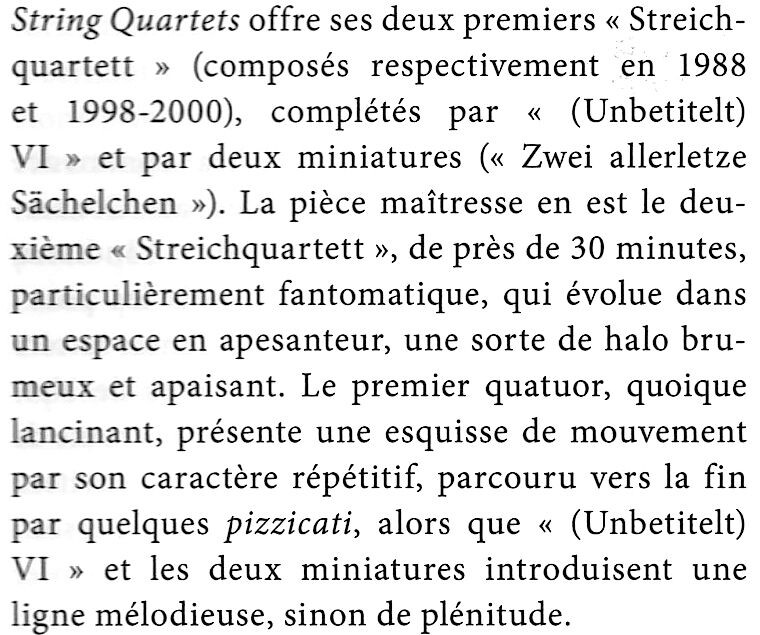
String Quartets presents the Swiss composer’s first two string quartets, including the masterly and almost ghostly
The first quartet is based on the same structural thinking, though it is more assertive in its gestures and volume of sound. Two miniatures complete the programme, the
Translated from French.
Needle Drops
Swiss composer
The Bozzini’s precise execution amplifies the music’s mesmerizing qualities, highlighting why they’ve become one of contemporary music’s most significant ensembles, having premiered approximately 500 works across diverse compositional approaches.
Review
Crítica
Amb el suport d’Actuellecd, un recurs inestimable en la música nova i d’avantguarda, que treballa, entre d’altres, amb DAME-Music, un segell discogràfic amb seu a Montréal, Canada.
El disc, que forma part de la Collection QB, recull quatre obres per a quartet de corda de
El llançament de l’àlbum
El compositor suís Jurg Frëy és poc conegut al nostre país. La seva música és lenta, reflexiva, amb cops d’arc llargs realitzats amb un so expressiu que dona coherència a tot el cos de la producció musical de Frëy.
En la peça central, Streichquartett, el quartet fa sonar uns repetitius intervals cromàtics descendents sotmesos a una llarga cadena d’acords lents que generen harmònics
El segon quartet està precedit per altres obres més breus. El díptic Zwei allerletze Sächelchen —Mailied i Vorbei— crida l’atenció per la seva delicada brevetat. Són moviments sorprenents perquè cadascun d’ells dura escassament un minut. Dues idees, dos instants.
El Quatuor Bozzini ofereix una visió moderada del cromatisme suau i insistent, una construcció harmònica innovada per
El Quartet de cordes núm. 2 és més ombrívol i les tècniques interpretatives del
El seu rigorós ofici, que cerca la qualitat per damunt de tot, els ha convertit en un dels conjunts de cambra de música d’avantguarda més importants de l’actualitat.
Blog
- Monday, February 23, 2026 / Press
… [the] disc was met with upon its release and has since been name-checked by
Björk […], praised by beloved criticAlex Ross , and cited as inspiration for many others, and justifiably so. More - Thursday, January 15, 2026 / Press
La pièce maîtresse en est le deuxième
Streichquartett , de près de 30 minutes, particulièrement fantomatique, qui évolue dans un espace en apesanteur, une sorte de halo brumeux et apaisant. More - Wednesday, January 7, 2026 / Press
… the Montréal quartet again impress us with their detail, as seemingly simple moments unfold with beauty, wonder and emotion that truly does justice to
Frey ’s work. More