actuellecd

Blog

49 results
  • 1
  • 2
  • 3
  • 4
  • 5
  • 6
  • 7
  • 8
  • 9
  • Hypnokaséta in Radiohoerer

    “Release Tipp: „Traumwelten“”, Henry Kozok, Radiohoerer, May 25, 2024
    Tuesday, August 13, 2024 Press

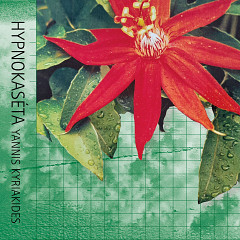
    Turning dreams into literature or music has a long tradition. Bruce Chatwin traveled dream paths in Australia, for Aphex Twin it was the path to his groundbreaking music and let’s not forget Sigmund Freud and many others. Yannis Kyriakides has written music for string quartet and electronics from his dreams and the resulting music is simply amazing!

    Hypnokaséta (2020-2021) is an ongoing series of 16 pieces for string quartet, improvisers (playing tapes and random instruments) and live electronics. The source material is based on dreams I had during the first months of the lockdown (April-June 2020). The accounts of these dreams are encoded in the music played by the quartet and also in the surrounding sound textures.

    The pieces alternate between the quartet in the foreground and electronic interludes in which solos or duos punctuate the soundscape. The title of the piece (Greek for ’sleep cassette’) refers to a dream theory proposed by Daniel Dennett, which states that dreams are loaded into consciousness during the night like a cassette and played just before waking up. The piece was premiered under the name “Cassettes” by Quatuor Bozzini and Andy Moor in October 2022 in Montréal and other locations in Quebec. It was subsequently recorded by Micha de Kanter at Studio Helmbrekers in Haarlem in November 2022.

    There are some interesting parallels here with other works involving a string quartet and electronic music. A piece by Scott Wilson was presented on BBC Radio 3 and the “New Music Show” series in April, which was performed as part of a concert entitled “CrossCurrents: The Ligeti Quartet — The Memory Project”. Project BEAST (Birmingham ElectroAcoustic Sound Theatre) was involved. Two pieces from this concert were presented in this program, one by Scott Wilson and one by Sara Caneva. I can recommend both without reservation. Just as I can warmly recommend the “New Music Show” series to anyone who is interested!

    I find the idea of writing works for string quartet and electronic music very appealing. On the one hand, a young audience is introduced to the musical world of string quartets through electronic music and the classical audience is introduced to the other. An opening that can be a gain for everyone.

    In any case, I think the realization of Yannis Kyriakides’ composition is very successful. The dreamlike quality is not comforting or cozy, no. The interjections of Kyriakides’ tapes and Andy Moor’s guitar do not allow this. The present doesn’t allow that and that’s how this music sounds. The beautiful moments are there, brief and just so that we don’t forget them. The whole thing leaves a strong and long-lasting impression and for me this is music at the height of our time. A favorite for the best of the year!

    The beautiful moments are there, short and just so that we don’t forget them. The whole thing leaves a strong and long-lasting impression and for me this is music, at the height of our time. A favourite for the best of the year!

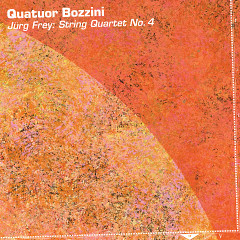
    Jürg Frey: String Quartet No. 4 in Nieuwe Noten

    “Kritiek”, Ben Taffijn, Nieuwe Noten, January 28, 2024
    Tuesday, August 13, 2024 Press

    The collaboration between Frey and Quatuor Bozzini is close. Violinist Clemens Merkel and Frey have known each other since 1990. Furthermore, the quartet previously premiered the second string quartet from the late 1990s and recorded the first three quartets for Ediotion Wandelweiser. With this five-movement fourth quartet, the collaboration went a step further, Frey explicitly involving the string quartet in the process of composing. The first movement is very slow, but also very even, with the sounds coinciding remarkably. Also special are the subtle but very exciting string movements in this first movement. The second movement stands out in particular for its repetitive pattern, sounding pretty much like a siren, while the third movement, which begins quite brightly, stands out for its melodic content, something we don’t often encounter with Frey. Following this, the fourth movement again sounds broodingly exciting, with its hushed string movements. Finally, we hear the impressive fifth movement, which at over 30 minutes is about as long as the first four movements. Beautiful, quite similar patterns, like a quietly flowing river.

    Beautiful, quite similar patterns, like a quietly flowing river.

    Éliane Radigue: Occam Delta XV in A Closer Listen

    “Review”, Joseph Sannicandro, A Closer Listen, December 20, 2023
    Tuesday, August 13, 2024 Press

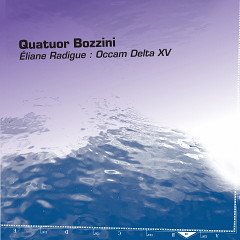
    In the first decade of the new millennium, just as she was finally receiving attention for her groundbreaking electronic works, Éliane Radigue surprisingly turned to composing for acoustic instruments. These “Occams” are compositions based on the particular resonances of a given instrument, each score growing out of the relationship between performers and their instrument: Rivers (for solo performer), Deltas (for small ensemble), and Oceans (for large ensemble). Occam Delta XV was written for Montréal string quartet Quatuor Bozzini, who have made a name for themselves as the finest interpreters of 20th century and contemporary new and experimental music. The result is like flowing water, seemingly static and yet always changing, the rich timbres of the string quartet generating overtones as sensuous as those of any synthesizer.

    The result is like flowing water, seemingly static and yet always changing, the rich timbres of the string quartet generating overtones as sensuous as those of any synthesizer.

    Éliane Radigue: Occam Delta XV in Nieuwe Noten

    “Kritiek”, Ben Taffijn, Nieuwe Noten, June 18, 2023
    Tuesday, August 13, 2024 Press

    Éliane Radigue is also among the founders of the musical movement we often refer to as minimalism, although by no means every composer agrees with this label either. She once started out with electronics, but some years back has devoted herself almost entirely to composing for acoustic instruments. Today, we focus on three recent pieces, performed by the musicians it was also written for. Quatuor Bozzini released a recording of ’Occam Delta XV’ on their own label; Ensemble Dedalus recorded ’Occam Hepta I’ and Ryoko Akama plays ’Occam XX’ on synthesiser. That second album was released by Montaigne Noire.

    Even more than the other composers we count under this movement, Radigue seems interested in the essence of sound. La Monte Young’s music comes closest to this. So it can happen that in that ’Occam Delta XV’, which adds up to over an hour of music, we find remarkably little variation. Radigue is more concerned with the coherence of the sound between the various instruments of the string quartet. Sometimes those sounds run a little further apart and a stratification arises, but regularly there is also a fairly even drone. So music that lacks progression, which is the case with a lot of music within this movement anyway, but Radigue goes a few steps further than many others. However, this does not mean that the music is static; there is plenty happening for those who have an ear for it. Something that, incidentally, is also evidenced by the fact that this album contains two recordings of the piece, which, despite that lack of variety, sound quite different.

    Radigue is more concerned with the coherence of the sound between the various instruments of the string quartet.

    Éliane Radigue: Occam Delta XV in A Closer Listen

    “Review”, Peter Tracy, A Closer Listen, February 18, 2023
    Tuesday, August 13, 2024 Press

    In certain circles, Éliane Radique needs no introduction. Among the first generation of composers to experiment with electroacoustic music, Radigue began her musical education in the mid-fifties alongside the legendary Pierre Schaeffer, becoming one of the few women involved in the emergence of musique concrète. After early experiments with tape and feedback in the late sixties, she found what would become her characteristic sound via the ARP 2500 synthesizer, which she used exclusively for the next twenty-five years. In the early 2000’s, she finally turned to composing for acoustic instruments, bringing some of the most respected names in experimental music along for the ride.

    The Canadian string quartet Quatuor Bozzini have also carved out a niche for themselves as an ensemble dedicated to a specific current of 20th and 21st century experimental music. Stemming largely from American minimalism and the work of John Cage, this tradition might also include names like Morton Feldman, Alvin Lucier, and James Tenney. Despite their obvious aesthetic differences, what these composers and Radigue have in common is more an approach than a single style, a philosophy rather than a system. In this tradition, simple processes yield complex results, time is a material, and the act of listening takes center stage.

    Occam Delta XV is the latest work in the ever-expanding Occam Series, begun in 2011 and comprising over eighty unique pieces for a wide variety of instrumentations. Perhaps the defining feature of Radigue’s work throughout both her electronic and acoustic periods is an attention to microbeats, those rhythmic pulses that can emerge when interference patterns occur between similar frequencies. In Occam Delta XV, this is achieved via long, sustained tones that slowly change and recombine overtime. Yet the form of the piece remains something of a mystery: apparently, the performance instructions were conveyed to the ensemble by the composer herself without being written down, resulting in a piece that is never the same twice. For their part, Quatuor Bozzini describe the piece as something more like a state of mind than a score.

    The album consists of two nearly equal halves, each comprising a performance of Occam Delta XV. The first rendition is akin to something like John Luther Adam’s Become Ocean or the opening movements of Radigue’s own Kyema (1988) from her epic Trilogie de la Mort. You feel the sun on your skin and the wind in your hair, the dawning of a new and solitary day. The second rendition is harmonically “darker” than the first, yet retains the contemplative air that characterizes Radigue’s work, with a seriousness that brings to mind her interest in Tibetan Buddhism. That the performers are able to coax such an orchestral texture from only four instruments is a testament to their skill and Radigue’s longtime-preoccupation with conjuring up these acoustic phenomena, yet it’s clear that the true work can only be experienced live, where the reverberations of the space create their own acoustic variations.

    This is a slow listen: put it on in the background and you’ll completely miss the point. Take the time, listen to each track fully, and try to catch those shimmering tones as they go by. Something like a different mode of listening is possible here, if only you’ll let it emerge.

    That the performers are able to coax such an orchestral texture from only four instruments is a testament to their skill and Radigue’s longtime-preoccupation with conjuring up these acoustic phenomena…

    New Arrivals

    Wednesday, July 17, 2024 New releases

    We have added 12 items to our shop today:

    Find out more about them today!

  • 1
  • 2
  • 3
  • 4
  • 5
  • 6
  • 7
  • 8
  • 9