actuellecd

Blog

86 results
  • 1
  • 2
  • 3
  • 4
  • 5
  • 6
  • 7
  • 8
  • 9
  • Mistpouffers in Toneshift

    “Review”, TJ Norris, Toneshift, October 6, 2018
    Saturday, October 6, 2018 Press

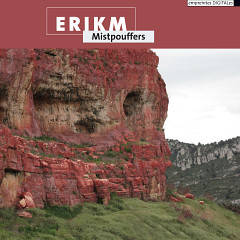
    Mistpouffers is a selection of three compositions completed between 2014-16, composed by French artist and improviser eRikm. Each piece runs approximately 17-18 minutes in length with two based on 8-channel fixed medium and one in stereo. Opening with Draugalimur where, poof like smoke, the setting is a quiet distant storm, some electronic squiggles and free-floating static. This is eRikm working in an atmosphere where a pin could be heard dropping, that is until a narrator like a public radio host, in French, reads from a text. The wind howls and electro-waves are emitted. While listening I gaze upon the cover image of a cliffside that starts to resemble a human skull. No you are not seeing things, like a mirage — it’s an in-situ illusion, only emphasized by a military jet flying past, from ear to ear as someone gasps for air. This dichotomy between air space and breathlessness is likely key to the narrative. The eerie unexpectedness here is quite palpable.

    Sonic boom? By occupying the space with layered field recordings, simple thing like chewing, and rummaging — with a silky drone and changing percussive parameters eRikm has developed a psycho-social space that is as inventive as it is cinematic. The whispers, the hive drone, the bouncing punctuation, all make his acoustic theatrics rife for live presentation, and perfect for visual listeners. Moving on to Poudre, which opens in darkness to creaking of chairs, or perhaps thunderclap or is it fireworks, or gunfire? The question mark here is the tension. With even the slight laughter heard int he mostly engaged crowd scene it would be menacing one way, and exhilarating another. But it seems to walk that fine line. The title translates to powder (and in gun powder) and this work does seem to float on air with the spirit of a nighttime curfew. It’s singular shots are disarming so to speak — “the bombs bursting in air” and so on. In wartime these echoes have a cerebral resonance that is unmistakable.

    Just after midpoint this layered field recording sounds like either a grande finale or a full-on battle. It’s actually quite disturbing, it’s chaotic imprint, relentless. At one point it’s literally just a wash of savage white noise. But the reverie switches up its candor on L’aire de la Moure 2. There are shadows of a dark kingdom interrupted by a happily chirping winged beast. The intermittent grey drone casts and draws as these treated bird samples are deployed like abstract illusions. eRikm has concocted a blend of granular electronics, a female narrator and low flying planes that zoom from air shot. The tingling microsound invades as though it’s evaporating over the spoken word.

    It’s an atonal radio play that seems to be collecting data in a laboratory. Small actions like pulling a topper from a cask, as well as elongated high tones create a focused format for deep listening — all ears on the speaker, and though I do not speak much français my ears can translate this as a scanner of the mind. Static like fire, and a series of slingshot thwapping are a peculiar combination alongside a deep bird caw. With so many constant variables you’d think this recording would be a schizo delusion but it’s not at all, it keeps your minds ear constantly pricked within this composer’s cosmic adventure.

    The tingling microsound invades as though it’s evaporating over the spoken word.

    Lézardes et zébrures in The Squid’s Ear

    “Review”, Jeph Jerman, The Squid’s Ear, October 1, 2018
    Monday, October 1, 2018 Press

    Jeweled miniatures constructed of fingerpicked guitar arpeggios and electronic treatments. Quiet and contemplative, like studying the patterns of shifting light and shadow on your afternoon wall.

    Distillations offers clouds of harmonics with squelchy, wheezy organ tones accreting. A few of the pieces stop dead and change tack in an arresting manner, not so much jarring as re-aligning, an intake of breath. The longest piece, Porcelain 360 has metallic, vibraphone tones and weird bent organ swells, a toy piano amid careful chord shapes which gradually gain speed and density over its twelve minute running time. Lopsided, but still managing to maintain a sense of development. Marcher sur la glace has a stuttering, leslie speaker feel, and Stalactites et stalagmites sets up a stately series of strummed chords with hovering held tones that gradually becomes more harmonically complex.

    For some reason I am reminded of a weighted hanging thread, slowly spinning one way and then the other, throwing tiny shards of fiber in graceful arcs as they glide to the floor. Somewhat hidden inside the cover are chord diagrams and short bits of musical staff, which I unfortunately cannot read.

    Jeweled miniatures constructed of fingerpicked guitar arpeggios and electronic treatments. Quiet and contemplative, like studying the patterns of shifting light and shadow on your afternoon wall.

    Just So in Just outside

    “Review”, Brian Olewnick, Just outside, September 12, 2018
    Wednesday, September 12, 2018 Press

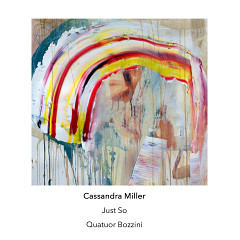
    Miller’s music is absorbing for any number of reasons. She makes use of aspects of various branches of modernism including minimalism and, in some pieces, a kind of structural stasis but almost always also references traditional forms and techniques, from Bach to folk songs to Ives and more. Just So collects four pieces for string quartet, performed in typically beautiful and rigorous fashion by the Bozzini Quartet, two shorter works bracketing two longer ones. The title composition is a lilting affair, recalling some kind of village gig or reel, the strings pitched high, dancing, the rhythms just this side of irregular, the cello coming in for some wonderful underpinning in the final few moments. A bracing, joyous number to open the set. Warblework, as the title implies, concerns itself with birds: three thrushes and a veery. To my ears, not birdsong as much as tracing the paths birds make in flight and very movingly so. The strings swirl and skitter in brief bursts for the Swainson’s thrush, alight for a moment, then take off once again while the hermit thrush swoops a bit more, stays lower to the ground and the wood thrush grunts and pushes its way through the underbrush before standing still to survey its surroundings, which are filled with lovely, dry harmonies. The veery, another kind of thrush, does seem to make a doleful call amidst grainy streaks, the calls multiplying, a little anxious as though espied. Here, as in other pieces, Miller makes subtle use of approximately iterated cells of music, a near repetition of clusters that nods to minimalism without ever falling into rote usage — this is an especially fine work.

    About Bach is the longest work presented here and kind of a centerpiece, illustrating the sort of structural tack that Miller seems to enjoy and that, in a way, she elaborates in her marvelous composition, Duet for Cello and Orchestra, commented on below. Here, if I’m not mistaken, one violin (maybe sometimes both?) plays a very highly pitched, seven-note ascending “scale” throughout the piece. Readers with more musical knowledge than I might identify it, but I was reminded, oddly enough, of the scale sung by the lead tenor at the conclusion of Glass’ 1979 opera, Satyagraha. It’s very poignant in and of itself, gathering strength and weight and, indeed, poignancy as it’s repeated again and again. The lower strings, in an almost conversational manner, reflect with phrases that seem obliquely derived from Bach, though with an entirely modern hesitancy and questioning aspect. Toward the end, it attains a clear dimension of solemnity. There’s a type of stasis in effect, pinioned by the violin (s) but also enhanced by the general self-similarity of the interposed phrases, though they in fact vary at all times. The sense of overhearing snatches of discussions in a large room pervades, dreamlike. Just a deep, marvelous and affecting work, brilliantly performed. The disc concludes with Leaving, another work that appears to have folk song roots, maybe a sea shanty, lolls in place like an old docked boat gently buffeted by small waves. Each of the strings seems to carry a related tune, melding together at times, drifting apart at other moments. It’s an immensely satisfying, soft kind of almost-lullaby, a fine ending to a superb recording.

    It’s an immensely satisfying, soft kind of almost-lullaby, a fine ending to a superb recording.
  • 1
  • 2
  • 3
  • 4
  • 5
  • 6
  • 7
  • 8
  • 9