actuellecd
  • This website is also available in English.

Blog

163 results
  • 6
  • 7
  • 8
  • 9
  • 10
  • 11
  • 12
  • 13
  • 14
  • Muets in Audion

    “Review”, Nick Mott, Audion, no. 43, September 1, 2000
    Friday, September 1, 2000 Press

    DAME presents a new Klaxon Gueule CD called Muets which, to quote the promo info, is “electroacoustic chamber music” akin to improvised Henry Cow, ffom the angle of AMM. Interesting, diverse and challenging.

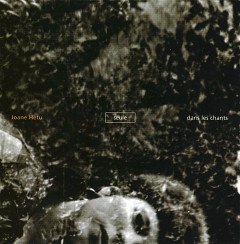
    Seule dans les chants in Audion

    “Review”, Nick Mott, Audion, no. 43, September 1, 2000
    Friday, September 1, 2000 Press

    Joane Hétu is becoming both a regular producer and musician for the label these days. Her Seule dans les chants (AM 077 CD), in spite of its title “Alone in The Songs” has no songs! It’s mostly an album of squeaky sax, vocal effects, mundane laughter and such like, and is very basic. The laughter and musical phrasing is all handled rather dead-pan, though there is humour in some bits where it sounds like a miniature Joane is running around and kissing the sax from inside! Overall it doesn’t amount to much.

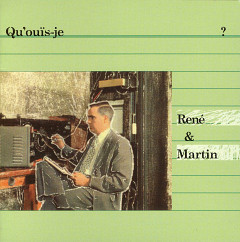
    Qu’ouïs-je? in emoRAGEi

    “Critique”, Jeff Bugz, emoRAGEi, no. 11, September 1, 2000
    Friday, September 1, 2000 Press

    On assiste ici à une mixture assez intéressante entre le virtuose René Lussier (Daxophone) et le manipulateur de table tournante Martin Tétreault (aussi synthétiseur, boîte à rythme). Le sirop a bon goût si vous êtes enrhumé et que vous aimez le son de votre toux. En d’autres mots, les bruits absolument non-commercials de ce disque vous transportent dans un monde d’innovation et de ré-interprétation sonore digne de ses 2 grands explorateurs. Quand vous êtes fatigués de fredonner les refrains de vos artistes préférés, tentez l’expérience d’écouter le disque de René et Martin, il vous plongerez dans d’étranges atmosphères qui en fait, vous changent de la routine pop. Ce ne sont pas les seuls artistes qui aiment créer des sons comme eux alors si vous aimez ce disque, vous voudrez en découvrir plus sur leurs semblables et ça devient une drogue. Il faut vraiment avoir l’esprit ouvert pour écouter cette musique et faut croire que Radio-Canada l’a, puisqu’elle semble avoir subventionné une partie du disque. (8/10)

    8/10

    Dérapages à cordes in emoRAGEi

    “Critique”, Jeff Bugz, emoRAGEi, no. 11, September 1, 2000
    Friday, September 1, 2000 Press

    Dérapages à cordes est vraiment LE titre approprié pour un disque d’expérimentation semblable. On pourrait qualifier l’album d’un anglicisme tel un “jam” ou une musique “bluesy” sans direction. Les 2 guitaristes utilisent plusieurs sortent de guitares différentes -que ce soit classique, semiacoustique ou slide- et dans quelques pièces, on ajoute des percussions et voix. Les gaillards se laissent emporter en transe dans leur musique déconstruite naviguant entre la démolition et la musique plus contemporaine. Bref on laisse parler nos instruments et on verra ce que ça donne! (7/10)

    7/10

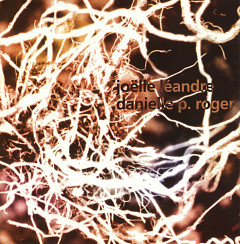
    Tricotage in Survivor Newsletter

    “Review”, Tom Schulte, Survivor Newsletter, no. 12:9, September 1, 2000
    Friday, September 1, 2000 Press

    In more challenging, avant garde Joëlle Léandre and Danielle Palardy Roger join on Tricotage (DAME). The pair’s instrumentation is double bass and percussion. The bass squeaks, taunting the percussion hydra kit drum beside it. The two instruments engage in a witty repartee throughout the album in a new vocabulary. Here the bass and percussion instruments become light and bird-like, star-like.

    The two instruments engage in a witty repartee throughout the album in a new vocabulary.

    Chants cachés in Signal to Noise

    “Review”, Stuart Broomer, Signal to Noise, no. 13, September 1, 2000
    Friday, September 1, 2000 Press

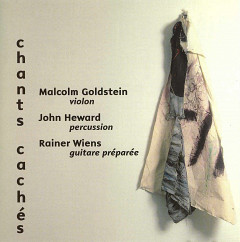
    This is a remarkable account of three improvising musicians recorded over four days in November 1997, but a much longer period of musical exchange has shaped the interaction of violinist Goldstein, percussionist Heward, and prepared guitarist Wiens. The six trio pieces and two duets by Goldstein and Wiens are improvisation in its purest form, reminiscent at times of some of the quieter editions of John Stevens’ Spontaneous Music Ensemble. Heward mentions in the notes that when “I think of and make improvised music I have images of water somewhere in and out of mind,” and that will serve as ideal point of entry to this music making. It is, above all, fluid, making its own course, absorbing other materials, progressing at the rate that the terrain allows. But it is also its own terrain, with figure and ground never absolutely defined. Also elemental, it is so insistently engaged in time that it becomes effectively timeless. Like all good improvisation, it is utterly distinct, each piece and each voice necessarily itself, but it is so in such a way that all our individual descriptions must be some how similar. It’s quiet music that invites a moving point of view. Heward sounds Like he’s restricting himself to small instruments, while Wiens’ prepared guitar focuses on the minutiae of sound, so that one is often at a loss to identi fy who is making what sound, and how, at a particular moment. Part of the process of listening is to surrender that need, to wander into the music’s movement. Each player enjoys elliding tonalities, slides and glissandi and glassy rattlings that will recall the sonic world of Harry Partch. In this flux, one sometimes hears a passage in which a sound is so close and so necessary to Goldstein’s line that it is best identified not as drum or guitar, but as not-violin, the sympathy so strong that Goldstein might be playing one of his partners instruments. That blurring is especially strong around grating sounds, a metallic rubbing that often acts to rub parts together. At other times, a player will enter the discourse in such a marked way as to make you wonder how he had been previously absent. The two duets are, I think less successful than the trios, Heward too large a component for this music to surrender. The results seem suddenly, and only, binary, Goldstein becoming too markedly linear Wiens more fixed. Otherwise, this has the lulling gentleness of water, that gentleness that will erode mountains.

  • 6
  • 7
  • 8
  • 9
  • 10
  • 11
  • 12
  • 13
  • 14