
Tricotage
Joëlle Léandre, Danielle Palardy Roger
This CD contains some good moments, and I think that any fan of this music would be happy to own a copy. — Musicworks, Canada
The music is delicate, sometimes brittle but never flimsy… — Rubberneck, UK
The meeting of two sound-worlds, the drums and a double bass
- Composer(s): Joëlle Léandre, Danielle Palardy Roger
- Cover image: Julie Belpaire
CD (AM 078, 2000)
- 1Les tricoteuses, 4:24
- 2Jersey gigue, 5:14
- 3Come on on on on, 4:45
- 4Jeux de mains, 4:37
- 5Au clair de lune, 3:16
- 6Les grands écheveaux, 6:33
- 7Coupes blanches, 5:44
- 8Knit One, Purl Three, 5:39
- 9Dernière minute, 0:59
- Label: Ambiances Magnétiques
- AM 078
- 2000
- UCC 771028107827
- Total duration: 41:32
- Jewel case
- 125 mm × 142 mm × 10 mm
- 100 g
On the web
Some recommended items
In the press
Chicks and Other Barnyard Fauna
With the notable exception of sugary pop, all music styles are dominated by the male. Whether he’s grunting into the microphone, strumming his guitar, or blowing his lungs out on the saxophone, the manly man monopolizes the image of the musician, be it in corporate rock or on the new music scene. When women venture into his domain, they are often coerced into fitting the mold of the industry.
That’s why it is so surprising to find this many creative, challenging, talented women in DAME’s catalog. But one should not forget that early in its lifetime the collective Ambiances Magnétiques welcomed three artists whose musical activities, organizing minds and determination provided a force of attraction for other women. Of course, I am talking about
Our three protagonists met at the turn of the ‘80s in
Soon after the release of Langages fantastiques, the three girls launched their solo careers. Linguistic marvel and a rough delivery keep singer and saxophonist Joane Hétu close to the field of outsider art. First she formed her own group
Toward the end of Justine’s life, Diane Labrosse traded in her keyboard for a sampler. After a solo album,
Since the disbanding of Justine, Danielle Palardy Roger’s discography has been growing slowly — she’s very busy organizing concerts as head of Productions SuperMusique. Her children’s tale
In 1986, Joane, Diane and Danielle took a vacation away from Wondeur Brass to investigate the limits of the pop song format under the name Les Poules — The Chicks (
The presence within Ambiances Magnétiques of these three creators has attracted to the label other female artists with similar interests. The first one to join the roaster was
So, is musique actuelle a man’s world
Translated from French.
Dynamic duo Mix it up in Montréal
New-musicians have taught us the valuable lesson that good music can be made with any sound, even those that were never meant to be made on a musical instrument. It might be argued that new genres of music are born when musicians take an object and make it produce new-musical sounds
The album is rather short, at fortyone minutes of free improvisation between Léandre and Roger. Léandre-ites will immediately recognize her style pizzicato, voice-like attacks mixed with often gritty arco work. Roger takes a complementary approach—she chooses to avoid loud, disruptive events like rim-shots and squeaking snare drumheads, and instead uses small bells, a lot of brush work, very occasional cymbals, and a constant trickle of mezzo-piano chatter on the middle drums. This approach is successful because it allows Roger to evoke rich textures without overwhelming the acoustic contrabass.
The flrst seconds of the recording will give the listener a teste of what is to come. Roger uses brushes to create tension by playing a sort of drum roll for a few moments, and then the release comes when Léandre enters with her sig nature chattering bass. The highlight for me is track three, Come on on on on, where it all comes together in a delicate five-minute conversation between snare drum and bass.
Each track features a different side of Léandre and Roger’s playing. Track four might be called “squeaky and plucky” and track five “nice classical bowing. “ The sixth track seems dedicated to the evocation of anxiety and its release, and the seventh to a jarring rhythmic theme. The CD ends with a brief vocalese discourse by Léandre, framed by Roger drumming.
This CD contains some good moments, and I think that any fan of this music would be happy to own a copy. Among works by Léandre, I would definitely rate it as one of the better recordings because of the role that texture plays. Roger’s restraint allows for a great deal of artistry and joy to come out. The best thing for me was to discover Danielle Roger. Not being familiar with the creative music scene in Canada, I have never heard Roger play and after hearing Tricotage, I hope to hear more of her.
Review
In stark contrast, Tricotage is stylistically settled and explores in detail a single area of the improvising spectrum. A consummate piece of improvisation, Léandre and percussionist Roger show a level of awareness of each other that is enviable, interacting as they do in almost effortless dialogue. Each of the nine splendidly crafted pieces has a distinct identity but is connected by a unity of purpose and approach. The music is delicate, sometimes brittle but never flimsy, contrasting a range of restrained almost understated sounds with more positive gestures. Léandre’s arco playing can often be poignant, even heart-rending but she is equally capable of producing a smile on her listener’s face with playful and even throwaway gestures.
Review
Two CDs of improvised music from the eminent Canadian label Ambiances Magnétiques.
The first is a meeting place for two accomplished improvisers and composers, Joëlle Léandre on double-bass and Danielle Palardy Roger on drums and percussion. Both artists have extensive discographies exploring a wide range of musical styles, and this is the first time they are working together. The music on this disc is challenging and complex. The double-bass is grating and hyperactive
Review
Léandre is very much at home in the duet setting having used this format on several recent recordings with different partners and instrumentation. On, she and drummer Roger speak in very personal tones that bring out the esthetic beauty of their two instruments. Léandre initiates the action with a vigorous display of arco playing, to which Roger simultaneously responds with a deft, sensitive drum touch. Roger uses bells cymbals, and other percussion devices to establish a serene mood. This state is temporary for she becomes more aggressive in response to the physicality displayed by Léandre. The bassist moves gracefully from bowing to plucking and back again, projecting hugely rich tones containing muscular strength and power. In step, Roger shrouds the output with quickly emerging splats of brush and stick work to set a galloping pace for the two women.
The program consists of nine exercises in bass/ drum intercommunication. Either artist is likely to set the direction. On Jeux de mains, Roger uses her hands and palms to rub abrasive textures into the song, which causes Léandre to become somewhat percussive herself as she aggressively taps the strings The rhythm patterns are not completely atonal. An occasional tangible beat will suddenly emerge and then flee as quickly as it appeared. On au clair de lune, Léandre plays a mournful strain while Roger is in complete contrast with spontaneous and rapid spitfires of sound. Throughout, the music is cloaked in density and weightiness. The foreboding overtones give way to hopefulness and then recede back in an undercurrent of darkness. Léandre vocally injects the spirit of the Native American on Coupes blanches, and the ethnic beat of Roger matches. These duets represent two very talented artists. painting a formidable picture of intense audibility. There is no need for any other instrument on this set. Léandre and Roger say it all.
Critique
Première rencontre
Critique
Tricoter
Tricoteuses
Y a-t-il ici une quelconque revendication
Enregistré à Montréal, cette knitting factory de poche subit aussi l’influence locale, en nous invitant à une sorte de rituel indien, invocation aux forces naturelles (coupes blanches).
Review
In May 1999, French bassist Joëlle Léandre was in Montréal for a concert and a recording session with drummer Danielle Palardy Roger (ex-Justine, Les Poules, Wondeur Brass). The result of this encounter was released in early 2000 by Ambiances Magnétiques under the tittle Tricotage (Knits), a feminine title for an album soaked in feminine sensibility. The two improvisers make one with their instruments, Léandre letting sighs and moans escape along the way (like on the beautiful Knit One, Purl Three). The pretentiousness found on Ambiances Magnétiques releases from the same period is absent on this CD
Review
In more challenging, avant garde Joëlle Léandre and Danielle Palardy Roger join on Tricotage (DAME). The pair’s instrumentation is double bass and percussion. The bass squeaks, taunting the percussion hydra kit drum beside it. The two instruments engage in a witty repartee throughout the album in a new vocabulary. Here the bass and percussion instruments become light and bird-like, star-like.
Review
Recensione
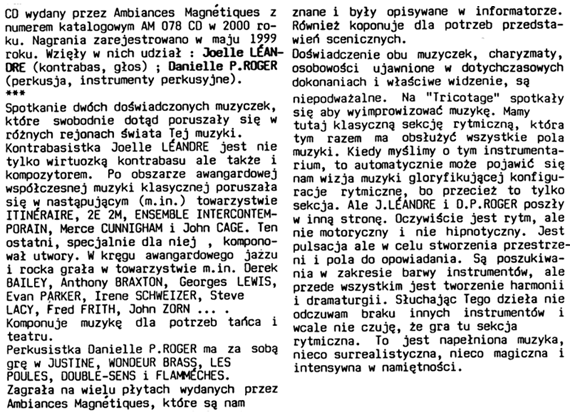
Sto pensando da tempo a un anticolo su Joëlle Léandre, ogni approccio viene però scoraggiato dalI enorme moie e varietà di situazioni attraversate dalla contrabassista francese — improvvisatrice con Derek Bailey, Anthony Braxton, Evan Parker, George Lewis, John Zorn… oltreché raffinata interprete di John Cage.
Giacinto Scelsi… Un’attitudine a 360˙ che oltretutto ha dato sostanza a una produzione come mimmo interessante. Un nuovo colpo alle mie velleità viene ora dato da questa coIlaborazione con la percussionista francofono-canadese Danielle Palardy Roger 11 background delle due strumentiste trova sistemazione in 9 improvvisazioni dove la cerebralità gnumosa della musica contemporanea, improwisata e non. si disfà via via in straniati attimi di melodia e ritmo, fino alle premonizioni ritualistico-iniziatiche di Coupes blanches e ai 59 secondi, tutti cageani. Della conclusiva Derniere minute,
Tricotage è un dovere per coloro che già rimasero impigliati nella rete tesa dall ammaliante contrabbassista, e un ottimo inizio per tutti i neofiti. Ma stiano attenti gli ultimi, e si ancorino ben bene alla realta. perche e arduo sfuggire atle lusinghe di tali Sirene
7
Soundcheck Review
Aptly titled, ‘knitting’ is what occurs in this meeting between bass virtuoso Léandre and percussionist Roger (formerly of Québec’s Wondeur Brass) Léandre’s technique is awesome, Rogers approach is more basic and intuitive They mesh nonetheless, the relationship takes preecedence. The sustained interweaving very occasional y suggests that welding as well as crochet is an option available to both players.
Critique
Danielle Palardy Roger est percussionniste et Joëlle Léandre, contrebassiste, et toutes deux sont d’inclassables solitaires vouées à la musique improvisée. À première vue, tout cela pourrait paraître bien austère. Un dialogue contrebasse-percussion n’a rien de très bandant en soi. Mais ces filles savent aussi que pour bien tricoter, il faut faire plus que jouer à une maille à l’endroit, une maille à l’envers et embrouiller savamment les fils. Léandre, qui a promené sa basse sur la terre entière, a fait de son instrument un véritable prolongement de sa personne et sait de toute évidence en tirer quelque chose. Le résultat est énergique et donne un exemple éloquent de ce que peut provoquer la rencontre réussie entre deux personnalités musicales franches. 8/10
8/10
Critique
Un duo contrebasse-batterie qui s’offre comme une rencontre que l’on imagine volontiers explosive. L’explosion résulte pourtant moins de la confrontation de ces deux instruments aux sonorités profondes que de l’intensité qui se noue peu à peu, au fil des improvisations entre les deux musiciennes.
More texts
- Nick Mott, Audion, no. 43, September 1, 2000