
Éliane Radigue: Occam Delta XV
Bozzini Quartet / Éliane Radigue
The infinitesimal perforations spreading across the sound’s spherical surface like mournful snails broke into my psyche and depressed the reset button. The opaque guise of stasis did little to betray the wonders occurring beneath. It was like seeing fireworks for the first time, shrunken down to the size of my palm and resonating twice as much. A graciously donated knife was slipped between the neurons of my auditory cortex
; the droning strings shivered, the harmonics appeared to grow shrill. — POW, USA
The result is like flowing water, seemingly static and yet always changing, the rich timbres of the string quartet generating overtones as sensuous as those of any synthesizer. — A Closer Listen, UK
I was very honoured to receive this request from Quatuor Bozzini, whose immense talent I already knew. The first meeting was very warm, friendly and familiar, like a reunion of old friends after a long separation. —Éliane Radigue
Thus began the collaboration between Quatuor Bozzini and Éliane Radigue. In the hospitable atmosphere of her apartment, the composer conveyed the intricacies of her sound to QB. Her entire career, Radigue has been dedicated to building a body of work in which, from long sustained tones, microbeats between frequencies emerge. Radigue transmitted Occam Delta XV (2018) to QB — the dedicatee of the piece — through an oral composition process which, given Radigue’s experience with electronic instruments, was the most natural way of communicating.
Playing Occam Delta XV, for QB, is like jumping in a lake when you know the water might be cold
The encounter between QB and Radigue points to the challenging nature of auditory availability in Radigue’s music. Yet, as one may experience while listening to this album, such acute awareness transfers to all listeners of Radigue’s music
- Composer(s): Éliane Radigue
- Performer(s): Bozzini Quartet, Clemens Merkel, Alissa Cheung, Stéphanie Bozzini, Isabelle Bozzini
CD (CQB 2331, 2023)
- This item can be downloaded and/or listened to at collectionqb.bandcamp.com.
- 1Occam Delta XV (2018), 37:41string quartetBozzini Quartet (Alissa Cheung, violin
; Clemens Merkel, violin; Stéphanie Bozzini, viola; Isabelle Bozzini, cello) - 2Occam Delta XV (2018), 36:31string quartetBozzini Quartet (Alissa Cheung, violin
; Clemens Merkel, violin; Stéphanie Bozzini, viola; Isabelle Bozzini, cello)
- Label: Collection QB
- CQB 2331
- 2023
- UCC 771028373123
- Total duration: 74:15
- Sympathique case
- 126 mm × 126 mm × 5 mm
- 35 g
On the web
Download (CQB 2331_NUM, 2023)
- This item can be downloaded and/or listened to at collectionqb.bandcamp.com.
- 1Occam Delta XV (2018), 37:41string quartetBozzini Quartet (Alissa Cheung, violin
; Clemens Merkel, violin; Stéphanie Bozzini, viola; Isabelle Bozzini, cello) - 2Occam Delta XV (2018), 36:31string quartetBozzini Quartet (Alissa Cheung, violin
; Clemens Merkel, violin; Stéphanie Bozzini, viola; Isabelle Bozzini, cello)
- Label: Collection QB
- CQB 2331_NUM
- 2023
- UCC 771028373185
- Total duration: 74:15
Video
-
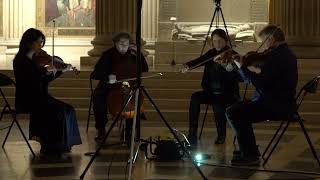
Trailer : Éliane Radigue: Occam Delta XV; Bozzini Quartet; video: Gilles Paté; January 2023; 4:44
Some recommended items

In the press
Review
Review
In the first decade of the new millennium, just as she was finally receiving attention for her groundbreaking electronic works,
Review
Since 2011, the compositional project of
This release from the Montréal-based
Like the other pieces in the Occam series, this work is not so much written for a particular medium as for a particular performer or group of performers.
The experience of watching the sea, or being immersed in water, is probably the best analogue for a listening experience which is ever changing and yet eternally the same. Occam Delta XV consists of long sustained string lines and a constant four-part texture. This is a completely non-hierarchical work, with all four voices having equal value and making an equally important contribution.
The two performances are of course different from each other
Kritiek
Even more than the other composers we count under this movement, Radigue seems interested in the essence of sound.
Translated from Dutch.
Original text
Ook
Meer nog dan de andere componisten die we onder deze stroming rekenen lijkt Radigue geïnteresseerd in het wezen van klank. De muziek van
Review

Review
You would think, by now, i’d be getting the hang of this piece.
The first observation to make is that the Huddersfield version, at around 20 minutes’ duration, is nearly half as long as the two recorded performances (37:25 and 36:31 respectively
i used the phrase “unstable stability” to describe the piece before, and as with so much of
From a listening perspective, an outcome of this is that it throws a lot of attention on the here and now, what’s happening in the music moment by moment. For music so glacially slow that might seem counterintuitive, yet it’s that sense of its infinitude that makes the question of a longer-term listening perspective (something i’ve spent years trying to cultivate) seem rather moot. It’s not that such a longer-term perspective is impossible, or meaningless, rather that what
In these two performances of
Especially nice is the way the Bozzinis control the texture as it ventures into more fragile territory. In the first track (‘2021-11-09’), at around the midpoint there’s a curious impression of rumble, and the harmony seems to be pulling in all directions such that the music sounds like it could just come apart at the seams. It ends up registrally polarised but somehow a perfect fifth fundamental rematerialises, whereupon the upper notes become dancing harmonics of the lower. In the second track (‘2021-11-10’), the fragility sounds more marked, which is appropriate considering how the opening minutes of this performance exhibit a greater sense of flux, as if made of concentric chords rotating at different rates, a mesmerising effect. The fundamental returns in the same way, and the closing minutes of both performances are, depending on your perspective, either an extended coda, gently tilting like soft fabric wafting in a breeze, or simply the current stage in an ongoing process without beginning or end.
Review
Eight women composers to watch in 2023
Much in the same way as she manipulated feedback on tape machines, this time live instrumentalists would be given a small, verbal instruction as impulse (typically a descriptive image), and asked to dwell on it. No notation is made by the composer, though players might make their own notes as memory aids. While attending to the play of high harmonics, musicians’ typically long and sustained pitches interact with utmost subtlety and delicacy (as can be heard in this recording by
Review
Review
If it were only the numbered series of releases from shiiin, that each Occam recording introduces something special could be considered a conscious aspect of presentation but as this characteristic continues through independent presentations too it might illuminate the naturalistic diversity inherent to a system whose foundation begins with the foundation of life. Recordings have seemed to so far systematically introduced occam, river, delta, and ocean forms, traced one performer through them, provoked comparison of behaviors in instrumentation with all strings or all winds. Always each showcases the relationship of the performer to their instrument and the limit of each. This delta feels special in that while other ensembles — Zinc & Copper, Decibel, Onceim — are anchored by a chevalier with an occam
And it is the first delta to sound deltaic to me. The quartet begins closer to unison than it ends, with the gradual recognition that bowing cadences seem to have drifted towards their instruments’ natural frequencies, twin violins in relative ecstatic excitation over low and slow cello, having got there by a meandering way that felt in the moment to be suspended, slow bowings’ strokes carving bank and bar in epochal time, a rise in volume splaying harmonics like the channel widens at the space it splits, the intuition and the information of never stepping in the same river twice. In between always a world of harmonics like life under a microscope, teeming. A few provide markers across evenings as fossils would. A kind of high-tension tanpura buzz. A dancing satyr fluting. The differences are subtle but tangible, felt more than known and ineffable. Perhaps the satyr’s bolder on the first night and the tanpura on the second. But it lights the imagination to wonder the minute physical parameters that would change the sound, the pressure and the temperature of the room one night or another, beyond the infinite variations in the performers’ hands.
Review
In certain circles,
The Canadian string quartet
Occam Delta XV is the latest work in the ever-expanding Occam Series, begun in 2011 and comprising over eighty unique pieces for a wide variety of instrumentations. Perhaps the defining feature of Radigue’s work throughout both her electronic and acoustic periods is an attention to microbeats, those rhythmic pulses that can emerge when interference patterns occur between similar frequencies. In Occam Delta XV, this is achieved via long, sustained tones that slowly change and recombine overtime. Yet the form of the piece remains something of a mystery
The album consists of two nearly equal halves, each comprising a performance of Occam Delta XV. The first rendition is akin to something like
This is a slow listen
Review
Nearly twelve years ago I was in the audience for
Review
For her ongoing series Occam Delta, the French composer
Blog
-
Tuesday, August 13, 2024 / Press
The result is like flowing water, seemingly static and yet always changing, the rich timbres of the string quartet generating overtones as sensuous as those of any synthesizer. More
-
Tuesday, August 13, 2024 / Press
Radigue is more concerned with the coherence of the sound between the various instruments of the string quartet. More -
Tuesday, August 13, 2024 / Press
That the performers are able to coax such an orchestral texture from only four instruments is a testament to their skill and
Radigue ’s longtime-preoccupation with conjuring up these acoustic phenomena… More