Sauter au contenu principal
actuellecd

Blogue

3585 résultats
  • 16
  • 17
  • 18
  • 19
  • 20
  • 21
  • 22
  • 23
  • 24
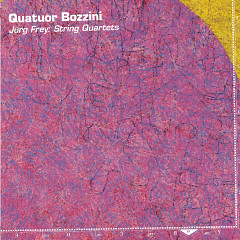
  • Jürg Frey: String Quartets dans Trybuna Muzyki Spontanicznej

    «Recenzje», Trybuna Muzyki Spontanicznej, 9 mai 2025
    mardi 13 mai 2025 Presse

    Un compositeur notable de musique contemporaine, un quatuor classique canadien tout aussi notable et cinq compositions datant du siècle dernier, interprétées au début du suivant et aujourd’hui rééditées. Les deux premières durent une douzaine de minutes chacune, les deux suivantes sont des miniatures de quelques dizaines de secondes, tandis que la dernière dure près d’une demi-heure, une épopée de sons qui s’estompent d’une beauté unique.

    La première histoire est une sorte de trépidation douloureuse, une berceuse déchirante et sans joie, sous la forme d’une répétition constante construite par des oppositions, tant sur le plan sonore que dramatique. Le récit ondule, adhérant avec détermination à l’idée de minimalisme et parfois de réductionnisme constitutif. Le silence joue ici un rôle important, qui, de temps à autre, fait entrer clandestinement des bribes de mélodies qui s’estompent. La deuxième piste semble s’inspirer de l’esthétique de la musique ancienne, est plus sombre et est certainement la plus classique de l’ensemble de l’album. La narration apparemment simple subit ici une rupture systématique, mais elle ne perd pas la marque d’une exposition moelleuse. Il fait souvent un pas en avant, puis deux en arrière. Il avale de petites portions de mélodie, les mâche et les remet en place. La fin même semble porter une note d’optimisme mystérieux. Parmi les miniatures annotées, la première cherche un fond, la seconde brille d’un post-baroque strident. Le cinquième morceau occupe la moitié de l’album et en constitue définitivement la qualité. Elle coule du fond de la crypte obscure, s’étirant entre les dents serrées, évoquant une procession des morts. C’est d’une beauté indicible, bien que construit avec des méthodes extrêmement réductrices. Une grande omission qui déplace des montagnes. Une vie qui porte depuis longtemps la marque d’une mort irrémédiable. Elle sent la musique ancienne, la bande-son parfaite d’une mort exceptionnellement lente.
    … d’une beauté indicible…

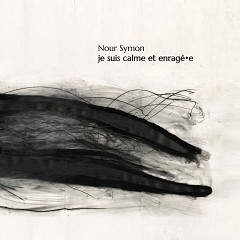
    Je suis calme et enragé·e dans Trybuna Muzyki Spontanicznej

    «Recenzje», Trybuna Muzyki Spontanicznej, 9 mai 2025
    mardi 13 mai 2025 Presse

    Après un album solo et deux quatuors, voici venu le temps d’un grand line-up, ici douze pour être exact, issus de deux formations. Il y a bien sûr aussi un compositeur, inspiré ici par des poèmes très contemporains. Et impossible de ne pas donner les crédits de l’album. Je suis calme et enragé·e est une pièce transdisciplinaire qui commence par ces mots de Roxane Desjardins. Ce projet ambitieux que vulnérable et donnant à entendre six tableaux sonores — partitions musicales visuelles composées par Nour Symon — pour autant de poèmes explorant des positions de détresse et de vertige par rapport à l’Histoire, à l’ampleur de l’humanité, aux désastres écologiques qui se profilent.

    L’œuvre méta-opéra, entièrement monumentale, s’ouvre sur une polyphonie équilibrée mais déjà très expressive, étayée par une narration de cordes en sourdine. L’électronique règne en arrière-plan, créant une tension, posant des questions, inspirant parfois. Ce récit dense et nerveux n’est cependant pas dépourvu d’une note de rêverie mystérieuse. Le deuxième mouvement est d’abord une sorte d’étirement musculaire paresseux — le flux instrumental-vocal semble s’écouler un peu plus haut. Il gagne rapidement en puissance et explose avec la force d’un orchestre de free-jazz. Au premier plan, cependant, se trouve le narrateur, qui distribue les rôles et fait respecter les engagements d’une voix ferme. Le troisième mouvement devient définitivement nerveux: cris, salves instrumentales, rythmes brisés et tordus, hauts d’opéra et bas décadents.

    Le début du quatrième poème est tissé de bagatelles instrumentales. La trompette, la flûte et les cordes ont toutes leur rôle à jouer. Ce n’est qu’à la cinquième minute qu’apparaît une meute de chanteurs malicieux qui commence à faire des ravages considérables. C’est l’équipage ivre d’un navire balayé par les vagues qui commence à faire la fête. Le tout ressemble à une improvisation… libre bien définie. Le point culminant est aussi mélodique et post-baroque que râpeux et strident. La cinquième histoire est tantôt une prière, tantôt une méditation étudiée, elle suinte la mélodie et la crasse. Le narrateur joue volontiers son rôle important, bien que tout le monde ici puisse crier, chanter et sentir l’odeur d’un voyage partagé. L’histoire se construit efficacement et se transforme en un carambolage presque free-jazz. Le début du dernier poème est un bourdon — vocal, à cordes et soutenu par des harmoniques anxieuses. L’histoire se transforme assez rapidement en une polyphonie théâtrale et nerveuse, qui reste refroidie dans la couche instrumentale, bien qu’imprégnée de rythmes mystérieux. La méditation berçante rencontre finalement un chœur de fous furieux, réfugiés d’un opéra en flammes. Ce sommet vocal implique une plus grande activité de la part des instrumentistes. Le final de cette interprétation frénétique est libre, expressif, joué avec un ensemble complet, avec des voix qui, sur la dernière ligne droite, semblent céder le terrain à la sphère instrumentale.

    … entièrement monumentale… récit dense et nerveux…

    Jürg Frey: String Quartets dans nitestylez.de

    «Review», Baze Djunkiii, nitestylez.de, 26 avril 2025
    mardi 29 avril 2025 Presse

    Released via the Quatuor Bozzini run and headed Collection QB label on March 7th, 2k25 is String Quartets, a collaborational release which sees the ensemble take on pieces by Swiss composer Jürg Frey. Originally put out on the circuit via Edition Wandelweiser in 2006 the recent re-issue was driven by the ensembles 25th anniversary the hour long album features a total of four compositions written in the period from 1988 to the year 2000, opening with Streichquartett — an eleven minutes spanning exploration of repetitive yet ever so slightly shifting Minimal Music with all four instruments playing in perfect unison whilst continuously meandering around a seemingly set set of parameters when it comes to pitch and sustain. With (Unbetitelt) VI we’re taken into a stripped down, yet emotionally touching world of Contemporary Classical composition whereas the two micro-pieces in Zwei allerletzte SächelchenMailied and Vorbei weigh in a brief excursion into unscathed rural beauty before the albums main piece Streichquartett 2 rounds things off in a surprisingly Dark Ambient-leaning manner, serving stripped down, yet highly fascinating, hypnotic and time-dissolving micro-movements at the very brink of the audible spectrum which therefore turn out to be quite an essential piece of contemporary Deep Listening Music for all genre aficionados. Go check!

    … an essential piece of contemporary Deep Listening Music for all genre aficionados.

    Je suis calme et enragé·e dans nitestylez.de

    «Review», Baze Djunkiii, nitestylez.de, 21 avril 2025
    mardi 29 avril 2025 Presse

    Put out on the circuit via the Ambiances Magnetiques imprint as their cat.no. 281 on March 7th, 2k25 is Je suis calme et enragé·e, the second full length album conceived for the label by composer Nour Symon who delivers a total of six pieces over the course of 57 minutes, performed by an entire ensemble of artists on both classical and electronic instruments of which some are operating under the name of Ensemble SuperMusique, with lyrics written and provided by poet Roxane Desjardins which, given our admitted lack of knowledge of the French language, to us provide just another sonic layer without being able to dive deep into their meaning. This being said, the opening piece that is Nous étions masques, miracles, empêtrées dans l’enthousiasme opens on a pretty intense, brooding and dissonant tip with its rumbling, low end-heavy Dark Ambient movements, sharp and somewhat angry poetry citations and nerve-wrecking dynamic bursts setting the vibe for the subsequent cut J’espère être absoute following — as well as the rest of the album — on a similar path leading ever deeper into deepest depths and hidden subsurface vaults of what could be described as unsettling, explorative, nightmare inducing and unsoothing Avantgarde music, probably even crossing the fringes of sanity at times as far as proper ’ensemble music’ might go for the untrained listeners ear, bringing forth spine-tingling scrapings, warped sirens blown over from afar, crossing barren lands whilst regular instruments — or better: regularly used instruments — only occasionally emerge out of hyper-dense sonic swamps before disappearing into the dark once again where joined by skittish creatures and ominous entities never seen by anyone, yet still being anchored as tell tale factualities in stories our elders have been told about many many centuries ago. This album is a werkschau of contemporary Avantgarde of the highest order and sonic intensity, for a niche audience only and not to be consumed by fractured and broken souls for many a reason. Keep away from minors.

    This album is a werkschau of contemporary Avantgarde of the highest order and sonic intensity…

    Je suis calme et enragé·e dans Monolith Cocktail

    «Review», Dominic Valvona, Monolith Cocktail, 7 mars 2025
    mardi 29 avril 2025 Presse

    Nour Symon’s orchestrated and instigated reification of angst, rage and activism speaks just as much about the present decade’s movement against authoritarianism, the State commodification of education and health, and the erosion of civil rights as it does about this work’s main inspiration, the “Printemps érable” protests of 2012.

    You could say that the expressions, the sonic and orchestral devices, the use of voices and poetry, of manifesto and barricade rattling are all just as prescient in the aftermath of the pandemic as they were thirteen years ago when a groundswell of support grew up around demonstrations against the proposed doubling of tuition fees in the province: increasingly expanding the remit, widening the disgruntlement, everyone from labour unions to environmentalists, leftists and marginalised groups ended up supporting a growing resentment, the ranks of which numbered around 250,000 at its peak.

    Despite various setbacks — the lockdowns had a knock-on effect for this project, forcing an abandonment of the original plan to work with the Montérégie Youth Symphony Orchestra — the Egyptian-Quebec composer transforms the energy and directs an abstract despair into an avant-garde electroacoustic and experimental voiced theatre of the absurd, dramatic, expressionist and pained. In many ways a cross-generational grief and pull of despair, political activism and action, this album’s notable contemporary poet collaborator Roxanne Desjardin draws upon the 1980s and 1990s countercultural writings of the iconic Quebec poets Denis Vanier and Josée Yvon.

    Ambitious and covering a multitude of disciplines from visual and text art (a graphic score was conceived to communicate the concept) to performance, orchestral transmogrification, opera and video, I am calm and angry uses a host of renowned, prize nominated poets, soloist musicians and ensembles; far too many to mention in detail here, but all integral to conveying the very real emotional maelstrom and rage of protest. Across six tracks, divided liberally into the Ensemble SuperMusique and Collective Ad Lib groupings, mewling, contorting, accented, untethered, enunciated and experimental theatre-like voices circle and ride the contours, rises and quirks of a fusion between the classical avant-garde, experimental arts, Musique concrète, and, of all things, a removed version of freeform jazz.

    Recognisable instruments from the wind, strings and brass sections join together with artistic impressionistic symbolism, percussion and electronic elements to evoke forebode, the unearthly, dramatic, mooning, unbalanced and abstract. Reference points within that overlapping sphere of influences and musical threads/connections includes (to these ears anyway) Charlie Morrow, Stockhausen, Cage, György Ligeti, Xenakis, the Art Ensemble of Chicago, Don Cherry and on the heralded, whip-cracked and concertinaed collective agonised ‘I will die in a closed room’, a strange fusion of Alex North and The Drift era Scott Walker.

    Unbalanced with the ground constantly shifting below, the tumultuous and agitated are invoked and revoked in a musical experiment of plummets, falls and rises. A mix of French, amorphous and descriptive languages is adopted in a successful attempt to merge the poetic arts with protest, manifesto and performance, whilst physically stimulating the emotions and trauma of such protest.

    A mix of French, amorphous and descriptive languages is adopted in a successful attempt to merge the poetic arts with protest, manifesto and performance, whilst physically stimulating the emotions and trauma of such protest.

    Jürg Frey: String Quartets dans the tonearm

    «Needle Drops», Lawrence Peryer, the tonearm, 14 mars 2025
    lundi 14 avril 2025 Presse

    Quatuor Bozzini’s reissue of Jürg Frey: String Quartets commemorates the quartet’s 25th anniversary and features five works documenting Frey’s compositional development from 1988 to 2000. The album’s centerpiece, the 29-minute Streichquartett 2, uses a fingering technique called half-tone harmonics that blurs pitch and timbre, creating an ethereal sound that hovers at the threshold of audibility. The hypnotic nature of this music has stopped me in my tracks, pulling me in closer with each listen.

    Swiss composer Frey’s approach draws from visual artist Agnes Martin, whose work Frey encountered while composing his first quartet in 1988. As he explains in the liner notes, “There was a kind of visibility to her art, which I felt corresponded to the audibility in my music.” This connection between sensory experience and minimal expression runs throughout the album, from the restrained chromaticism of Streichquartett to the almost monophonic unfolding of (Unbetitelt) VI and the brief, delicate sketches of Zwei allerletzte Sächelchen (which should not be listened to while operating heavy equipment).

    The Bozzini’s precise execution amplifies the music’s mesmerizing qualities, highlighting why they’ve become one of contemporary music’s most significant ensembles, having premiered approximately 500 works across diverse compositional approaches.

    The Bozzini’s precise execution amplifies the music’s mesmerizing qualities, highlighting why they’ve become one of contemporary music’s most significant ensembles…
  • 16
  • 17
  • 18
  • 19
  • 20
  • 21
  • 22
  • 23
  • 24