Political Ritual dans Le canal auditif
Le premier album de

Le premier album de
Le
Nowadays, our stance against the vestiges of lowercase improvisation is less rigid than before. Especially because many of its practitioners have eventually understood that the theoretical fecundity of that ground has been nullified by a large number of incompetent locusts. As a result, abundant doses of whoosh-clink-and-sputter apathy have conclusively annihilated whatever good intention there was on this side of the speakers.
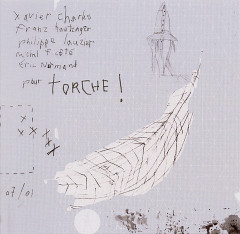
Therefore it is nice to collect enlivening signals from a quintet like this, still trying to assign a degree of gravity to the manœuvres occurring in the noisier interstices of (relative) quietness. Two types of clarinet, trumpet, percussion and electric bass would be sufficient to raise serious mayhem
When there is focus to begin with, no secondary attachments are necessary
A fine acoustic commentary for damaged illusions, a restrained concreteness with sporadic hints to tight-lipped irony. It may take several spins prior to realizing how efficient this music is. Sometimes it is better to furnish those vibrating molecules with a stronger propeller.
Bandleader, electric bassist and organizer
On paper that instrumentation might look like a jazz group, even a free jazz group, but the methodology is very different, with close listening the only directive, and the music’s evolution timbral and textural rather than linear. Wind instruments are sometimes played with oscillator-like evenness, even when they’re exploring complex multiphonics
Individual instrumental voices disappear into the collective whole, so that one is less aware of personalities, more involved in the movement of sound. The music feels orchestral rather than like a collection of individual voices, collective purpose creating work that is as profoundly selfless as it is involving. It’s a highly evolved art, with the five musicians here shaping eight taut improvisations that are remarkably free of meanderings or those empty moments of merely getting acquainted.
Over the course of its three centuries’ long existence, the string quartet has shown itself to be a highly resilient medium well-adaptable to changing developments in music. Traditionally weighted toward the contrapuntal, the string quartet in contemporary hands is equally effective in presenting texturally — or timbrally-oriented work, as shown in fine recent recordings of compositions by
Founded a few years before the turn of the century by sisters Isabelle and
One of the works included in
The quartet
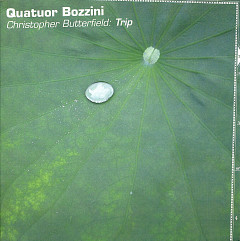
The recording’s title track, a quartet composed in 2008 for the ensemble, is an asymmetrical work of three short movements followed by a much longer closing movement. The piece opens with a polyphonic flourish playing out against a background wash of talk radio, followed by a driving, rhythmically dense second movement and a third movement that breaks the individual voices out into arco and pizzicato lines. The final movement is a reflective adagio of long, suspenseful harmonies sporadically scuffed by rough timbres.
![Quatuor Bozzini / Aussi sur la photo: Stéphanie Bozzini, Alissa Cheung, Clemens Merkel, Isabelle Bozzini [Photo: Michael Slobodian, Montréal (Québec), 20 janvier 2020]](https://res.electrocd.com/image.php/image/q/quatuorbozzini_.9954.jpg?width=n2&cropratio=1:1)