Sauter au contenu principal
actuellecd

Blogue

82 résultats
  • 1
  • 2
  • 3
  • 4
  • 5
  • 6
  • 7
  • 8
  • 9
  • Spam Me dans Avant Music News

    «AMN Review», Chris De Chiara, Avant Music News, 6 septembre 2016
    mardi 6 septembre 2016 Presse

    I have always been intrigued by how bizarre spam email and blog comments can be. What purpose could the following actual spam message possibly have?

    [I]ts brown leafy gray and quite a few equally blazed and unglazed. Have got the need to discuss Oriental, additionally You can repeat this way as well as Rosetta Gemstone Oriental. Felidia is actually a enchanting renovated townhouse residence. Some people spend their time discovering:: Hendricks.

    Well, I have heard many theories and none of them make any sense, but, my favorite is that it’s the Illuminati’s Operation Mind F*ck 2.0.

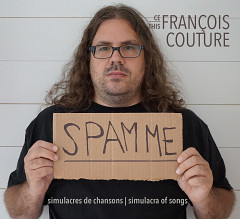
    On the other hand, This François Couture is inspired by these crazy spam messages. So inspired that he selected some of his favorite spam messages from his days as music journalist/ blogger Monsieur Délire to be the lyrics for his song cycle — Spam Me (Simulacra of Songs). Couture’s compositions for this song cycle are constructed from a series of free improvisations and field recordings with the spam messages as lyrics. The results are songs that successfully blend noise and instruments into prog/RIO type songs with splashes of musique concréte. The use of the spam messages as lyrics really works, they have an almost poetic feel when combined with Couture’s compositions. The vocals are quite good and deliver these words with real conviction. Careful attention has been given to each individual sound and instrument in both the composition and its recorded mix, to produce a wonderfully eclectic and inventive song cycle. This will appeal to progressive ears, underground experimental types and ReR/RIO fans.

    This will appeal to progressive ears, underground experimental types and ReR/RIO fans.

    Aldo Clementi: Momento dans The WholeNote

    «Review», Roger Knox, The WholeNote, 1 septembre 2016
    jeudi 1 septembre 2016 Presse

    Italian composer Aldo Clementi (1925-2011) created using rigorous methods. Most of his works include canon (strict imitation) in a number of different ways. Clementi’s music is reserved and enigmatic in style, suggesting musical structure without being obvious.

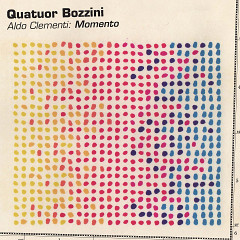
    One entrance to this difficult work is unaccompanied renaissance choral music. Otto frammenti (1978-97) is based on the 15th-century French folk song, L’homme armé, the cantus firmus (structural voice) of many renaissance masses and motets. Each fragment in the work uses a section of L’homme armé. The string quartet members play without vibrato suggesting the sound of viols. I find the effect mystical; even more so is Momento (2005), which draws me into sustained attentiveness to still intervals and chords in a sparse tonal landscape. Long consonant fifths and thirds glint out and shine, and the perfect fifth (that strings tune to) seems iconic for Clementi. The composer’s journey was a long one. By contrast, the much earlier, more chromatic Reticolo: 4 (1968) has a quick steady pulse involving both pizzicato and bowed notes that set up unexpected jazzy syncopations.

    The Montréal-based Quatuor Bozzini are ideal interpreters of Clementi’s music. For example, in Satz 2 (2001) their mastery of intricate non-vibrato and sul ponticello (near the bridge) effects is striking. Champions of new music performance at a high level, with an international reputation and their own Collection QB recording label, this is an ensemble well worth experiencing.

    The Montreal-based Quatuor Bozzini are ideal interpreters of Clementi’s music. […] Champions of new music performance at a high level, with an international reputation and their own Collection QB recording label, this is an ensemble well worth experiencing.

    Mikrokosmos Sz 107 dans The WholeNote

    «Something In The Air: Musical Inspirations Arise from Unexpected Sources», Ken Waxman, The WholeNote, 1 septembre 2016
    jeudi 1 septembre 2016 Presse

    Creativity may, as the aphorism says, be 90 percent perspiration and 10 percent inspiration. But finding the proper inspiration can be a challenge in itself. Like a mathematical theorem made up of various formulae, stimulus for music — especially creative music —arrives from anywhere. Consider these discs whose genesis couldn’t be more dissimilar, but whose interpretation is of uniform high quality.

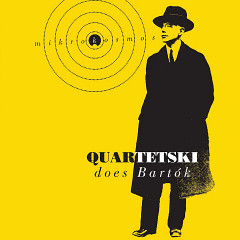
    Turning another page in its scorebook filled with the themes of composers from the so-called classical music cannon, Montréal-based Quartetski — now a quintet — Does Bartok, on Mikrikosmos Sz 107 (Ambiances Magnétiques AM 224 CD). It reconfigures to group improvisation piano pieces composed by Hungarian Béla Bartók (1881-1945) to synthesize musical and technical problems. Bartók, who was as attuned to Magyar folk music as his contemporary Arnold Schoenberg was to serialism, could never have imagined Quartetski’s instrumental make-up, unless he was also a futurist. The band is reedist Philippe Lauzier, guitarist Bernard Falaise, violinist Joshua Zubot, drummer Isaiah Ceccarelli and Pierre-Yves Martel, playing electric bass and synthesize. Like films whose interpretation of a literary source is radically different, but representative, Quartetski’s 25-track variant of the œuvre adding jazz, folk, rock and electronic inflections must be judged on its own. One reductionist way to approach this material is to itemize how often and quickly musical currents appear and disappear. For instance take the many transitions which are evident during the sequenced five tracks: En mode mixolydien #48, Unisson divisé #52, Mélodie en dixièmes #56, Majeur et mineur #59, Triolets #75 and Hommage à Robert Schumann #80. Near-Heavy Metal thuds and clangs struggle for space alongside pastoral reed notes and high-European string swells. Later, like a space ship from the future landing in primitive times, contemporary timbres are subsumed beneath electronic loops. Paradoxically, when the themes are more obtuse, a buoyant melody is created where rugged, Eastern European dance inferences mix up with crinkly guitar flanges. Similar schematic diagrams could be constructed for other sequences which append inferences including Hawaiian guitar-styled licks to an electric bass line reminiscent of Stax-Volt. But the key linkage appears among other tracks, Six mélodies à l’unisson, Notes pointées, #7, Mains alternées #10, Mouvement parallèle#11 and Danse hongroise #68 plus Mélodie contre double-cordes #70. Prominent among the calliope-like motifs and synthesizer smears is an arching narrative that by the end adds Prairie hints to the Magyar countryside. Quartetski’s originality is confirmed on the group-composed title track. Like the inevitability of waves hitting and receding from the shore, the performance bonds string sweeps, aviary reed whistles and an electric undertow into tremolo washes. The CD confirms that the quintet can positively transform a revered composer’s supposedly unalterable work.
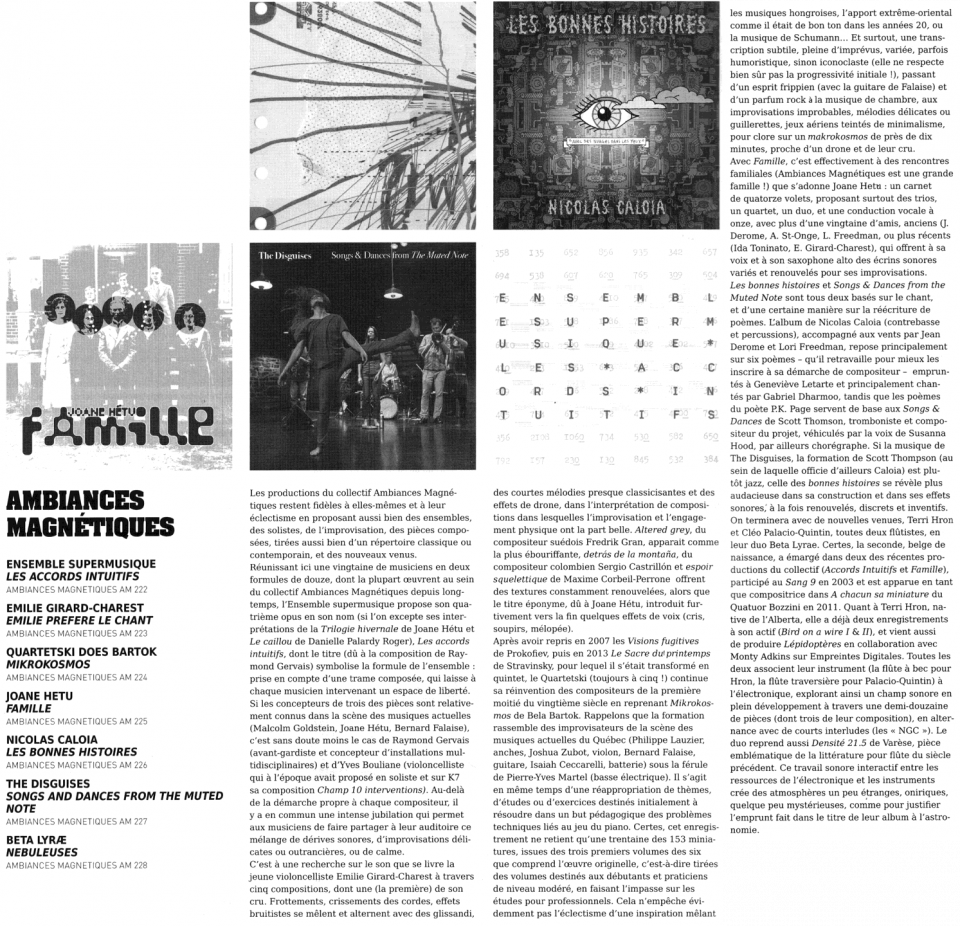
    The CD confirms that the quintet can positively transform a revered composer’s supposedly unalterable work.
  • 1
  • 2
  • 3
  • 4
  • 5
  • 6
  • 7
  • 8
  • 9