Sauter au contenu principal
actuellecd

Blogue

96 résultats
  • 3
  • 4
  • 5
  • 6
  • 7
  • 8
  • 9
  • 10
  • 11
  • Le refuge dans The WholeNote

    «Review», Stuart Broomer, The WholeNote, 1 octobre 2013
    mardi 1 octobre 2013 Presse
    La pianiste montréalaise Marianne Trudel assemble sa musique à partir d’un large spectre d’éléments, mélangeant le jazz, le folk, la pop, la musique classique et les musiques du monde dans un tout original et convaincant.

    Pierre-Yves Martel, Quartetski dans La Scena Musicale

    «Off Festival de Jazz. Du disque au concert», Marc Chénard, La Scena Musicale, no 19:2, 1 octobre 2013
    mardi 1 octobre 2013 Presse
    Inscrit au programme du festival Montréal Nouvelles Musiques (MNM) en février dernier, le concert de l’ensemble du gambiste Pierre-Yves Martel a présenté une vision tout à fait rafraîchissante du Sacre du Printemps de Stravinski. Le mois suivant, il s’est dirigé vers le studio avec son groupe (un quintette pour l’occasion) pour consigner sa version sur disque, lequel sera lancé pendant le festival. Spécialisée dans les relectures du répertoire concertant (entrecoupées de libres improvisations), cette formation ajoute Stravinski à son tableau de chasse, choix qui s’imposait presque en ce centenaire de la première du chef-d’œuvre d’Igor. Après avoir visité les musiques de Prokofiev, Satie, Purcell, Hume, et même un petit détour du côté d’Ellington, Quartetski se présentera donc en concert avec disque à l’appui, son premier en sept ans. Dans la foulée de ce concert, l’ensemble prendra la route, se produisant à Ottawa et à Toronto pour ensuite s’envoler vers la France pour deux autres prestations. Bravo messieurs!

    Le concert de l’ensemble du gambiste Pierre-Yves Martel a présenté une vision tout à fait rafraîchissante du Sacre du Printemps de Stravinski

    Victoriaville mai 2011 dans The Squid’s Ear

    «Heard In», Massimo Ricci, The Squid’s Ear, 16 septembre 2013
    lundi 16 septembre 2013 Presse

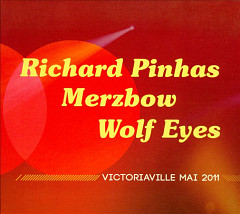
    “The noisiest concert of FIMAV 2011” is an unsurprising press release designation as soon as you take a look at the names behind this document. However, Victoriaville Mai 2011 comprises “spontaneous compositions” that seem to be born from quietness: the set begins with rarefied synthetic signals and small background noises, to end instead in a type of reasonably regimented mayhem where each of the components is given a proper role. A process of nuclear fission observed from safe distance, in a way.

    There are at least two factors that prevent the music to cross the borders of utter chaos. Pinhas’ all-encompassing guitar loops are — rather evidently — the main anchor for the whole sonic ship to stay within the waters of harmonic tolerability, whereas the occasional pulsations produced (presumably) by Masami Akita’s electronics throw an ounce of virtual steadiness to distorted heaps, uncontainable oscillations and straying feedbacks. Yet it’s not easy to establish where exactly supreme noise and functional sound meet in the Japanese’s arsenal.

    On the other hand, Wolf Eyes are definitely a fundamental addition to this rite of cathartic discharge, perfectly put in plain detail by Nathan Young’s filtered screaming. On the contrary, unobtrusively condensed lumps of sax and guitar collocate a few sections of the improvisation straight into Tranceville, slight echoes of early minimalism crossing the mind as one imagines benign smiles by Terry Riley and Tony Conrad should they ever stumble upon the “calmer” traits of this record. But when the reins are let loose — it happens quite often, especially in the 9 1/2 minutes of the encore — it’s still better to step back a little to avoid the flames.

    … when the reins are let loose — it happens quite often, especially in the 9 ½ minutes of the encore — it’s still better to step back a little to avoid the flames.

    Arômes d’ailleurs dans The WholeNote

    «Something In The Air: The Guelph Jazz Festival Turns 20», Ken Waxman, The WholeNote, no 19:1, 1 septembre 2013
    dimanche 1 septembre 2013 Presse

    Twenty years after its modest beginning, the Guelph Jazz Festival (GJF), which this year takes place September 3 to 8, has grown to be one of this country’s major improvised music celebrations. Unlike many other so-called jazz fests which lard their programs with crooners masquerading as jazz singers, tired rock or pop acts, or so-called World or C&W performers who make no pretense of playing jazz, the GJF continues to showcase committed improvisers in sympathetic settings including during the fourth installment of the dusk-to-dawn Nuit Blanche. […]

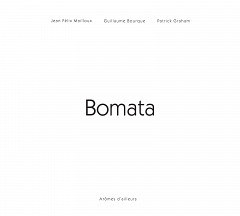
    Outstanding double bass work from closer to home is on tap during a free Market Square afternoon concert that same day when Montréal bassist Jean Félix Mailloux performs his compositions from Bomata Arômes d’allieurs Malasartes mam 016 with his associates, percussionist Patrick Graham and Guillaume Bourque playing clarinet and bass clarinet. A trio which has internalized “scents from elsewhere” — the translation of the CD title, Bomata’s unhurried performances reference various ethnic styles without becoming the subservient to any. A fine instance of this mixing is Cardamome when cross pulses from Graham and second drummer Phillippe Melanson move contrapuntally alongside a walking bass line, providing a trembling rhythm to Bourque’s mid-range, Klezmer-like overlay. The reedman’s mercurial high-note skill is on display on Shaman, with the bass taking on a slinky oud-like resonance and guest frame drummer Ziya Tabassian adding hard thwacks to toughen the beat. Yet as intense as the bassist’s and clarinetist’s improvisations become neither disrupts the basic thematic flow. Pianist Jérôme Beaulieu, who joins Bomata on a couple of tracks, is a little too decorous, creating a crystallite Nordic feel which clashes with Bourque’s ney-like sound on Nuit Blanche. Although with 13 tracks, sameness sets in at points, most performances argue well for the band’s continued evolution from this 2012 CD. Chinoiseries could offer one path, with the arrangement open enough to allow the reedist some altissimo smears even as the theme stays linear, with the end product suggesting both Eastern European concertina-like riffs plus a swinging jazz-like interface. […]
    A trio which has internalized “scents from elsewhere” — the translation of the CD title, Bomata’s unhurried performances reference various ethnic styles without becoming the subservient to any.
  • 3
  • 4
  • 5
  • 6
  • 7
  • 8
  • 9
  • 10
  • 11