Sauter au contenu principal
actuellecd

Blogue

187 résultats
  • 19
  • 20
  • 21
  • 22
  • 23
  • 24
  • 25
  • 26
  • 27
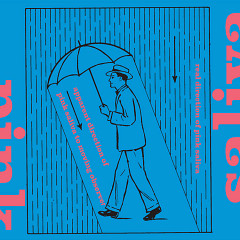
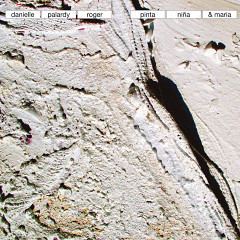
  • Pinta, Niña & Maria dans La Scena Musicale

    «Critique», Marc Chénard, La Scena Musicale, 1 mars 2011
    mardi 1 mars 2011 Presse

    Suite musicale en trois volets contrastants inspirée par les navires de Christophe Colomb. Interprètes: le Grand Groupe Régional d’Improvisation Libre, l’Ensemble SuperMusique et l’Ensemble contemporain de Montréal. Véritable inventaire de pratiques musicales et de clins d’œil stylistiques, à l’image des musiques actuelles… ambiantes, magnétiques et autres.

    Véritable inventaire de pratiques musicales et de clins d’œil stylistiques, à l’image des musiques actuelles… ambiantes, magnétiques et autres.

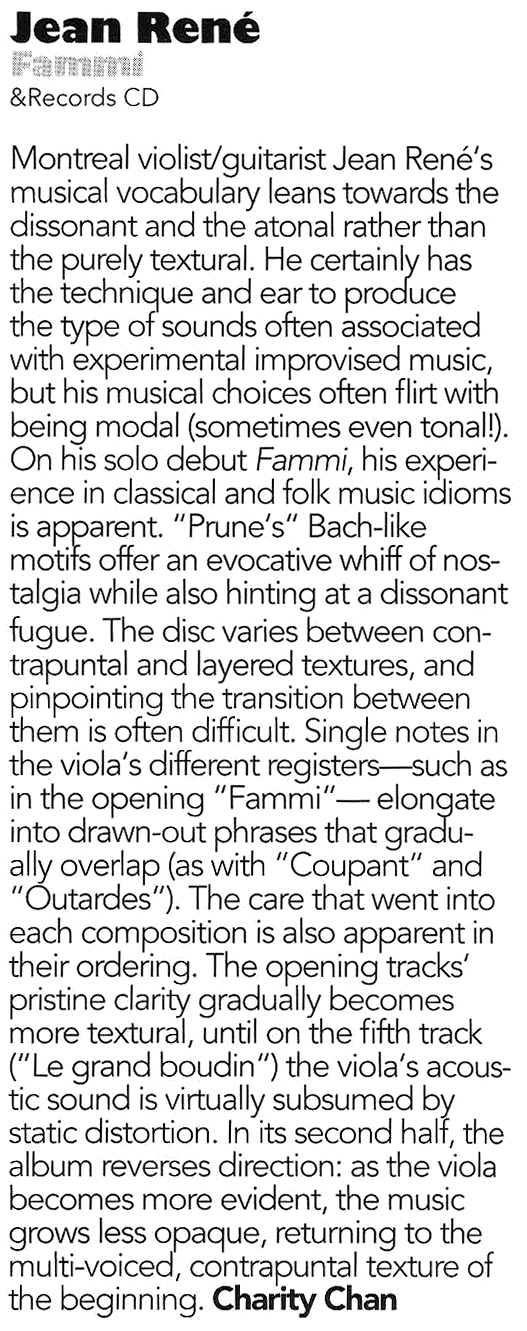
    Fammi dans Signal to Noise

    «Review», Charity Chan, Signal to Noise, no 61, 1 mars 2011
    mardi 1 mars 2011 Presse
    The care that went into each composition is also apparent in their ordering.

    Pink Saliva dans The Squid’s Ear

    «Heard In», Dave Madden, The Squid’s Ear, 1 mars 2011
    mardi 1 mars 2011 Presse

    Following John Cage’s views on improvisation, playing “what you know, and what you like, and what you feel” is a deterrent to the act of invention; “I mean doing something beyond the control of the ego… What I would like to find is an improvisation that is not descriptive of the performer, but is descriptive of what happens, and which is characterized by an absence of intention”. On the subject of “Intuitive Music”, Stockhausen concurs: “Musicians must learn to become the opposite of egocentric; otherwise you only play yourself.”

    But what if your ego is forged from a lifetime of experience spent making and learning from mistakes / successes? Now combine three such egos into a relationship of earned respect and trust whose story is enthralling the first and hundredth (subtly changed) telling. This is how you could become a peer of Pink Saliva.

    This veteran Montréal-based trio of Michel F Côté (drums, microphones, lapsteel), Alexandre St-Onge (electric bass, laptop) and newcomer to the group, trumpeter Ellwood Epps (replacing Gordon Allen), has, individually, established distinguished personalities — all of them generally big, verbose when called for, unique, something you could pick out of a lineup. Together, they form a curious mélange of sacred history lessons and noisy futurism. With the opener, Amour, Amour, Amour, they introduce a pulsing soundscape (the majority of the disc foregoes the usual frenetic stop / start of free jazz in favor of loose grooves — do not read that as “funk”) of tom thumps and a raggedy manipulated shadow of these in the foreground, Ellwood Epps’s extended, somber, dying drones, rolling electric bass that evolves via virtual pedals, and lap steel whose shimmering scream fills the distant horizon. The trio often delves into what sounds as the offspring of Throbbing Gristle and Bitches Brew outtakes, particularly during Debout les morts! when modular squeals and sine waves accompany a symphony of delayed trumpet notes. 54˚ de céphalorgie and Nachtmützen abstain from driving rhythms to let Côté work his trademark juggling flurry of staccato drum rolls, intricate bash-cymbal-grab-cymbal aggression and feedback bursts; but the most noteworthy moments arrive when St-Onge hinges his instrument to synthetic processing (i.e. Yes, as a Look Springs to Its Face) the results being a microtonal cloud hovering somewhere between Indian raga masters and Jaco Pastorius’ grave.

    The “self is nothing but a big bag full of stored information”, said Stockhausen as a frowning punctuation to the earlier mentioned statement.* Five albums in, and we’re still thrilled to rifle though the myriad trinkets in Pink Saliva’s duffel.

    *I revere Stockhausen and Cage, but I love to see someone escape their checkmate.

    … but the most noteworthy moments arrive when St-Onge hinges his instrument to synthetic processing, the results being a microtonal cloud hovering somewhere between Indian raga masters and Jaco Pastorius’ grave.

    Ice Machine dans Canadian Review of Literature in Performance

    «Reviews», Kaie Kellough, Canadian Review of Literature in Performance, no 1, 1 mars 2011
    mardi 1 mars 2011 Presse

    Ice Machine is the debut CD by Montréal duo Mankind, made up of word-sound digitizer Alexis O’Hara, and poet at large D. Kimm. The CD is short — its overall running time is 40:39, yet within that brevity it sprawls. Ice Machine blends electronic effects, a range of vocal expressions, riffs on the fairy-tale, the nursery rhyme, and the mafia film score. It incorporates storytelling, sound poetry, and sound-collage. It moves from seemingly improvised pieces to compact song-like works to longer, text-based explorations. The album includes bilingual tracks (English/French) and unilingual ones (English, French, Spanish), and as a result, has no dominant language.

    The first piece on Ice Machine, Mile End Throat Singers recalls the rhythmic throat singing of Tanya Tagaq, and the layered breath-work of French sound-poet Henri Chopin, but it incorporates laughing and coughing, and employs delay and echo to enhance and abstract the sound of breath.

    Track 7, Post Colonial plays on the meditation chant. The two voices, both chanting, weave in and out of harmony, and a third harmonizing voice emerges, that of “the machine,” conjured by electronics. Then, just as this track has established its serene mood, its serenity is undercut by a different type of meditation.

    Track 8, Charming compiles a bilingual list of insults, ranging from the common (asshole) to the more imaginative and exemplary (microbe). Kimm’s and O’Hara’s voices alternate in this seedy, misanthropic exercise, but their voices never rise above an intimate conversational hum.

    Track 4 Le Corps C’est Trop Physique and Track 10 The Anti-Rules flirt with pop — each has a chorus and a beat. But both tracks complicate any idea of facile, bouncy pop with their blasé tales of failed love, and their admissions of musically inexact singing sung in a child’s warble.

    Despite its variety, Ice Machine feels like it could be a single long work, albeit one chopped into fragments, one in which those fragments have been shuffled and re-assembled. The sound is consistent throughout, with an icy electronic hum forming the sonic backdrop for each track. This hum is the sound we hear late on a winter night in downtown Montréal. It is the hum of electricity flowing through a million homes. It is the sound of the nocturnal city, and it can both comfort and menace.

    Seduction, love, and confusion are themes that recur, in either D. Kimm’s world-weary, fluid delivery or in Alexis’ wry speak. Mankind plays with genre and expectation, mechanizing the meditative chant, challenging the trite pop tune, and going yet further: Mankind remains unruly, creating itself according to its own impulses.

    Mankind plays with genre and expectation, mechanizing the meditative chant, challenging the trite pop tune, and going yet further: Mankind remains unruly, creating itself according to its own impulses.
  • 19
  • 20
  • 21
  • 22
  • 23
  • 24
  • 25
  • 26
  • 27