Sauter au contenu principal
actuellecd

Blogue

276 résultats
  • 34
  • 35
  • 36
  • 37
  • 38
  • 39
  • 40
  • 41
  • 42
  • Pee Wee et moi dans Jazz Word

    «Review», Ken Waxman, Jazz Word, 6 mars 2006
    lundi 6 mars 2006 Presse

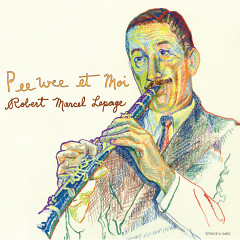
    Explorations among the wood, metal and air columns of the reed family […] Pee Wee et moi has a different agenda. Featuring Robert Marcel Lepage, one of the major players in Quebec’s musique actuelle scene, it’s an exploration of his links to Pee Wee Russell (1906–1969), jazz’s most idiosyncratic reed player. Russell, who over the course of his career played with everyone from Bix Beiderbecke to Thelonious Monk, was his own man in any situation. The strength of his oeuvre is such that Lepage, who composes theatre, dance and film pieces as well as improvises, felt, that long with a rhythm section, he had to invite six other clarinetists to share the clarinet role.

    Although six reedists often playing in unison may conjure up bad memories of retro-jobs like Supersax, Québécois quirkiness prevents this. With the reed section, including Vancouver’s François Houle, made up of outright modernists and the rhythm section members – guitarist René Lussier, bassist Normand Guilbeault and drummer Pierre Tanguay – leaders of their own projects, this isn’t a band likely to play a Dixieland Jazz hotel party any time soon.

    Instead, two Russell compositions and 12 of Lepage’s are used to sketch a slightly off-kilter view of the older clarinetist’s legacy. Taking Dixie-Swing conventions and turning them on their heads, at any time some of the musicians work from a 1930s base, while a few others are resolutely in the 21st century. Part of the date’s success has to be attributed to Maxime Séguin, who collaborated on the arrangements.

    Look what’s done with Russell’s own Muskogee Blues, for instance. With Tanguay playing a simple backbeat and Lussier jangling T-Bone Walker-like licks, the tune surges polyrhythmically as one clarinetist growls in false registers like a modern version of Russell, while another emits a more elegant Jimmy Hamilton-like tone. Just after the turnaround the entire ensemble suddenly speeds up, then slows down to mid-tempo for the finale.

    Unfortunately the booklet notes don’t name any of the clarinet soloists – surely Lepage couldn’t do all the work himself – but the key to this collection of blues lines is how Séguin and Lepage alter our perception of Quebec’s musique actuelle musicians as much as the purported Dixielanders.

    Guilbeault, whose avowed influence is Charles Mingus, slaps his bass à la Pops Foster on Pee Wee fait des archaïsmes, moi je fais des anachronismes, while Lussier’s strings scratching suggests a tinny version of Tiny Grimes’ style. Right in the middle of the composition there’s a quick turnabout as the tempo leapfrogs from andante to agitato, followed by a high-pitched clarinet solo that in this context, sounds like Pete Fountain fronting a 1930s Swing Era band.

    Similarly, Pee Wee joue aux échelles et serpents is a parody two-step, riding on Tanguay’s paradiddles. Here the guitarist showcases distorted strumming in Eddie Lang fashion, as the horn section riffs around him. Reed solo exhibitions include double-tonguing harmonic vibrations and chalumeau excursions.

    Portrait de Pee Wee à la face longue finds Lussier procuring a Middle-Eastern, lotar-like sound from his axe, creating finger-picking reverb that meets a chorus of spetrofluctuation from one of the clarinetists, with the duo surrounded by repetitive legato riffs from the other reeds.

    Fully POMO, despite the instrumentation, other tracks are redolent of Miles DavisBirth Of The Cool sessions – if that session had featured crisscrossing rasgueado guitar work; one of Gerry Mulligan pseudo-Swing Era lines, with a clarinet lead, two-beat drumming and the threat of bursting into barnyard cacophony every chorus; and Dixieland as interpreted in the style of French chanson by a marching band. The last includes a species of musical fanfare that springs from the European roots that influenced both Russell and Lepage.

    Then there’s Dixie chinois, which sounds a lot more like Heavy Metal than Chinese music. Still, it does prove that the combined smeared overblowing of seven clarinets, often adding pedal-point snorts, can be as solidly rhythmic as any guitar-laden hard rock band.

    Rippling unison section work from the reeds doesn’t upset the foot-tapping fervor of most of the tunes. Who knows maybe because of this the musique actuelle types will investigate Pee Wee’s Dixieland and – though doubtful – perhaps a few Classic Jazz fans will try to listen to POMO – or even MO – improvisations.

    Sur une balançoire dans All About Jazz Italy

    «C’est ça… Joelle Léandre…», Francesca Odilia Bellino, All About Jazz Italy, 5 mars 2006
    dimanche 5 mars 2006 Presse

    […] Diversissime le atmosfere di Sur une balançoire con la Léandre (contrabbasso e voce) e il pianista Gianni Lenoci (pianoforte e oggetti). Il titolo evoca una musica in sospensione, che si muove in quattordici tracce anonime come su un’altalena. Quattordici immagini scattate veloci, mosse, estemporanee, in bianco e nero. Il retroterra di Lenoci, pianista da sempre attento alla musica contemporanea, permea abbondantemente sonorità che ricordano a tratti un Morton Feldman, un Sylvano Bussotti e anche qualche rarefatta nota di Érik Satie. La potenza del suono della Léandre pare piegata. Coglie l’atmosfera rarefatta del piano, vi ci si avvicina, senza tuttavia mai sembrare completamente assorbita. È questo l’equilibrio instabile? È questo il vero (dis)equilibrio in Duo? È questo il gioco dei diversi in perenne rincorsa l’uno dell’altro? (3,5/5)

    3,5

    Arrêter les machines dans La Presse

    «Arrêter les machines, trouver l’essentiel», Alain Brunet, La Presse, 4 mars 2006
    samedi 4 mars 2006 Presse

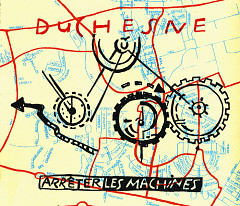
    Longtemps après avoir été leader de Conventum (groupe alternatif parmi les plus allumés de nos années 70), après trois décennies émaillées d’albums en solo ou en formation (Les 4 Guitaristes de l’Apocalypso Bar, Locomotive), de musiques de films et de compositions «sérieuses», de passages à vide et de précarité matérielle, André Duchesne signe ici un disque magnifique dans ce qu’il fait de mieux: la chanson. Arrêter les machines évite le piège de la surcharge poétique, ce disque fait aussi valoir le talent du compositeur (après tout, il fut recruté pour la Symphonie du millénaire), sans que la complexité ne l’emporte sur la clarté — ce qui n’empêche pas les mesures composées, la complexité harmonique, l’atonalité passagère, la tenue impeccable de Jean Derome aux flûtes et saxes, de Pierre Tanguay à la batterie, de Patrick Hamilton à la basse. À 57 ans, Duchesne peut être fier d’avoir ainsi épuré son expression, trouvé l’essentiel au cœur de l’âme rock qu’il a toujours. Voilà un disque qui traite de la beauté jaillissant de l’adversité.

    Duchesne peut être fier d’avoir ainsi épuré son expression, trouvé l’essentiel au coeur de l’âme rock qu’il a toujours.

    Three Cities in the Life of Dr Norman Bethune dans Vital

    «Review», Dolf Mulder, Vital, no 515, 3 mars 2006
    vendredi 3 mars 2006 Presse

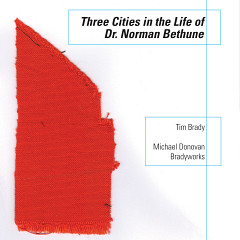
    This cd introduces the newest work of canadian composer Tim Brady, played by his ensemble Bradyworks and baritone Michael Donovan. It is a one-act chamber opera written for voice, electric guitar, piano, percussion, saxophones, string quartet and tape. The work is inspired on the life and work of Norman Bethune (1890-1939) who was a talented surgeon and medical inventor who left his comfortable life in Montréal to fight with the Republican International Brigade in Spain in 1936, and finally to join the Chinese Army in early 1938. For this composition Brady used writings of Bethune that are sung by baritone Donovan. The opera has three parts, each one representing a phase of the life of Bethune: Montréal, Madrid and Chin Ch’a Chi. Evidently the texts play a central role in this work and because of that the voice of Donovan also. The composition and the instrumentation fulfill a serving role in evoking Bethune’s life through the texts. Brady makes good use of the different instruments from the ensemble. It’s a very colorful work and very well arranged and performed. And the composition is a successful dramatization of the story. Track eight for instance is almost rock-music reminding of the work of Louis Andriessen. Through tape Brady introduces sound-material that evokes the different geographical locations. For my ears this is most apparent in the part that tells of Bethune’s chinese adventures. I needed repeated listening before this opera began to talk to me. But in the end this thoroughly composed opera revealed its beauty for my ears.

    … this thoroughly composed opera revealed its beauty for my ears.

    Bruiducœur, prières des infidèles dans Vital

    «Review», Dolf Mulder, Vital, no 515, 3 mars 2006
    vendredi 3 mars 2006 Presse

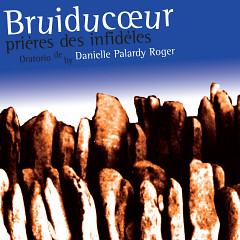
    Danielle Roger is known for her work with all-women groups like Wondeur Brass, Les Poules and Justine. With these and many other projects she became a leading force as a percussionist and composer in the new music scene of Montréal since early 80s. In recent years she concentrated more and more on composing music. On her new cd Bruiducoeur Roger presents an extensive vocal composition, recorded live in june 2004. It’s a vocal work for two narrators, two soloists, two percussionists and a thirteen-piece mixed choir. An oratorio to be more exact. Not a very regular musical form. I know Florian Fricke of Popol Vuh always wanted to write one. The oratorio is a musical composition that was at his peak in the 17th and 18th century. Most oratorios had religious themes. This seems to be case with Bruiducoeur also as it is subtitled “Prières des infidèles”. “This secular ceremony revolves around three characters: LUI, who is dying, scared and delirious; ELLE, who acts as an ironic witness, describing his fears and his struggle; and the CHOIR and SOLOISTS, empathic, representing us, the others, as we too will die one day.” For full enjoyment of this cd it helps if you understand french, but the booklet helps as it contains the full text in french and english. Voices sing, speak, scream. Sentences, words, but sometimes only syllables, or just sounds. The soloists and narrators do a great job. The whole is sparsely instrumented with percussion. Overall the music is not very melodic. At moments medieval sounding melodies appear at the surface, like in track one and three. Track six starts with mongolian throat overtone singing. In general it is a kind of ‘sprechgesang’ that dominates.

  • 34
  • 35
  • 36
  • 37
  • 38
  • 39
  • 40
  • 41
  • 42