Sauter au contenu principal
actuellecd

Blogue

258 résultats
  • 13
  • 14
  • 15
  • 16
  • 17
  • 18
  • 19
  • 20
  • 21
  • Veuillez procéder dans Splendid E-Zine

    «Review», Ron Davies, Splendid E-Zine, 4 juillet 2005
    lundi 4 juillet 2005 Presse

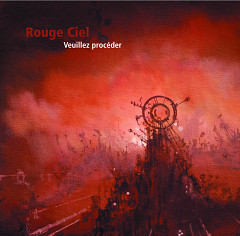
    In a departure from Ambiances Magnetiques’ noise-heavy catalog, this jazz quartet weaves heavy doses of melody and form into their arrangements. Admittedly, the group leaps nimbly from one genre to the next with the dizzying speed of a caffeinated monkey, but they never lose sight of the music’s underpinnings. Although everything on Veuillez procéder is filtered through a contemporary jazz mindset, the individual pieces’ flavor varies widely, both within and across compositions.

    Pour Hortense begins quietly, with a caressing piano. As violin subtly weaves itself into the melody, the tempo begins to pick up. As the track hits a solid Latin rhythm, the piano alternates runs with wood block breakdowns. Finally, the piece abruptly shifts into a melodramatic conclusion that packs a Yanni-esque grandeur (I like Yanni, so that’s intended as a compliment). If this seems like a lot for one quartet to take on, consider the surrounding tracks: Teuteuta, a prog-rock workout with enough odd rhythmic patterns to satisfy any King Crimson fan, and Bond précisionnel, an ominous, back-alley noise piece. Rouge Ciel’s stylistic chameleon act is reinforced by the members’ instrumental acrobatics — they utilize various percussion, keyboard, string, wind and electronic instruments to create their dizzying statements.

    Like much contemporary jazz, the results are a bit overwhelming, particularly on the eleven-minute Nevrealite postparapsychophysiologique. Even so, the trio plays with an openness that keeps the music from becoming overbearing — in part by balancing denser pieces with cuts like the breathy Bois mou, which combines smooth strings with comparably flowing horn work. This is a crucial element of the music’s success; these challenging compositions could easily make it seem as if the band is lecturing to its audience, but by providing plenty of melodic signposts and lots of breathing room, the group transform the listening experience into a dialogue. The album’s combination of restraint and highly impressive musicanship suggests that Rouge Ciel have some very promising days ahead of them.

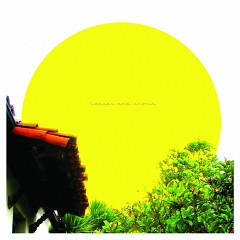
    Leaves and Snows dans Blow Up

    «Recensione», Nicola Catalano, Blow Up, no 86-87, 1 juillet 2005
    vendredi 1 juillet 2005 Presse

    Giovane (classe 1977) e talentuoso chitarrista di Montréal, Antoine Berthiaume ha in passato incrociato la sua sei corde con quelle di due vecchie volpi dell’improvvisazione radicale come Derek Bailey e Fred Frith (cfr Shoshin del 2002, sempre su Ambiances Magnétiques). Adesso è la volta di un album in trio col pianista francese Quentin Sirjacq e l’ingegnere del suono americano Norman Teale, qui agli strumenti elettronici. Grevi implosioni improvvisative, sempre in bilico tra calore cromatico e astrazione, coi fulminei ronzi entomologici di Comme un lézard sous le grand fouet du jour caniculaire sospesi tra l’immaginario/immaginifico fanta-blues Contemplating Innuendo e le desolate ambientazioni morriconiane di Staring at a Western Time. (7/8)

    Grevi implosioni improvvisative, sempre in bilico tra calore cromatico e astrazione…
    7

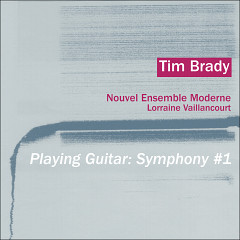
    Playing Guitar: Symphony #1 dans Electronics Musician

    «Review», Matt Gallagher, Electronics Musician, 1 juillet 2005
    vendredi 1 juillet 2005 Presse

    For 25 year, Tim Brady has been carving a niche for the electric guitar within classical music. Playing Guitar Symphony #1 (Ambiances Magnetiques, 2004) is Brady’s tenth album. Composed largely on electric guitar, it presents his contemporary classical score in five movements for a 15-piece acoustic chamber orchestra.

    Brady and coproducer Morris Apelbaum sought to combine the guitar and orchestra with Brady’s guitar samples and textures. “My music is somewhat unusual in its combinstion of acoustic and clectmnic sound sources,” he says. “I compose on the guitar, on the piano, by singing, writing directly onto score paper, or using a sequencer or multitrack recorder. The choice of composing medium depends on what I’m trying to get at.”

    Apelbaum and four assistant engineers recorded the Nouvel Ensemble Moderne, conducted by Lorraine Vaillancourt, in Oscar Peterson Concert Hall at Concordia University in Montréal. “We didn’t have to fix the room sound”, Brady says. “The hall is used frequently for recording in Montréal”. Apelbaum recorded the orchestra onto 24 tracks through a number of mic preamps and Apogee AD-16 converters into an Alesis HD24 hard-disk recorder.

    The engineers miked each musician individually. “That allowed me to create the final balance in the studio, rather than rely on the conductor’s balance”, Brady says. “Balancing the tone of the electric guitar and sampler with the orchestra was a question of subtle timbral decisions. Even in a live space with no isolation, [multiple mics] give one a lot more control than a stereo pair”. ln addition, the engineers placed each mic 18 to 24 inches from an instrument’s sound source.

    Brady brought the orchestra tracks into his personal studio, which indudes a dual-processor Mac G4 running MOTUDigital Performer 3.1 and MOTU2408 audio interface. “I played untreated guitar lines live with the orchestra, and then added the processed stuff later,” he says. “l replaced a few parts with overdubs. Sometimes I didn’t like the mix of the original guitar tone with the ensemble. EQ can do only so much sometimes you have to change pick-ups or even guitars to get the sound that you want.

    “All the guitar parts were edited and then reamped in my studio using the speaker simulator on my Koch Twintone tube amp.” Brady says “That added warmth, depth, and subtle tube compression. Tubes offer acoustic attack and decay characteristics, so they blend better with classical instruments.”

    Brady recorded and processed guitar samples in his Yamaha A4000 sampler, which he later added to the existing tracks. His TC Electronic Fireworx effects processor also played a key role. “I used just two bands of EQ to bring out the chatacter of an instrument in the mix, Brady says. “With good mics, good preamps, a good room, and great players, you don’t need tons of EQ. I added some reverb and I used DP’s volume curves for subtle volume changes”.

    The album concludes with Frame 1—Resonance, Brady’s piece for electric guitar and acoustic piano. “[It features] quite a bit of digital processing, using primarily an old Boss SE-70 effects processor,” Brady says. “The SE-70 has a crude 16-bit sound, but it has some amazing algorithms. The piano plays a dreamlike fantasia part, and the guitar acts like an electroacoustic sustain pedal, taking ideas from the piano and transforming them into an ongoing musical dialogue. I plan on composing more works that I explore the electric guitar in a small, intimate chamber-music context—if all goes according to plan.”

    For 25 year, Tim Brady has been carving a niche for the electric guitar within classical music.
  • 13
  • 14
  • 15
  • 16
  • 17
  • 18
  • 19
  • 20
  • 21