Sauter au contenu principal
actuellecd

Blogue

304 résultats
  • 34
  • 35
  • 36
  • 37
  • 38
  • 39
  • 40
  • 41
  • 42
  • Carré de sable dans Vital

    «Review», Dolf Mulder, Vital, no 416, 23 mars 2004
    mardi 23 mars 2004 Presse

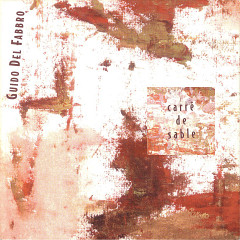
    Carré de sable is the hard to classify debut of Guido del Fabbro. Fabbro (1980) is a violonist and composer from Montréal. Interested in both improvised and written music he gathered his experience in groups like Fanfare Pourpour, L’Hotel du boût de la terre, and Rouge Ciel. On his first solo effort sound experiments and instrumental pieces succeed each other. Both of them are nor extremely experimental nor plainly conventional. But his music fits perfectly with the esthetics of the Ambiances Magnétiques label. Throughout the album Del Fabbro plays violin and a great diversity of instruments: violins, guitars, mandoline, harmonica, flutes, and many more. He is helped by Marie-Claude Lamoureux on voice in two tracks and Pierre-Emmanuel Poizat on bass clarinet also on two tracks. With Carré de sable he composed a multitracked work that is a pleasure to listen to. Folky dance tunes and abstract sound experiments succeed each other, and go wonderfully hand in hand. Del Fabbro explains, “This collection of hotel chamber music pieces is the soundtrack to the time taken to create personal ecosystems & to have fun with very simple materials, like a child in a sandbox”

    … a pleasure to listen to. Folky dance tunes and abstract sound experiments succeed each other, and go wonderfully hand in hand.

    Soshin dans Zookeeper Online

    «Album review»
    lundi 22 mars 2004 Presse

    A collection of mostly improvised guitar duets that range from abstract wanderings to busy pointed interactions. Berthiaume is a 24 year old guitar player from Montréal and he’s the driving force that made this disc happen. His playing tends to be minimal, lots of extended techniques, and effected with lots of non-guitar-like sounds.

    1. Berthiaume solo, well sort of, he’s multi-tracked. Lots of ambient guitar playing with drawn out notes which sound as if they are bowed. I thought the most interesting part of the track was when he was picking somewhat normally over his bowed drawn out notes. The track stays slow and patient most of the time.

    **2. Frith and Berthiaume on this track. They start out getting some very unique sounds out of their guitars. At times pretty and not sounding like a guitar. More bowed pitch bending. One of them suddenly starts playing a picked slightly bluesy sort of way and it works really well.

    3. Even further out in terms of the sounds they get from their guitars. This track on one hand is more aggressive but on the other more minimal. At one point I thought I was listening to experimental electronic music, not guitars and at another point, because of more bowing they sounded like horns. The track is very long and goes through a lot of changes.

    4. Bailey and Berthiaume. I had a feeling these two styles of playing would have a difficult time playing together. Bailey does his usual out, acoustic sounding individual note improv which has little connection to most other music. Berthiaume speeds up his abstractness and sounds like he spends half the track just trying to keep up. That said, there is a nice conversation between the two during a good portion of the track. Gee, staccato plucking that creates a more European improv sound. Surprise surprise.

    **5. Frith and Berthiaume. Probably the furthest out track. All sorts of scratching, percussion, bending and crackling noises come from the two guitars. Prickly and tense. There is such a connection between the two players here that you tell me who makes what sounds.

    6. Bailey and Berthiaume. Short, quiet, and percussive.

    Good stuff.

    Good stuff.

    10 compositions dans AllMusic

    «Review», François Couture, AllMusic, 18 mars 2004
    jeudi 18 mars 2004 Presse

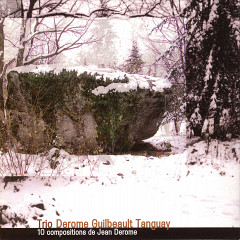
    Jean Derome is a prime mover on Montréal’s new music scene, but despite all his free improv units and large-scale projects, the man is first and foremost known in his native city as a jazzman. And the Trio Derome Guilbeault Tanguay he formed with his trusty sidemen Normand Guilbeault (bassist) and Pierre Tanguay (drums) is a regular fixture in the city’s modern jazz clubs. Yet, Derome’s jazziest side has rarely been documented on record (his two albums with the trio Évidence aside). For its first CD, the Trio DGT focuses on its leader’s compositions — the unit is also known for its sizzling tributes to many neglected jazz heroes. Derome has selected 10 pieces written between the mid-’70s and early 2000s. Those familiar with the saxophonist’s work will not be surprised to find a strong Thelonious Monk influence in many tracks (especially the opener Marcher sur des Braises), but several other names could be mentioned, from Lennie Tristanoto Ornette Coleman and Joe McPhee. The melodies are developed in unpredictable ways (Pangolin), the musicians fool around with polyrhythmical layers (Marcher sur des Braises again, where Tanguay plays a game of hide and seek with the beat) and are given a lot of freedom to weave their own voices into the written material. Highlights also include the tender Vérone, the spiky Étymologie, Guilbeault’s solo in Quek’un!, and Derome’s limping baritone sax in Pangolin, a track named after an anteater-like animal. This reviewer only has one complaint: a redoubtable flutist, Derome picks up the flute only once, for the closing Michka, which is a shame. 10 Compositions is by far Derome’s most accessible album to date. Fans of his more daring projects (his long-standing duo with Tanguay, for instance) may find this one a bit light in the offering, but the Trio DGT’s modern jazz still steers resolutely clear from the mainstream.

    … by far Derome’s most accessible album to date.

    Le bal dans Voir

    «La Fanfare Pourpour», Olivier Robillard Laveaux, Voir, 18 mars 2004
    jeudi 18 mars 2004 Presse

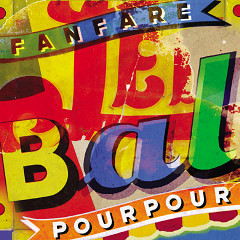
    En 1975, l’Enfant Fort est devenue sur le Plateau-Mont-Royal une fanfare symbo lique de la contre-culture; une forme orchestrale évoluée pour qui le temps ne semble pas avoir d’existence. Jouant dans les rues pour les enfants, les nouveaux mariés et les vieilles sur leur balcon, pour eux, seuls la fête et le plaisir comptent. Se rebaptisant ensuite Pouet Pouet Band, Montréal Transport Limité et aujourd’hui La Fanfare Pourpour, la troupe de musiciens (environ une quinzaine, âgés entre 18 et 63 ans) lance le lundi 22 mars au Lion d’or son deuxième album, sous la direction de Jean Derome. Intitulé Le bal, il vous transporte avec finesse grâce à ses valses et ses airs aux accents jazz; cajun et swing. Un amalgame chavirant et rafraîchissant qui jouit d’un engouement renouvelé en ce 21e siècle.

    Un amalgame chavirant et rafraîchissant qui jouit d’un engouement renouvelé en ce 21e siècle.

    Le bal dans Ici Montréal

    «Fanfarons», Patrick Baillargeon, Ici Montréal, 18 mars 2004
    jeudi 18 mars 2004 Presse

    Qui ne connaît pas la Fanfare Pourpour? Qui n’a jamais vu cette joyeuse bande à une occasion ou une autre? Collectif à géometrie variable, la Fanfare est le meilleur remède contre la morosité et les jours de cafard, toujours partante pour jouer partout, pour une cause qui lui tient à cœur ou tout simplement pour le plaisir de faire de la musique entre amis et en famille. Parce que, depuis ses debuts en 1975 (sous le nom de L’Enfant Fort puis du Pouet Pouet Band), cette fanfare est surtout une histoire d’amour et d’amitié. Une longue histoire de sons et de sens, marquée parles allées et venues d’un tas de musiciens et de tripeux, une histoire qui dure encore aujourd’hui avec la sortie du bal, deuxieme album du collectif. La Pourpour, c’est un collectif mais c’est d’abord une gang de chums qui ne cesse de grandir,insiste Lou Babin, accordeoniste et membre de la première heure avec quelque huit autres musiciens toujours à bord. La Pourpour, c’est une histoire d’amitié et de projets communs. C’était ça au départ, et ça l’est toujours aujourd’hui. Reste que, si le passé nous a tissés, c’est ce qu’on fait aujourd’hui qui nous définit.»

    Le bal, voilà ce qu’elle fait aujourd’hui,la troupe. Et elle valse. Elle valse entre le swing, le jazz de Nouvelle-Orleans, le cajun, le ragtime, la chanson française et la musique klezmer ou arabe avec une belle aisance et un plaisir toujours contagieux. «Avec ce disque, on est en train d’écrire une autre page de l’histoire de la Pourpour, s’enthousiasme Lou. Il y a plus de chansons, plus d’improvisation, plus de couleur aussi. Le plus étonnant, c’est qu’on a enregistre tout l’album live en sept jours! On voulait le feeling d’un concert ou d’une répétition et c’est Jean Derome, qui fait partie de la Fanfare, qui a dirigé un peu tout ça. Il a amené beaucoup de calme et d’humour en studio. Y’a une espèce de spontanéité qui nous sied bien dans toute cette entreprise, poursuit la musicienne. Un album, c’est une empreinte, un témoignage et, ce disque, on trouve qu’il représente bien ce qu’est la Fanfare aujourd’hui. Avec Le bal, on sent qu’on n’a pas terminé et que l’aventure risque de se poursuivre encore longtemps.»

    … la Fanfare est le meilleur remède contre la morosité et les jours de cafard…
  • 34
  • 35
  • 36
  • 37
  • 38
  • 39
  • 40
  • 41
  • 42