Sauter au contenu principal
actuellecd
  • This website is also available in English.

Blogue

255 résultats
  • 23
  • 24
  • 25
  • 26
  • 27
  • 28
  • 29
  • 30
  • 31
  • Bernard Falaise, Rémi Leclerc, Papa Boa, Ambiances Magnétiques dans AllMusic

    «Portrait: Papa Boa», François Couture, AllMusic, 1 juin 2002
    samedi 1 juin 2002 Presse

    A Montréal avant-rock group with ties to the Ambiances Magnétiques collective, Papa Boa is one of many projects involving Bernard Falaise and Rémi Leclerc. The group writes complex songs out of studio improvisation sessions, including lots of sampling and oddities, and is driven by Falaise’s highly original guitar work. They have one album out.

    In 1991, Falaise, drummer Rémi Leclerc (of Miriodor and various projects by André Duchesne) and bassist Frédéric Roverselli struck a friendship. Out of it came Papa Boa, at first a loose studio collective to which reedist Pierre Labbé was later added. All members (minus Labbé, a jazzman) have a rock background and their first intention was to explore freer structures that would include electronics. Their first experiments consisted mostly of improvisations. The group debuted on stage in 1991 during the Festival du Théâtre des Amériques in Montréal. The next few years saw little activity, the unit being used mostly as a laboratory as Falaise and Leclerc’s profiles were constantly on the rise in avant-rock circles.

    The group provided the soundtrack to Michel Lefebvre and Eva Quintas’ multimedia work Liquidation in 1997. Engagements began to pile up, leading to an active period of three years. The quartet (occasionally augmented by guests such as Marcelle Hudon and storyteller Michel Faubert) performed concerts at various Quebec festivals (Festival des Musiques Fraîches in Quebec, Festival des musiques de création in Jonquières). They built a repertoire of quirky angular songs and recorded Tête à queue, their first CD. It was released in May 1999 by Ambiances Magnétiques. Performances at the Festival International de Musique Actuelle de Victoriaville in May 2000 and the Montréal Jazz Festival the following year raised the group’s profile, but the members’ other projects finally claimed them back and Papa Boa went dormant.

    … a repertoire of quirky angular songs…

    Les 4 Guitaristes de l’Apocalypso Bar, André Duchesne, Ambiances Magnétiques dans AllMusic

    «Portrait: Les 4 guitaristes de l’Apocalypso-Bar», François Couture, AllMusic, 1 juin 2002
    samedi 1 juin 2002 Presse

    Put together by Montréal guitarist André Duchesne, Les 4 Guitaristes de l’Apocalypso-Bar was a conceptual electric guitar quartet (plus drums), something rarely seen before. His longest-lasting project (four years), it was also the one that got the most international attention, thanks to the presence of ex-Henry Cow drummer Chris Cutler (some say it served as the blueprint for the Fred Frith Guitar Quartet). The group released two LPs on Ambiances Magnétiques in 1987 and 1989, although titles and recording dates are willingly misleading — after all, this was a band from the future. Both albums have been reissued in 1995 by ReR Megacorp under the title World Tour ’98 (see what I mean?).

    In the early ’80s, André Duchesne was writing avant-rock songs — something like This Heat with a Quebec twist (see his LP Le Temps des Bombes, 1984). But by 1986 he was working on a series of cuntrapuntal pieces for guitar quartet, a cross between Robert Fripp’s circular motifs and Fred Frith’s angular playing. He drafted René Lussier and Jean-Pierre Bouchard, colleagues from the late-’70s avant-folk collective Conventum, and Roger Boudreault. The Festival International de Musique Actuelle de Victoriaville expressed interest to premiere the project in October 1986, but Duchesne still needed a drummer. He rang up Chris Cutler, as former Henry Cow members and the Ambiances Magnétiques collective were multiplying collaborations and associations at the time (Lussier and Fred Frith would play as a duo at FIMAV that year too). Cutler’s group Cassiber was already part of the festival’s line-up, so arrangements were made and the 4 Guitarists of the Apocalypso-Bar began rehearsals.

    Duchesne had a concept, inspired by the ghost of Jimi Hendrix himself (or so the tongue-in-cheek liner notes to the first LP stated). This was the resident band at the Apocalypso-Bar, a joint in post-apocalypse Canada. They were sleek, they were hot, they obeyed all the laws of early 20th century dance bands: they wore white suits and tiger ties, sat down to play (the soloing guitarist got to stand up) and bowed down in unison to applause. Tournée Mondiale ’89 came out in 1987 (it’s a studio album, in case you wonder). The group toured Canada, the US and Europe, appearing among other places at The Kitchen in New York. A second album was recorded in early 1989 (Fin de siècle, once more ahead of its time), but by then Duchesne was already experiencing problems keeping the band together. Claude Fradette replaced Boudreault and young Miriodor drummer Rémi Leclerc filled in whenever Cutler was unavailable. Nevertheless the concept was wearing thin, so the group split shortly after. Duchesne went on to form Locomotive, bringing along Fradette and Leclerc.

    His longest-lasting project, it was also the one that got the most international attention…

    Jean Derome et les Dangereux Zhoms, Jean Derome, Ambiances Magnétiques dans AllMusic

    «Portrait: Jean Derome et les Dangereux Zhoms», François Couture, AllMusic, 1 juin 2002
    samedi 1 juin 2002 Presse

    In the mid-’90s, Jean Derome et les Dangereux Zhoms was Montréal saxophonist Jean Derome’s prime project. The group released three albums from 1994 to 1998. Although activities have slowed down, it continues to perform around the world — in the Ambiances Magnétiques roaster it stands as the most popular act abroad.

    1992 was a good year for Jean Derome. He recorded the final (and best) album by his duo Les Granules with René Lussier and the first by his trio Évidence, among many other projects including music for dance and theatre. He was touring like crazy and began to keep a travel diary in which he jotted down musical impressions. It appeared to him that this “road music” screamed for a band of its own. Drawing from all of his activities, he put together Jean Derome et les Dangereux Zhoms (“Jean Derome and the Dangerous Guyz,” to pick up the intentional misspelling in the last word). The group, conceived as a road band just like the music, consists of the avant-garde jazz trio Évidence (Derome, bassist Pierre Cartier and drummer Pierre Tanguay), plus Les Granules (guitarist Lussier), plus two of Derome’s regular sidemen, trombonist Tom Walsh and keyboardist Guillaume Dostaler.

    For this unit Derome penned a repertoire of pieces that blend avant-jazz, avant-rock and free improv, focusing on jazz stylings Évidence derived from Thelonious Monk, the saxophonist’s idiosyncratic contrapuntal writing and the warped stage humor that was the trademark of Les Granules. They gave one hell of a dynamite show. The Dangereux Zhoms began to perform in Montréal and the East Coast. A first CD, Carnets de Voyage (“travel diaries”) was recorded and released in 1994. Navré came out a year later. The group continued to tour extensively, in the US and soon in Europe too. By the end of 1997, tensions between Derome and Lussier had reached new heights and the two parted ways after two decades of close collaboration. The group was put on hiatus and Derome produced a live album from tapes recorded at the Théâtre La Chapelle in Montréal in February 1996. Torticolis was released in 1998 and the three Dangereux Zhoms CDs were packaged together as the box set 1994-96. The chapter was closed… or so it seemed.

    In 1999 Derome reactivated the unit, minus Lussier. Local performances have been sparse and limited to special events (like a two-week Derome residency/retrospective at the same Théâtre La Chapelle in 2000), but the group still performs regularly outside Montréal and has appeared at jazz festivals in Guelph and Vancouver and at the 2001 RingRing festival in the Czech Republic.

    … in the Ambiances Magnétiques roster it stands as the most popular act abroad.

    André Duchesne, Ambiances Magnétiques dans AllMusic

    «Portrait: André Duchesne», François Couture, AllMusic, 1 juin 2002
    samedi 1 juin 2002 Presse

    A core member of the late-’70s avant-folk collective Conventum and co-founder of the “musique actuelle” collective and record label Ambiances Magnétiques in the early ’80s, André Duchesne has been both quieter and louder than his acolytes. Quieter because he released albums at the rate of a trickle; louder because his guitar riffs take him closer to the essence of rock than any other AM musician. His recorded output shows interests in avant-prog, rock ’n’ roll, film music, symphonic extravaganzas, free improv and solo classical guitar.

    Duchesne is a son of Montréal. He learned the acoustic guitar like most of his teen buddies in the 1970s. But unlike them he was not satisfied with Harmonium and Creedence Clearwater Revival’s strum-along songs. Teaming up with René Lussier, Jean-Pierre Bouchard, Jacques Laurin, Bernard Cormier and poet Alain-Arthur Painchaud he formed Conventum, an influential underground unit that blended Quebec’s folk roots with absurd poetry and progressive arrangements. The group recorded two LPs (À l’affût d’un complot, 1977 and Le bureau central des utopies, 1979).

    In 1983 Duchesne, Lussier, Jean Derome and Robert Marcel Lepage threw together the basis of Ambiances Magnétiques, an artist-run label devoted to avant-garde music. His first album to come out was the collection of modern rock songs Le temps des bombes (1984). His next project, more successful, was the four-guitar rock quintet Les 4 Guitaristes de l’Apocalypso-Bar, which included Lussier and Bouchard from Conventum, plus Roger Boudreault and ex-Henry Cow drummer Chris Cutler, from England. This group also recorded two LPs and toured Europe and the US before splitting up.

    The early 1990s saw Duchesne active on various fronts. He recorded film music for the Gagné brothers (the soundtrack of “Le Royaume ou l’Asile” is the only one available) and premiered his most ambitious work ever, L’ ou ’L, at the FIMAV festival in Victoriaville in 1990. The orchestral overtones of this piece were soon counterbalanced by the raucous riffs of Locomotive, still Duchesne’s best album and band (with guitarists Claude Fradette and Francis Grandmont, and drummer Rémi Leclerc).

    After 1992 Duchesne went very low profile, appearing on albums by modern trad singer Michel Faubert and sporadically putting together rock bands that never recorded (Diesel, No Band’s Land). His 1999 anti-climactic come back Réflexions featured him solo on classical guitar and was not what fans had been hoping for. The 2001 offering Polaroïde is a free improv trio session.

    … his guitar riffs take him closer to the essence of rock than any other Ambiances Magnétiques musician.

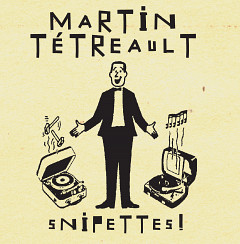
    Snipettes!, Martin Tétreault dans AllMusic

    «Review», François Couture, AllMusic, 1 juin 2002
    samedi 1 juin 2002 Presse

    This cassette must be Martin Tétreault’s rarest album. It came out in 1992, in Ambiances Magnétiques’ short-lived series “Archives Magnétiques,” in a limited edition of 250 copies. At the time the turntable wizard was still widely unknown outside the province of Quebec and had only one album to his credit (Des pas et des mois, 1990). In two continuous suites of 20 minutes each, Tétreault rummages through his record collection to find the weirdest pieces of pressed petroleum. Citations, strange confrontations, and medium destruction come together for pure enjoyment of the ears. In 1992, Tétreault had not yet pushed his art below the record to work in the turntable’s insides, but he was cutting up records to paste unrelated pieces together and using creative skipping techniques. In Snipettes, the cast of the original TV series Star Trek (Spock: “I have never heard anything quite like it”), a Time-Life collection on the space race, a muzak rendition of “South of the Border” and various records of classical and electronic music (including the infamous Perrey & Kingsley trilogy) form a twisted narrative. In “Morceaux Choisis” excerpts from self-help records (psychology, relaxation and such) provide a loose structure for noise-based improvisations and a feature for glued LPs. The narrative contents of this piece will be lost on English-speaking listeners, but the English samples and the type of humor found in Snipettes can appeal to a wider audience (even the non-experimental type). Let’s just say this cassette presents Tétreault at his most irreverant.

    This cassette must be Martin Tétreault’s rarest album! Let’s just say this cassette presents Tétreault at his most irreverant.

    Joane Hétu, Ambiances Magnétiques dans AllMusic

    «Portrait: Joane Hétu», François Couture, AllMusic, 1 juin 2002
    samedi 1 juin 2002 Presse

    Saxophonist, singer, improviser, composer, and record label manager Joane Hétu ranks among the pillars of the Montréal avant-garde music scene revolving around the collective Ambiances Magnétiques. A small but very stubborn woman, she made a career for herself starting out of nowhere at age 19, to become a successful businesswoman and a vocalist with a very distinctive style. She has recorded many albums with the groups Wondeur Brass, Justine, Les Poules, Castor et Compagnie, with her husband Jean Derome and solo.

    A Montréaler born and raised, Hétu turned to music in 1977, at age 19 when she started to learn the alto saxophone by herself, with no notions of music theory. Two years later she briefly fell in love with pianist Pierre St-Jak who introduced her to an eccentric bunch of artists tied to the Pouet Pouet Band and L’Enfant Fort (which years later would evolve into the Fanfare Pourpour). These experimentalists confirmed her musical vision. With keyboardist Diane Labrosse and drummer Danielle Palardy Roger she formed the feminist avant-rock group Wondeur Brass, learning the basics of music during rehearsals. In 1985 the three members were asked to join the collective Ambiances Magnétiques, recently established by Robert Marcel Lepage, René Lussier, André Duchesne, and Jean Derome (the latter would become her life and major musical partner). Wondeur Brass released two critically acclaimed albums in the mid-’80s (Ravir and Simoneda, Reine des Esclaves). Hétu, Labrosse and Roger played in two similar projects, Les Poules and Justine, and toured North-America and Europe.

    In 1991, at a time when the volunteer structure of the collective was becoming a burden on the shoulders of its members, Hétu created DAME (Distribution Ambiances Magnétiques Etcetera), a record label/distribution outlet with the aim to regroup local independent avant-garde labels under one roof. Her dedication to the company convinced federal and provincial governments to start subsidizing avant-garde music a little more and the Ambiances Magnétiques catalog began to grow steadily. Meanwhile, she formed her own group Castor et Compagnie in 1992 for which she wrote a repertoire of twisted erotic songs, and performed with many of the other AM members’ projects. In the late 1990s her impetus shifted from avant-gardist songwriting to improvised music with Nous perçons les oreilles (with Derome) and her solo album Seule dans les chants. The beautiful Musique d’hiver showcased her talents as a composer.

    A small but very stubborn woman, she made a career for herself starting out of nowhere at age 19, to become a successful businesswoman and a vocalist with a very distinctive style.
  • 23
  • 24
  • 25
  • 26
  • 27
  • 28
  • 29
  • 30
  • 31