
D’autres critiques peuvent se trouver dans les pages des albums de cette artiste.
Sonic Voyageurs
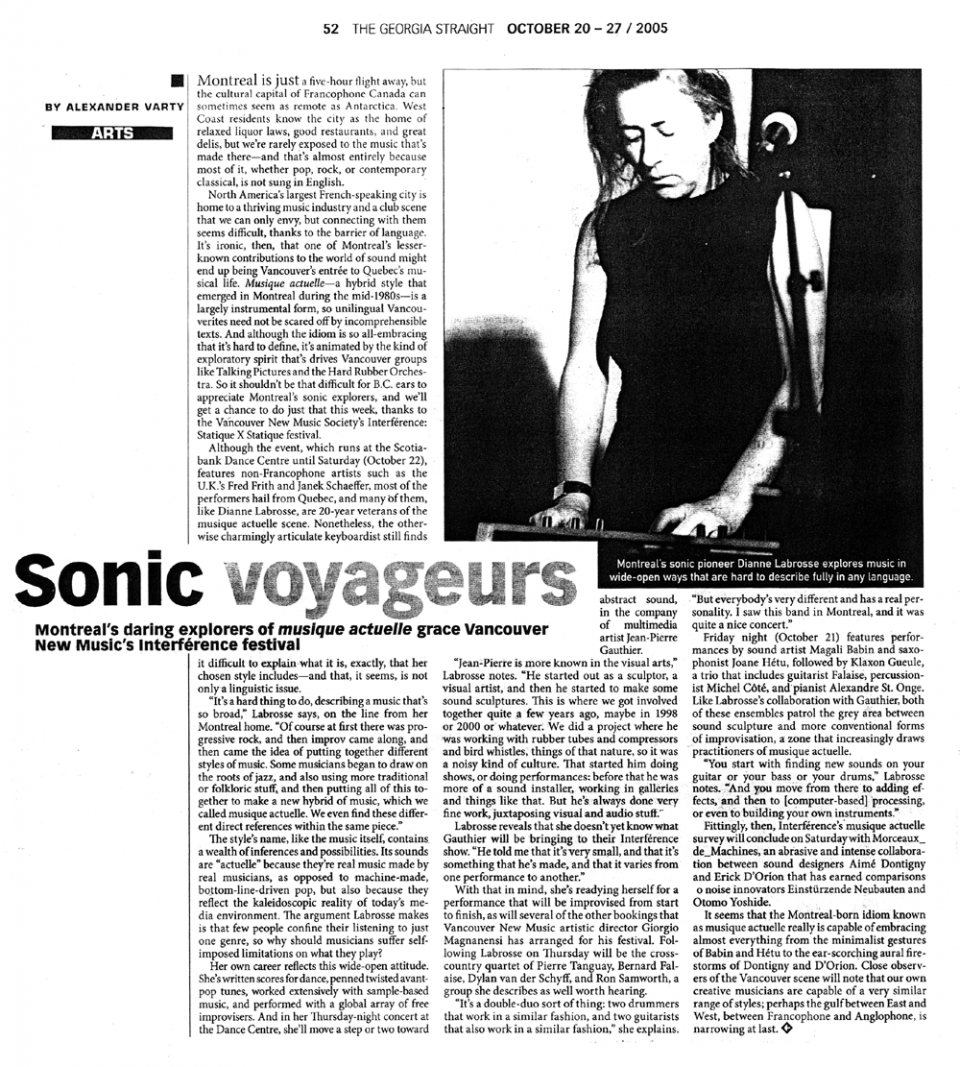
Montréal is just a five-hour flight away, but the cultural capital of Francophone Canada can sometimes seem as remote as Antarctica. West Coast residents know the city as the home of relaxed liquor laws, good restaurants, and great delis, but we’re rarely exposed to the music that’s made there—and that’s almost entirely because most of it, whether pop, rock, or contemporary classical, is not sung in English.
North America’s largest French-speaking city is home to a thriving music industry and a club scene that we can only envy, but connecting with them seems difficult, thanks to the barrier of language. It’s ironic, then, that one of Montréal’s lesser-known contributions to the world of sound might end up being Vancouver’s entrée to Quebec’s musical life. Musique actuelle—a hybrid style that emerged in Montréal during the mid-1980s—is a largely instrumental form, so unilingual Vancouverites need not be scared off by incomprehensible texts. And although the idiom is so all-embracing that it’s hard to define, it’s animated by the kind of exploratory spirit that’s drives Vancouver groups like Talking Pictures and the Hard Rubber Orchestra. So it shouldn’t be that difficult for B.C. ears to appreciate Montréal’s sonic explorers, and we’ll get a chance to do just that this week, thanks to the Vancouver New Music Society’s Interférence
Although the event, which runs at the Scotiabank Dance Centre until Saturday (October 22), features non-Francophone artists such as the U.K.’s Fred Frith and Janek Schaeffer, most of the performers hail from Quebec, and many of them, like Diane Labrosse, are 20-year veterans of the musique actuelle scene. Nonetheless, the otherwise charmingly articulate keyboardist still finds it difficult to explain what it is, exactly, that her chosen style includes—and that, it seems, is not only a linguistic issue.
“It’s a hard thing to do, describing a music that’s so broad,” Labrosse says, on the line from her Montréal home. “Of course at first there was progressive rock, and then improv came along, and then came the idea of putting together different styles of music. Some musicians began to draw on the roots of jazz, and also using more traditional or folkloric stuff, and then putting all of this together to make a new hybrid of music, which we called musique actuelle. We even find these different direct references within the same piece.”
The style’s name, like the music itself, contains a wealth of inferences and possibilities. Its sounds are “actuelle” because they’re real music made by real musicians, as opposed to machine-made, bottom-line-driven pop, but also because they reflect the kaleidoscopic reality of today’s media environment. The argument Labrosse makes is that few people confine their listening to just one genre, so why should musicians suffer self- imposed limitations on what they play
Her own career reflects this wide-open attitude. She’s written scores for dance, penned twisted avant-pop tunes, worked extensively with sample-based music, and performed with a global array of free improvisers. And in her Thursday-night concert at the Dance Centre, she’ll move a step or two toward abstract sound, in the company of multimedia artist Jean-Pierre Gauthier.
“Jean-Pierre is more known in the visual arts,” Labrosse notes. “He started out as a sculptor, a visual artist, and then he started to make some sound sculptures. This is where we got involved together quite a few years ago, maybe in 1998 or 2000 or whatever. We did a project where he was working with rubber tubes and compressors and bird whistles, things of that nature, so it was a noisy kind of culture. That started him doing shows, or doing performances
Labrosse reveals that she doesn’t yet know what Gauthier will be bringing to their Interférence show. “He told me that it’s very small, and that it’s something that he’s made, and that it varies from one performance to another.”
With that in mind, she’s readying herself for a performance that will be improvised from start to finish, as will several of the other bookings that Vancouver New Music artistic director Giorgio Magnanensi has arranged for his festival. Following Labrosse on Thursday will be the cross-country quartet of Pierre Tanguay, Bernard Falaise, Dylan van der Schyff, and Ron Samworth, a group she describes as well worth hearing.
“It’s a double-duo sort of thing
Friday night (October 21) features performances by sound artist Magali Babin and saxophonist Joane Hétu, followed by Klaxon Gueule, a trio that includes guitarist Falaise, percussionist Michel F Côté, and pianist Alexandre St-Onge. Like Labrosse’s collaboration with Gauthier, both of these ensembles patrol the grey area between sound sculpture and more conventional forms of improvisation, a zone that increasingly draws practitioners of musique actuelle.
“You start with finding new sounds on your guitar or your bass or your drums,” Labrosse notes. “And you move from there to adding effects, and then to [computer-based] processing, or even to building your own instruments.”
Fittingly, then, Interférence’s musique actuelle survey will conclude on Saturday with Morceaux_de_Machines, an abrasive and intense collaboration between sound designers Aimé Dontigny and Érick d’Orion that has earned comparisons to noise innovators Einstürzende Neubauten and Otomo Yoshihide.
It seems that the Montréal-born idiom known as musique actuelle really is capable of embracing almost everything from the minimalist gestures of Babin and Hétu to the ear-scorching aural firestorms of Dontigny and d’Orion. Close observers of the Vancouver scene will note that our own creative musicians are capable of a very similar range of styles
Son en tête
Pour mieux faire connaître les musiciens de concert, souvent oubliés des médias, le Conseil québécois de la musique a décidé d’en donner en
D’abord attirée par les sonorités rock, cette amoureuse du son a plongé ensuite dans l’improvisation, l’instrumental, le bruitisme (musique inspirée des sons de l’environnement). Depuis, son saxophone chante comme le vent dans les branches aux côtés du piano ou de l’échantillonneur, à la recherche de l’émotion par le son. La compositrice ne dédaigne pas intégrer parfois des bouts de textes à ses œuvres. En ce moment, elle travaille sur La filature, un projet de théâtre sonore mené par l’Ensemble SuperMusique, important rassemblement de musiciens actuels. Dans ce spectacle, qui sera présenté à l’Usine C en mars prochain, la vidéo, la danse et l’éclairage seront au service du son, un renversement total par rapport aux conventions habituelles.
Complètement libre dans ses compositions et ses improvisations, la musicienne a néanmoins les deux pieds sur terre lorsqu’elle porte sa casquette d’administratrice. En 1991, elle fondait la compagnie de disques DAME (Distribution Ambiances Magnétiques Etcetera). Son catalogue contient maintenant près de 140 disques en musique actuelle, souvent vendus directement au consommateur via Internet.
Joane Hétu’s Diverse Musical Missions
S’improviser
Born in 1958 in Montréal,
She may not have been playing an instrument seriously in her teens, but she was already developing strong individual tastes in music. “In my circle of friends, I was the only girl who had a decent stereo system. At fourteen, I heard
While studying pure sciences in college,
Soon,
The adventures of
In 1980, eleven female musicians, professionals and amateurs alike, came together to organize benefit concerts to celebrate the fifth anniversary of Montréal’s women’s bookstore, Librairie des Femmes. These were important events for
In the spring of 1981,
But was
In 1982,
In the meantime, a few experimental male musicians were attempting to organize their own collective for performing and recording, Ambiances Magnétiques.
How did they perceive the daring female musicians-entrepreneurs
By then it was 1985. The music had changed, and those who remembered the group from its early stage shows would have a hard time recognizing
The album sold well (over 4,000 copies) and was even picked up by the feminist magazine
Eventually, they opted for
from Justine to Castor
The group would release two more albums,
It was
“And the difference in financial needs is so important with songwriting. When it comes to recording, everyone is more or less equal in improvisation, while some people are able to invest linge amounts of money in song-based albums. Recording a song requires more studio time, more personnel, and in my line of songwriting, I could rarely afford that.”
Is she interested in coniing back to songwriting
There are two sides to a desk
The success of
Over the past fifteen years,
Meanwhile, the ever-shrinking involvement of the governments in experimental arts has made it almost impossible to plan ahead, leading to an almost catastrophic financial year in 2000. “Government funding bodies dont like to subsidize things that they don’t understand,”
For the love of winter
These difficulties have kept
Much as it is underperformed and underdocumented,
The first piece, also titled
“My technique was not quite right for that one. The musicians had to juggle with page after page of directions
So what will be phase three
In the meantime,
And in the Spring of 2006
Somehow, it feels like we are back to
Bari Taverna del Maltese — Nous perçons les oreilles
Per la rassegna
Gli NPLO, fondatori dell’etichetta Ambiances Magnétiques, sono senza dubbio due tra gli artisti più interessati alla sperimentazione e alla contaminazione di linguaggi nel panorama mondiale. Come ben esplica la breve presentazione che precede il concerto, amano definirsi
Non è una caso che
Dal canto loro,
Risulta chiaro l’intento, peculiare dell’attività di ciascuno dei quattro artisti sul palco, di ricercare nuovi linguaggi sonori, dimostrando che la musica è un elemento intrinseco alla natura, e dunque che si possono creare melodie utilizzando oggetti tipici della nostra vita quotidiana. Inoltre è propria l’intenzione dei NPLO di
Per concludere, il concerto è risultato di difficile comprensione per un pubblico che è apparso
Edgefest 2004, Ann Arbor MI, 13-16 October 2004
Edgefest in Ann Arbor, Michigan is an avant-garde jazz Brigadoon. Walking into the Kerrytown Concert House, the same folks are settling into the same seats as they were just over a year ago, and as they have been in the six years I’ve been making the trek up here. And even the leader of the band ready to take the stage was familiar. Guitarist James Emery had been here last year with the String Trio of New York. In fact, Edgehead-in-chief David Lynch likes to present musicians in different formats. This year he presented Emery leading his own quartet featuring ace reedman Marty Ehrlich with the rhythm team of bassist Drew Gress and percussionist Kevin Norton.[…]
But Thursday I’m ready to make the short six-block walk to the Firefly Club, a cozy nightspot in the heart of Ann Arbor’s downtown. Opening the two-band show was Nous Percons les Oreillles (We Pierce the Ears) featuring
“We’re from Montréal”,
So how did Edgefest 2004 stack up
Annual Edgefest Kicks into high Sonic Gear
Avantjazz’s outer edge isn’t only razor sharp
And the fact that some of these performers are pretty far out there only adds merit to their accomplishments. That a vocalist squealing and grunting in French and slapping her torso in time to her accompanist’s caterwauls on various whistles can come across not only as listenable, but enjoyable and oddly soothing, is a tribute not only to the artists’ abilities but to the patience of an open-eared audience.[…]