actuellecd
  • This website is also available in English.

Blog

3585 results
  • 129
  • 130
  • 131
  • 132
  • 133
  • 134
  • 135
  • 136
  • 137
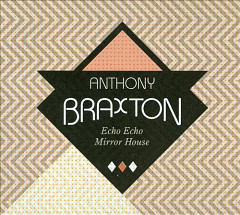
  • Echo Echo Mirror House in The WholeNote

    “Something In The Air: Recorded in Canada, Appreciated World-Wide”, Ken Waxman, The WholeNote, no. 19:3, November 3, 2013
    Sunday, November 3, 2013 Press

    Without question one of jazz’s most representative records is of a 1954 concert with Bop masters Dizzy Gillespie, Charlie Parker, Bud Powell, Charles Mingus and Max Roach in their only performance together. That the session was recorded in Toronto’s Massey Hall makes it distinctive as well as replaceable. But Jazz at Massey Hall isn’t the only instance of jazz history being made north of the border. Precisely because of gig opportunities for committed international improvisers discs recorded at Canadian gigs or festivals are an important part of the music’s fabric.

    One of the most significant recent sessions recorded in similar circumstances is Anthony Braxton’s Echo Echo Mirror House. Featuring the composer’s septet, this 2011 premiere at the annual Festival International de Musique Actuelle from Victoriaville, Quebec rolls controlled cacophony and fragmented polyphony into an hour-long protoplasmic performance that sounds as if it’s emanating from two orchestras playing simultaneously, although there are only seven musicians on stage. Having long dispensed with the idea of solo and accompaniment, Braxton’s composition allows the two brass players, two percussionists, three string players plus the composer’s saxophones to enter and exit the sequences at will. Miraculously all the parts hang together. This situation is even more remarkable when you consider that several of the players double or triple, and always conversant with technology, all are equipped with iPods. The latter adds snatches of pre-recorded voices, vocal and instrumental music to the mix and use live processing to integrate sequences recorded during performance back into the composition. While this description may appear formidable, the music isn’t that difficult. The initial theme reappears at junctures, while at all times motifs, such as Mary Halvorson’s guitar twangs or Jay Rozen’s tuba blasts, provide the continuum. Meanwhile the pressurized polytonal narrative recedes enough in spots so that Braxton’s alto saxophone yelps, Taylor Ho Bynum’s wispy flugelhorn grace notes or the polyrhythmic strokes uniting Jessica Pavone’s viola and Aaron Siegel’s vibes are clearly audible. Mid-way through, as the tension dissipates a bit, cutting reed bites and ringing vibes separately presage the additional of iPod samples featuring female speaking voices and a male vocal chorus. Later, following subtle reprises of the theme, pre-recorded piano recital-like dynamics threaten to unduly soften the performance until Siegel’s whapping percussion, Bynum’s plunger work and Braxton’s strident sax lines, shatter any tendencies towards sweetness. With every musician and every iPod producing climatic timbres, and when it appears as if the rattling, staccato undulations can’t become any more overwrought, conductor Braxton abruptly ends the performance. The effect is as if a harrowing but pleasurable journey has been completed.

    Featuring the composer’s septet, this 2011 premiere rolls controlled cacophony and fragmented polyphony into an hour-long protoplasmic performance that sounds as if it’s emanating from two orchestras playing simultaneously, although there are only seven musicians on stage.

    David Arango Valencia, Magali Babin, Martin Bédard, Simon Chioini, Andrea-Jane Cornell, Martine H Crispo, Fünf, Émilie Mouchous, Matthew Schoen, Erin Sexton, Nick Storring in Montréalistement

    “Akousma: premier contact”, Normand Babin, Montréalistement, October 24, 2013
    Thursday, October 24, 2013 Press

    Le festival des musiques numériques immersives Akousma s’est ouvert hier soir avec un concert consacré aux nouvelles générations d’électroacousticiens et électroacousticiennes. Car oui, il y a enfin un peu plus de elles chez les compositeurs en général et en électroacoustique en particulier.

    Le concert s’ouvrait avec deux pièces de factures assez classiques des David Arango-Valencia et Martin Bédard. L’oreille a apprivoisé le large spectre sonore que représente le grand orchestre de haut-parleurs composé de plus de 40 enceintes. Bien entendu, les deux compositeurs s’en sont donnés à cœur joie, faisant circuler des trombes de sons d’un bout à l’autre de la salle, faisant tournoyer les glissades, les orages et les bruits d’avion. Au plan des sonorités, cela m’a semblé un peu trop près de ce qu’on peut entendre au cinéma. Sans le film. Une bonne structure dans l’écriture réchappait la donne et donnait à entendre une musique cohérente, deux véritable compositions. Les meilleurs moments arrivent souvent lorsque peu d’enceintes sont utilisées, lorsque des bruits semblent se mouvoir délicatement autour de notre tête. La partie aquatique de Burundanga d’Arango-Valencia m’a semblé très réussie en ce sens.

    Terminal Burrowing du Torontois Nick Storring nous a démontré toutes les possibilités de cet orchestre, toutes les nuances de l’expérience acousmatique. L’intégration de sons d’instruments acoustiques ajoute beaucoup de richesse au texte musical. Fort brillante donc au plan des sonorités, la pièce souffre d’un manque de plan et fait plus penser à un catalogue de sons qu’à une véritable musique organisée. À suivre…

    Le moment le plus fort de la soirée nous est venu avec le duo Schoen / Chioini. Droits devant l’audience, armés de leurs laptops, ils s’amusent et improvisent à partir d’une banque de sons et d’images une œuvre qui curieusement démontre un grand sens de la structure. Les images, en noir et blanc, ponctuent le rythme, imitent les sons dans leurs mouvements. Une véritable merveille de synchronisme de la part des deux performeurs. L’aspect vivant de la performance ajoute beaucoup d’intérêt à la soirée, et en fait la musique électroacoustique nous séduit bien plus facilement avec une touche humaine et performative.

    Toute la deuxième partie de ce (trop?) long concert était consacrée au quintette Fünf. Cinq filles qui bidouillent, triturent et manigances devant nous sur une grande table remplie d’étranges instruments. Réels ou inventés, cette panoplie d’appareils intriguent. Mouvements se veut une «chorégraphie gestuelle de matériaux sonores». À partir d’un schéma établi, les performeuses improvisent dans ce qui m’a paru une interminable démonstration de bibittes à sons. Quelques beaux moments, quelques idées de génie, mais aussi différents sons absolument insupportables, suraigus et ultrasons qui arrachent le tympan. Pas du tout convaincu de la pertinence de ce propos qui a toutefois été très longuement applaudi, je retourne au festival Akousma entendre maintenant les compositeurs séniors, voire mythiques tel François Bayle et vous reviens sur le sujet ce week-end.

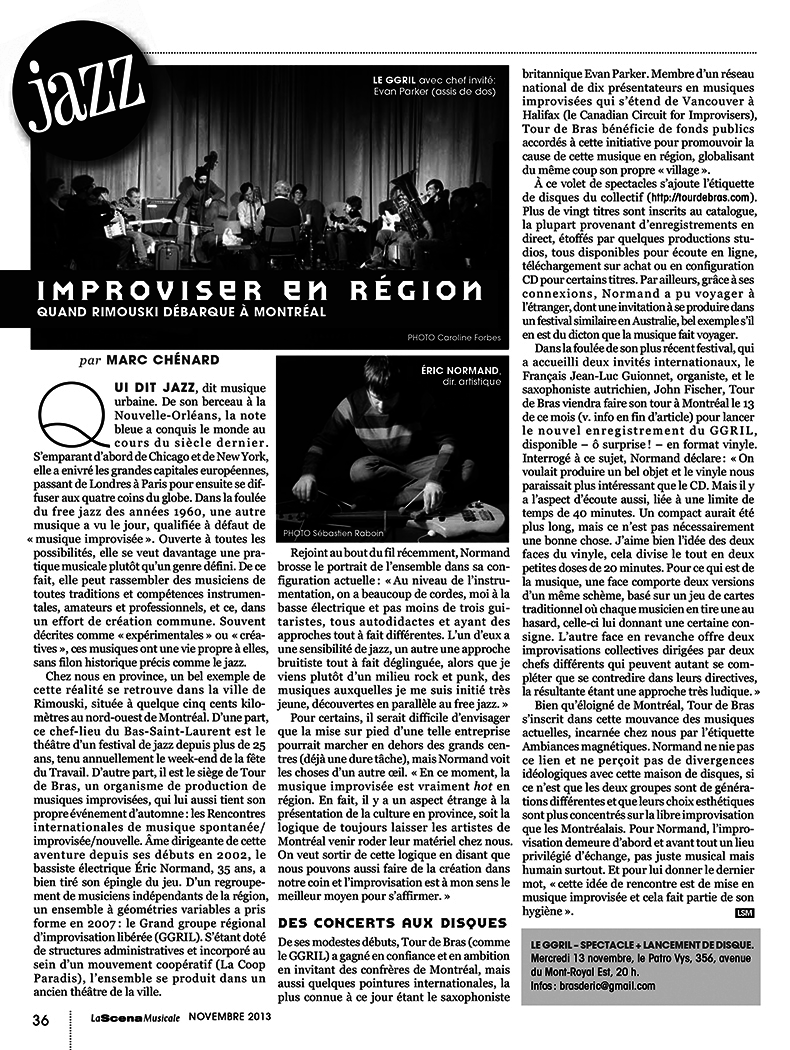
    Le lait maternel in Monsieur Délire

    “Listening Diary”, François Couture, Monsieur Délire, October 24, 2013
    Thursday, October 24, 2013 Press

    Robert Marcel Lepage, a founding member of Ambiances Magnétiques, is back with a new CD culling film music recorded between 2003 and 2010. Eighteen short pieces covering several genres, in which I hear a form of humour and a sensibility I know very well. No, this one does not have the strenght of La Plante humaine nor the zaniness of Les clarinettes ont-elles besoin d’un escalier de secours, but… it’s still worthy of your time, and it puts a firm smile on my face.

    … it puts a firm smile on my face.

    Le Sacre du printemps in Monsieur Délire

    “Listening Diary”, François Couture, Monsieur Délire, October 23, 2013
    Wednesday, October 23, 2013 Press

    After Prokofiev, Pierre-Yves Martel’s Quartetski tackles a founding work of modern music: Le Sacre du printemps. First of all, Quartetski has become a quintetski: Martel on viola da gamba, Philippe Lauzier (bass clarinet and soprano sax), Joshua Zubot (violin), Bernard Falaise (el. guitar), and Isaiah Ceccarelli (drums). Martel’s arrangement is faithful to Stravinsky’s ballet — each section is duly represented and cared for — while allowing for moments of freedom, textural plays, and tricks that make sure we don’t miss the symphonic orchestra. Execution is precise yet fluid. I was expecting a more thorough reinvention of the work, but this remains a brilliant arrangement that retains pretty much all the marvel and genius of this most important piece of music.

    This is a brilliant arrangement that retains pretty much all the marvel and genius of this most important piece of music.

    Transparence in Monsieur Délire

    “Listening Diary”, François Couture, Monsieur Délire, October 23, 2013
    Wednesday, October 23, 2013 Press

    I got some Québécois demanding music this morning. First up: the great relationship between Philippe Lauzier and the German label schraum continues to flourish, this time with a solo CD. Lauzier recorded this dozen of short solos in the course of three years. Instrumentation (bass clarinet, saxes) and approaches (amplification, feedback, multitracking) vary greatly. The results reveal a top-notch technician, and a musician with a keen sense of dosage — a must in this type of microsonic improvisation. For that is what this is about. I can hear some of John Butcher’s techniques in his repertoire, alongside things I have never heard before. Very impressive and captivating.

    Very impressive and captivating.
  • 129
  • 130
  • 131
  • 132
  • 133
  • 134
  • 135
  • 136
  • 137