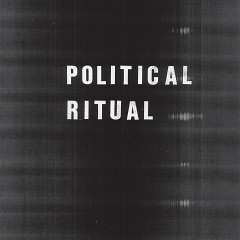
As Political Ritual, Maxime Corbeil-Perron and Félix-Antoine Morin offer sequences of disparate tones ~ sometimes tonal opposites, often at war ~ and invite listeners to hear their own metaphors. The album is a great experiment on impressions, as this simple prompt leads to all manner of ideas. One of the most obvious (and amusing) is that the acronym PR is itself shared with another more famous word pairing.
We live in a world on the brink of chaos. This simple fact affects all new art, whether consciously or not. “ Cérémonie ” is a study in contrast, beginning in fluttering electronics and solid, growing drones, but eventually incorporating organ-like tones and a bit of melody. One might glean an impression of chaos v. order, modernity v. tradition, sense v. nonsense. By the halfway mark, a new dominant sound emerges, a tempo-driven vibration that sounds like a misread CD-R; this is, however, a record. The music continues to play; the sound continues to intrude, with no end in sight. When stronger voices (beats) emerge, the mechanism rights itself for a brief period, but then changes form and returns. One might liken the effect to the game Whac-a-Mole, arriving at the conclusion that nothing will ever be perfect, that systems will always fail, and that even if one area is fixed, another will break. From this conclusion will stem one’s worldview. Either it’s worth trying, or it’s not. It’s worth going on, or it’s not. The evidence of this artistic statement is a vote for the latter.
Side B is a different animal: subtle, soothing, and calm. The first sounds of “ Projection_cathodique ” are those of water and chimes. This initial context makes the dark chords seem more ritualistic than foreboding. Is this still Political Ritual? Is this the longed-for nirvana that arrives at the tail end of all our efforts, making every ounce of suffering worthwhile? Or is this the sound of narcotic escape, a surrender to barbiturate entertainment, a desensitization to the world as it is? The two artists again provide little clue, but perhaps their very obliqueness is a clue: think for yourselves, people, we don’t have to tell you what everything means! All we will say is that the piece is lovely, like hands gently passed across doorway curtains, activating beads and bells. Compare the two sides and realize that they live in the same twelve inches of space, like a flattened globe. Make whatever conclusions you may.