actuellecd

Blog

108 results
  • 9
  • 10
  • 11
  • 12
  • 13
  • 14
  • 15
  • 16
  • 17
  • Jean Derome in La Scena Musicale

    “Jazz: Jean Derome”, Marc Chénard, La Scena Musicale, no. 20:6, April 1, 2015
    Wednesday, April 1, 2015 Press

    In January 2013, the Arts Council of Quebec (CALQ) bestowed one of its prestigious lifetime achievement awards in the arts to Jean Derome. With a career spanning over 40 years, this composer and multi-instrumentalist certainly qualified on longevity alone ─ yet the $60,000 attached to the prize was not just handed to him. First, he had to apply for it then a jury had to adjudicate his application with 58 others stemming from all fields except film.

    Piece de Résistance

    To qualify for this bursary, he had to outline a series of projects in his proposal. A demanding task, one could say, but this undertaking also required a lot of thought on his part, plenty of paperwork and two years’ lead time to set everything up. As fate/luck would have it, he turns 60 this year, a serendipitous (auspicious?) occurrence to say the least. On May 14, Derome will finally kick off a year’s worth of events at the Victoriaville festival (FIMAV) with the premiere of “Résistances”, an ambitious work for 20 musicians that should clock in around the 60-minute mark!

    During a talk in late February, the musician pointed out that there was more to that number than mere coincidence: “Electricity has always fascinated me; in fact that word was my working title, but it seemed too general. Since then, a number of events caught my attention, like the springtime student strikes of two years ago, so the word ‘resistance’ came to my mind. I like it because it means so many different things, far beyond the physical phenomena.”

    The work hinges conceptually on that electrical phenomena. The composer learned that the North American power grid is tuned to the frequency of 60 Hz, a discovery that lead him to use that pitch as its tonal centre. But this choice raises some problems, because it lays between the Bb and B natural of the tempered scale. “Stringed instruments can tune accordingly,” he explains, “but that’s harder to do for wind instruments, so I’ll have to devise some alternate fingerings to produce quarter tones. I have a piano which will remain at standard pitch, but my intention here is precisely that: to make these tunings clash in spots.”

    With regards to instrumentation, the group will be divided in three sections, or layers, as he calls them: three reed players, two violinists and two brassmen will occupy the front line, a keyboardist, a synthesizer player, two guitarists, one bass guitarist, a sampler player and another on turntables will be in the middle, while three percussionists and as many bassists will fill out the back row. Its overall form will be divided in four main parts of 15 minutes. What’s more, the work will be enhanced by a host of organizational procedures ranging from conventionally notated scores to graphic ones and hand signals, or divisions into ‘circuits’, i.e. sub-groups that will be connected in either alternative or parallel modes. After spending much of March fitting the pieces of the puzzle together, Derome gathers his troops for the first of nine rehearsals on April 10. The composer himself has provided his own introductory text (in French), appended to his article in the French version of this article (see link at top or bottom of page). But for now, here is a translation of his final words on the subject: “I hope to create quite a shock at Victoriaville […] with this new creation for the Year of Jean Derome. We should all get a good buzz out of it.”

    Things to Come

    On April 28, Derome will unveil his plans in toto in Montreal at the Maison de la culture Mont-Royal. From 5 to 7 PM, there will be a record launch, a short excerpt from a documentary, and two live music performances. The recording presented will focus on chamber-music works written by Derome. The film is an hour-long feature on the musician whose probable title may well be its working one: Turbulences musicales, un portrait de Jean Derome. Started in Y2K, the project remained on the shelf until recently, but will finally be premiered in the first days of summer at the Cinémathèque québécoise.

    Jean Derome’s banner year of musical projects will stretch out into the next year with an array of performances, most involving him as a performer, but some uniquely as a composer. As a preview, here are a few for the current year:

    » Derome-Guilbeault-Tanguay concert in June at the Festival international de jazz de Montréal

    » October concerts in Montreal and Quebec City of his small group les Dangereux Zhoms

    »“Phèdre sans mots de Racine”, a reprise of earlier work performed in November by the Ensemble SuperMusique and the Joker Choir

    Looking ahead to 2016:

    » Improvisational game pieces for and by SuperMusique

    » Commissioned work for the contemporary chamber ensemble Transmission

    » Concert proposals for the FIMAV festival and Suoni per il Popolo in Montreal

    But that is only part of the story, with plenty more to come, and a few surprises, too.

    On April 28, Derome will also launch his personal website. “I want to archive my work online, even if,” Derome concedes, “the task is quite forbidding. I have so many scores, cassettes, tapes, press kits, posters, that I can only scratch the surface of it all. Our government now offers funding for creation in digital art, but nothing for archival purposes, so I can only do so much. The plan is to have the site online that day, and I have some assistance from a small team.”

    Since receiving this award, Jean Derome has pondered on the state of affairs in the artistic community at large. “What strikes me the most is how fragile things are. When I first approached people two years ago, many were caught off guard; some didn’t even know if the’y still be around! In classical music, there are better guarantees for continuity, which is not the case for the area I work in. You see, musicians there earn a salary; we don’t.” But Derome has enough of the smarts to best compose with that.

    Monk Work in The WholeNote

    “Review”, Stuart Broomer, The WholeNote, no. 20:7, March 29, 2015
    Sunday, March 29, 2015 Press

    The compositions of Thelonious Monk represent a unique body of work in the jazz canon, pieces that have been explored repeatedly by musicians from mainstream to avant-garde, many finding something new in Monk’s quirky puzzles of rhythm and harmony. Among the most dedicated advocates is the Quebec trio Évidence, consisting of electric bassist Pierre Cartier, saxophonist Jean Derome and drummer Pierre Tanguay who together have been exploring Monk’s music since 1985, and who in 2014 interpreted his complete works in a three-day Montreal marathon. Évidence brings its own voice to this selection, mixing and matching the familiar and obscure in Monk’s repertoire. Stylistically Évidence invokes another master, Ornette Coleman, with Derome developing a similar lyricism while the rhythm section work masterfully through the kind of flexible, sprung rhythms that distinguished Coleman’s early work. Derome plays baritone on Coming on the Hudson with a wry wit akin to Monk’s own, while Cartier maintains fluid rhythm and Tanguay sustains the mood with light, crisp, animating brushwork. Derome’s vocalic alto comes to the fore in the fine three-way dialogue of Skippy.

    Évidence brings its own voice to this selection, mixing and matching the familiar and obscure in Monk’s repertoire.

    John Cage: Four in Nowamuzyka

    “Recenzje”, Łukasz Komła, Nowamuzyka, March 27, 2015
    Friday, March 27, 2015 Press

    Niezwykle ceniony kanadyjski kwartet smyczkowy Quatuor Bozzini: Clemens Merkel (skrzypce), Alissa Cheung (skrzypce), Stéphanie Bozzini (altówka), Isabelle Bozzini (wiolonczela), sięga po trzy różne nagrania Johna Cage’a. Pierwsza kompozycja to String Quartet in Four Parts (1949-50). W tamtym okresie Cage odchodził od typowej funkcji kompozytora i jednocześnie wcielał się w postać, która pozwoli mu przedstawić swoją twórczość bez większych emocjonalnych i narracyjnych intencji. Kilka dekad później stworzył Thirty Pieces for String Quartet (1983), z kolei w tym utworze Cage położył spory nacisk na określone sekwencje działań w określonych ramach czasowych. Zaś w 1989 roku Amerykanin napisał Four — prace nad tym dziełem rozpoczął już w 1987 roku i prowadził aż do śmierci w 1992 roku. Znakomite interpretacje tych kompozycji znajdziecie na albumie John Cage: Four. Materiał zarejestrowano w kwietniu 2014 roku podczas koncertów w Montrealu.

    Le Sacre du printemps in The Arts Desk

    “Review”, Graham Rickson, The Arts Desk, March 14, 2015
    Saturday, March 14, 2015 Press

    Pierre-Yves Martel’s Quartetski are based in Montreal. They’ve already reinterpreted Prokofiev’s Visions Fugitives and there’s a Bartók disc in the pipeline. Martel’s approach is looser and more anarchic than Hofbauer’s, the ballet recast for drums, electric guitar, reeds and violin. Martel plays viola da gamba, and, tantalisingly, what’s listed as “objets divers”. The 32-minute original is extended here to nearly 50 minutes. The score’s folky roots emerge more strongly, and the improvisation is a lot freer. The extended instrumental solos never outstay their welcome, and Martel’s pungent distillation of the work’s essence continually throws up surprises: the wonderful overlaying of duple and triple time rhythms in Augers of Spring, and the chilliness at the opening of the ballet’s second half. Quartetski’s Sacrificial Dance is a freer, spookier affair: drummer Isaiah Ceccarelli pounds out Stravinsky’s rhythms against a sustained chords and scratchy vinyl samples, before the music fades out. If you love this piece, don’t feel you have to choose between Hofbauer and Quartetski. Buy both.

    The extended instrumental solos never outstay their welcome, and Martel’s pungent distillation of the work’s essence continually throws up surprises…

    Invisible Backgrounds in Voir

    “Critique”, Alex Pelchat, Voir, March 13, 2015
    Friday, March 13, 2015 Press

    Le trompettiste Philippe Battikha fut l’un des premiers trompettistes que j’ai eu la chance d’entendre lorsque je me suis intéressé à la scène locale de free jazz en 2008. C’est avec plaisir que je l’ai vu toucher à toutes sortes d’approches au cours des six dernières années, que ce soit avec le métal expérimental de La Part maudite, les improvisations free jazz avec Corse ou le travail plus noisy et électronique en solo. Invisible Backgrounds prend une approche singulière en incluant du matériel très éclectique, allant de la performance jazz solo très mélodieuse à des explorations plus électroniques ainsi que l’utilisation de field recordings. Bien que l’album soit majoritairement un projet solo, l’excellent contrebassiste Jonah Fortune accompagne avec brio Battikha sur deux pièces particulièrement bien réussies. Battikha a aussi profité du studio pour ajouter du piano sur certaines pièces ou pour “multiplier” sa trompette. Trop souvent, les albums solo en musique expérimentale s’en tiennent surtout à un seul son et le choix plutôt créatif de Battikha d’aller toucher à l’ensemble de son identité musicale offre un album de qualité tout en nuance et en beauté.

    Invisible Backgrounds prend une approche singulière en incluant du matériel très éclectique, allant de la performance jazz solo très mélodieuse à des explorations plus électroniques ainsi que l’utilisation de field recordings.

    Seven ElectroAcoustic Septet in Free Jazz Blog

    “Review”, Martin Schray, Free Jazz Blog, March 12, 2015
    Thursday, March 12, 2015 Press

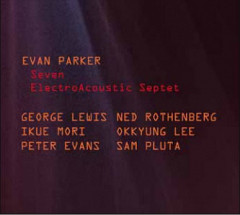
    It was Cecil Taylor who once said that the compositional process begins with the selection of the players. In an allusion to Taylor Evan Parker stated that his art of composition consisted in choosing the right people and asking them to improvise. He also meant that the resulting music arose from this sequence of decisions and that his art of composition consisted in choosing the right people. And with Ned Rothenberg (clarinets, shakuhachi), Peter Evans (trumpets), George Lewis (trombone, electronics), Okkyung Lee (cello), Ikue Mori (electronics) and Sam Pluta (electronics) he chose the perfect musicians for his ElectroAcoustic Septet, which was invited to the 2014 Victoriaville Festival.

    In the field of electro-acoustic contributions to improvised music Evan Parker is a pioneer. At a very early stage he has included electronics and processing in his music, e.g. with his long time companion Paul Lytton on Collective Calls (Urban) (Two Microphones) (Incus, 1972). His interest in sound processing led to the foundation of the Electro-Acoustic Ensemble in 1992, from their first album Towards the Margins (ECM, 1997) up to Hasselt (Psi, 2012), when the ensemble was expanded to 14 musicians (at their latest concerts there were even 18).

    For Seven Parker has reduced the band members for his project drastically, and he has chosen musicians mainly working in the US (often based in New York) with whom he has had a history. With Evans and Pluta he played in Rocket Science, he released a great trio CD with Lee and Evans, worked in a duo with Ned Rothenberg, and his cooperation with George Lewis is history (From Saxophone and Trombone, Incus, 1980). He has even joined Ikue Mori on Near Nadir.

    However, even fans of Parker sometimes have difficulties with his electronic excursions because they think that the part of “real” instruments, its warmth, the organic flow, and the authentic sound is underrepresented. But then again there is a perfect balance between the acoustic instruments and sound processing (Parker doesn’t like the term “electronics”) in his electro-acoustic ensembles because the processors manipulate and treat pre-recorded and live material — it’s rather a transformation of sound.

    The music on Seven sounds as if you were in the middle of a huge and crowded insectarium, with bees, dragonflies, ants, bumblebees, spiders, butterflies and mosquitoes, all grotesquely amplified. The result is a whirlwind of fizzling, gabbling and buzzing — it’s a strange drone. There are ostinato parts, small solos are interspersed, even far eastern elements are integrated (Rothenberg’s shakuhachi), and Parker is able to use his trademark, circular breathing, in a very effective and natural way, so that it becomes a perfect part of the interaction, the density of sound, and the overall consistency.

    Seven is beautiful noise par excellence, a marvelous piece of art, a successful communication, something you can get lost in endlessly. Just splendid.

    Just splendid.
  • 9
  • 10
  • 11
  • 12
  • 13
  • 14
  • 15
  • 16
  • 17