actuellecd

Blog

85 results
  • 1
  • 2
  • 3
  • 4
  • 5
  • 6
  • 7
  • 8
  • 9
  • La vie commence ici in Wondering Sound

    “Review”, Dave Sumner, Wondering Sound, October 29, 2014
    Wednesday, October 29, 2014 Press

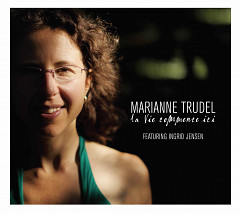
    Marianne Trudel, La vie commence ici: Terrifically resonant recording from pianist Trudel, who doesn’t seem to be doing anything very complicated, and yet each song is supremely engaging to where it becomes nearly impossible to do anything other than sit back and listen. Modern pieces, but nothing that will scare the old-schoolers off. Most tracks keep to the quiet end of the spectrum, but radiate an energy that gives the songs a big presence. Joining Trudel is trumpeter Ingrid Jensen, saxophonist Jonathan Stewart, bassist Morgan Moore and drummer Robbie Kuster. Outstanding. Pick of the Week.

    Terrifically resonant recording from pianist Trudel, who doesn’t seem to be doing anything very complicated, and yet each song is supremely engaging to where it becomes nearly impossible to do anything other than sit back and listen.

    La vie commence ici in Le Droit

    “Critique”, Yves Bergeras, Le Droit, October 25, 2014
    Saturday, October 25, 2014 Press

    La pianiste Marianne Trudel a fait appel à une trompettiste de renom, la New-Yorkaise Ingrid Jensen, se glisse à pas feutrés, sourdine en main, au milieu des tableaux évocateurs, de La vie commence ici, sixième opus de la jazzwoman et compositrice québécoise, qui s’exprime cette fois en quintette.

    Berçant, son disque n’a pas besoin de la moindre parole pour résonner avec force; on pourra s’en rendre compte samedi soir, au Centre national des arts, où elle vient défendre l’album, accompagnée de Mme Jensen et de ses collaborateurs émérites. Entre elles, se faufilent la contrebasse légère et joueuse, de Morgan Moore; le saxophone enamouré de Jonathan Stewart; et les coups de baguette subtils de Robbie Kuster. Ça ressemble davantage à une longue trame sonore mouvante et «progressive» qu’à une série de pièces bien découpées, mais la technique est sans faille. Et ne cherche à se substituer ni à l’inspiration, ni à la sensibilité, ni aux mélodies, qui coulent de leur source organique.

    Undulating and soothing, the music on her album doesn’t need a single lyric to resonate powerfully […] Inspiration, sensitivity, and melodies all flow organically from the source.

    Holy Seven in Musicworks

    “Review”, Ken Waxman, Musicworks, October 21, 2014
    Tuesday, October 21, 2014 Press

    One of the linchpins of Montréal’s Musique Actuelle potpourri, bassist Nicolas Caloia is, underneath it all, a jazz musician, and this session shows off his mastery of the idiom. With the group Tilting, he elaborates his take on jazz by utilizing the talents of fellow travellers baritone saxophonist Jean Derome, pianist Guillaume Dostaler, drummer Isaiah Ceccarelli, and — on one track each — bass clarinetist Lori Freedman and alto saxophonist Yves Charuest. What that means is that Caloia’s eight compositions tilt towards the freer side of free bop, without ever abandoning underlying rhythms.

    With Caloia’s bass sonority directing from behind, and Derome’s bulky low-pitched smears upfront, the band still works effectively to ensure that weightiness doesn’t turn into logginess. Dostaler is the key here, whether he’s outputting processional cadenzas or comping decorously to knit together seemingly disparate parts. Holy Seven Fields, the most traditional of the tunes, has a heavy Charles Mingus influence, with spirited piano timbres pushing Derome’s slurps upwards to middle-register expression.

    The title of Apart (for Conlon Nancarrow) must be an inside joke, since Nancarrow’s super-swift pianism isn’t referred to at all; instead, Apart is made memorable by a straightahead bass solo. “Wren” balances on Caloia’s fluid continuum as dramatic baritone smears take centre stage.

    Unsurprisingly, Freedman’s bass clarinet adds some needed buoyancy when harmonized with Derome’s sax on Flox, together attaining a climax of tremolo vibrations. As for Charuest, his peeps and judders on Locked are backed by spiccato string-pulls from the bassist that create the most dissonant track. Here, a frenzied reed counterpoint of shrieked notes finally reassembles amoeba-like into a shimmering whole.

    Tilting may be the band’s name, but it’s evident that the only direction it leans towards is one made up of unique compositions and performances.

    Tilting may be the band’s name, but it’s evident that the only direction it leans towards is one made up of unique compositions and performances.

  • 1
  • 2
  • 3
  • 4
  • 5
  • 6
  • 7
  • 8
  • 9